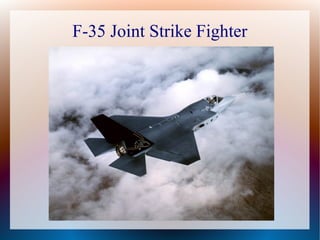
F-35 Joint Strike Fighter
Requirements jungle
●   air superiority          ●   CTOL
●   fleet defense            ●   STOL
●   tactical bombing         ●   CATOBAR
●   ground attack / strike
●   CAS                      ●   replaces F-16, AV-8, F-
●   reconnaissance               18, A-10, F-117, F-111,
                                 A-6, Tornado
●   air control              ●   closest foreign
●   intelligence gathering       counterpart Dassault
                                 Rafale
Conflicting requirements
●   air superiority                 ●   low-level strike
        –   low wing loading                –   high wing loading
        –   high thrust to weight   ●   tactical bombing
              ratio
                                            –   high payload
        –   small size
                                    ●   stealth
        –   ability to achieve
              quick kills                   –   internal missile
                                                  carriage
                                            –   gun doors
Programme mismanagement
●   LRIP
●   no competetive prototyping
●   30% parts commonality between different versions
●   cost increases
        –   197 million USD F-35A, 237,7 million USD F-35B,
              236,8 million USD F-35B >> flyaway costs
Is it really the best multirole aircraft?
●   Establish important requirements
●   Compare it with most similar US and foreign
    aircraft
        –   F-16
        –   Saab Gripen
        –   Dassault Rafale
        –   Eurofighter Typhoon
F-35 air combat philosophy
●   maneuverability is irrelevant = depends on radar
    missile BVR shots to shoot down opponent
        –   AIM-7
               ●   promised Pk: 0,7
               ●   actual Pk: 0,08
        –   AIM-120
               ●   combat Pk: 0,46
               ●   ten recorded kills; 4 kills from WVR
               ●   targets:
                        –   no sensors
                        –   no ECM
                        –   not maneuvering
               ●   US had numerical superiority
BVR vs WVR
●   Vietnam Pk (vs maneuvering targets):
        –   gun: 28%
        –   IR missile: 15%
        –   BVR missile: 8%
●   Deset Storm PK (vs non-maneuvering targets):
        –   gun: 100% (A-10 vs helicopters)
        –   IR missile: 67%
        –   BVR missile: 34%
BVR vs WVR
●   Pk ratios have stayed the same: radar missile
    lethality 1/2 of IR missile lethality; IR missile
    lethality 1/2 of gun lethality
●   Even LPI radars vulnerable to detection and
    countermeasures
●   Result: WVR combat between capable opponents as
    important as ever
BVR vs WVR
●   BVR requirements add:
        –   size
        –   weight
        –   cost
        –   maintenance downtime
●   result:
        –   smaller numbers
        –   more vulnerable
        –   less time for pilot training
LPI - frequency hopping
Combat requirements
●   first look
●   first shot
●   first kill
●   avoid getting bounced
●   outmaneuver opponent to fire
●   high cruise speed
●   outnumber enemy in the air
First look
●   F-117 VLO
●   1 shot down, 1 irrepareably damaged from 1 300
    sorties in Kosovo war
●   flew only at night
●   F-16 "legacy" aircraft
●   1 shot down from 4 500 sorties in Kosovo war
●   flew both at day and at night
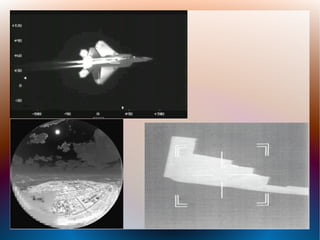
●   IRST can detect stealth aircraft completely
    passively, and at long range; radar gives away
    position
First look
●   F-35 assumptions:
        –   LPI radar cannot be detected
        –   F-35s IRST better than opponent's
        –   F-35s IR signature lower than opponent's
●   Reality:
        –   Russians and Europeans have advantage in IRST
             technology
        –   F-35s visual and IR signature larger than that of F-
              16, Gripen, Rafale and Typhoon
        –   LPI radar can be detected and jammed by modern
             EW suites
First look
First shot
●   stealth requires internal weapons carriage
        –   gun bay doors cause 0,5 seconds to time between
              pressing the button and first bullet leaving the gun
        –   F-35s gun has 0,4 s spin-up time; F-16s 0,5 s,
              revolver guns 0,05 s
                 ●   result: F-35s gun needs almost full second to reach
                       full rate of fire after pilot has pressed the trigger
        –   IR missile has to be lowered by mechanism before
              being fired: at least 1 second delay
First shot
●   radar-guided missiles require 10 - 15 s acquisition
    for cooperative target
●   radar warns enemy and allows it to track and ID
    radar-using fighter
●   radar still has to penetrate any possible jamming
●   enemy can cue in BVR IR missile or use anti-
    radiation missile
●   unlike F-22, F-35 can use IRST: renders opponent's
    radar LO measures meaningless
F-35: bounce
●   rearward visibility: angle obscured
Maneuverability
●   Operational/ultimate g limits:
        –   F-35A: 9 g / 13,5 g
        –   F-35B: 7 g / 10,5 g
        –   F-35C: 7,5 g / 11,3 g
●   G limits for 4,5th generation aircraft: 9 g
    operational, 13,5 g ultimate
        –   Rafale 9 g / 16,7 g, Gripen 9 g / 13,5 g, F-16 9 g /
             13,5 g, Typhoon 9 g / 12,6 g
●   Instanteneous g limits for 3rd generation aircraft: 7-
    8 g operational, 10,5-12 g ultimate
Maneuverability
●   Sustained g limits:
        –   F-35A: 4,95 g @ M 0,8 and 4 600 m
        –   F-4E: 5,5 g @ M 0,8 and 3 100 m with 40% fuel
●   Wing loading @ 50% fuel, 4 AMRAAM and 2
    Sidewinder:
        –   F-35A: 428 kg/m2, F-35B: 434,2 kg/m2, F-35C: 338
              kg/m2
        –   Rafale C: 276 kg/m2
        –   Gripen C: 287 kg/m2
        –   F-16 C: 392 kg/m2
Maneuverability
●   Thrust-to-weight ratio @ 50% fuel, 4 AMRAAM
    and 2 Sidewinder:
       –   F-35A: 1,07
       –   F-35B: 1,05
       –   F-35C: 0,93
       –   Rafale C: 1,22
       –   Gripen C: 0,95
       –   F-16C: 1,186
Maneuverability
●   Combat weight:
       –   18 270 kg F-35A
       –   18 541 kg F-35B
       –   21 009 kg F-35C
       –   12 629 kg Rafale C
       –   8 605 kg Gripen C
       –   10 936 kg F-16C
Speed
●   internal carriage means that speed is same in combat
    and in clean configuration
        –   M 1,6 maximum
●   maximum speed in combat configuration:
        –   Rafale M 1,8, Typhoon M 1,8, Gripen M 1,8, F-16 M
             1,6
●   maximum speed in clean configuration:
        –   Rafale M 2, Typhoon M 2, Gripen M 2, F-16 M 1,8
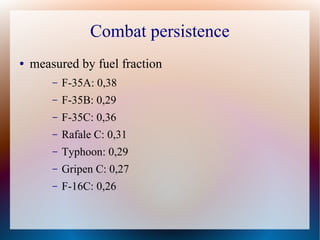
Combat persistence
●   measured by fuel fraction
        –   F-35A: 0,38
        –   F-35B: 0,29
        –   F-35C: 0,36
        –   Rafale C: 0,31
        –   Typhoon: 0,29
        –   Gripen C: 0,27
        –   F-16C: 0,26
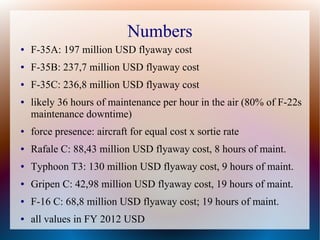
Numbers
●   F-35A: 197 million USD flyaway cost
●   F-35B: 237,7 million USD flyaway cost
●   F-35C: 236,8 million USD flyaway cost
●   likely 36 hours of maintenance per hour in the air (80% of F-22s
    maintenance downtime)
●   force presence: aircraft for equal cost x sortie rate
●   Rafale C: 88,43 million USD flyaway cost, 8 hours of maint.
●   Typhoon T3: 130 million USD flyaway cost, 9 hours of maint.
●   Gripen C: 42,98 million USD flyaway cost, 19 hours of maint.
●   F-16 C: 68,8 million USD flyaway cost; 19 hours of maint.
●   all values in FY 2012 USD
Numbers
●   Aircraft for 1 billion USD:
        –   F-35 A: 5
        –   F-35 B: 4
        –   F-35 C: 4
        –   F-16 C: 14
        –   Gripen C: 23
        –   Rafale C: 11
        –   Typhoon T3: 7
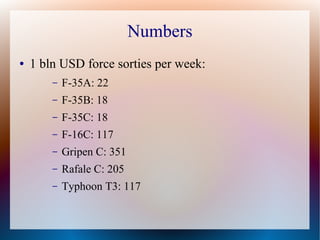
Numbers
●   1 bln USD force sorties per week:
        –   F-35A: 22
        –   F-35B: 18
        –   F-35C: 18
        –   F-16C: 117
        –   Gripen C: 351
        –   Rafale C: 205
        –   Typhoon T3: 117
Comparision: weapons effectiveness


vs non-maneuvering targets


                                                                 gun
                                                                 IR missile
                                                                 radar missile


    vs maneuvering targets


                             0   20   40   60   80   100   120
Comparision: bounce
Comparision: gun firing delay


Gun                                                                 F-35
                                                                    F-16
                                                                    Rafale/Gripen


      0   0,1   0,2   0,3   0,4   0,5   0,6   0,7   0,8   0,9   1
Comparision: maneuverability

  Combat w eight


Thrust-to-w eight


                                                      F-35 A
                                                      F-35 B
                                                      F-35 C
     Wing loading                                     Rafale C
                                                      Gripen C
                                                      F-16 C
                                                      T3 Typhoon


Operational g limit


    Ultimate g limit
Comparision: force presence


       Aircraft


                                                         Rafale C
                                                         Gripen C
                                                         T3 Typhoon
                                                         F-16C
                                                         F-35A
                                                         F-35B
                                                         F-35C


Sorties per day


                  0      10   20   30   40   50     60
Conclusion: air combat
●   F-35 is failure on all fronts
        –   unlikely to achieve first look or first shot
        –   unable to outmaneuver modern fighter aircraft in
              order to gain firing solution
        –   unable to escape if detected
        –   unable to provide required force presence
        –   unable to withstand attrition
Fleet defense
●   F-35 incapable of fighting modern fighter aircraft or
    performing most missions other than ground attack
●   low sortie rate especially problematic due to limited
    number of aircraft carrier can carry
●   single engine: more vulnerable to corrosion
Tactical bombing
●   requirements
        –   ability to attack tactical targets on the ground
●   only mission F-35 can actually do
●   still requires cooperation with slower aircraft if there
    is danger of unwanted collateral damage
CAS
●   definition: usage of aircraft against hostile targets
    representing possible threat to friendly forces
        –   result: targets attacked are often in close proximity to
              friendly forces
●   F-35 too delicate to survive ground fire and too fact
    to find and attack ground targets
Reconnaissance
●   sensory suite is suitable for scout missions, but it
    cannot escape if attacked
●   low sortie rate and high cost - both per-aircraft and
    per-sortie - will make such missions rare and high
    risk
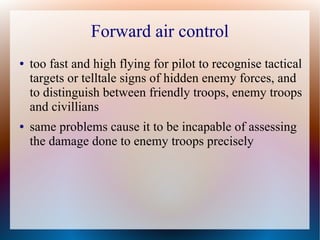
Forward air control
●   too fast and high flying for pilot to recognise tactical
    targets or telltale signs of hidden enemy forces, and
    to distinguish between friendly troops, enemy troops
    and civillians
●   same problems cause it to be incapable of assessing
    the damage done to enemy troops precisely
Written by
●   Picard578
●   http://defenseissues.wordpress.com/
●   13. 3. 2013.

F 35 brief

  • 1.
  • 2.
    Requirements jungle ● air superiority ● CTOL ● fleet defense ● STOL ● tactical bombing ● CATOBAR ● ground attack / strike ● CAS ● replaces F-16, AV-8, F- ● reconnaissance 18, A-10, F-117, F-111, A-6, Tornado ● air control ● closest foreign ● intelligence gathering counterpart Dassault Rafale
  • 3.
    Conflicting requirements ● air superiority ● low-level strike – low wing loading – high wing loading – high thrust to weight ● tactical bombing ratio – high payload – small size ● stealth – ability to achieve quick kills – internal missile carriage – gun doors
  • 4.
    Programme mismanagement ● LRIP ● no competetive prototyping ● 30% parts commonality between different versions ● cost increases – 197 million USD F-35A, 237,7 million USD F-35B, 236,8 million USD F-35B >> flyaway costs
  • 5.
    Is it reallythe best multirole aircraft? ● Establish important requirements ● Compare it with most similar US and foreign aircraft – F-16 – Saab Gripen – Dassault Rafale – Eurofighter Typhoon
  • 6.
    F-35 air combatphilosophy ● maneuverability is irrelevant = depends on radar missile BVR shots to shoot down opponent – AIM-7 ● promised Pk: 0,7 ● actual Pk: 0,08 – AIM-120 ● combat Pk: 0,46 ● ten recorded kills; 4 kills from WVR ● targets: – no sensors – no ECM – not maneuvering ● US had numerical superiority
  • 7.
    BVR vs WVR ● Vietnam Pk (vs maneuvering targets): – gun: 28% – IR missile: 15% – BVR missile: 8% ● Deset Storm PK (vs non-maneuvering targets): – gun: 100% (A-10 vs helicopters) – IR missile: 67% – BVR missile: 34%
  • 8.
    BVR vs WVR ● Pk ratios have stayed the same: radar missile lethality 1/2 of IR missile lethality; IR missile lethality 1/2 of gun lethality ● Even LPI radars vulnerable to detection and countermeasures ● Result: WVR combat between capable opponents as important as ever
  • 9.
    BVR vs WVR ● BVR requirements add: – size – weight – cost – maintenance downtime ● result: – smaller numbers – more vulnerable – less time for pilot training
  • 10.
  • 11.
    Combat requirements ● first look ● first shot ● first kill ● avoid getting bounced ● outmaneuver opponent to fire ● high cruise speed ● outnumber enemy in the air
  • 12.
    First look ● F-117 VLO ● 1 shot down, 1 irrepareably damaged from 1 300 sorties in Kosovo war ● flew only at night ● F-16 "legacy" aircraft ● 1 shot down from 4 500 sorties in Kosovo war ● flew both at day and at night ● IRST can detect stealth aircraft completely passively, and at long range; radar gives away position
  • 14.
    First look ● F-35 assumptions: – LPI radar cannot be detected – F-35s IRST better than opponent's – F-35s IR signature lower than opponent's ● Reality: – Russians and Europeans have advantage in IRST technology – F-35s visual and IR signature larger than that of F- 16, Gripen, Rafale and Typhoon – LPI radar can be detected and jammed by modern EW suites
  • 15.
  • 17.
    First shot ● stealth requires internal weapons carriage – gun bay doors cause 0,5 seconds to time between pressing the button and first bullet leaving the gun – F-35s gun has 0,4 s spin-up time; F-16s 0,5 s, revolver guns 0,05 s ● result: F-35s gun needs almost full second to reach full rate of fire after pilot has pressed the trigger – IR missile has to be lowered by mechanism before being fired: at least 1 second delay
  • 18.
    First shot ● radar-guided missiles require 10 - 15 s acquisition for cooperative target ● radar warns enemy and allows it to track and ID radar-using fighter ● radar still has to penetrate any possible jamming ● enemy can cue in BVR IR missile or use anti- radiation missile ● unlike F-22, F-35 can use IRST: renders opponent's radar LO measures meaningless
  • 19.
    F-35: bounce ● rearward visibility: angle obscured
  • 20.
    Maneuverability ● Operational/ultimate g limits: – F-35A: 9 g / 13,5 g – F-35B: 7 g / 10,5 g – F-35C: 7,5 g / 11,3 g ● G limits for 4,5th generation aircraft: 9 g operational, 13,5 g ultimate – Rafale 9 g / 16,7 g, Gripen 9 g / 13,5 g, F-16 9 g / 13,5 g, Typhoon 9 g / 12,6 g ● Instanteneous g limits for 3rd generation aircraft: 7- 8 g operational, 10,5-12 g ultimate
  • 21.
    Maneuverability ● Sustained g limits: – F-35A: 4,95 g @ M 0,8 and 4 600 m – F-4E: 5,5 g @ M 0,8 and 3 100 m with 40% fuel ● Wing loading @ 50% fuel, 4 AMRAAM and 2 Sidewinder: – F-35A: 428 kg/m2, F-35B: 434,2 kg/m2, F-35C: 338 kg/m2 – Rafale C: 276 kg/m2 – Gripen C: 287 kg/m2 – F-16 C: 392 kg/m2
  • 22.
    Maneuverability ● Thrust-to-weight ratio @ 50% fuel, 4 AMRAAM and 2 Sidewinder: – F-35A: 1,07 – F-35B: 1,05 – F-35C: 0,93 – Rafale C: 1,22 – Gripen C: 0,95 – F-16C: 1,186
  • 23.
    Maneuverability ● Combat weight: – 18 270 kg F-35A – 18 541 kg F-35B – 21 009 kg F-35C – 12 629 kg Rafale C – 8 605 kg Gripen C – 10 936 kg F-16C
  • 24.
    Speed ● internal carriage means that speed is same in combat and in clean configuration – M 1,6 maximum ● maximum speed in combat configuration: – Rafale M 1,8, Typhoon M 1,8, Gripen M 1,8, F-16 M 1,6 ● maximum speed in clean configuration: – Rafale M 2, Typhoon M 2, Gripen M 2, F-16 M 1,8
  • 25.
    Combat persistence ● measured by fuel fraction – F-35A: 0,38 – F-35B: 0,29 – F-35C: 0,36 – Rafale C: 0,31 – Typhoon: 0,29 – Gripen C: 0,27 – F-16C: 0,26
  • 26.
    Numbers ● F-35A: 197 million USD flyaway cost ● F-35B: 237,7 million USD flyaway cost ● F-35C: 236,8 million USD flyaway cost ● likely 36 hours of maintenance per hour in the air (80% of F-22s maintenance downtime) ● force presence: aircraft for equal cost x sortie rate ● Rafale C: 88,43 million USD flyaway cost, 8 hours of maint. ● Typhoon T3: 130 million USD flyaway cost, 9 hours of maint. ● Gripen C: 42,98 million USD flyaway cost, 19 hours of maint. ● F-16 C: 68,8 million USD flyaway cost; 19 hours of maint. ● all values in FY 2012 USD
  • 27.
    Numbers ● Aircraft for 1 billion USD: – F-35 A: 5 – F-35 B: 4 – F-35 C: 4 – F-16 C: 14 – Gripen C: 23 – Rafale C: 11 – Typhoon T3: 7
  • 28.
    Numbers ● 1 bln USD force sorties per week: – F-35A: 22 – F-35B: 18 – F-35C: 18 – F-16C: 117 – Gripen C: 351 – Rafale C: 205 – Typhoon T3: 117
  • 29.
    Comparision: weapons effectiveness vsnon-maneuvering targets gun IR missile radar missile vs maneuvering targets 0 20 40 60 80 100 120
  • 30.
  • 31.
    Comparision: gun firingdelay Gun F-35 F-16 Rafale/Gripen 0 0,1 0,2 0,3 0,4 0,5 0,6 0,7 0,8 0,9 1
  • 32.
    Comparision: maneuverability Combat w eight Thrust-to-w eight F-35 A F-35 B F-35 C Wing loading Rafale C Gripen C F-16 C T3 Typhoon Operational g limit Ultimate g limit
  • 33.
    Comparision: force presence Aircraft Rafale C Gripen C T3 Typhoon F-16C F-35A F-35B F-35C Sorties per day 0 10 20 30 40 50 60
  • 34.
    Conclusion: air combat ● F-35 is failure on all fronts – unlikely to achieve first look or first shot – unable to outmaneuver modern fighter aircraft in order to gain firing solution – unable to escape if detected – unable to provide required force presence – unable to withstand attrition
  • 35.
    Fleet defense ● F-35 incapable of fighting modern fighter aircraft or performing most missions other than ground attack ● low sortie rate especially problematic due to limited number of aircraft carrier can carry ● single engine: more vulnerable to corrosion
  • 36.
    Tactical bombing ● requirements – ability to attack tactical targets on the ground ● only mission F-35 can actually do ● still requires cooperation with slower aircraft if there is danger of unwanted collateral damage
  • 37.
    CAS ● definition: usage of aircraft against hostile targets representing possible threat to friendly forces – result: targets attacked are often in close proximity to friendly forces ● F-35 too delicate to survive ground fire and too fact to find and attack ground targets
  • 38.
    Reconnaissance ● sensory suite is suitable for scout missions, but it cannot escape if attacked ● low sortie rate and high cost - both per-aircraft and per-sortie - will make such missions rare and high risk
  • 39.
    Forward air control ● too fast and high flying for pilot to recognise tactical targets or telltale signs of hidden enemy forces, and to distinguish between friendly troops, enemy troops and civillians ● same problems cause it to be incapable of assessing the damage done to enemy troops precisely
  • 40.
    Written by ● Picard578 ● http://defenseissues.wordpress.com/ ● 13. 3. 2013.