Seminar Topic On
Stealth Technology
Presented To:- Presented By:-
Prof R.N.Yadav Ashish Singh Yadav
(Department of ME)
Under The Supervision - Mr. Gaurav Gupta
I. Introduction
II. Stealth Principle
III. Detection Method
IV. Types Of Stealth
V. Radar Stealth
VI. Infrared Stealth
VII.Visual Stealth
VIII.Plasma Stealth
IX. Advantages
X. Disadvantages
XI. Conclusion
XII.Future scope
XIII.Reference
Context
Introduction
Stealth technology also known as LOT (Low Observability
Technology).
It covers a range of techniques used with aircraft, ships and
missiles, in order to make them less visible (ideally invisible).
Stealth technology cannot make the aircraft invisible to
enemy or friendly radar.
This is similar to the camouflage tactics used by soldiers in
jungle warfare.
Only few countries has such technology like Russia, U.S.A,
France, India.
Stealth Principle
Stealth technology (or LO for "Low Observability") is not a single
technology. It is a combination of technologies that attempt to greatly reduce
the distances at which a vehicle can be detected.
The goal of stealth technology is to make an airplane invisible to radar.
There are two different ways to create invisibility:
 The airplane can be shaped so that any radar signals it reflects are
reflected away from the radar equipment.
 The airplane can be covered in materials that absorb radar signals.
Comparison
Passenger aeroplane
• Most conventional aircraft
have a rounded shape
• It also creates a very
efficient radar reflector
Fighter plane
• It is made up of completely
flat surfaces and very sharp
edges
• Radar signal hits a plane
reflects away at any angle
fig(1) Passenger Plane fig(2) F-35
Detection method
 RCS(Radar cross-section)
 Infrared signature
 Acoustic Signature
 Visible Signature
 Laser Cross Section
fig(4) RCS
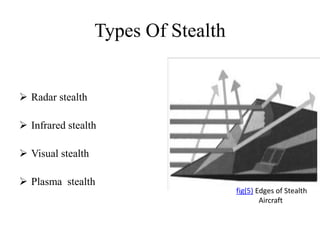
Types Of Stealth
 Radar stealth
 Infrared stealth
 Visual stealth
 Plasma stealth
fig(5) Edges of Stealth
Aircraft
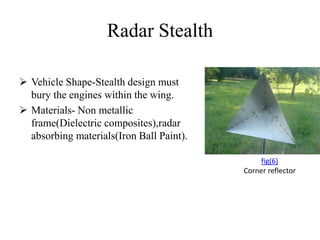
Radar Stealth
 Vehicle Shape-Stealth design must
bury the engines within the wing.
 Materials- Non metallic
frame(Dielectric composites),radar
absorbing materials(Iron Ball Paint).
fig(6)
Corner reflector
Infrared Stealth
 Infra-red radiation are emitted by all
matter above absolute temperature zero
 Hot zones such as engine exhaust , wing
surface friction due to air get heated
which rather increases the visibility
 These part should be kept cool as
possible it can be .
 Option would be mixing of cool air with
the hot engine exhaust
fig(7) optical blocking
hot engine parts
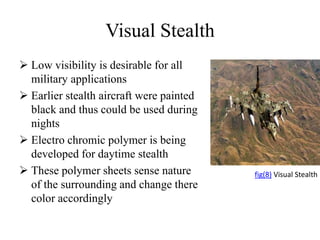
Visual Stealth
 Low visibility is desirable for all
military applications
 Earlier stealth aircraft were painted
black and thus could be used during
nights
 Electro chromic polymer is being
developed for daytime stealth
 These polymer sheets sense nature
of the surrounding and change there
color accordingly
fig(8) Visual Stealth
Plasma Stealth
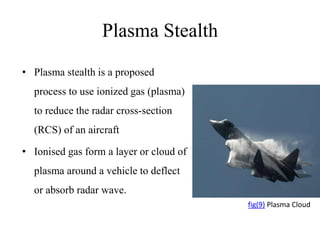
• Plasma stealth is a proposed
process to use ionized gas (plasma)
to reduce the radar cross-section
(RCS) of an aircraft
• Ionised gas form a layer or cloud of
plasma around a vehicle to deflect
or absorb radar wave.
fig(9) Plasma Cloud
Advantages
• Reduces the causality rates during war
• Saving military budget
• Develop the military secretes
• Bluff the anti-detective device
• Efficiency can be increased while in a war zone
Disadvantages
• Stealth aircraft cannot fly as fast as conventional aircraft
• Can carry limited amount of load
• Very economic B-2 cost [ $2 billion ] ,F-22[$100 million
• Wing shape does not provide the optimum lift
• Cost of maintenance very high
Future Scope
• Air defence systems grow more accurate
• It will be incorporated in missile, drones.
• Hypersonic- the idea is to travel with M>5 to avoid detection
• The Infrared Invisibility Cloak: Shield one’s body heat from
infrared sensors, effectively making them invisible to infrared
cameras
Conclusion
• Undoubtedly, stealth technology is the future of military
combat and at present is one of the best technology to make
things invisible as far as possible.
• But , the main problem with stealth is its very high cost and
because of this, not all nations can adopt this technology.
• So we need to find ways to reduce cost or adopt a different
technology with stealth like characteristics and at low cost.
Reference
https://en.wikipedia.org/wiki/Stealth_technolo
gy
http://www.encyclopedia.com/stealth
Stealth Technology: The Art of Black Magic
by Joseph Jones
www.generationbeyondinschool.com/
Thank You

Stealth technology

  • 1.
    Seminar Topic On StealthTechnology Presented To:- Presented By:- Prof R.N.Yadav Ashish Singh Yadav (Department of ME) Under The Supervision - Mr. Gaurav Gupta
  • 2.
    I. Introduction II. StealthPrinciple III. Detection Method IV. Types Of Stealth V. Radar Stealth VI. Infrared Stealth VII.Visual Stealth VIII.Plasma Stealth IX. Advantages X. Disadvantages XI. Conclusion XII.Future scope XIII.Reference Context
  • 3.
    Introduction Stealth technology alsoknown as LOT (Low Observability Technology). It covers a range of techniques used with aircraft, ships and missiles, in order to make them less visible (ideally invisible). Stealth technology cannot make the aircraft invisible to enemy or friendly radar. This is similar to the camouflage tactics used by soldiers in jungle warfare. Only few countries has such technology like Russia, U.S.A, France, India.
  • 4.
    Stealth Principle Stealth technology(or LO for "Low Observability") is not a single technology. It is a combination of technologies that attempt to greatly reduce the distances at which a vehicle can be detected. The goal of stealth technology is to make an airplane invisible to radar. There are two different ways to create invisibility:  The airplane can be shaped so that any radar signals it reflects are reflected away from the radar equipment.  The airplane can be covered in materials that absorb radar signals.
  • 5.
    Comparison Passenger aeroplane • Mostconventional aircraft have a rounded shape • It also creates a very efficient radar reflector Fighter plane • It is made up of completely flat surfaces and very sharp edges • Radar signal hits a plane reflects away at any angle fig(1) Passenger Plane fig(2) F-35
  • 6.
    Detection method  RCS(Radarcross-section)  Infrared signature  Acoustic Signature  Visible Signature  Laser Cross Section fig(4) RCS
  • 7.
    Types Of Stealth Radar stealth  Infrared stealth  Visual stealth  Plasma stealth fig(5) Edges of Stealth Aircraft
  • 8.
    Radar Stealth  VehicleShape-Stealth design must bury the engines within the wing.  Materials- Non metallic frame(Dielectric composites),radar absorbing materials(Iron Ball Paint). fig(6) Corner reflector
  • 9.
    Infrared Stealth  Infra-redradiation are emitted by all matter above absolute temperature zero  Hot zones such as engine exhaust , wing surface friction due to air get heated which rather increases the visibility  These part should be kept cool as possible it can be .  Option would be mixing of cool air with the hot engine exhaust fig(7) optical blocking hot engine parts
  • 10.
    Visual Stealth  Lowvisibility is desirable for all military applications  Earlier stealth aircraft were painted black and thus could be used during nights  Electro chromic polymer is being developed for daytime stealth  These polymer sheets sense nature of the surrounding and change there color accordingly fig(8) Visual Stealth
  • 11.
    Plasma Stealth • Plasmastealth is a proposed process to use ionized gas (plasma) to reduce the radar cross-section (RCS) of an aircraft • Ionised gas form a layer or cloud of plasma around a vehicle to deflect or absorb radar wave. fig(9) Plasma Cloud
  • 12.
    Advantages • Reduces thecausality rates during war • Saving military budget • Develop the military secretes • Bluff the anti-detective device • Efficiency can be increased while in a war zone
  • 13.
    Disadvantages • Stealth aircraftcannot fly as fast as conventional aircraft • Can carry limited amount of load • Very economic B-2 cost [ $2 billion ] ,F-22[$100 million • Wing shape does not provide the optimum lift • Cost of maintenance very high
  • 14.
    Future Scope • Airdefence systems grow more accurate • It will be incorporated in missile, drones. • Hypersonic- the idea is to travel with M>5 to avoid detection • The Infrared Invisibility Cloak: Shield one’s body heat from infrared sensors, effectively making them invisible to infrared cameras
  • 15.
    Conclusion • Undoubtedly, stealthtechnology is the future of military combat and at present is one of the best technology to make things invisible as far as possible. • But , the main problem with stealth is its very high cost and because of this, not all nations can adopt this technology. • So we need to find ways to reduce cost or adopt a different technology with stealth like characteristics and at low cost.
  • 16.
  • 17.