DRK College of Engineering & Technology
Date Technical Seminar
DRK College of Engineering & Technology
Technical SeminarDate
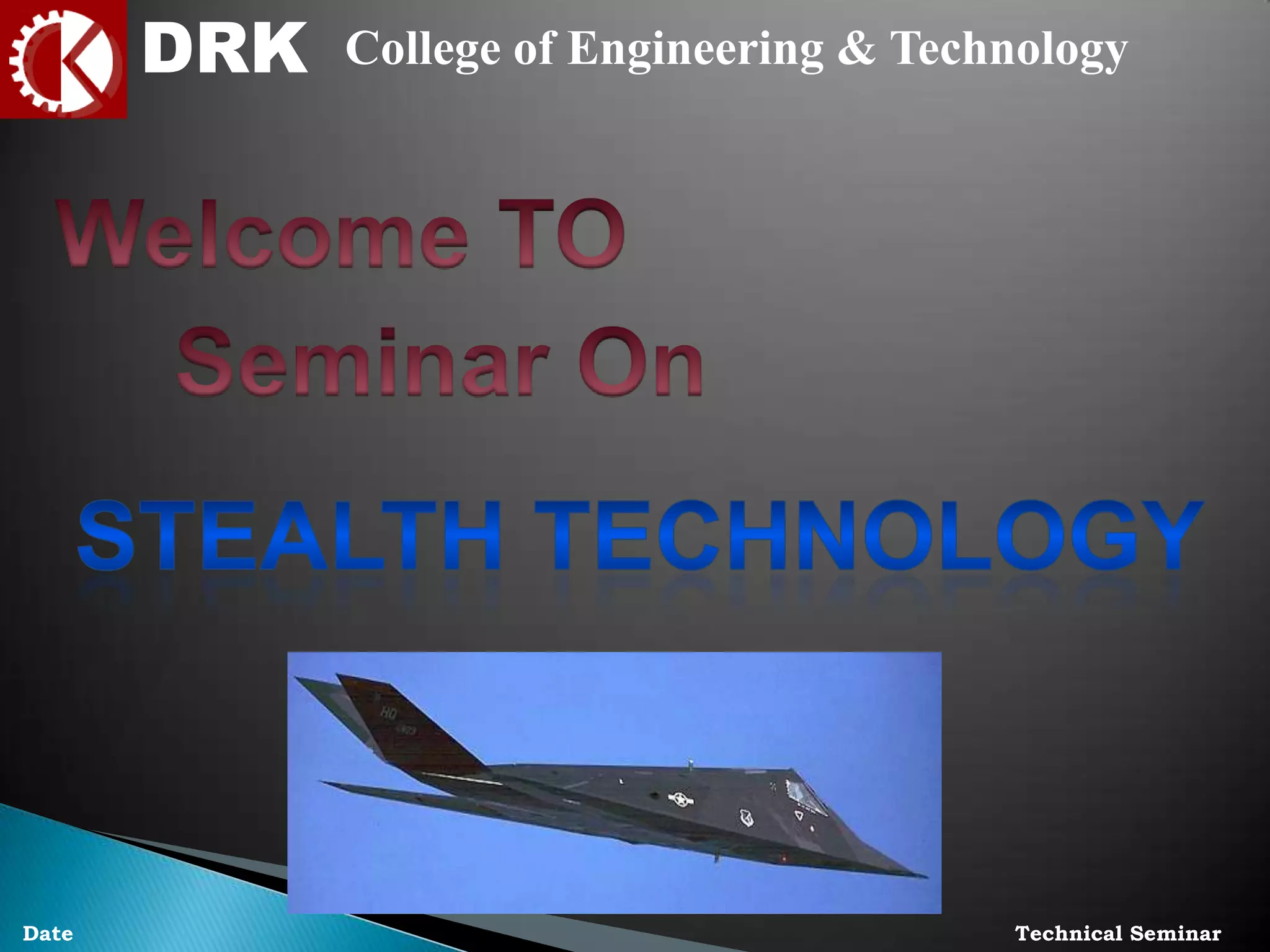
Stealth Technology
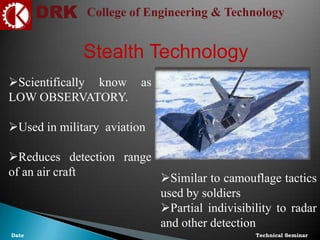
Scientifically know as
LOW OBSERVATORY.
Used in military aviation
Reduces detection range
of an air craft Similar to camouflage tactics
used by soldiers
Partial indivisibility to radar
and other detection
DRK College of Engineering & Technology
Technical SeminarDate
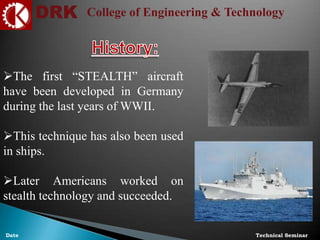
The first “STEALTH” aircraft
have been developed in Germany
during the last years of WWII.
This technique has also been used
in ships.
Later Americans worked on
stealth technology and succeeded.
DRK College of Engineering & Technology
Technical SeminarDate
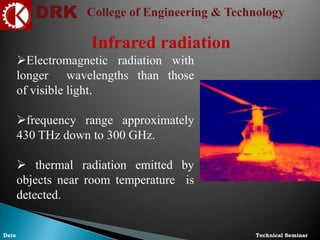
Electromagnetic radiation with
longer wavelengths than those
of visible light.
frequency range approximately
430 THz down to 300 GHz.
 thermal radiation emitted by
objects near room temperature is
detected.
Infrared radiation
DRK College of Engineering & Technology
Technical SeminarDate
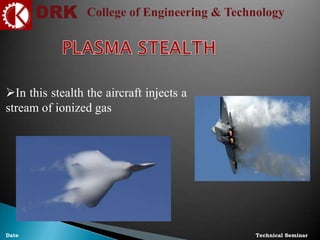
In this stealth the aircraft injects a
stream of ionized gas
DRK College of Engineering & Technology
Technical SeminarDate
DRK College of Engineering & Technology
Technical SeminarDate
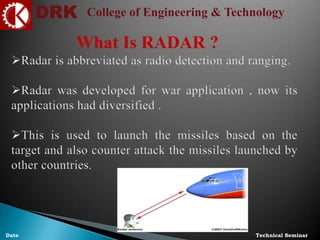
What Is RADAR ?
DRK College of Engineering & Technology
Technical SeminarDate
Almost since the invention of radar, various techniques have
been tried to minimize detection
Some of the techniques used for this purpose are:
1.Vehicle shape
2.Radar absorbing material
DRK College of Engineering & Technology
Technical SeminarDate
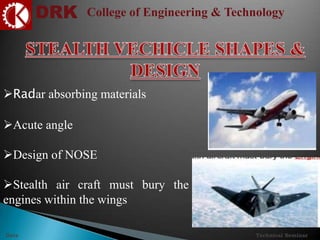
Radar absorbing materials
Acute angle
Design of NOSE
Stealth air craft must bury the
engines within the wings
DRK College of Engineering & Technology
Technical SeminarDate
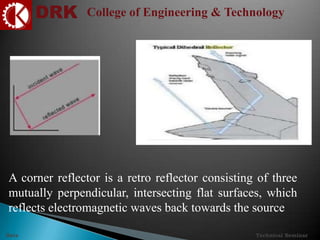
A corner reflector is a retro reflector consisting of three
mutually perpendicular, intersecting flat surfaces, which
reflects electromagnetic waves back towards the source
DRK College of Engineering & Technology
Technical SeminarDate
DRK College of Engineering & Technology
Technical SeminarDate
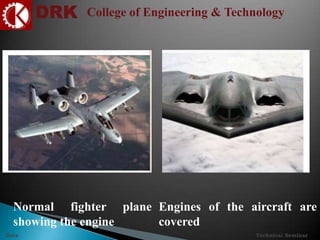
Normal fighter plane
showing the engine
Engines of the aircraft are
covered
DRK College of Engineering & Technology
Technical SeminarDate
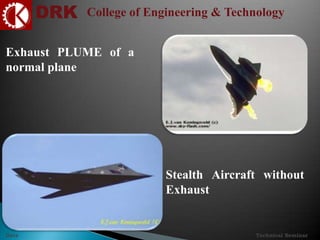
Exhaust PLUME of a
normal plane
Stealth Aircraft without
Exhaust
DRK College of Engineering & Technology
Technical SeminarDate
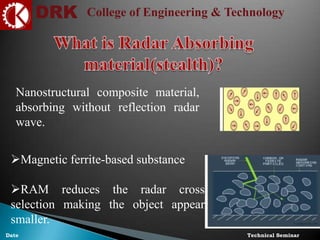
Nanostructural composite material,
absorbing without reflection radar
wave.
Magnetic ferrite-based substance
RAM reduces the radar cross
selection making the object appear
smaller.
DRK College of Engineering & Technology
Technical SeminarDate
DRK College of Engineering & Technology
Technical SeminarDate
DRK College of Engineering & Technology
Technical SeminarDate
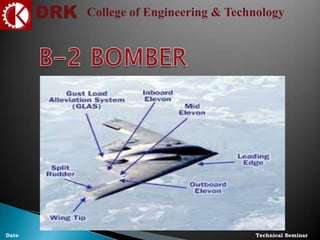
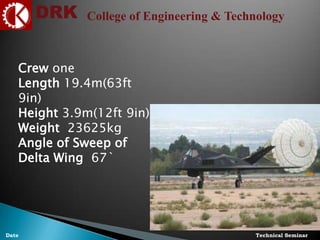
Crew one
Length 19.4m(63ft
9in)
Height 3.9m(12ft 9in)
Weight 23625kg
Angle of Sweep of
Delta Wing 67`
DRK College of Engineering & Technology
Technical SeminarDate
DRK College of Engineering & Technology
Technical SeminarDate
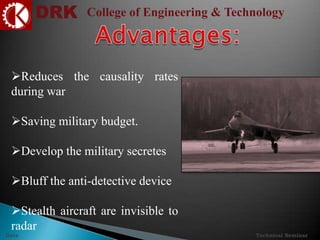
Reduces the causality rates
during war
Saving military budget.
Develop the military secretes
Bluff the anti-detective device
Stealth aircraft are invisible to
radar
DRK College of Engineering & Technology
Technical SeminarDate
.
DRK College of Engineering & Technology
Technical SeminarDate
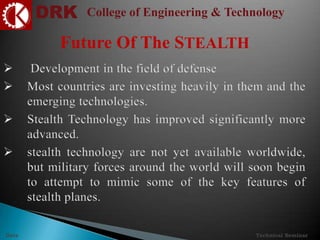
Future Of The STEALTH
DRK College of Engineering & Technology
Technical SeminarDate
 Stealth technology developed a lot.
 Investment needed is very high.
 High chance of low cost gain.
 A lot learned about signature reduction and
absorption.
 Success yet to be proved extensively.
 Useful for other projects.
DRK College of Engineering & Technology
Technical SeminarDate
DRK College of Engineering & Technology
Technical SeminarDate
References:
1. http://www.totalairdominance.50megs.com/stealth.htm
2. http://en.wikipedia.org/wiki/Stealth_technology
3. http://en.wikipedia.org/wiki/Radar
4. http://en.wikipedia.org/wiki/Stealth_ship
5. http://www.resonancepub.com/images/stealth_ship.gif
6. http://images.google.co.in/images
7. http://www.airplanedesign.info/51.htm
8. http://www.military-heat.com/43/russian-
plasma-stealth-fighters/

Presentation on stealth technology

  • 1.
    DRK College ofEngineering & Technology Date Technical Seminar
  • 2.
    DRK College ofEngineering & Technology Technical SeminarDate Stealth Technology Scientifically know as LOW OBSERVATORY. Used in military aviation Reduces detection range of an air craft Similar to camouflage tactics used by soldiers Partial indivisibility to radar and other detection
  • 3.
    DRK College ofEngineering & Technology Technical SeminarDate The first “STEALTH” aircraft have been developed in Germany during the last years of WWII. This technique has also been used in ships. Later Americans worked on stealth technology and succeeded.
  • 4.
    DRK College ofEngineering & Technology Technical SeminarDate Electromagnetic radiation with longer wavelengths than those of visible light. frequency range approximately 430 THz down to 300 GHz.  thermal radiation emitted by objects near room temperature is detected. Infrared radiation
  • 5.
    DRK College ofEngineering & Technology Technical SeminarDate In this stealth the aircraft injects a stream of ionized gas
  • 6.
    DRK College ofEngineering & Technology Technical SeminarDate
  • 7.
    DRK College ofEngineering & Technology Technical SeminarDate What Is RADAR ?
  • 8.
    DRK College ofEngineering & Technology Technical SeminarDate Almost since the invention of radar, various techniques have been tried to minimize detection Some of the techniques used for this purpose are: 1.Vehicle shape 2.Radar absorbing material
  • 9.
    DRK College ofEngineering & Technology Technical SeminarDate Radar absorbing materials Acute angle Design of NOSE Stealth air craft must bury the engines within the wings
  • 10.
    DRK College ofEngineering & Technology Technical SeminarDate A corner reflector is a retro reflector consisting of three mutually perpendicular, intersecting flat surfaces, which reflects electromagnetic waves back towards the source
  • 11.
    DRK College ofEngineering & Technology Technical SeminarDate
  • 12.
    DRK College ofEngineering & Technology Technical SeminarDate Normal fighter plane showing the engine Engines of the aircraft are covered
  • 13.
    DRK College ofEngineering & Technology Technical SeminarDate Exhaust PLUME of a normal plane Stealth Aircraft without Exhaust
  • 14.
    DRK College ofEngineering & Technology Technical SeminarDate Nanostructural composite material, absorbing without reflection radar wave. Magnetic ferrite-based substance RAM reduces the radar cross selection making the object appear smaller.
  • 15.
    DRK College ofEngineering & Technology Technical SeminarDate
  • 16.
    DRK College ofEngineering & Technology Technical SeminarDate
  • 17.
    DRK College ofEngineering & Technology Technical SeminarDate Crew one Length 19.4m(63ft 9in) Height 3.9m(12ft 9in) Weight 23625kg Angle of Sweep of Delta Wing 67`
  • 18.
    DRK College ofEngineering & Technology Technical SeminarDate
  • 19.
    DRK College ofEngineering & Technology Technical SeminarDate Reduces the causality rates during war Saving military budget. Develop the military secretes Bluff the anti-detective device Stealth aircraft are invisible to radar
  • 20.
    DRK College ofEngineering & Technology Technical SeminarDate .
  • 21.
    DRK College ofEngineering & Technology Technical SeminarDate Future Of The STEALTH
  • 22.
    DRK College ofEngineering & Technology Technical SeminarDate  Stealth technology developed a lot.  Investment needed is very high.  High chance of low cost gain.  A lot learned about signature reduction and absorption.  Success yet to be proved extensively.  Useful for other projects.
  • 23.
    DRK College ofEngineering & Technology Technical SeminarDate
  • 24.
    DRK College ofEngineering & Technology Technical SeminarDate References: 1. http://www.totalairdominance.50megs.com/stealth.htm 2. http://en.wikipedia.org/wiki/Stealth_technology 3. http://en.wikipedia.org/wiki/Radar 4. http://en.wikipedia.org/wiki/Stealth_ship 5. http://www.resonancepub.com/images/stealth_ship.gif 6. http://images.google.co.in/images 7. http://www.airplanedesign.info/51.htm 8. http://www.military-heat.com/43/russian- plasma-stealth-fighters/