Data Intensive Computing on Heterogeneous Platforms  Norm Rubin  Fellow  GPG graphics products group AMD HPEC 2009
What might we see in future platforms? Multi-core implies reprogramming so all kinds of new architectures are possible The traditional view of more performance per year, based on clock changes is over New approaches will change our view of computing platforms Compute is about to change radically
The drivers  for compute New more natural user interfaces Search (e.g., finding things in images)  Massive data Search over time changing data (e.g., live video) Massive data Machine learning (starting with simple models) Massive data Standard compute tasks Data intensive covers 2,3, and 4
Massive Data and machine learning Data-driven models become  tractable and usable Less need for  analytical models Less need for heuristics  Real-time connectivity enables continuous model refinement Poor model is an acceptable starting point Classification accuracy improves over time
Simple Models Google demonstrated the value of applying massive amounts of computation to language translation in the 2005 NIST machine translation competition.  They won all four categories of the competition translating Arabic to English and Chinese to English. Purely statistical approach  multilingual United Nations documents comprising over 200 billion words, as well as English-language documents comprising over one trillion words.  No one in their machine translation group knew either Chinese or Arabic.  Google tops translation ranking.  [email_address] , Nov. 6, 2006.
How Technology May Soon "Read" Your Mind Establish the correspondence between a simple cognitive state (such as the thought of a  hammer ) and the underlying brain activity. Use machine learning techniques to identify the neural pattern of brain activity underlying various thought processes.  MRI scanner generates data Data base of responses of individuals Using fMRI Brain Activation to Identify Cognitive States Associated with Perception of Tools and Dwellings S.V. Shinkareva, R.A. Mason, V.L. Malave, W. Wang, T. M. Mitchel, and M. A. Just,  PLoS ONE 3(1): e1394. doi:10.1371/journal.pone.0001394, January 2, 2008.
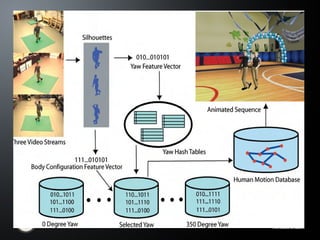
New ways to program graphics  A domain expert (the programmer), 3 cameras, silhouette extraction and  a large data base of human motions Use 3D movement  as a programming language L. Ren, G. Shakhnarovich, J. K. Hodgins, H. Pfister, and P. Viola. Learning silhouette features for control of human motion.  ACM Transactions on Graphics , 24(4), October 2005 .
 
How will GPU/CPU change to meet big data? Current machine models are two separate devices GPU – a graphics thing, maybe also a data parallel accelerator, good for lots of data, small programs CPU – a serial processor, maybe capable of task parallelism, good for limited data, big programs CPU  strength is single thread performance  (latency machine) GPU strength is massive thread performance  (throughput machine)
GPU compared with CPU GPU Great float Great bandwidth High performance without fixed  isa, lots of room for innovation, without breaking code  different to program But Limited scratchpad memory in place of a cache CPU Great control flow Lots of existing code Locked into an legacy isa  Very good at reuse, real caches  But  Limited ability to scale with cores
Some limitations of today's GPU general cross thread communication task switching, task parallel problems nested parallelism dynamic parallelism very expensive to move  data between GPU/CPU programmer controlled small scratch pad memory
The 3C view of the future,  (c-cubed?) We are in a time of architectural  change much like the switch from mainframes to microprocessors abundant content, connections, compute Slash dot http://science.slashdot.org/article.pl?sid=09/08/20/1233258 NASA Probe Blasts 461 Gigabytes of Moon Data Daily  On its current space scouting mission, NASA's Lunar Reconnaissance Orbiter (LRO) is using a pumped up communications device to deliver  461 gigabytes of data and images per day , at a rate of up to 100 Mbps. As the first high data rate K-band transmitter to fly on a NASA spacecraft, the 13-inch-long tube, called a Traveling Wave Tube Amplifier, is making it possible for NASA scientists to receive massive amounts of images and data about the moon's surface and environment…  It kills me that the  moon  has better bandwidth than my house.
Software Challenge Most of the successful parallel applications seem to have dedicated languages (DirectX ® 11/map-reduce/sawzsall) for limited domains Small programs can build interesting applications,  Programmers are not super experts in the hardware Programs survive machine generations Can we replicate this success in other domains?
Can we get performance with high level languages? CUDA and OpenCL are good languages in the hands of experts but they are still too low level We need high level programming models that express computations over data One possible model is “MapReduce” Map part selects interesting data Reduce part combines the interesting data
MapReduce Map:  for each input in parallel if the input is interesting – output a key and a value, values might be compound structures Sort based on the keys  Reduce: in parallel for each key for each value with the same key, combine
Observations on MapReduce Developers only write a small part of the program, rest of the code comes from libraries  No race conditions are possible No error reporting (just keep going) Can view the program as serial (per input) No developer knows the number of processors Not like pthreads Hard part is reductions, but it appears that there are only a few that are common, so maybe they can be prebuilt
Notice nested parallelism in MapReduce For each key (in parallel) do a parallel reduction (also parallel) One key may have lots of values, a second key might have a few (work stealing? Dynamic parallelism?)
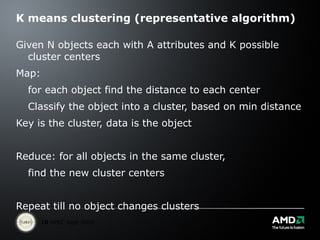
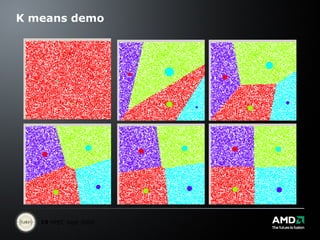
K means clustering (representative algorithm) Given N objects each with A attributes and K possible cluster centers Map: for each object find the distance to each center Classify the object into a cluster, based on min distance Key is the cluster, data is the object Reduce: for all objects in the same cluster,  find the new cluster centers Repeat till no object changes clusters
K means demo
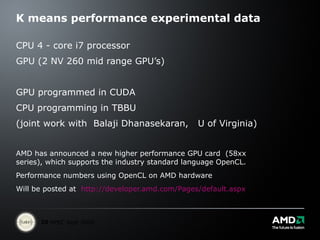
K means performance experimental data CPU 4 - core i7 processor  GPU (2 NV 260 mid range GPU’s) GPU programmed in CUDA CPU programming in TBBU (joint work with  Balaji Dhanasekaran,  U of Virginia) AMD has announced a new higher performance GPU card  (58xx series), which supports the industry standard language OpenCL. Performance numbers using OpenCL on AMD hardware Will be posted at  http://developer.amd.com/Pages/default.aspx
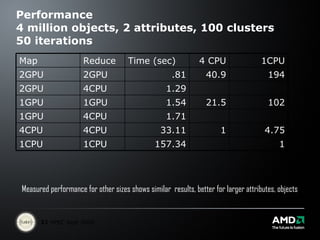
Performance 4 million objects, 2 attributes, 100 clusters 50 iterations  Measured performance for other sizes shows similar  results, better for larger attributes, objects Map Reduce Time (sec) 4 CPU 1CPU 2GPU 2GPU .81 40.9 194 2GPU 4CPU 1.29 1GPU 1GPU 1.54 21.5 102 1GPU 4CPU 1.71 4CPU 4CPU 33.11 1 4.75 1CPU 1CPU 157.34 1
K-means Do most of the work on the GPU, but do some of the reductions on the CPU if you have enough idle cores. Preliminary numbers suggest GPU can solve this very well. Can we develop software that automatically adjusts for this,  or do programmers have to write variant algorithms?
Disclaimer and Attribution DISCLAIMER The information presented in this document is for informational purposes only and may contain technical inaccuracies, omissions and typographical errors. AMD MAKES NO REPRESENTATIONS OR WARRANTIES WITH RESPECT TO THE CONTENTS HEREOF AND ASSUMES NO RESPONSIBILITY FOR ANY INACCURACIES, ERRORS OR OMISSIONS THAT MAY APPEAR IN THIS INFORMATION. AMD SPECIFICALLY DISCLAIMS ANY IMPLIED WARRANTIES OF MERCHANTABILITY OR FITNESS FOR ANY PARTICULAR PURPOSE.  IN NO EVENT WILL AMD BE LIABLE TO ANY PERSON FOR ANY DIRECT, INDIRECT, SPECIAL OR OTHER CONSEQUENTIAL DAMAGES ARISING FROM THE USE OF ANY INFORMATION CONTAINED HEREIN, EVEN IF AMD IS EXPRESSLY ADVISED OF THE POSSIBILITY OF SUCH DAMAGES. ATTRIBUTION © 2009 Advanced Micro Devices, Inc.  All rights reserved.  AMD, the AMD Arrow logo, ATI, the ATI logo, CrossFireX, PowerPlay and Radeon and combinations thereof are trademarks of Advanced Micro Devices, Inc. Other names are for informational purposes only and may be trademarks of their respective owners.
Questions?

Presentation

  • 1.
    Data Intensive Computingon Heterogeneous Platforms Norm Rubin Fellow GPG graphics products group AMD HPEC 2009
  • 2.
    What might wesee in future platforms? Multi-core implies reprogramming so all kinds of new architectures are possible The traditional view of more performance per year, based on clock changes is over New approaches will change our view of computing platforms Compute is about to change radically
  • 3.
    The drivers for compute New more natural user interfaces Search (e.g., finding things in images) Massive data Search over time changing data (e.g., live video) Massive data Machine learning (starting with simple models) Massive data Standard compute tasks Data intensive covers 2,3, and 4
  • 4.
    Massive Data andmachine learning Data-driven models become tractable and usable Less need for analytical models Less need for heuristics Real-time connectivity enables continuous model refinement Poor model is an acceptable starting point Classification accuracy improves over time
  • 5.
    Simple Models Googledemonstrated the value of applying massive amounts of computation to language translation in the 2005 NIST machine translation competition. They won all four categories of the competition translating Arabic to English and Chinese to English. Purely statistical approach multilingual United Nations documents comprising over 200 billion words, as well as English-language documents comprising over one trillion words. No one in their machine translation group knew either Chinese or Arabic. Google tops translation ranking. [email_address] , Nov. 6, 2006.
  • 6.
    How Technology MaySoon "Read" Your Mind Establish the correspondence between a simple cognitive state (such as the thought of a hammer ) and the underlying brain activity. Use machine learning techniques to identify the neural pattern of brain activity underlying various thought processes. MRI scanner generates data Data base of responses of individuals Using fMRI Brain Activation to Identify Cognitive States Associated with Perception of Tools and Dwellings S.V. Shinkareva, R.A. Mason, V.L. Malave, W. Wang, T. M. Mitchel, and M. A. Just, PLoS ONE 3(1): e1394. doi:10.1371/journal.pone.0001394, January 2, 2008.
  • 7.
    New ways toprogram graphics A domain expert (the programmer), 3 cameras, silhouette extraction and a large data base of human motions Use 3D movement as a programming language L. Ren, G. Shakhnarovich, J. K. Hodgins, H. Pfister, and P. Viola. Learning silhouette features for control of human motion. ACM Transactions on Graphics , 24(4), October 2005 .
  • 8.
  • 9.
    How will GPU/CPUchange to meet big data? Current machine models are two separate devices GPU – a graphics thing, maybe also a data parallel accelerator, good for lots of data, small programs CPU – a serial processor, maybe capable of task parallelism, good for limited data, big programs CPU strength is single thread performance (latency machine) GPU strength is massive thread performance (throughput machine)
  • 10.
    GPU compared withCPU GPU Great float Great bandwidth High performance without fixed isa, lots of room for innovation, without breaking code different to program But Limited scratchpad memory in place of a cache CPU Great control flow Lots of existing code Locked into an legacy isa Very good at reuse, real caches But Limited ability to scale with cores
  • 11.
    Some limitations oftoday's GPU general cross thread communication task switching, task parallel problems nested parallelism dynamic parallelism very expensive to move data between GPU/CPU programmer controlled small scratch pad memory
  • 12.
    The 3C viewof the future, (c-cubed?) We are in a time of architectural change much like the switch from mainframes to microprocessors abundant content, connections, compute Slash dot http://science.slashdot.org/article.pl?sid=09/08/20/1233258 NASA Probe Blasts 461 Gigabytes of Moon Data Daily On its current space scouting mission, NASA's Lunar Reconnaissance Orbiter (LRO) is using a pumped up communications device to deliver 461 gigabytes of data and images per day , at a rate of up to 100 Mbps. As the first high data rate K-band transmitter to fly on a NASA spacecraft, the 13-inch-long tube, called a Traveling Wave Tube Amplifier, is making it possible for NASA scientists to receive massive amounts of images and data about the moon's surface and environment… It kills me that the moon has better bandwidth than my house.
  • 13.
    Software Challenge Mostof the successful parallel applications seem to have dedicated languages (DirectX ® 11/map-reduce/sawzsall) for limited domains Small programs can build interesting applications, Programmers are not super experts in the hardware Programs survive machine generations Can we replicate this success in other domains?
  • 14.
    Can we getperformance with high level languages? CUDA and OpenCL are good languages in the hands of experts but they are still too low level We need high level programming models that express computations over data One possible model is “MapReduce” Map part selects interesting data Reduce part combines the interesting data
  • 15.
    MapReduce Map: for each input in parallel if the input is interesting – output a key and a value, values might be compound structures Sort based on the keys Reduce: in parallel for each key for each value with the same key, combine
  • 16.
    Observations on MapReduceDevelopers only write a small part of the program, rest of the code comes from libraries No race conditions are possible No error reporting (just keep going) Can view the program as serial (per input) No developer knows the number of processors Not like pthreads Hard part is reductions, but it appears that there are only a few that are common, so maybe they can be prebuilt
  • 17.
    Notice nested parallelismin MapReduce For each key (in parallel) do a parallel reduction (also parallel) One key may have lots of values, a second key might have a few (work stealing? Dynamic parallelism?)
  • 18.
    K means clustering(representative algorithm) Given N objects each with A attributes and K possible cluster centers Map: for each object find the distance to each center Classify the object into a cluster, based on min distance Key is the cluster, data is the object Reduce: for all objects in the same cluster, find the new cluster centers Repeat till no object changes clusters
  • 19.
  • 20.
    K means performanceexperimental data CPU 4 - core i7 processor GPU (2 NV 260 mid range GPU’s) GPU programmed in CUDA CPU programming in TBBU (joint work with Balaji Dhanasekaran, U of Virginia) AMD has announced a new higher performance GPU card  (58xx series), which supports the industry standard language OpenCL. Performance numbers using OpenCL on AMD hardware Will be posted at http://developer.amd.com/Pages/default.aspx
  • 21.
    Performance 4 millionobjects, 2 attributes, 100 clusters 50 iterations Measured performance for other sizes shows similar results, better for larger attributes, objects Map Reduce Time (sec) 4 CPU 1CPU 2GPU 2GPU .81 40.9 194 2GPU 4CPU 1.29 1GPU 1GPU 1.54 21.5 102 1GPU 4CPU 1.71 4CPU 4CPU 33.11 1 4.75 1CPU 1CPU 157.34 1
  • 22.
    K-means Do mostof the work on the GPU, but do some of the reductions on the CPU if you have enough idle cores. Preliminary numbers suggest GPU can solve this very well. Can we develop software that automatically adjusts for this, or do programmers have to write variant algorithms?
  • 23.
    Disclaimer and AttributionDISCLAIMER The information presented in this document is for informational purposes only and may contain technical inaccuracies, omissions and typographical errors. AMD MAKES NO REPRESENTATIONS OR WARRANTIES WITH RESPECT TO THE CONTENTS HEREOF AND ASSUMES NO RESPONSIBILITY FOR ANY INACCURACIES, ERRORS OR OMISSIONS THAT MAY APPEAR IN THIS INFORMATION. AMD SPECIFICALLY DISCLAIMS ANY IMPLIED WARRANTIES OF MERCHANTABILITY OR FITNESS FOR ANY PARTICULAR PURPOSE. IN NO EVENT WILL AMD BE LIABLE TO ANY PERSON FOR ANY DIRECT, INDIRECT, SPECIAL OR OTHER CONSEQUENTIAL DAMAGES ARISING FROM THE USE OF ANY INFORMATION CONTAINED HEREIN, EVEN IF AMD IS EXPRESSLY ADVISED OF THE POSSIBILITY OF SUCH DAMAGES. ATTRIBUTION © 2009 Advanced Micro Devices, Inc. All rights reserved. AMD, the AMD Arrow logo, ATI, the ATI logo, CrossFireX, PowerPlay and Radeon and combinations thereof are trademarks of Advanced Micro Devices, Inc. Other names are for informational purposes only and may be trademarks of their respective owners.
  • 24.