Deep Learning for FinTech
GEETA CHAUHAN, CTO SVSG
Agenda
 AI & Deep Learning in FinTech
 What is Deep Learning?
 Rise of Specialized Compute
 Techniques for Optimization
 Look into future
 Steps for starting your AI journey
 References
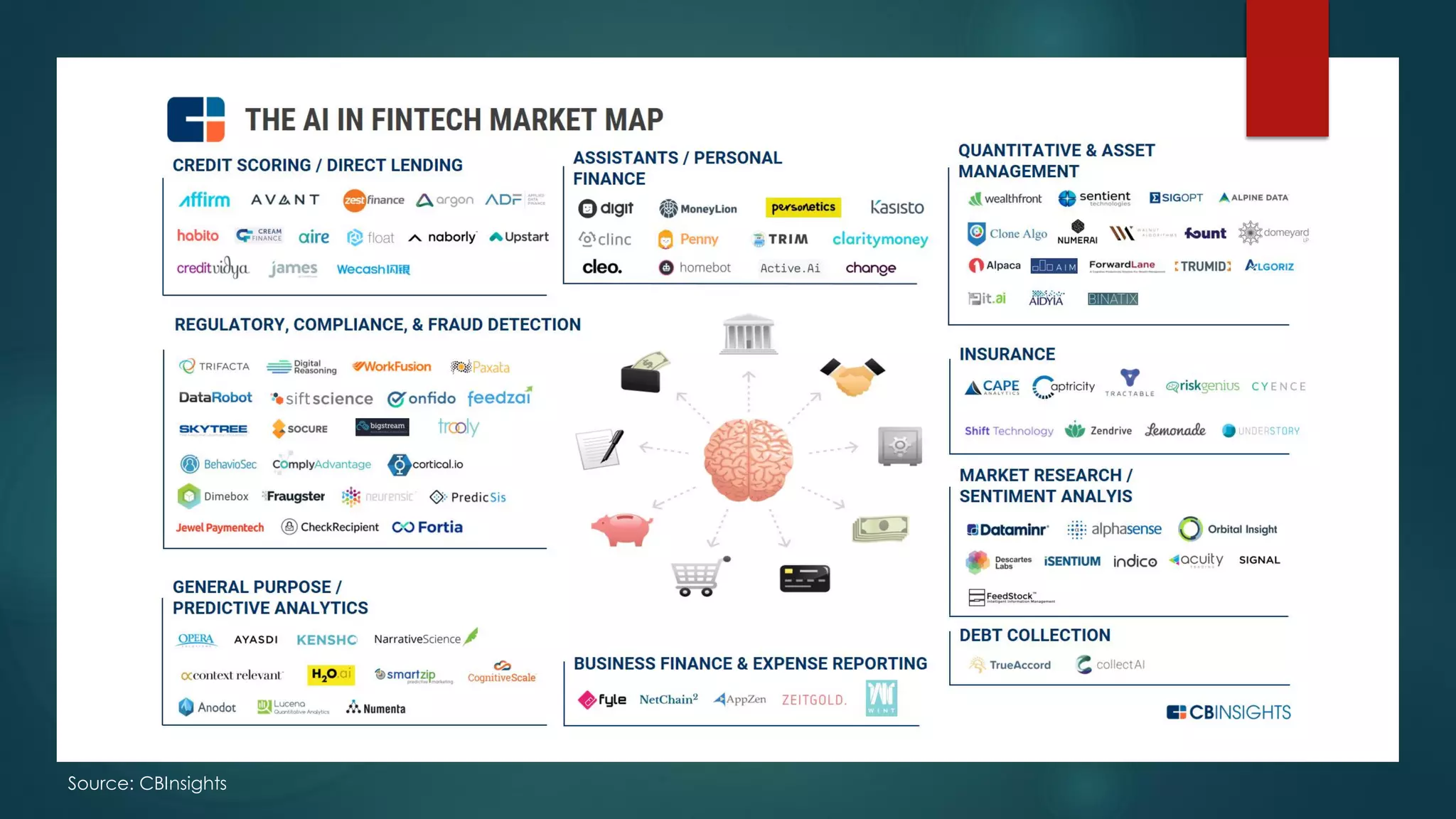
Source: CBInsights
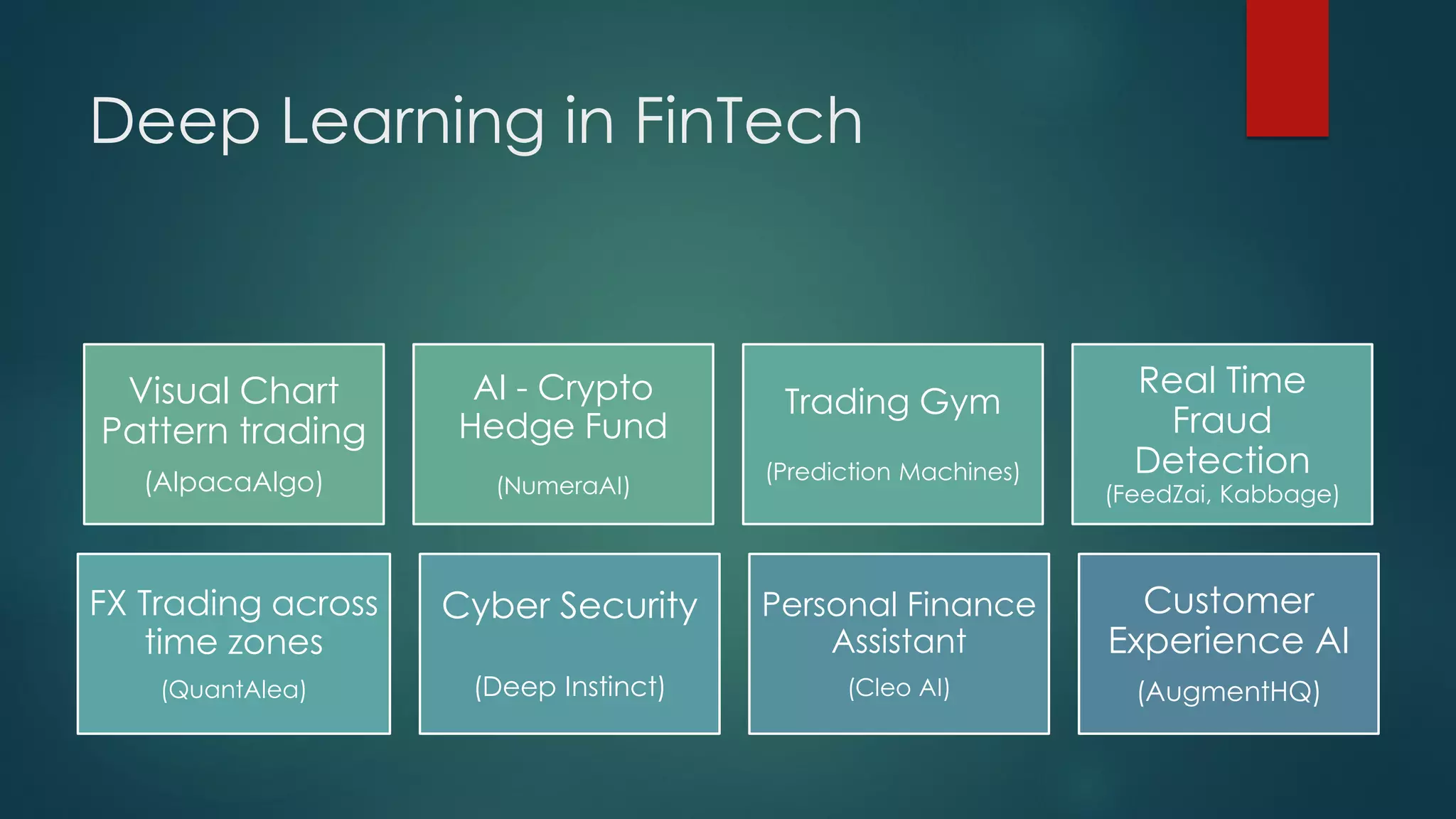
Deep Learning in FinTech
Visual Chart
Pattern trading
(AlpacaAlgo)
AI - Crypto
Hedge Fund
(NumeraAI)
Trading Gym
(Prediction Machines)
Real Time
Fraud
Detection
(FeedZai, Kabbage)
FX Trading across
time zones
(QuantAlea)
Cyber Security
(Deep Instinct)
Personal Finance
Assistant
(Cleo AI)
Customer
Experience AI
(AugmentHQ)
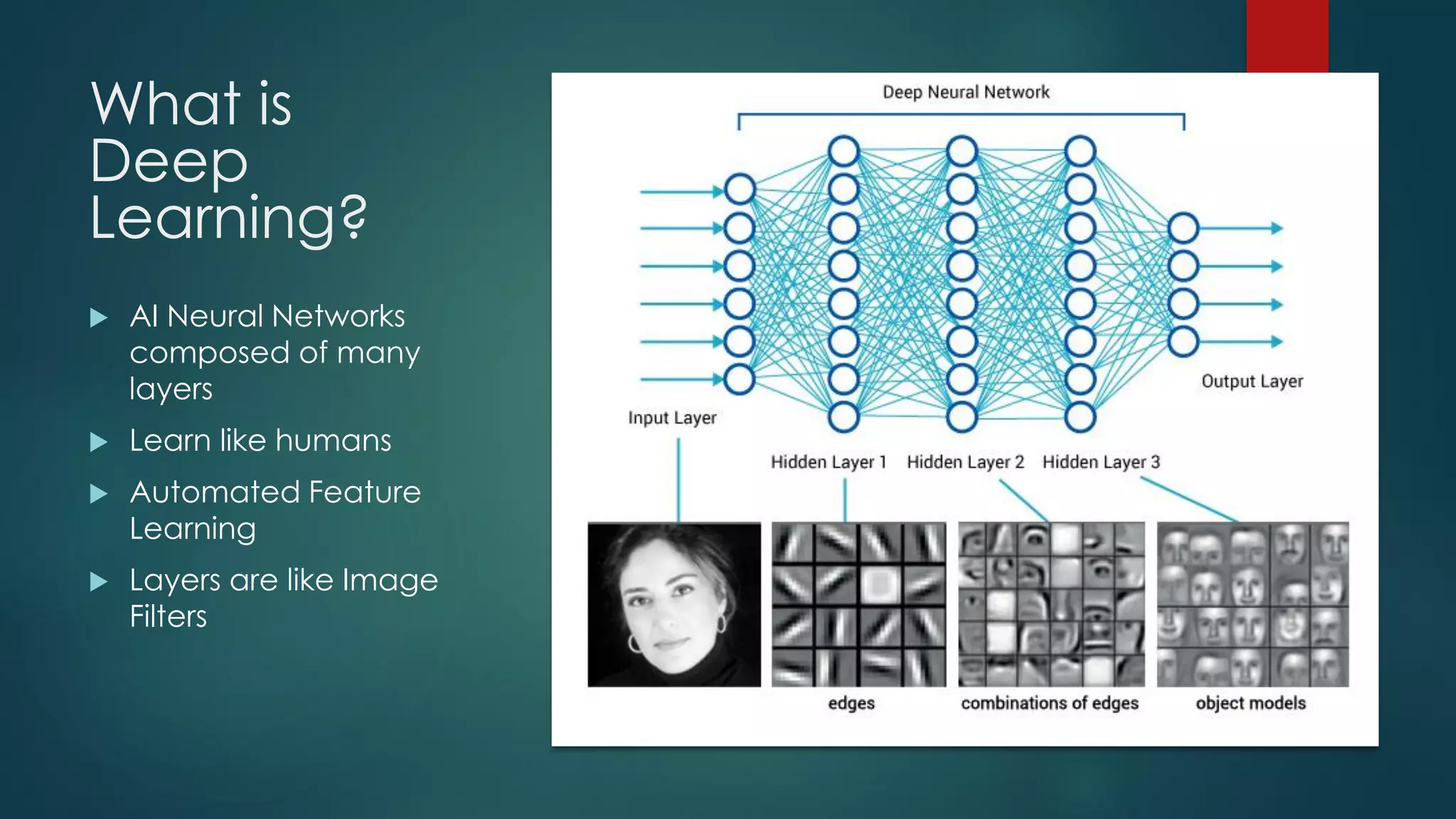
What is
Deep
Learning?
 AI Neural Networks
composed of many
layers
 Learn like humans
 Automated Feature
Learning
 Layers are like Image
Filters
Rise of Deep Learning
• Computer Vision, Language Translation,
Speech Recognition, Question & Answer,
…
Major Advances
in AI
• Latency, Cost, Power consumption issues
• Complexity & size outpacing commodity
“General purpose compute”
• Hyper-parameter tuning, Black box
Challenging to
build & deploy
for large scale
applications
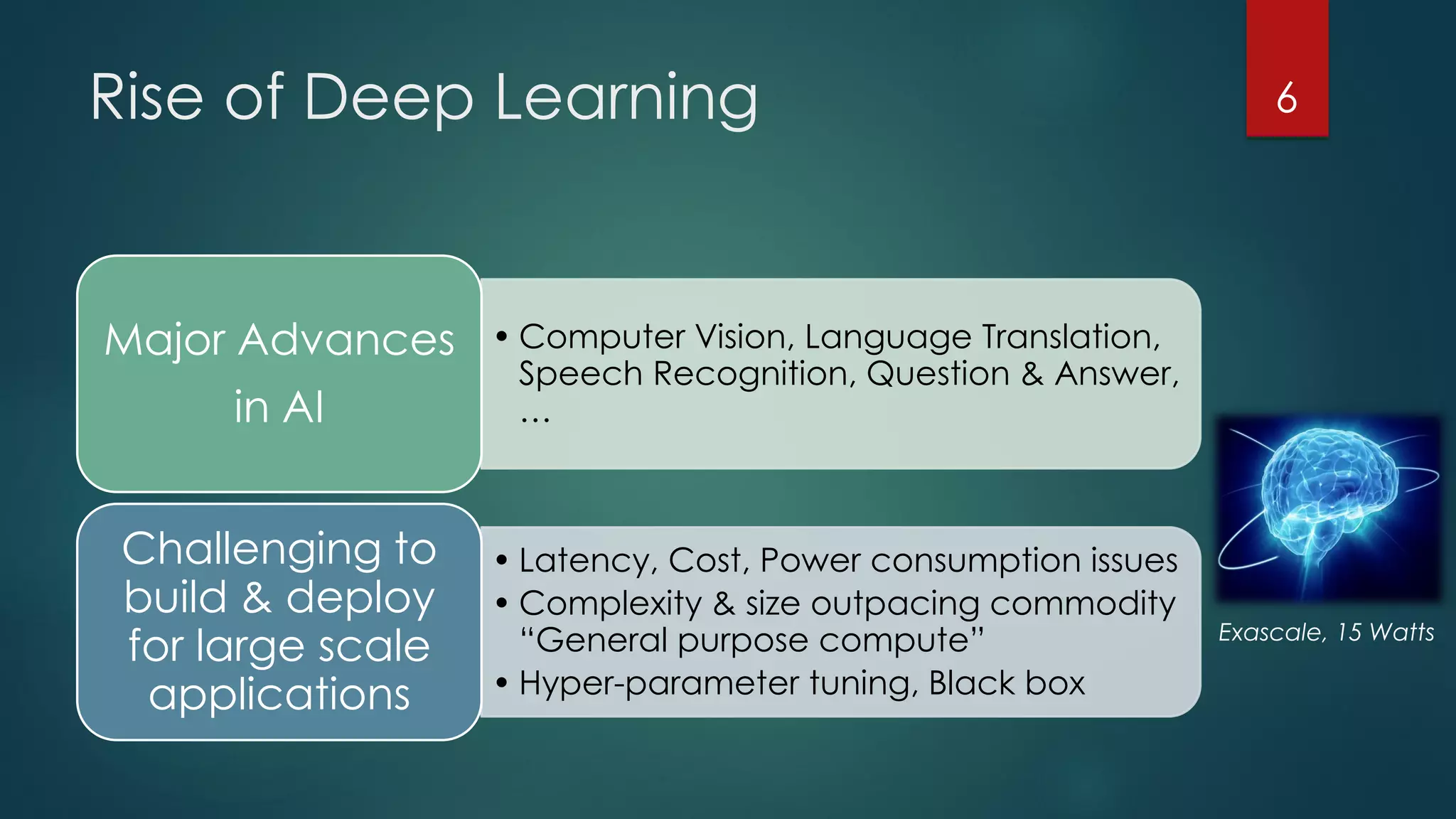
Exascale, 15 Watts
6
Shift towards Specialized Compute
 Special purpose Cloud
 Google TPU, Microsoft Brainwave, Intel Nervana, IBM Power AI, Nvidia v100
 Bare Metal Cloud – Preview AWS, GCE coming April 2018
 Spectrum: CPU, GPU, FPGA, Custom Asics
 Edge Compute: Hardware accelerators, AI SOC
 Intel Neural Compute Stick, Nvidia Jetson, Nvidia Drive PX (Self driving cars)
 Architectures
 Cluster Compute, HPC, Neuromorphic, Quantum compute
 Complexity in Software
 Model tuning/optimizations specific to hardware
 Growing need for compilers to optimize based on deployment hardware
 Workload specific compute: Model training, Inference
7
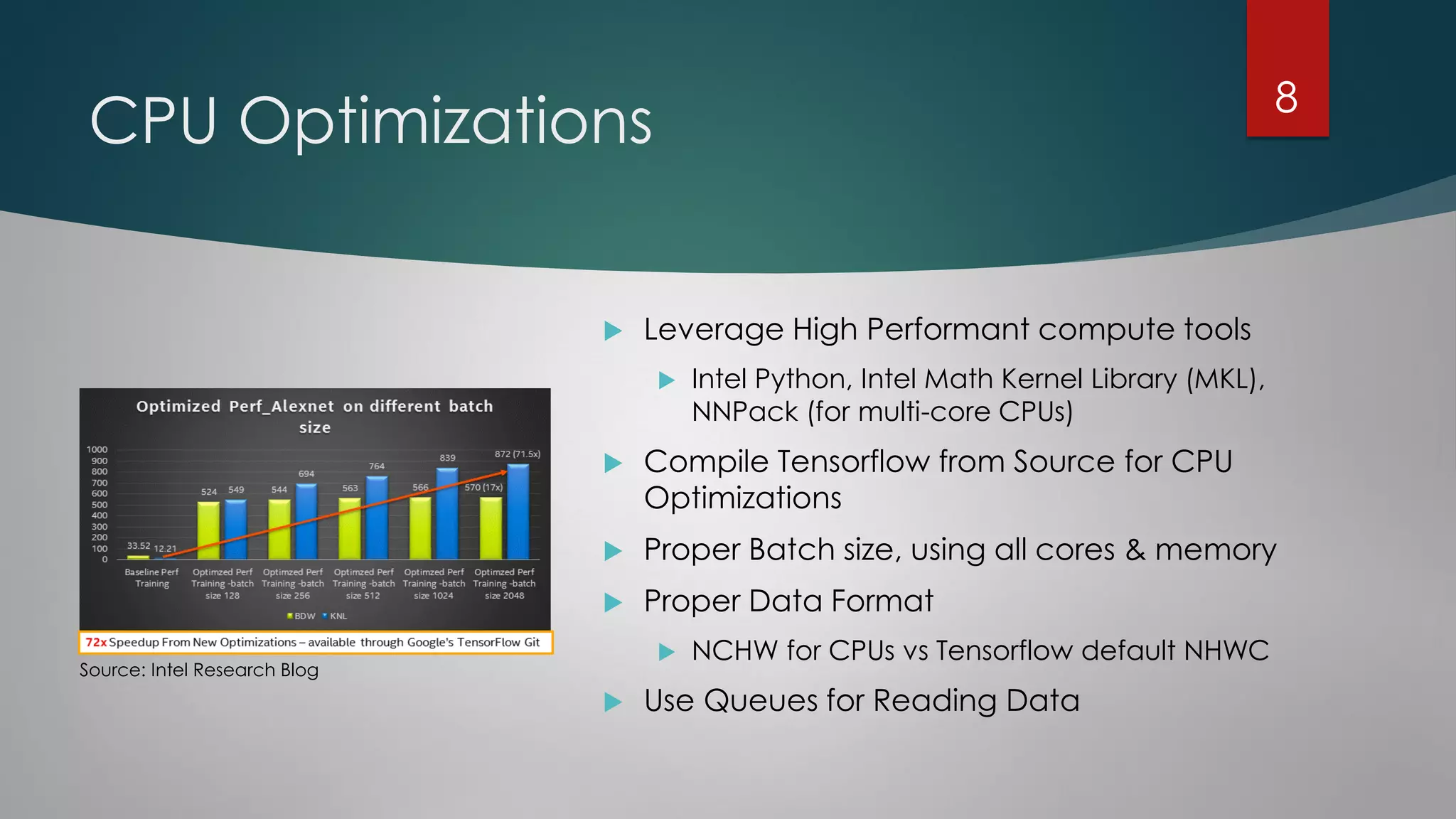
CPU Optimizations
 Leverage High Performant compute tools
 Intel Python, Intel Math Kernel Library (MKL),
NNPack (for multi-core CPUs)
 Compile Tensorflow from Source for CPU
Optimizations
 Proper Batch size, using all cores & memory
 Proper Data Format
 NCHW for CPUs vs Tensorflow default NHWC
 Use Queues for Reading Data
Source: Intel Research Blog
8
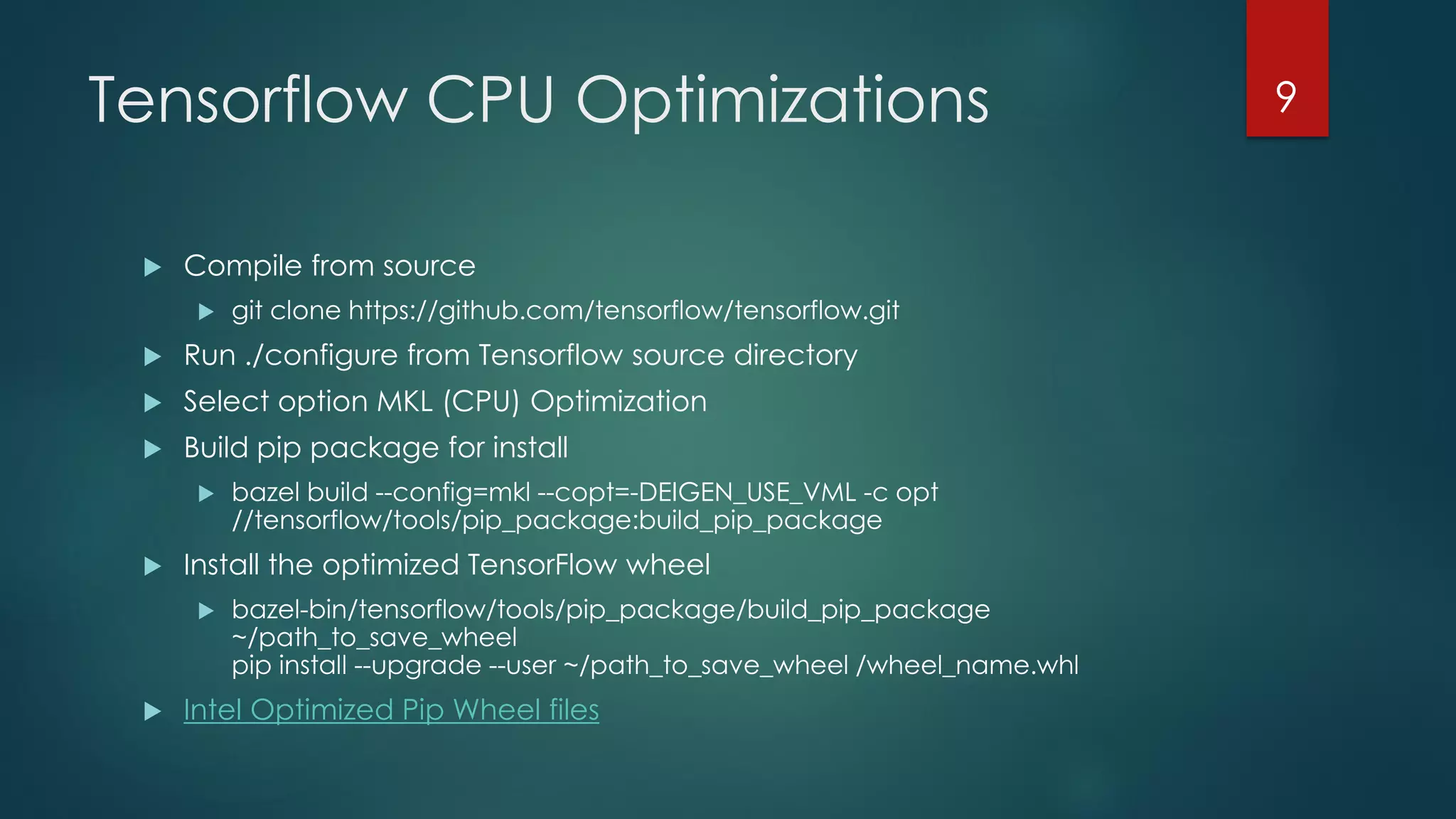
Tensorflow CPU Optimizations
 Compile from source
 git clone https://github.com/tensorflow/tensorflow.git
 Run ./configure from Tensorflow source directory
 Select option MKL (CPU) Optimization
 Build pip package for install
 bazel build --config=mkl --copt=-DEIGEN_USE_VML -c opt
//tensorflow/tools/pip_package:build_pip_package
 Install the optimized TensorFlow wheel
 bazel-bin/tensorflow/tools/pip_package/build_pip_package
~/path_to_save_wheel
pip install --upgrade --user ~/path_to_save_wheel /wheel_name.whl
 Intel Optimized Pip Wheel files
9
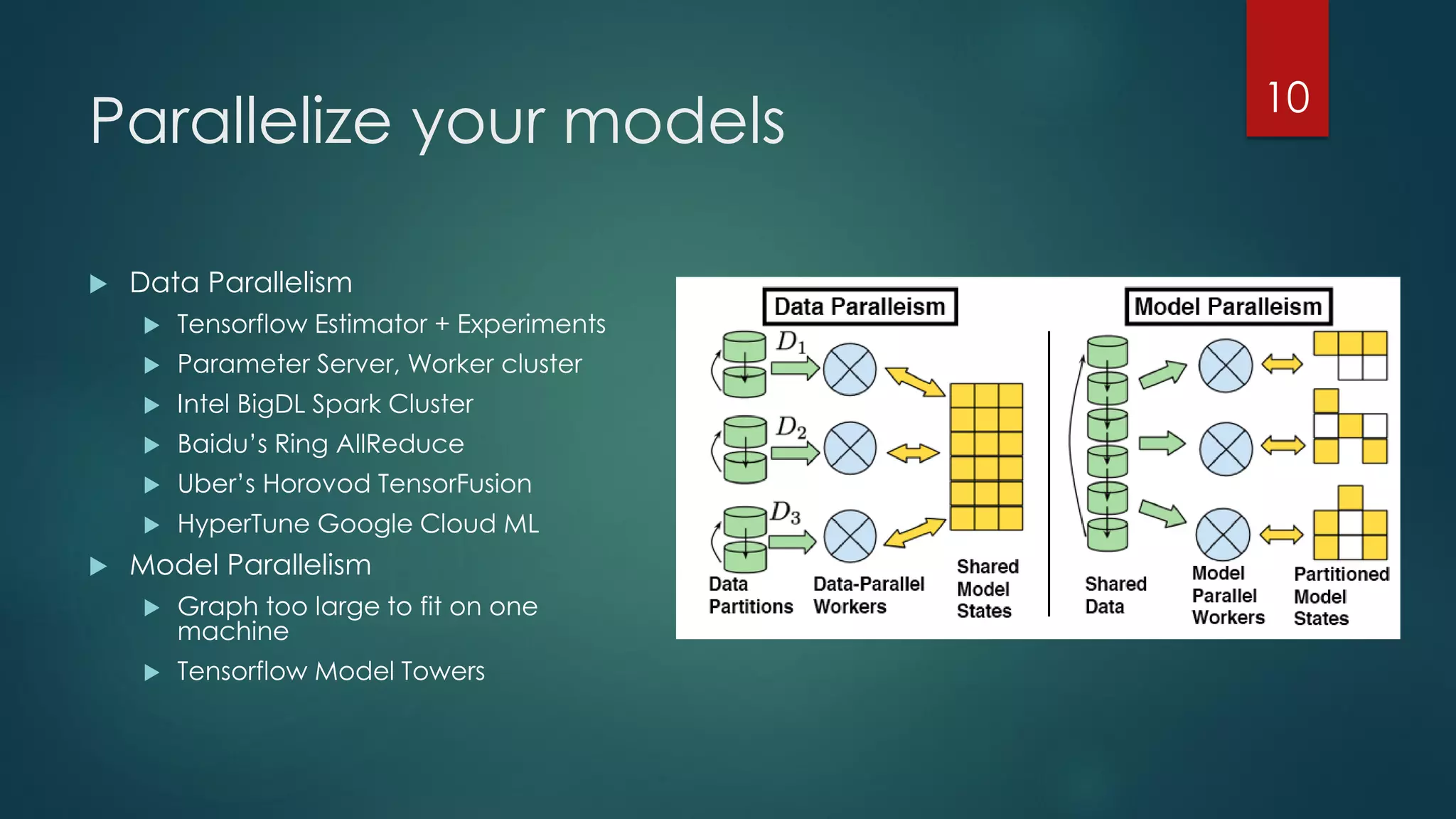
Parallelize your models
 Data Parallelism
 Tensorflow Estimator + Experiments
 Parameter Server, Worker cluster
 Intel BigDL Spark Cluster
 Baidu’s Ring AllReduce
 Uber’s Horovod TensorFusion
 HyperTune Google Cloud ML
 Model Parallelism
 Graph too large to fit on one
machine
 Tensorflow Model Towers
10
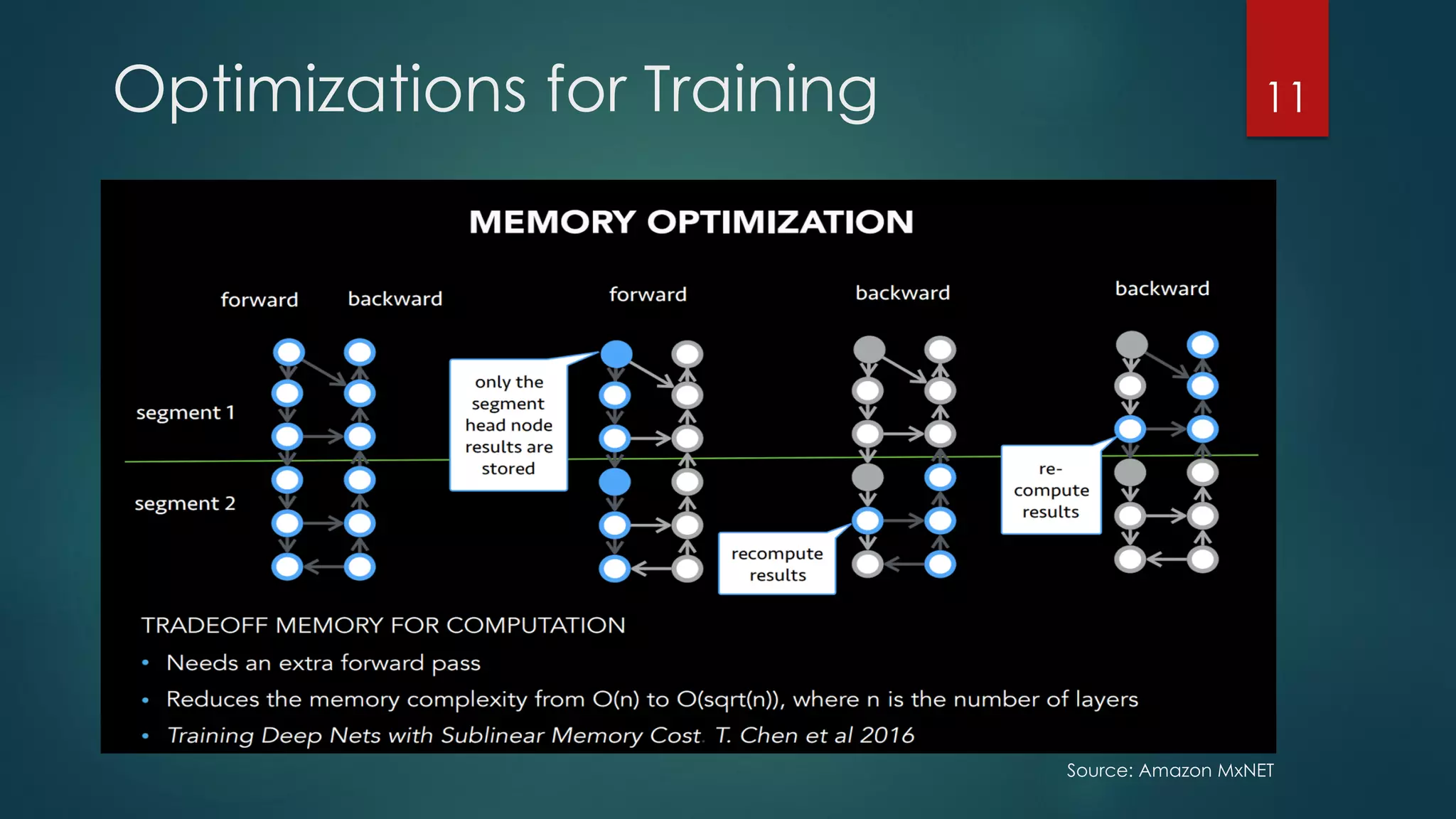
Optimizations for Training
Source: Amazon MxNET
11
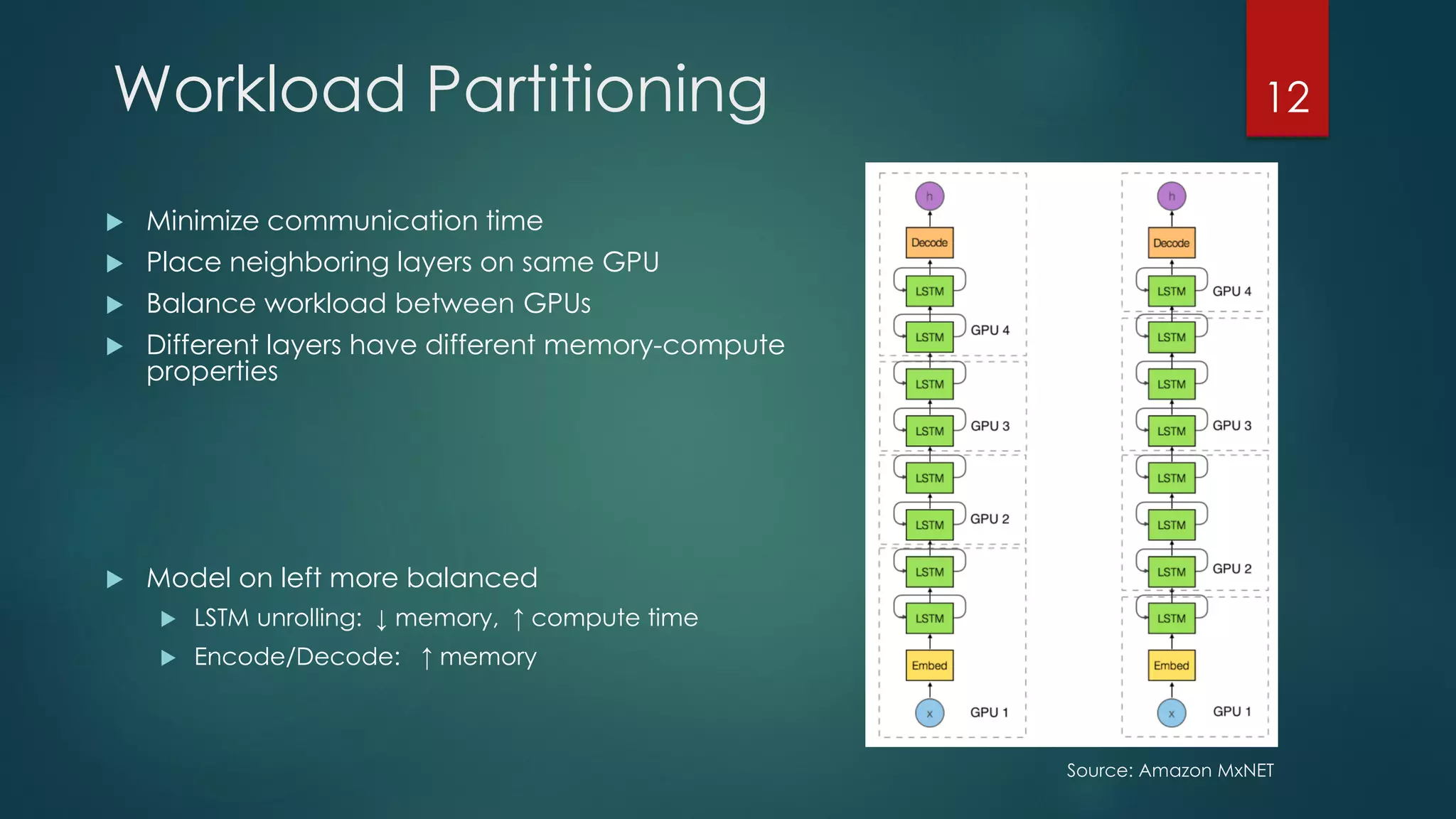
Workload Partitioning
Source: Amazon MxNET
 Minimize communication time
 Place neighboring layers on same GPU
 Balance workload between GPUs
 Different layers have different memory-compute
properties
 Model on left more balanced
 LSTM unrolling: ↓ memory, ↑ compute time
 Encode/Decode: ↑ memory
12
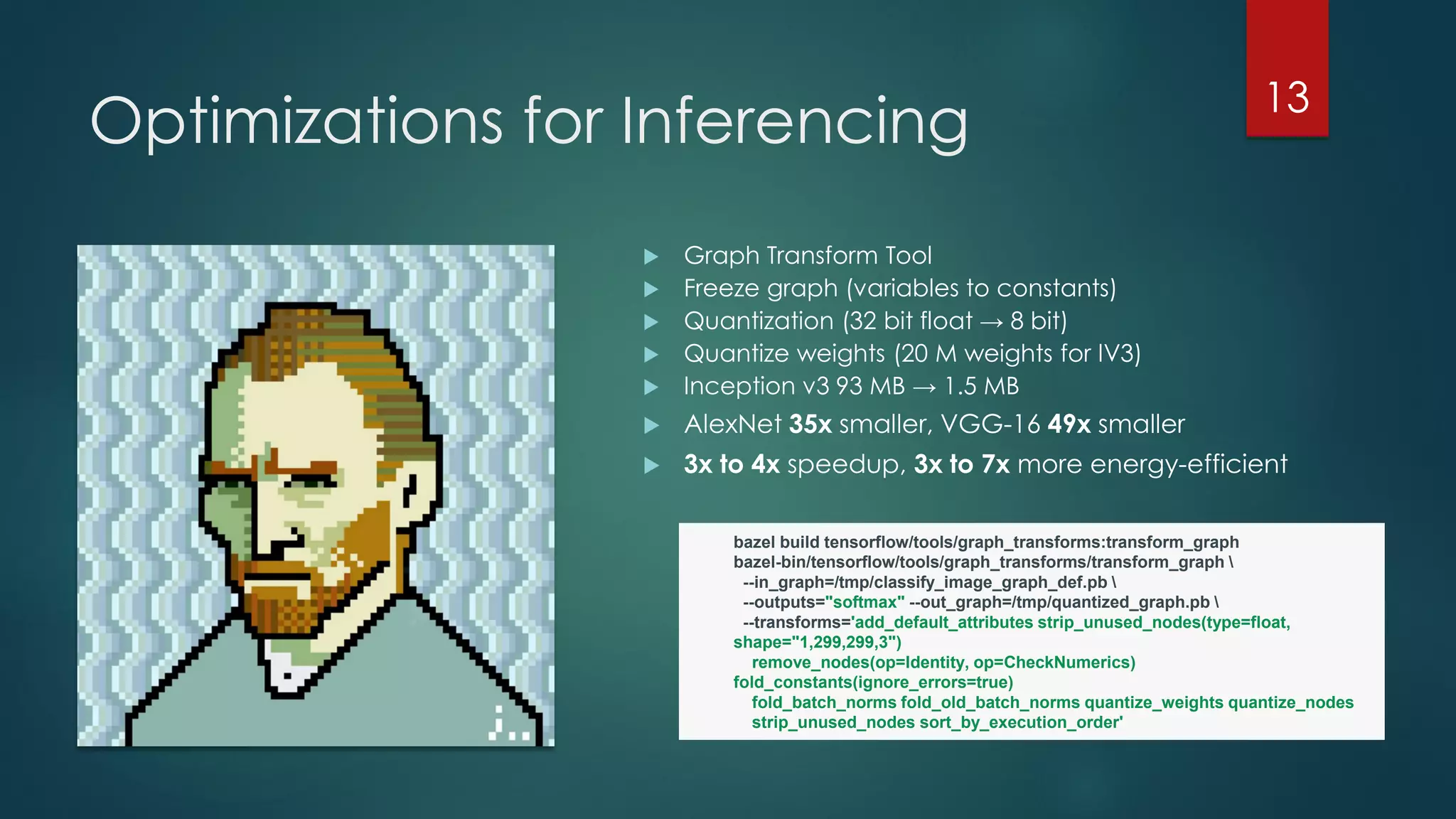
Optimizations for Inferencing
 Graph Transform Tool
 Freeze graph (variables to constants)
 Quantization (32 bit float → 8 bit)
 Quantize weights (20 M weights for IV3)
 Inception v3 93 MB → 1.5 MB
 AlexNet 35x smaller, VGG-16 49x smaller
 3x to 4x speedup, 3x to 7x more energy-efficient
13
bazel build tensorflow/tools/graph_transforms:transform_graph
bazel-bin/tensorflow/tools/graph_transforms/transform_graph 
--in_graph=/tmp/classify_image_graph_def.pb 
--outputs="softmax" --out_graph=/tmp/quantized_graph.pb 
--transforms='add_default_attributes strip_unused_nodes(type=float,
shape="1,299,299,3")
remove_nodes(op=Identity, op=CheckNumerics)
fold_constants(ignore_errors=true)
fold_batch_norms fold_old_batch_norms quantize_weights quantize_nodes
strip_unused_nodes sort_by_execution_order'
Cluster
Optimizations
 Define your ML Container locally
 Evaluate with different parameters in the cloud
 Use EFS / GFS for data storage and sharing across
nodes
 Create separate Data processing container
 Mount EFS/GFS drive on all pods for shared
storage
 Avoid GPU Fragmentation problems by bundling
jobs
 Placement optimizations – Kubernetes Bundle
as pods, Mesos placement constraints
 GPU Drivers bundling in container a problem
 Mount as Readonly volume, or use Nvidia-
docker
14
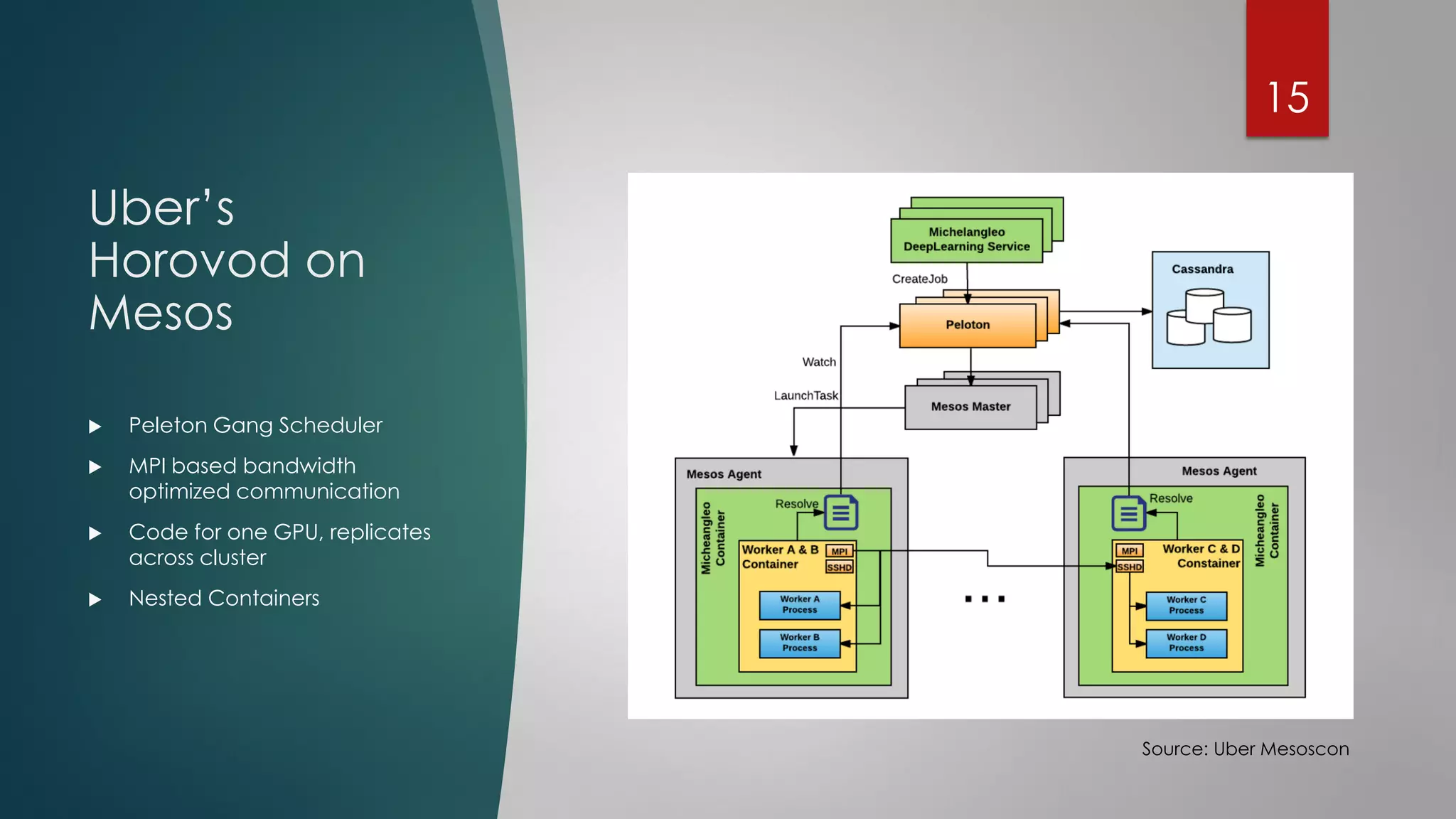
Uber’s
Horovod on
Mesos
 Peleton Gang Scheduler
 MPI based bandwidth
optimized communication
 Code for one GPU, replicates
across cluster
 Nested Containers
15
Source: Uber Mesoscon
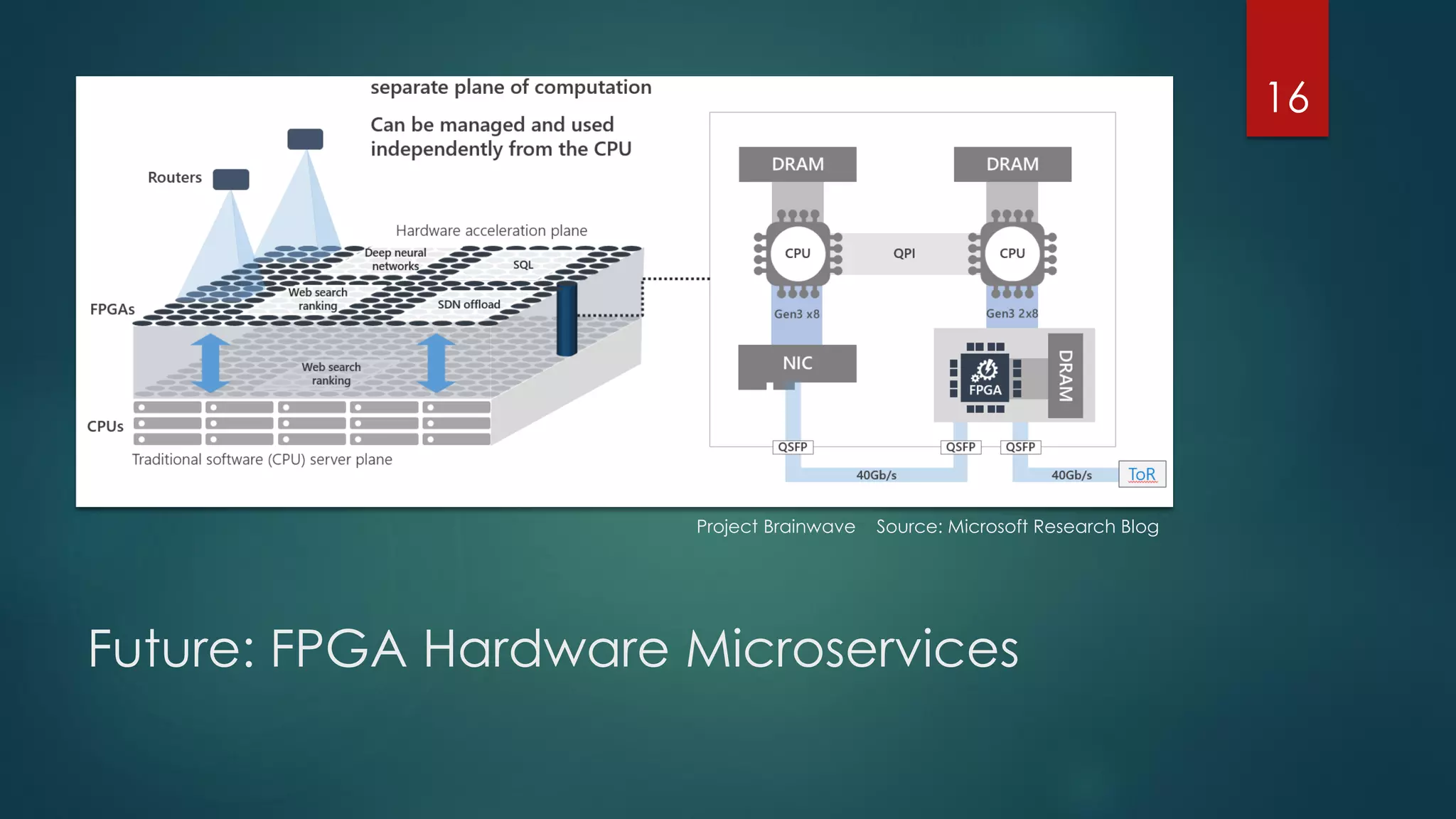
Future: FPGA Hardware Microservices
Project Brainwave Source: Microsoft Research Blog
16
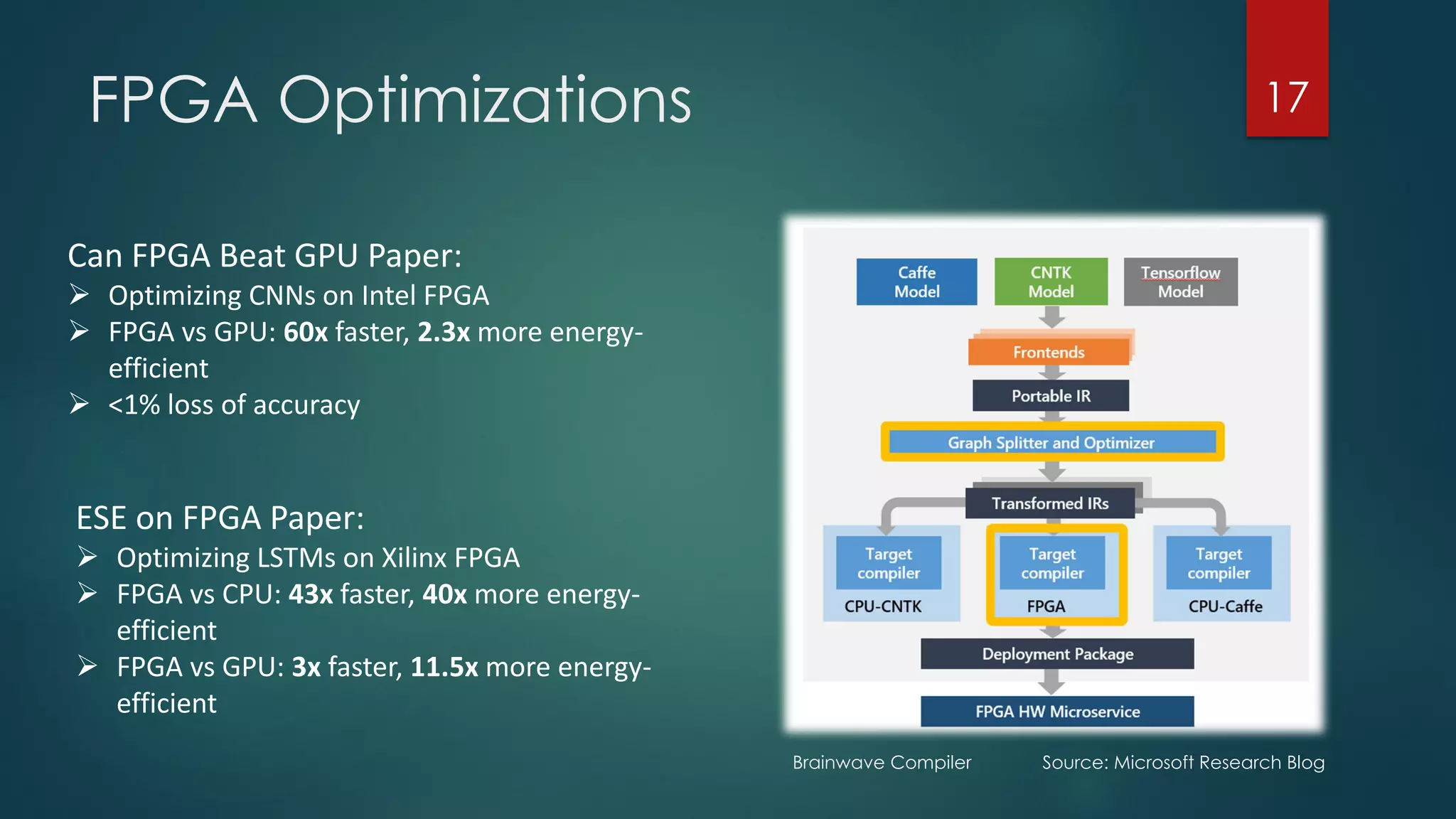
FPGA Optimizations
Brainwave Compiler Source: Microsoft Research Blog
17
Can FPGA Beat GPU Paper:
➢ Optimizing CNNs on Intel FPGA
➢ FPGA vs GPU: 60x faster, 2.3x more energy-
efficient
➢ <1% loss of accuracy
ESE on FPGA Paper:
➢ Optimizing LSTMs on Xilinx FPGA
➢ FPGA vs CPU: 43x faster, 40x more energy-
efficient
➢ FPGA vs GPU: 3x faster, 11.5x more energy-
efficient
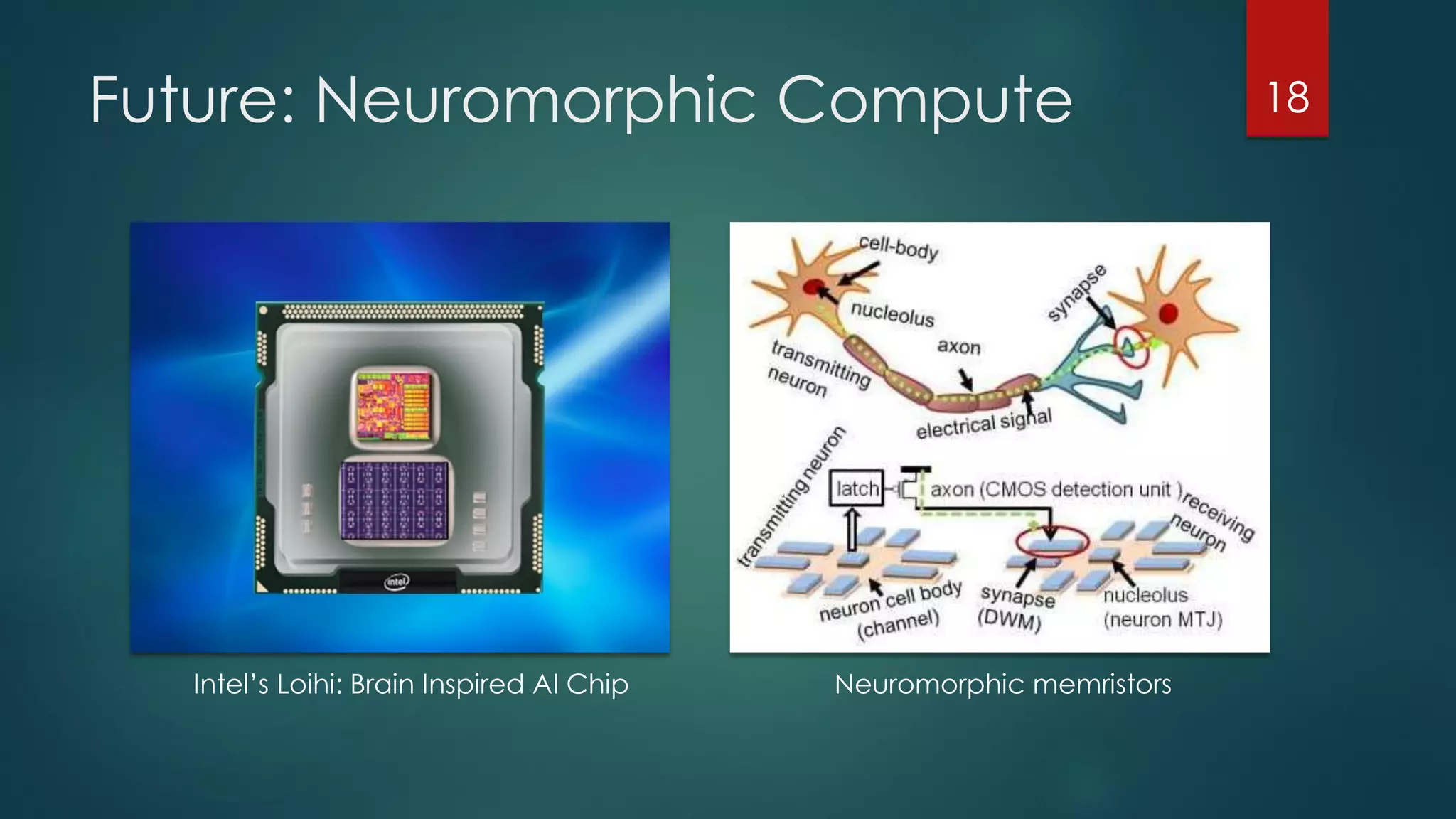
Future: Neuromorphic Compute
Intel’s Loihi: Brain Inspired AI Chip Neuromorphic memristors
18
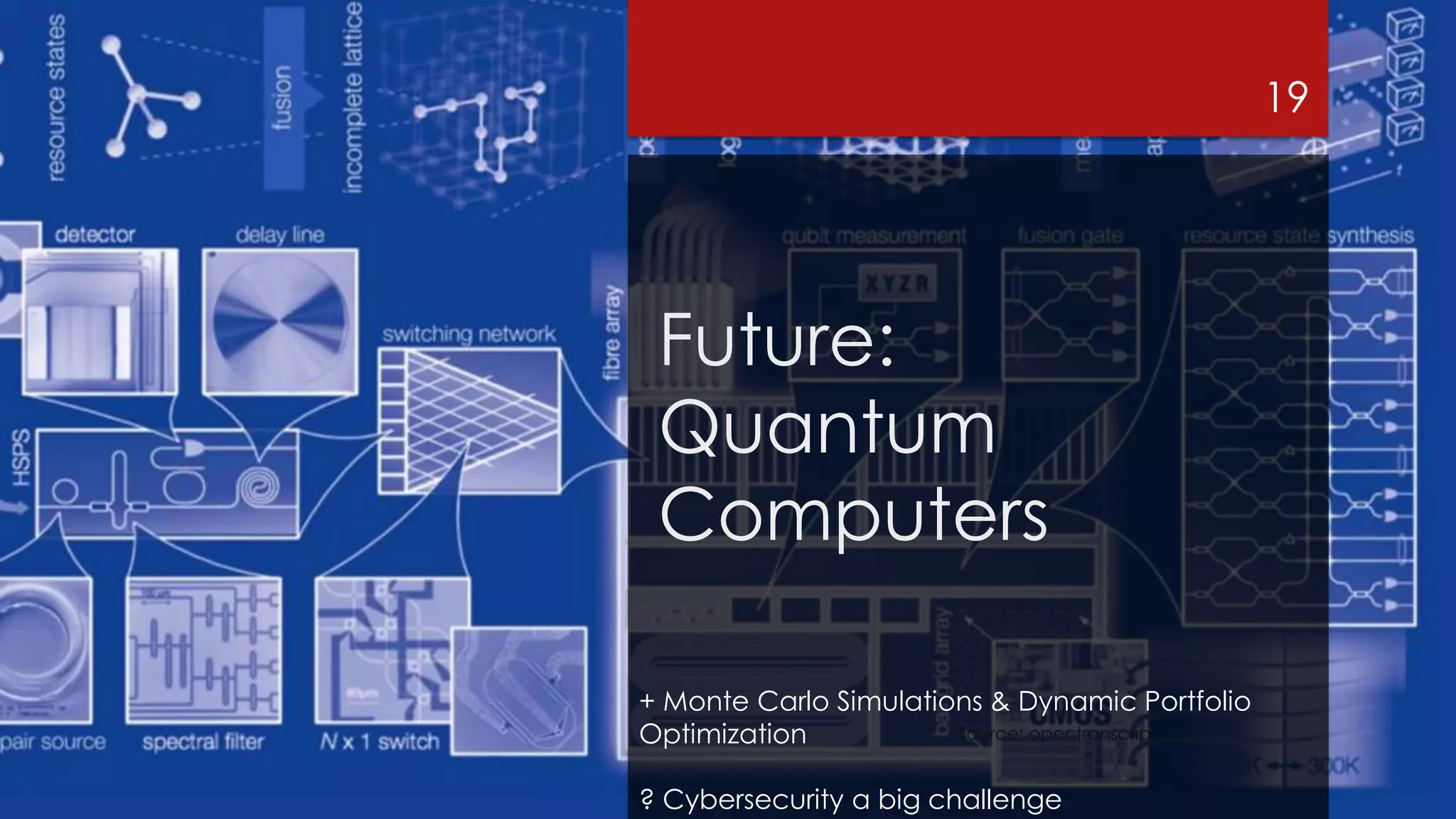
Future:
Quantum
Computers
Source: opentranscripts.org
+ Monte Carlo Simulations & Dynamic Portfolio
Optimization
? Cybersecurity a big challenge
19
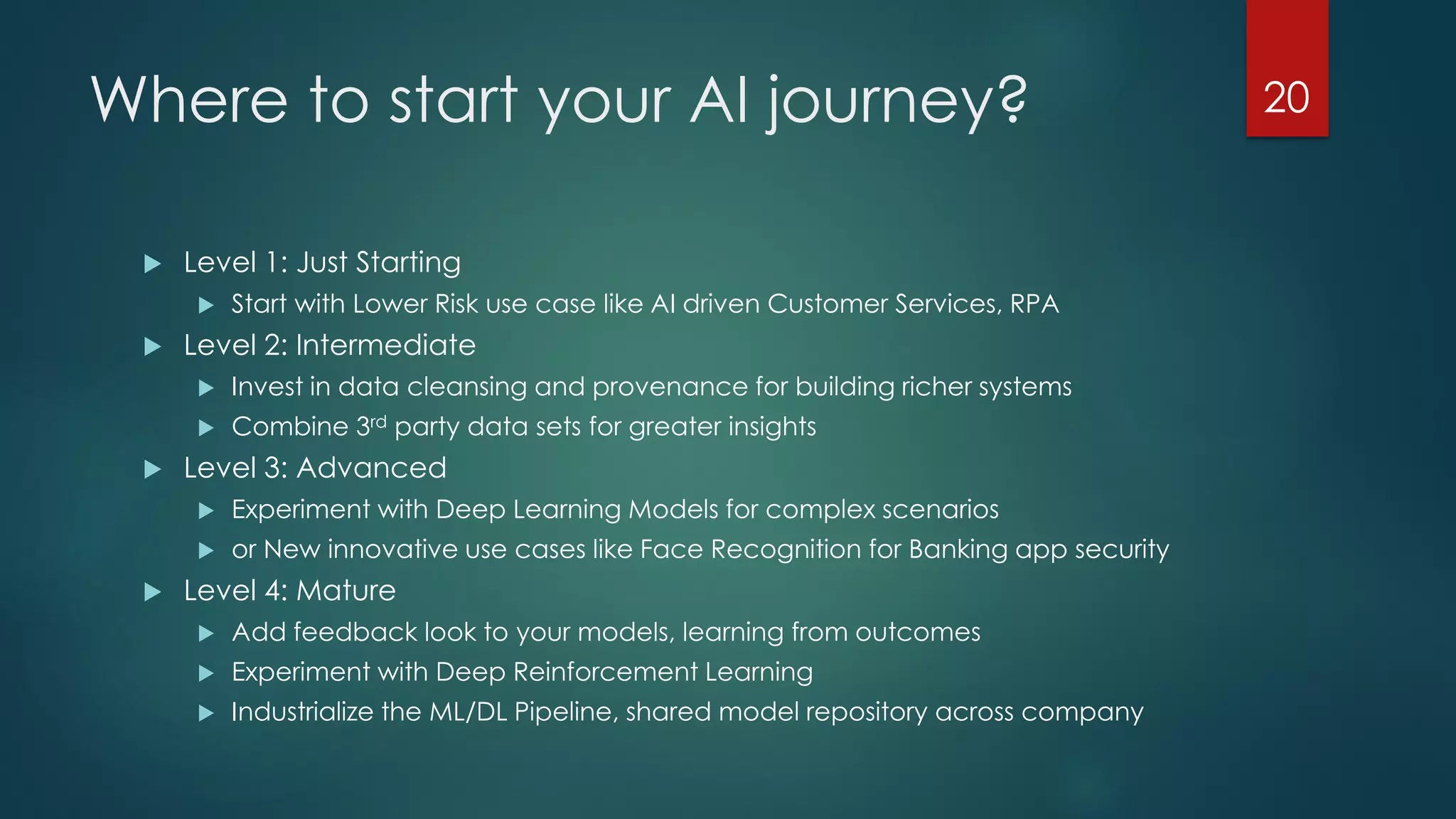
Where to start your AI journey?
 Level 1: Just Starting
 Start with Lower Risk use case like AI driven Customer Services, RPA
 Level 2: Intermediate
 Invest in data cleansing and provenance for building richer systems
 Combine 3rd party data sets for greater insights
 Level 3: Advanced
 Experiment with Deep Learning Models for complex scenarios
 or New innovative use cases like Face Recognition for Banking app security
 Level 4: Mature
 Add feedback look to your models, learning from outcomes
 Experiment with Deep Reinforcement Learning
 Industrialize the ML/DL Pipeline, shared model repository across company
20
Resources
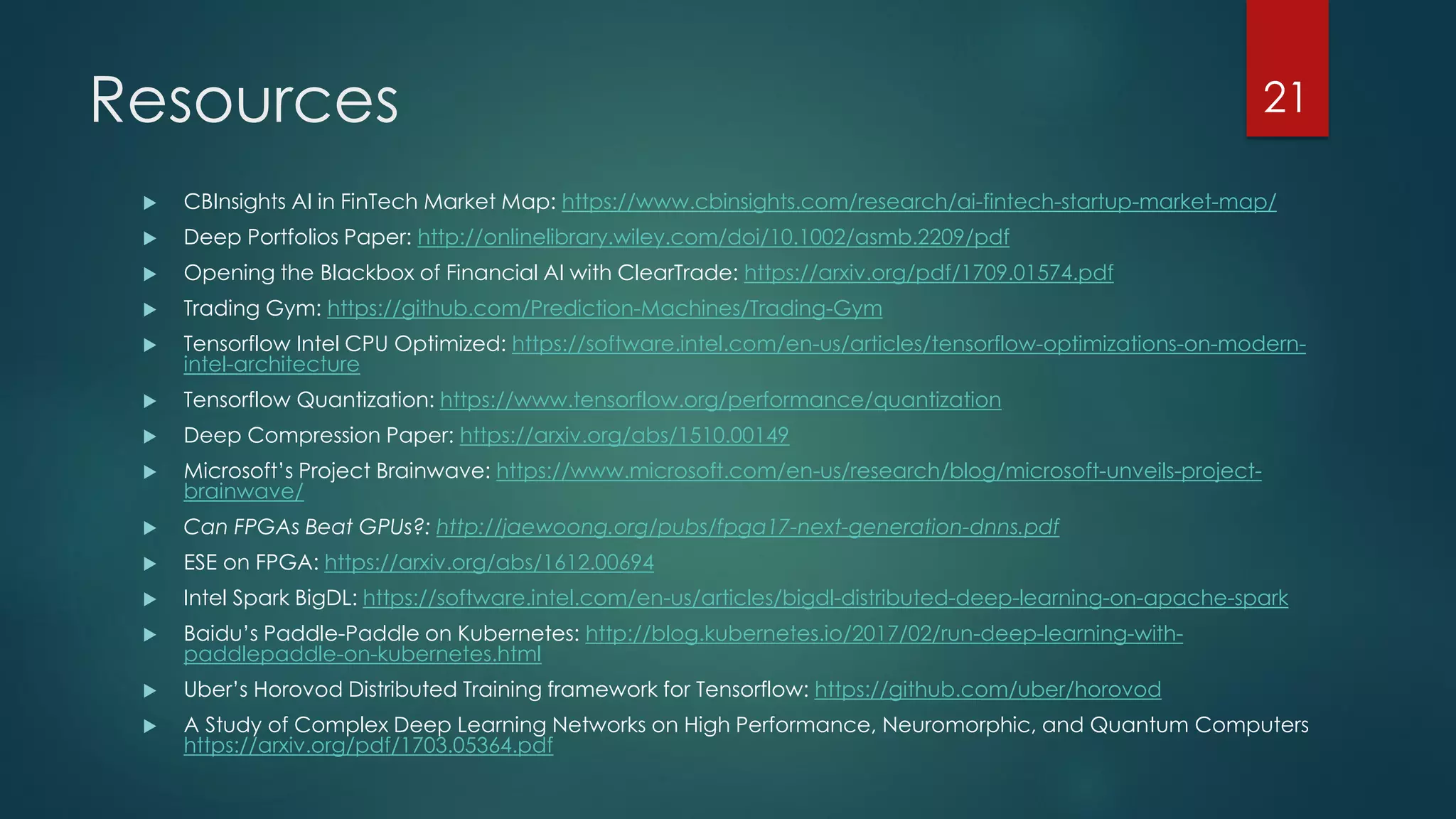
 CBInsights AI in FinTech Market Map: https://www.cbinsights.com/research/ai-fintech-startup-market-map/
 Deep Portfolios Paper: http://onlinelibrary.wiley.com/doi/10.1002/asmb.2209/pdf
 Opening the Blackbox of Financial AI with ClearTrade: https://arxiv.org/pdf/1709.01574.pdf
 Trading Gym: https://github.com/Prediction-Machines/Trading-Gym
 Tensorflow Intel CPU Optimized: https://software.intel.com/en-us/articles/tensorflow-optimizations-on-modern-
intel-architecture
 Tensorflow Quantization: https://www.tensorflow.org/performance/quantization
 Deep Compression Paper: https://arxiv.org/abs/1510.00149
 Microsoft’s Project Brainwave: https://www.microsoft.com/en-us/research/blog/microsoft-unveils-project-
brainwave/
 Can FPGAs Beat GPUs?: http://jaewoong.org/pubs/fpga17-next-generation-dnns.pdf
 ESE on FPGA: https://arxiv.org/abs/1612.00694
 Intel Spark BigDL: https://software.intel.com/en-us/articles/bigdl-distributed-deep-learning-on-apache-spark
 Baidu’s Paddle-Paddle on Kubernetes: http://blog.kubernetes.io/2017/02/run-deep-learning-with-
paddlepaddle-on-kubernetes.html
 Uber’s Horovod Distributed Training framework for Tensorflow: https://github.com/uber/horovod
 A Study of Complex Deep Learning Networks on High Performance, Neuromorphic, and Quantum Computers
https://arxiv.org/pdf/1703.05364.pdf
21
Questions?
Contact
http://bit.ly/geeta4c
geeta@svsg.co
@geeta4c

Deep learning for FinTech

  • 1.
    Deep Learning forFinTech GEETA CHAUHAN, CTO SVSG
  • 2.
    Agenda  AI &Deep Learning in FinTech  What is Deep Learning?  Rise of Specialized Compute  Techniques for Optimization  Look into future  Steps for starting your AI journey  References
  • 3.
  • 4.
    Deep Learning inFinTech Visual Chart Pattern trading (AlpacaAlgo) AI - Crypto Hedge Fund (NumeraAI) Trading Gym (Prediction Machines) Real Time Fraud Detection (FeedZai, Kabbage) FX Trading across time zones (QuantAlea) Cyber Security (Deep Instinct) Personal Finance Assistant (Cleo AI) Customer Experience AI (AugmentHQ)
  • 5.
    What is Deep Learning?  AINeural Networks composed of many layers  Learn like humans  Automated Feature Learning  Layers are like Image Filters
  • 6.
    Rise of DeepLearning • Computer Vision, Language Translation, Speech Recognition, Question & Answer, … Major Advances in AI • Latency, Cost, Power consumption issues • Complexity & size outpacing commodity “General purpose compute” • Hyper-parameter tuning, Black box Challenging to build & deploy for large scale applications Exascale, 15 Watts 6
  • 7.
    Shift towards SpecializedCompute  Special purpose Cloud  Google TPU, Microsoft Brainwave, Intel Nervana, IBM Power AI, Nvidia v100  Bare Metal Cloud – Preview AWS, GCE coming April 2018  Spectrum: CPU, GPU, FPGA, Custom Asics  Edge Compute: Hardware accelerators, AI SOC  Intel Neural Compute Stick, Nvidia Jetson, Nvidia Drive PX (Self driving cars)  Architectures  Cluster Compute, HPC, Neuromorphic, Quantum compute  Complexity in Software  Model tuning/optimizations specific to hardware  Growing need for compilers to optimize based on deployment hardware  Workload specific compute: Model training, Inference 7
  • 8.
    CPU Optimizations  LeverageHigh Performant compute tools  Intel Python, Intel Math Kernel Library (MKL), NNPack (for multi-core CPUs)  Compile Tensorflow from Source for CPU Optimizations  Proper Batch size, using all cores & memory  Proper Data Format  NCHW for CPUs vs Tensorflow default NHWC  Use Queues for Reading Data Source: Intel Research Blog 8
  • 9.
    Tensorflow CPU Optimizations Compile from source  git clone https://github.com/tensorflow/tensorflow.git  Run ./configure from Tensorflow source directory  Select option MKL (CPU) Optimization  Build pip package for install  bazel build --config=mkl --copt=-DEIGEN_USE_VML -c opt //tensorflow/tools/pip_package:build_pip_package  Install the optimized TensorFlow wheel  bazel-bin/tensorflow/tools/pip_package/build_pip_package ~/path_to_save_wheel pip install --upgrade --user ~/path_to_save_wheel /wheel_name.whl  Intel Optimized Pip Wheel files 9
  • 10.
    Parallelize your models Data Parallelism  Tensorflow Estimator + Experiments  Parameter Server, Worker cluster  Intel BigDL Spark Cluster  Baidu’s Ring AllReduce  Uber’s Horovod TensorFusion  HyperTune Google Cloud ML  Model Parallelism  Graph too large to fit on one machine  Tensorflow Model Towers 10
  • 11.
  • 12.
    Workload Partitioning Source: AmazonMxNET  Minimize communication time  Place neighboring layers on same GPU  Balance workload between GPUs  Different layers have different memory-compute properties  Model on left more balanced  LSTM unrolling: ↓ memory, ↑ compute time  Encode/Decode: ↑ memory 12
  • 13.
    Optimizations for Inferencing Graph Transform Tool  Freeze graph (variables to constants)  Quantization (32 bit float → 8 bit)  Quantize weights (20 M weights for IV3)  Inception v3 93 MB → 1.5 MB  AlexNet 35x smaller, VGG-16 49x smaller  3x to 4x speedup, 3x to 7x more energy-efficient 13 bazel build tensorflow/tools/graph_transforms:transform_graph bazel-bin/tensorflow/tools/graph_transforms/transform_graph --in_graph=/tmp/classify_image_graph_def.pb --outputs="softmax" --out_graph=/tmp/quantized_graph.pb --transforms='add_default_attributes strip_unused_nodes(type=float, shape="1,299,299,3") remove_nodes(op=Identity, op=CheckNumerics) fold_constants(ignore_errors=true) fold_batch_norms fold_old_batch_norms quantize_weights quantize_nodes strip_unused_nodes sort_by_execution_order'
  • 14.
    Cluster Optimizations  Define yourML Container locally  Evaluate with different parameters in the cloud  Use EFS / GFS for data storage and sharing across nodes  Create separate Data processing container  Mount EFS/GFS drive on all pods for shared storage  Avoid GPU Fragmentation problems by bundling jobs  Placement optimizations – Kubernetes Bundle as pods, Mesos placement constraints  GPU Drivers bundling in container a problem  Mount as Readonly volume, or use Nvidia- docker 14
  • 15.
    Uber’s Horovod on Mesos  PeletonGang Scheduler  MPI based bandwidth optimized communication  Code for one GPU, replicates across cluster  Nested Containers 15 Source: Uber Mesoscon
  • 16.
    Future: FPGA HardwareMicroservices Project Brainwave Source: Microsoft Research Blog 16
  • 17.
    FPGA Optimizations Brainwave CompilerSource: Microsoft Research Blog 17 Can FPGA Beat GPU Paper: ➢ Optimizing CNNs on Intel FPGA ➢ FPGA vs GPU: 60x faster, 2.3x more energy- efficient ➢ <1% loss of accuracy ESE on FPGA Paper: ➢ Optimizing LSTMs on Xilinx FPGA ➢ FPGA vs CPU: 43x faster, 40x more energy- efficient ➢ FPGA vs GPU: 3x faster, 11.5x more energy- efficient
  • 18.
    Future: Neuromorphic Compute Intel’sLoihi: Brain Inspired AI Chip Neuromorphic memristors 18
  • 19.
    Future: Quantum Computers Source: opentranscripts.org + MonteCarlo Simulations & Dynamic Portfolio Optimization ? Cybersecurity a big challenge 19
  • 20.
    Where to startyour AI journey?  Level 1: Just Starting  Start with Lower Risk use case like AI driven Customer Services, RPA  Level 2: Intermediate  Invest in data cleansing and provenance for building richer systems  Combine 3rd party data sets for greater insights  Level 3: Advanced  Experiment with Deep Learning Models for complex scenarios  or New innovative use cases like Face Recognition for Banking app security  Level 4: Mature  Add feedback look to your models, learning from outcomes  Experiment with Deep Reinforcement Learning  Industrialize the ML/DL Pipeline, shared model repository across company 20
  • 21.
    Resources  CBInsights AIin FinTech Market Map: https://www.cbinsights.com/research/ai-fintech-startup-market-map/  Deep Portfolios Paper: http://onlinelibrary.wiley.com/doi/10.1002/asmb.2209/pdf  Opening the Blackbox of Financial AI with ClearTrade: https://arxiv.org/pdf/1709.01574.pdf  Trading Gym: https://github.com/Prediction-Machines/Trading-Gym  Tensorflow Intel CPU Optimized: https://software.intel.com/en-us/articles/tensorflow-optimizations-on-modern- intel-architecture  Tensorflow Quantization: https://www.tensorflow.org/performance/quantization  Deep Compression Paper: https://arxiv.org/abs/1510.00149  Microsoft’s Project Brainwave: https://www.microsoft.com/en-us/research/blog/microsoft-unveils-project- brainwave/  Can FPGAs Beat GPUs?: http://jaewoong.org/pubs/fpga17-next-generation-dnns.pdf  ESE on FPGA: https://arxiv.org/abs/1612.00694  Intel Spark BigDL: https://software.intel.com/en-us/articles/bigdl-distributed-deep-learning-on-apache-spark  Baidu’s Paddle-Paddle on Kubernetes: http://blog.kubernetes.io/2017/02/run-deep-learning-with- paddlepaddle-on-kubernetes.html  Uber’s Horovod Distributed Training framework for Tensorflow: https://github.com/uber/horovod  A Study of Complex Deep Learning Networks on High Performance, Neuromorphic, and Quantum Computers https://arxiv.org/pdf/1703.05364.pdf 21
  • 22.