
spcl.inf.ethz.ch
@spcl_eth
Data-Centric Parallel Programming
Torsten Hoefler, Keynote at AsHES @ IPDPS’19, Rio, Brazil
Alexandros Ziogas, Tal Ben-Nun, Guillermo Indalecio, Timo Schneider, Mathieu Luisier, and Johannes de Fine Licht
and the whole DAPP team @ SPCL
https://eurompi19.inf.ethz.ch
spcl.inf.ethz.ch
@spcl_eth
2
Changing hardware constraints and the physics of computing
[1]: Marc Horowitz, Computing’s Energy Problem (and what we can do about it), ISSC 2014, plenary
[2]: Moore: Landauer Limit Demonstrated, IEEE Spectrum 2012
130nm
90nm
65nm
45nm
32nm
22nm
14nm
10nm
0.9 V [1]
32-bit FP ADD: 0.9 pJ
32-bit FP MUL: 3.2 pJ
2x32 bit from L1 (8 kiB): 10 pJ
2x32 bit from L2 (1 MiB): 100 pJ
2x32 bit from DRAM: 1.3 nJ
…
Three Ls of modern computing:
How to address locality challenges on standard architectures and programming?
D. Unat et al.: “Trends in Data Locality Abstractions for HPC Systems”
IEEE Transactions on Parallel and Distributed Systems (TPDS). Vol 28, Nr. 10, IEEE, Oct. 2017
spcl.inf.ethz.ch
@spcl_eth
3
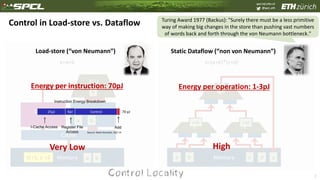
Control in Load-store vs. Dataflow
Memory
Cache
RegistersControl
x=a+b
ld a, r1
ALU
ald b, r2 badd r1, r2
ba
x
bast r1, x Memory
+
c d y
y=(a+b)*(c+d)
a b
+
x
a b c d
a+b c+d
y
Turing Award 1977 (Backus): "Surely there must be a less primitive
way of making big changes in the store than pushing vast numbers
of words back and forth through the von Neumann bottleneck."
Load-store (“von Neumann”)
Energy per instruction: 70pJ
Source: Mark Horowitz, ISSC’14
Energy per operation: 1-3pJ
Static Dataflow (“non von Neumann”)
Very Low High
spcl.inf.ethz.ch
@spcl_eth
Still Lower
Control Locality
4
Single Instruction Multiple Data/Threads (SIMD - Vector CPU, SIMT - GPU)
Memory
Cache
RegistersControl
ALUALU
ALUALU
ALUALU
ALUALU
ALUALU
45nm, 0.9 V [1]
Random Access SRAM:
8 kiB: 10 pJ
32 kiB: 20 pJ
1 MiB: 100 pJ
Memory
+
c d ya b
+
x
a b c d
45nm, 0.9 V [1]
Single R/W registers:
32 bit: 0.1 pJ
[1]: Marc Horowitz, Computing’s Energy Problem (and what we can do about it), ISSC 2014, plenary
High Performance Computing really
became a data management challenge
spcl.inf.ethz.ch
@spcl_eth
5
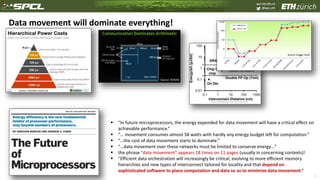
Data movement will dominate everything!
Source: Fatollahi-Fard et al.
 “In future microprocessors, the energy expended for data movement will have a critical effect on
achievable performance.”
 “… movement consumes almost 58 watts with hardly any energy budget left for computation.”
 “…the cost of data movement starts to dominate.”
 “…data movement over these networks must be limited to conserve energy…”
 the phrase “data movement” appears 18 times on 11 pages (usually in concerning contexts)!
 “Efficient data orchestration will increasingly be critical, evolving to more efficient memory
hierarchies and new types of interconnect tailored for locality and that depend on
sophisticated software to place computation and data so as to minimize data movement.”
Source: NVIDIA
Source: Kogge, Shalf
spcl.inf.ethz.ch
@spcl_eth
 Well, to a good approximation how we programmed yesterday
 Or last year?
 Or four decades ago?
 Control-centric programming
 Worry about operation counts (flop/s is the metric, isn’t it?)
 Data movement is at best implicit (or invisible/ignored)
 Legion [1] is taking a good direction towards data-centric
 Tasking relies on data placement but not really dependencies (not visible to tool-chain)
 But it is still control-centric in the tasks – not (performance) portable between devices!
 Let’s go a step further towards an explicitly data-centric viewpoint
 For performance engineers at least!
6
“Sophisticated software”: How do we program today?
Backus ‘77: “The assignment statement
is the von Neumann bottleneck of programming
languages and keeps us thinking in word-at-a-time
terms in much the same way the computer’s
bottleneck does.”
[1]: Bauer et al.: “Legion: expressing locality and independence with logical regions”, SC12, 2012
spcl.inf.ethz.ch
@spcl_eth
7
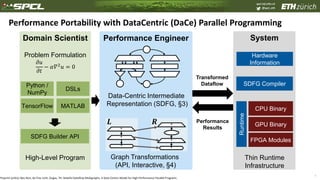
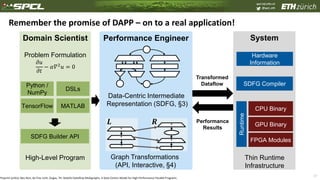
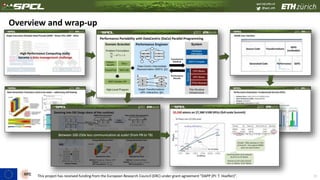
Performance Portability with DataCentric (DaCe) Parallel Programming
Preprint (arXiv): Ben-Nun, de Fine Licht, Ziogas, TH: Stateful Dataflow Multigraphs: A Data-Centric Model for High-Performance Parallel Programs
SystemDomain Scientist Performance Engineer
High-Level Program
Data-Centric Intermediate
Representation (SDFG, §3)
𝜕𝑢
𝜕𝑡
− 𝛼𝛻2 𝑢 = 0
Problem Formulation
FPGA Modules
CPU Binary
Runtime
Hardware
Information
Graph Transformations
(API, Interactive, §4)
SDFG Compiler
Transformed
Dataflow
Performance
Results
Thin Runtime
Infrastructure
GPU Binary
Python /
NumPy
𝑳 𝑹
*
*
*
*
*
*
TensorFlow
DSLs
MATLAB
SDFG Builder API
spcl.inf.ethz.ch
@spcl_eth
8
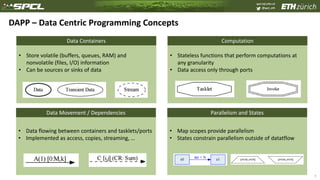
DAPP – Data Centric Programming Concepts
• Store volatile (buffers, queues, RAM) and
nonvolatile (files, I/O) information
• Can be sources or sinks of data
• Stateless functions that perform computations at
any granularity
• Data access only through ports
• Data flowing between containers and tasklets/ports
• Implemented as access, copies, streaming, …
• Map scopes provide parallelism
• States constrain parallelism outside of datatflow
Data Containers Computation
Data Movement / Dependencies Parallelism and States
spcl.inf.ethz.ch
@spcl_eth
9
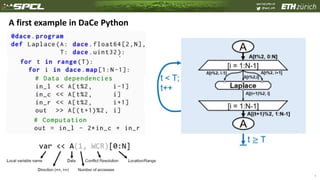
A first example in DaCe Python
spcl.inf.ethz.ch
@spcl_eth
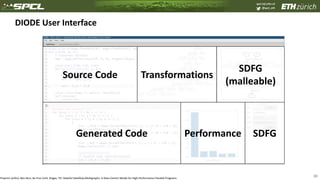
DIODE User Interface
10
Source Code Transformations
SDFG
(malleable)
SDFGGenerated Code Performance
Preprint (arXiv): Ben-Nun, de Fine Licht, Ziogas, TH: Stateful Dataflow Multigraphs: A Data-Centric Model for High-Performance Parallel Programs
spcl.inf.ethz.ch
@spcl_eth
11
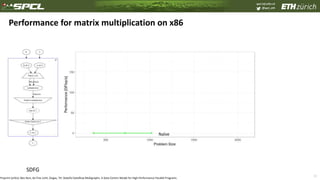
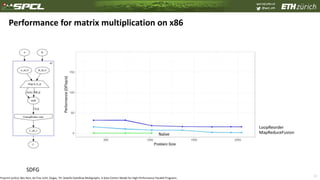
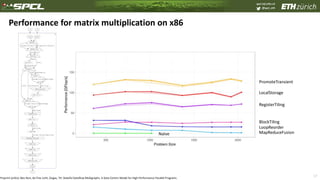
Performance for matrix multiplication on x86
SDFG
Naïve
Preprint (arXiv): Ben-Nun, de Fine Licht, Ziogas, TH: Stateful Dataflow Multigraphs: A Data-Centric Model for High-Performance Parallel Programs
spcl.inf.ethz.ch
@spcl_eth
12
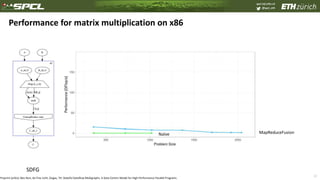
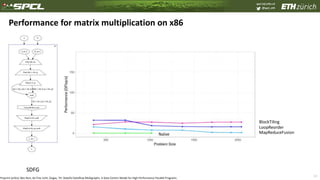
Performance for matrix multiplication on x86
SDFG
MapReduceFusionNaïve
Preprint (arXiv): Ben-Nun, de Fine Licht, Ziogas, TH: Stateful Dataflow Multigraphs: A Data-Centric Model for High-Performance Parallel Programs
spcl.inf.ethz.ch
@spcl_eth
13
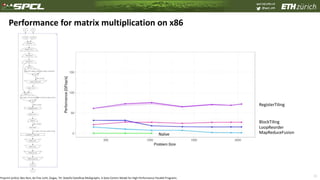
Performance for matrix multiplication on x86
SDFG
LoopReorder
MapReduceFusionNaïve
Preprint (arXiv): Ben-Nun, de Fine Licht, Ziogas, TH: Stateful Dataflow Multigraphs: A Data-Centric Model for High-Performance Parallel Programs
spcl.inf.ethz.ch
@spcl_eth
14
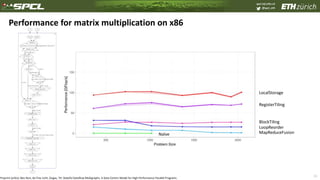
Performance for matrix multiplication on x86
SDFG
BlockTiling
LoopReorder
MapReduceFusionNaïve
Preprint (arXiv): Ben-Nun, de Fine Licht, Ziogas, TH: Stateful Dataflow Multigraphs: A Data-Centric Model for High-Performance Parallel Programs
spcl.inf.ethz.ch
@spcl_eth
15
Performance for matrix multiplication on x86
RegisterTiling
BlockTiling
LoopReorder
MapReduceFusionNaïve
Preprint (arXiv): Ben-Nun, de Fine Licht, Ziogas, TH: Stateful Dataflow Multigraphs: A Data-Centric Model for High-Performance Parallel Programs
spcl.inf.ethz.ch
@spcl_eth
16
Performance for matrix multiplication on x86
LocalStorage
RegisterTiling
BlockTiling
LoopReorder
MapReduceFusionNaïve
Preprint (arXiv): Ben-Nun, de Fine Licht, Ziogas, TH: Stateful Dataflow Multigraphs: A Data-Centric Model for High-Performance Parallel Programs
spcl.inf.ethz.ch
@spcl_eth
17
Performance for matrix multiplication on x86
PromoteTransient
LocalStorage
RegisterTiling
BlockTiling
LoopReorder
MapReduceFusionNaïve
Preprint (arXiv): Ben-Nun, de Fine Licht, Ziogas, TH: Stateful Dataflow Multigraphs: A Data-Centric Model for High-Performance Parallel Programs
spcl.inf.ethz.ch
@spcl_eth
Preprint (arXiv): Ben-Nun, de Fine Licht, Ziogas, TH: Stateful Dataflow Multigraphs: A Data-Centric Model for High-Performance Parallel Programs
18
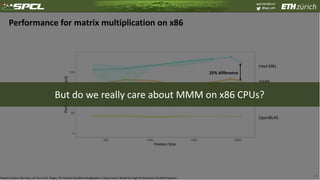
Performance for matrix multiplication on x86
Intel MKL
OpenBLAS
25% difference
DAPP
With more tuning: 98.6% of MKLBut do we really care about MMM on x86 CPUs?
spcl.inf.ethz.ch
@spcl_eth
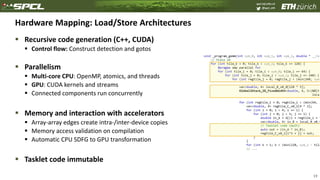
Hardware Mapping: Load/Store Architectures
 Recursive code generation (C++, CUDA)
 Control flow: Construct detection and gotos
 Parallelism
 Multi-core CPU: OpenMP, atomics, and threads
 GPU: CUDA kernels and streams
 Connected components run concurrently
 Memory and interaction with accelerators
 Array-array edges create intra-/inter-device copies
 Memory access validation on compilation
 Automatic CPU SDFG to GPU transformation
 Tasklet code immutable
19
spcl.inf.ethz.ch
@spcl_eth
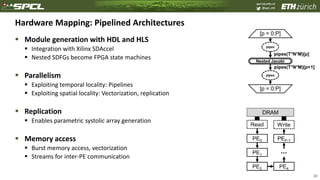
Hardware Mapping: Pipelined Architectures
 Module generation with HDL and HLS
 Integration with Xilinx SDAccel
 Nested SDFGs become FPGA state machines
 Parallelism
 Exploiting temporal locality: Pipelines
 Exploiting spatial locality: Vectorization, replication
 Replication
 Enables parametric systolic array generation
 Memory access
 Burst memory access, vectorization
 Streams for inter-PE communication
20
spcl.inf.ethz.ch
@spcl_eth
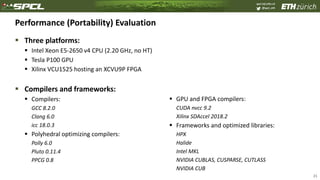
Performance (Portability) Evaluation
 Three platforms:
 Intel Xeon E5-2650 v4 CPU (2.20 GHz, no HT)
 Tesla P100 GPU
 Xilinx VCU1525 hosting an XCVU9P FPGA
 Compilers and frameworks:
 Compilers:
GCC 8.2.0
Clang 6.0
icc 18.0.3
 Polyhedral optimizing compilers:
Polly 6.0
Pluto 0.11.4
PPCG 0.8
 GPU and FPGA compilers:
CUDA nvcc 9.2
Xilinx SDAccel 2018.2
 Frameworks and optimized libraries:
HPX
Halide
Intel MKL
NVIDIA CUBLAS, CUSPARSE, CUTLASS
NVIDIA CUB
21
spcl.inf.ethz.ch
@spcl_eth
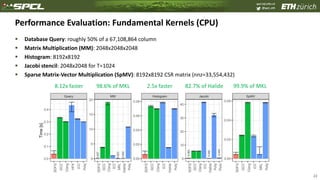
Performance Evaluation: Fundamental Kernels (CPU)
 Database Query: roughly 50% of a 67,108,864 column
 Matrix Multiplication (MM): 2048x2048x2048
 Histogram: 8192x8192
 Jacobi stencil: 2048x2048 for T=1024
 Sparse Matrix-Vector Multiplication (SpMV): 8192x8192 CSR matrix (nnz=33,554,432)
22
99.9% of MKL8.12x faster 98.6% of MKL 2.5x faster 82.7% of Halide
spcl.inf.ethz.ch
@spcl_eth
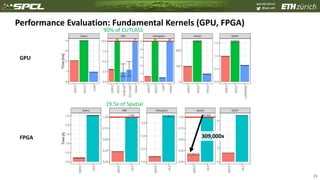
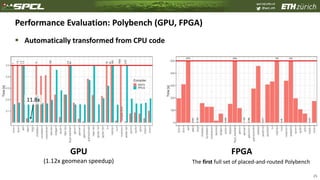
Performance Evaluation: Fundamental Kernels (GPU, FPGA)
23
GPU
FPGA 309,000x
19.5x of Spatial
90% of CUTLASS
spcl.inf.ethz.ch
@spcl_eth
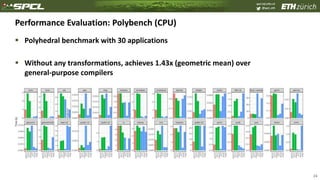
Performance Evaluation: Polybench (CPU)
 Polyhedral benchmark with 30 applications
 Without any transformations, achieves 1.43x (geometric mean) over
general-purpose compilers
24
spcl.inf.ethz.ch
@spcl_eth
Performance Evaluation: Polybench (GPU, FPGA)
 Automatically transformed from CPU code
25
GPU
(1.12x geomean speedup)
FPGA
The first full set of placed-and-routed Polybench
11.8x
spcl.inf.ethz.ch
@spcl_eth
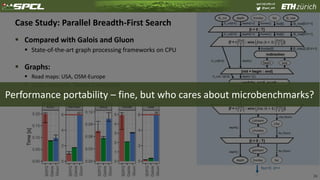
Case Study: Parallel Breadth-First Search
 Compared with Galois and Gluon
 State-of-the-art graph processing frameworks on CPU
 Graphs:
 Road maps: USA, OSM-Europe
 Social networks: Twitter, LiveJournal
 Synthetic: Kronecker Graphs
26
Performance portability – fine, but who cares about microbenchmarks?
spcl.inf.ethz.ch
@spcl_eth
27
Remember the promise of DAPP – on to a real application!
Preprint (arXiv): Ben-Nun, de Fine Licht, Ziogas, TH: Stateful Dataflow Multigraphs: A Data-Centric Model for High-Performance Parallel Programs
SystemDomain Scientist Performance Engineer
High-Level Program
Data-Centric Intermediate
Representation (SDFG, §3)
𝜕𝑢
𝜕𝑡
− 𝛼𝛻2 𝑢 = 0
Problem Formulation
FPGA Modules
CPU Binary
Runtime
Hardware
Information
Graph Transformations
(API, Interactive, §4)
SDFG Compiler
Transformed
Dataflow
Performance
Results
Thin Runtime
Infrastructure
GPU Binary
Python /
NumPy
𝑳 𝑹
*
*
*
*
*
*
TensorFlow
DSLs
MATLAB
SDFG Builder API
spcl.inf.ethz.ch
@spcl_eth
28
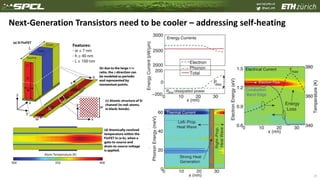
Next-Generation Transistors need to be cooler – addressing self-heating
spcl.inf.ethz.ch
@spcl_eth
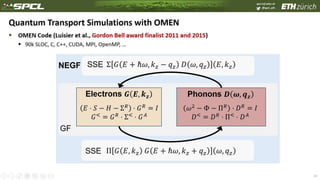
 OMEN Code (Luisier et al., Gordon Bell award finalist 2011 and 2015)
 90k SLOC, C, C++, CUDA, MPI, OpenMP, …
29
Quantum Transport Simulations with OMEN
Electrons 𝑮 𝑬, 𝒌 𝒛 Phonons 𝑫 𝝎, 𝒒 𝒛
GF
SSE
SSE
Σ 𝐺 𝐸 + ℏ𝜔, 𝑘 𝑧 − 𝑞 𝑧 𝐷 𝜔, 𝑞 𝑧 𝐸, 𝑘 𝑧
Π 𝐺 𝐸, 𝑘 𝑧 𝐺 𝐸 + ℏ𝜔, 𝑘 𝑧 + 𝑞 𝑧 𝜔, 𝑞 𝑧
𝐸 ⋅ 𝑆 − 𝐻 − Σ 𝑅
⋅ 𝐺 𝑅
= 𝐼
𝐺<
= 𝐺 𝑅
⋅ Σ<
⋅ 𝐺 𝐴
𝜔2
− Φ − Π 𝑅
⋅ 𝐷 𝑅
= 𝐼
𝐷<
= 𝐷 𝑅
⋅ Π<
⋅ 𝐷 𝐴
NEGF
spcl.inf.ethz.ch
@spcl_eth
30
All of OMEN (90k SLOC) in a single SDFG – (collapsed) tasklets contain more SDFGs
𝐻
𝑘 𝑧, 𝐸
RGF
Σ≷
convergence
𝐺≷
Φ
𝑞 𝑧, 𝜔
RGF
Π≷
𝐷≷
𝑏
𝛻𝐻
𝑘 𝑧, 𝐸, 𝑞 𝑧, 𝜔, 𝑎, 𝑏
SSE
Π≷
G≷
Σ≷
D≷
Not 𝑏
𝑏
GF
SSE
𝑖++𝑖=0 𝑞 𝑧, 𝜔𝑘 𝑧, 𝐸
𝐻[0:𝑁𝑘 𝑧
] Φ[0:𝑁𝑞 𝑧
]Σ≷
[0:𝑁𝑘 𝑧
,0:𝑁𝐸]
𝐼𝑒 𝐼 𝜙
Π≷
[0:𝑁𝑞 𝑧
,
1:𝑁 𝜔]
𝐻[𝑘 𝑧] Φ[𝑞 𝑧]Σ≷
[𝑘 𝑧,E] Π≷
[𝑞 𝑧,𝜔]
𝐺≷
[𝑘 𝑧,E] 𝐷≷
[𝑞 𝑧,𝜔]𝐼Φ (CR: Sum)
𝐼Φ (CR: Sum)𝐼e (CR: Sum)
𝐼e (CR: Sum)
𝐷≷
[0:N 𝑞 𝑧
,
1:N 𝜔]
G≷
[0:𝑁𝑘 𝑧
,0:𝑁𝐸]
𝛻𝐻 G≷
D≷
Π≷
(CR: Sum)Σ≷
(CR: Sum)
Σ≷
[…]
(CR: Sum)
Π≷
[…]
(CR: Sum)
𝛻𝐻[…] G≷
[…] D≷
[…]
𝑘 𝑧, 𝐸, 𝑞 𝑧, 𝜔, 𝑎, 𝑏
𝐼e 𝐼Φ
𝑏
spcl.inf.ethz.ch
@spcl_eth
31
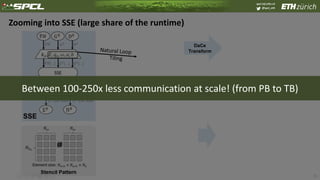
Zooming into SSE (large share of the runtime)
DaCe
Transform
Between 100-250x less communication at scale! (from PB to TB)
spcl.inf.ethz.ch
@spcl_eth
32
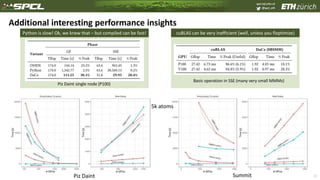
Additional interesting performance insights
Python is slow! Ok, we knew that – but compiled can be fast!
Piz Daint single node (P100)
cuBLAS can be very inefficient (well, unless you floptimize)
Basic operation in SSE (many very small MMMs)
5k atoms
Piz Daint Summit
spcl.inf.ethz.ch
@spcl_eth
33
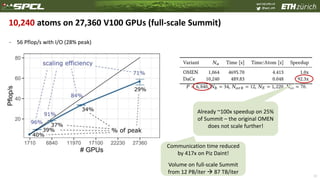
10,240 atoms on 27,360 V100 GPUs (full-scale Summit)
- 56 Pflop/s with I/O (28% peak)
Already ~100x speedup on 25%
of Summit – the original OMEN
does not scale further!
Communication time reduced
by 417x on Piz Daint!
Volume on full-scale Summit
from 12 PB/iter  87 TB/iter
spcl.inf.ethz.ch
@spcl_eth
34
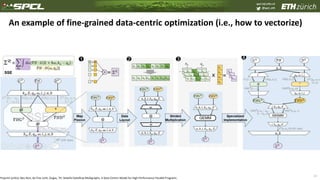
An example of fine-grained data-centric optimization (i.e., how to vectorize)
Preprint (arXiv): Ben-Nun, de Fine Licht, Ziogas, TH: Stateful Dataflow Multigraphs: A Data-Centric Model for High-Performance Parallel Programs
spcl.inf.ethz.ch
@spcl_eth
35
Overview and wrap-up
This project has received funding from the European Research Council (ERC) under grant agreement "DAPP (PI: T. Hoefler)".

Data-Centric Parallel Programming

  • 1.
    spcl.inf.ethz.ch @spcl_eth Data-Centric Parallel Programming TorstenHoefler, Keynote at AsHES @ IPDPS’19, Rio, Brazil Alexandros Ziogas, Tal Ben-Nun, Guillermo Indalecio, Timo Schneider, Mathieu Luisier, and Johannes de Fine Licht and the whole DAPP team @ SPCL https://eurompi19.inf.ethz.ch
  • 2.
    spcl.inf.ethz.ch @spcl_eth 2 Changing hardware constraintsand the physics of computing [1]: Marc Horowitz, Computing’s Energy Problem (and what we can do about it), ISSC 2014, plenary [2]: Moore: Landauer Limit Demonstrated, IEEE Spectrum 2012 130nm 90nm 65nm 45nm 32nm 22nm 14nm 10nm 0.9 V [1] 32-bit FP ADD: 0.9 pJ 32-bit FP MUL: 3.2 pJ 2x32 bit from L1 (8 kiB): 10 pJ 2x32 bit from L2 (1 MiB): 100 pJ 2x32 bit from DRAM: 1.3 nJ … Three Ls of modern computing: How to address locality challenges on standard architectures and programming? D. Unat et al.: “Trends in Data Locality Abstractions for HPC Systems” IEEE Transactions on Parallel and Distributed Systems (TPDS). Vol 28, Nr. 10, IEEE, Oct. 2017
  • 3.
    spcl.inf.ethz.ch @spcl_eth 3 Control in Load-storevs. Dataflow Memory Cache RegistersControl x=a+b ld a, r1 ALU ald b, r2 badd r1, r2 ba x bast r1, x Memory + c d y y=(a+b)*(c+d) a b + x a b c d a+b c+d y Turing Award 1977 (Backus): "Surely there must be a less primitive way of making big changes in the store than pushing vast numbers of words back and forth through the von Neumann bottleneck." Load-store (“von Neumann”) Energy per instruction: 70pJ Source: Mark Horowitz, ISSC’14 Energy per operation: 1-3pJ Static Dataflow (“non von Neumann”) Very Low High
  • 4.
    spcl.inf.ethz.ch @spcl_eth Still Lower Control Locality 4 SingleInstruction Multiple Data/Threads (SIMD - Vector CPU, SIMT - GPU) Memory Cache RegistersControl ALUALU ALUALU ALUALU ALUALU ALUALU 45nm, 0.9 V [1] Random Access SRAM: 8 kiB: 10 pJ 32 kiB: 20 pJ 1 MiB: 100 pJ Memory + c d ya b + x a b c d 45nm, 0.9 V [1] Single R/W registers: 32 bit: 0.1 pJ [1]: Marc Horowitz, Computing’s Energy Problem (and what we can do about it), ISSC 2014, plenary High Performance Computing really became a data management challenge
  • 5.
    spcl.inf.ethz.ch @spcl_eth 5 Data movement willdominate everything! Source: Fatollahi-Fard et al.  “In future microprocessors, the energy expended for data movement will have a critical effect on achievable performance.”  “… movement consumes almost 58 watts with hardly any energy budget left for computation.”  “…the cost of data movement starts to dominate.”  “…data movement over these networks must be limited to conserve energy…”  the phrase “data movement” appears 18 times on 11 pages (usually in concerning contexts)!  “Efficient data orchestration will increasingly be critical, evolving to more efficient memory hierarchies and new types of interconnect tailored for locality and that depend on sophisticated software to place computation and data so as to minimize data movement.” Source: NVIDIA Source: Kogge, Shalf
  • 6.
    spcl.inf.ethz.ch @spcl_eth  Well, toa good approximation how we programmed yesterday  Or last year?  Or four decades ago?  Control-centric programming  Worry about operation counts (flop/s is the metric, isn’t it?)  Data movement is at best implicit (or invisible/ignored)  Legion [1] is taking a good direction towards data-centric  Tasking relies on data placement but not really dependencies (not visible to tool-chain)  But it is still control-centric in the tasks – not (performance) portable between devices!  Let’s go a step further towards an explicitly data-centric viewpoint  For performance engineers at least! 6 “Sophisticated software”: How do we program today? Backus ‘77: “The assignment statement is the von Neumann bottleneck of programming languages and keeps us thinking in word-at-a-time terms in much the same way the computer’s bottleneck does.” [1]: Bauer et al.: “Legion: expressing locality and independence with logical regions”, SC12, 2012
  • 7.
    spcl.inf.ethz.ch @spcl_eth 7 Performance Portability withDataCentric (DaCe) Parallel Programming Preprint (arXiv): Ben-Nun, de Fine Licht, Ziogas, TH: Stateful Dataflow Multigraphs: A Data-Centric Model for High-Performance Parallel Programs SystemDomain Scientist Performance Engineer High-Level Program Data-Centric Intermediate Representation (SDFG, §3) 𝜕𝑢 𝜕𝑡 − 𝛼𝛻2 𝑢 = 0 Problem Formulation FPGA Modules CPU Binary Runtime Hardware Information Graph Transformations (API, Interactive, §4) SDFG Compiler Transformed Dataflow Performance Results Thin Runtime Infrastructure GPU Binary Python / NumPy 𝑳 𝑹 * * * * * * TensorFlow DSLs MATLAB SDFG Builder API
  • 8.
    spcl.inf.ethz.ch @spcl_eth 8 DAPP – DataCentric Programming Concepts • Store volatile (buffers, queues, RAM) and nonvolatile (files, I/O) information • Can be sources or sinks of data • Stateless functions that perform computations at any granularity • Data access only through ports • Data flowing between containers and tasklets/ports • Implemented as access, copies, streaming, … • Map scopes provide parallelism • States constrain parallelism outside of datatflow Data Containers Computation Data Movement / Dependencies Parallelism and States
  • 9.
  • 10.
    spcl.inf.ethz.ch @spcl_eth DIODE User Interface 10 SourceCode Transformations SDFG (malleable) SDFGGenerated Code Performance Preprint (arXiv): Ben-Nun, de Fine Licht, Ziogas, TH: Stateful Dataflow Multigraphs: A Data-Centric Model for High-Performance Parallel Programs
  • 11.
    spcl.inf.ethz.ch @spcl_eth 11 Performance for matrixmultiplication on x86 SDFG Naïve Preprint (arXiv): Ben-Nun, de Fine Licht, Ziogas, TH: Stateful Dataflow Multigraphs: A Data-Centric Model for High-Performance Parallel Programs
  • 12.
    spcl.inf.ethz.ch @spcl_eth 12 Performance for matrixmultiplication on x86 SDFG MapReduceFusionNaïve Preprint (arXiv): Ben-Nun, de Fine Licht, Ziogas, TH: Stateful Dataflow Multigraphs: A Data-Centric Model for High-Performance Parallel Programs
  • 13.
    spcl.inf.ethz.ch @spcl_eth 13 Performance for matrixmultiplication on x86 SDFG LoopReorder MapReduceFusionNaïve Preprint (arXiv): Ben-Nun, de Fine Licht, Ziogas, TH: Stateful Dataflow Multigraphs: A Data-Centric Model for High-Performance Parallel Programs
  • 14.
    spcl.inf.ethz.ch @spcl_eth 14 Performance for matrixmultiplication on x86 SDFG BlockTiling LoopReorder MapReduceFusionNaïve Preprint (arXiv): Ben-Nun, de Fine Licht, Ziogas, TH: Stateful Dataflow Multigraphs: A Data-Centric Model for High-Performance Parallel Programs
  • 15.
    spcl.inf.ethz.ch @spcl_eth 15 Performance for matrixmultiplication on x86 RegisterTiling BlockTiling LoopReorder MapReduceFusionNaïve Preprint (arXiv): Ben-Nun, de Fine Licht, Ziogas, TH: Stateful Dataflow Multigraphs: A Data-Centric Model for High-Performance Parallel Programs
  • 16.
    spcl.inf.ethz.ch @spcl_eth 16 Performance for matrixmultiplication on x86 LocalStorage RegisterTiling BlockTiling LoopReorder MapReduceFusionNaïve Preprint (arXiv): Ben-Nun, de Fine Licht, Ziogas, TH: Stateful Dataflow Multigraphs: A Data-Centric Model for High-Performance Parallel Programs
  • 17.
    spcl.inf.ethz.ch @spcl_eth 17 Performance for matrixmultiplication on x86 PromoteTransient LocalStorage RegisterTiling BlockTiling LoopReorder MapReduceFusionNaïve Preprint (arXiv): Ben-Nun, de Fine Licht, Ziogas, TH: Stateful Dataflow Multigraphs: A Data-Centric Model for High-Performance Parallel Programs
  • 18.
    spcl.inf.ethz.ch @spcl_eth Preprint (arXiv): Ben-Nun,de Fine Licht, Ziogas, TH: Stateful Dataflow Multigraphs: A Data-Centric Model for High-Performance Parallel Programs 18 Performance for matrix multiplication on x86 Intel MKL OpenBLAS 25% difference DAPP With more tuning: 98.6% of MKLBut do we really care about MMM on x86 CPUs?
  • 19.
    spcl.inf.ethz.ch @spcl_eth Hardware Mapping: Load/StoreArchitectures  Recursive code generation (C++, CUDA)  Control flow: Construct detection and gotos  Parallelism  Multi-core CPU: OpenMP, atomics, and threads  GPU: CUDA kernels and streams  Connected components run concurrently  Memory and interaction with accelerators  Array-array edges create intra-/inter-device copies  Memory access validation on compilation  Automatic CPU SDFG to GPU transformation  Tasklet code immutable 19
  • 20.
    spcl.inf.ethz.ch @spcl_eth Hardware Mapping: PipelinedArchitectures  Module generation with HDL and HLS  Integration with Xilinx SDAccel  Nested SDFGs become FPGA state machines  Parallelism  Exploiting temporal locality: Pipelines  Exploiting spatial locality: Vectorization, replication  Replication  Enables parametric systolic array generation  Memory access  Burst memory access, vectorization  Streams for inter-PE communication 20
  • 21.
    spcl.inf.ethz.ch @spcl_eth Performance (Portability) Evaluation Three platforms:  Intel Xeon E5-2650 v4 CPU (2.20 GHz, no HT)  Tesla P100 GPU  Xilinx VCU1525 hosting an XCVU9P FPGA  Compilers and frameworks:  Compilers: GCC 8.2.0 Clang 6.0 icc 18.0.3  Polyhedral optimizing compilers: Polly 6.0 Pluto 0.11.4 PPCG 0.8  GPU and FPGA compilers: CUDA nvcc 9.2 Xilinx SDAccel 2018.2  Frameworks and optimized libraries: HPX Halide Intel MKL NVIDIA CUBLAS, CUSPARSE, CUTLASS NVIDIA CUB 21
  • 22.
    spcl.inf.ethz.ch @spcl_eth Performance Evaluation: FundamentalKernels (CPU)  Database Query: roughly 50% of a 67,108,864 column  Matrix Multiplication (MM): 2048x2048x2048  Histogram: 8192x8192  Jacobi stencil: 2048x2048 for T=1024  Sparse Matrix-Vector Multiplication (SpMV): 8192x8192 CSR matrix (nnz=33,554,432) 22 99.9% of MKL8.12x faster 98.6% of MKL 2.5x faster 82.7% of Halide
  • 23.
    spcl.inf.ethz.ch @spcl_eth Performance Evaluation: FundamentalKernels (GPU, FPGA) 23 GPU FPGA 309,000x 19.5x of Spatial 90% of CUTLASS
  • 24.
    spcl.inf.ethz.ch @spcl_eth Performance Evaluation: Polybench(CPU)  Polyhedral benchmark with 30 applications  Without any transformations, achieves 1.43x (geometric mean) over general-purpose compilers 24
  • 25.
    spcl.inf.ethz.ch @spcl_eth Performance Evaluation: Polybench(GPU, FPGA)  Automatically transformed from CPU code 25 GPU (1.12x geomean speedup) FPGA The first full set of placed-and-routed Polybench 11.8x
  • 26.
    spcl.inf.ethz.ch @spcl_eth Case Study: ParallelBreadth-First Search  Compared with Galois and Gluon  State-of-the-art graph processing frameworks on CPU  Graphs:  Road maps: USA, OSM-Europe  Social networks: Twitter, LiveJournal  Synthetic: Kronecker Graphs 26 Performance portability – fine, but who cares about microbenchmarks?
  • 27.
    spcl.inf.ethz.ch @spcl_eth 27 Remember the promiseof DAPP – on to a real application! Preprint (arXiv): Ben-Nun, de Fine Licht, Ziogas, TH: Stateful Dataflow Multigraphs: A Data-Centric Model for High-Performance Parallel Programs SystemDomain Scientist Performance Engineer High-Level Program Data-Centric Intermediate Representation (SDFG, §3) 𝜕𝑢 𝜕𝑡 − 𝛼𝛻2 𝑢 = 0 Problem Formulation FPGA Modules CPU Binary Runtime Hardware Information Graph Transformations (API, Interactive, §4) SDFG Compiler Transformed Dataflow Performance Results Thin Runtime Infrastructure GPU Binary Python / NumPy 𝑳 𝑹 * * * * * * TensorFlow DSLs MATLAB SDFG Builder API
  • 28.
  • 29.
    spcl.inf.ethz.ch @spcl_eth  OMEN Code(Luisier et al., Gordon Bell award finalist 2011 and 2015)  90k SLOC, C, C++, CUDA, MPI, OpenMP, … 29 Quantum Transport Simulations with OMEN Electrons 𝑮 𝑬, 𝒌 𝒛 Phonons 𝑫 𝝎, 𝒒 𝒛 GF SSE SSE Σ 𝐺 𝐸 + ℏ𝜔, 𝑘 𝑧 − 𝑞 𝑧 𝐷 𝜔, 𝑞 𝑧 𝐸, 𝑘 𝑧 Π 𝐺 𝐸, 𝑘 𝑧 𝐺 𝐸 + ℏ𝜔, 𝑘 𝑧 + 𝑞 𝑧 𝜔, 𝑞 𝑧 𝐸 ⋅ 𝑆 − 𝐻 − Σ 𝑅 ⋅ 𝐺 𝑅 = 𝐼 𝐺< = 𝐺 𝑅 ⋅ Σ< ⋅ 𝐺 𝐴 𝜔2 − Φ − Π 𝑅 ⋅ 𝐷 𝑅 = 𝐼 𝐷< = 𝐷 𝑅 ⋅ Π< ⋅ 𝐷 𝐴 NEGF
  • 30.
    spcl.inf.ethz.ch @spcl_eth 30 All of OMEN(90k SLOC) in a single SDFG – (collapsed) tasklets contain more SDFGs 𝐻 𝑘 𝑧, 𝐸 RGF Σ≷ convergence 𝐺≷ Φ 𝑞 𝑧, 𝜔 RGF Π≷ 𝐷≷ 𝑏 𝛻𝐻 𝑘 𝑧, 𝐸, 𝑞 𝑧, 𝜔, 𝑎, 𝑏 SSE Π≷ G≷ Σ≷ D≷ Not 𝑏 𝑏 GF SSE 𝑖++𝑖=0 𝑞 𝑧, 𝜔𝑘 𝑧, 𝐸 𝐻[0:𝑁𝑘 𝑧 ] Φ[0:𝑁𝑞 𝑧 ]Σ≷ [0:𝑁𝑘 𝑧 ,0:𝑁𝐸] 𝐼𝑒 𝐼 𝜙 Π≷ [0:𝑁𝑞 𝑧 , 1:𝑁 𝜔] 𝐻[𝑘 𝑧] Φ[𝑞 𝑧]Σ≷ [𝑘 𝑧,E] Π≷ [𝑞 𝑧,𝜔] 𝐺≷ [𝑘 𝑧,E] 𝐷≷ [𝑞 𝑧,𝜔]𝐼Φ (CR: Sum) 𝐼Φ (CR: Sum)𝐼e (CR: Sum) 𝐼e (CR: Sum) 𝐷≷ [0:N 𝑞 𝑧 , 1:N 𝜔] G≷ [0:𝑁𝑘 𝑧 ,0:𝑁𝐸] 𝛻𝐻 G≷ D≷ Π≷ (CR: Sum)Σ≷ (CR: Sum) Σ≷ […] (CR: Sum) Π≷ […] (CR: Sum) 𝛻𝐻[…] G≷ […] D≷ […] 𝑘 𝑧, 𝐸, 𝑞 𝑧, 𝜔, 𝑎, 𝑏 𝐼e 𝐼Φ 𝑏
  • 31.
    spcl.inf.ethz.ch @spcl_eth 31 Zooming into SSE(large share of the runtime) DaCe Transform Between 100-250x less communication at scale! (from PB to TB)
  • 32.
    spcl.inf.ethz.ch @spcl_eth 32 Additional interesting performanceinsights Python is slow! Ok, we knew that – but compiled can be fast! Piz Daint single node (P100) cuBLAS can be very inefficient (well, unless you floptimize) Basic operation in SSE (many very small MMMs) 5k atoms Piz Daint Summit
  • 33.
    spcl.inf.ethz.ch @spcl_eth 33 10,240 atoms on27,360 V100 GPUs (full-scale Summit) - 56 Pflop/s with I/O (28% peak) Already ~100x speedup on 25% of Summit – the original OMEN does not scale further! Communication time reduced by 417x on Piz Daint! Volume on full-scale Summit from 12 PB/iter  87 TB/iter
  • 34.
    spcl.inf.ethz.ch @spcl_eth 34 An example offine-grained data-centric optimization (i.e., how to vectorize) Preprint (arXiv): Ben-Nun, de Fine Licht, Ziogas, TH: Stateful Dataflow Multigraphs: A Data-Centric Model for High-Performance Parallel Programs
  • 35.
    spcl.inf.ethz.ch @spcl_eth 35 Overview and wrap-up Thisproject has received funding from the European Research Council (ERC) under grant agreement "DAPP (PI: T. Hoefler)".

Editor's Notes

  • #3 JOHANNES: you said something about that scaling stops at 0nm which didn’t make a lot of sense. It’s like you also said, the scaling stops when you hit the size of individual molecules  Mark Horowitz talk: https://www.youtube.com/watch?v=7gGnRGko3go 45nm, 0.9V  32bit FADD: 0.9pJ, FMUL: 3.7pJ, 2 operand (64bit) load from L1 (8kiB): 10pJ, from L2 (1MiB): 100pJ, from DRAM: 1.3-2.6nJ [1] FP computation approaches Landauer limit (3e-21 J) [2] Assuming all bits are switched in 32 bit FP, ~0.2aJ (atto Joules = 10e-6pJ) Electrical data movement suffers from resistance Heat loss: ~ resistancy * length / cross-section-area  process shrinkage benefits computation energy but increases communication energy
  • #4 - Add explanation for Control Locality GPUs and CPUs reduce control overhead with SIMD/SIMT – if it’s 10x wide than we’re again op-dominated BUT memory problem remains, so we need large inefficient (due to addressing) caches, not so in Dataflow
  • #5 GPUs and CPUs reduce control overhead with SIMD/SIMT – if it’s 10x wide than we’re again op-dominated BUT memory problem remains, so we need large inefficient (due to addressing) caches, not so in Dataflow SIMD/SIMT is also less flexible --- but of course more efficient due to better silicon optimization
  • #11 IDE Plugin?
  • #20 Vector types for all architectures Weakly connected components
  • #21 Weakly connected components
  • #22 Thorough
  • #26 Keep in mind that PPCG is a specialized tool that does this transformation only for polyhedral applications.
  • #27 Highly irregular Around 3 transformations IIRC We have more applications in deep learning and more
  • #34 - Needs better communication models!!!
  • #35 - Needs better communication models!!!