TRIGGERSTRIGGERS
Dr. Marshall GoldsmithDr. Marshall Goldsmith
Marshall@MarshallGoldsmith.comMarshall@MarshallGoldsmith.com
www.MarshallGoldsmith.comwww.MarshallGoldsmith.com
Creating Behavior that Lasts -
Becoming the Person
You Want to Be
Goals
• Understand the concept of triggers - how we create
our world and how it creates us.
• Understand why we do not achieve our goals and
share practical tools that enable us to use structure
to improve lives.
• Be ready to practice an integrated approach to
planning life and business.
• Learn the daily question process and how active
questions can be used to help achieve personal
goals and increase employee engagement.
• Be able to apply key concepts to help you be a
better coach, have a better life and experience less
shame and regret.
What happens?
• If we know the people that we want to
become
• Why don’t we become these people?
• Millions of employees around the world:
– Disengaged
– Depressed
– Not achieving personal goals
• Many teams and organizations are
dysfunctional
Why is change so difficult?
• New Year’s resolutions that are never
achieved?
• Coaching clients that don’t change?
• Our daily failures to do – even the small
things – that we plan?
What is a trigger?
TRIGGER –
ANY STIMULUS
THAT MAY IMPACT OUR BEHAVIOR
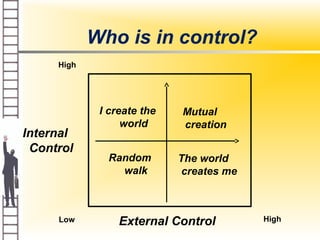
Who is in control?
External Control
Internal
Control
The world
creates me
Mutual
creation
I create the
world
Random
walk
High
Low High
Mutual creation
I am creating my world
and at the same time
triggers in my world
are creating me
Fate vs. choice
• Fate – The hand of cards that we
have been dealt.
• Choice – How we play the hand.
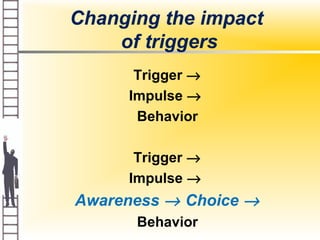
Changing the impact
of triggers
Trigger →
Impulse →
Behavior
Trigger →
Impulse →
Awareness → Choice →
Behavior
Dealing with triggers
• The negative case – correcting driving
• The positive case – the hard day
Triggers: today’s ‘perfect storm’
for distraction
• Emails, cell phones, tablets, texting
• On demand TV, movies, games
• Social media
• Multi-tasking
• ‘The dream’
It is OK to need
help and structure
• The changing role of coaching – from
‘fixing losers’ to ‘helping winners’
• 27 top executive endorsements
• Athletes, movie stars, world leaders
• If could have fixed it by yourself, it
would probably be fixed by now
• ‘I need help and it is OK!’
The value of structure
• The Checklist Manifesto
• Stakeholder centered coaching process
• Alan Mulally process
• Six Question process
• Daily question process
Alan Mulally:
the Ford turnaround story
Establishing clear leadership behavior:
•Determining the desired behavior
•Communicating across the company
•Zero tolerance for behavior violations
Getting clear on priorities
•The ‘top five’ per person
•Red, yellow, green
•Complete alignment to the plan
Alan Mulally:
the Ford turnaround story
Creating an open, transparent culture
•Getting rid of shame
•One set of numbers
•Sharing at all levels
•‘You cannot manage a secret’
•‘The data will set you free’
The leader as ‘facilitator’ not ‘boss’
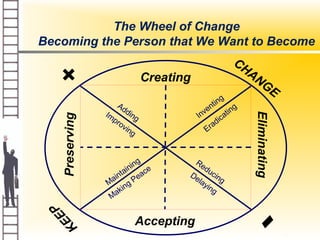
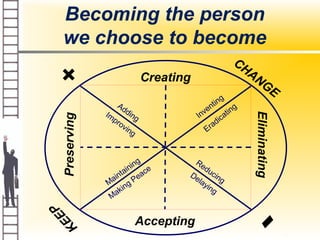
The Wheel of Change
Becoming the Person that We Want to Become
Accepting
Preserving
CHANGE
KEEP
+
-
Creating
Eliminating
Inventing
Eradicating
Reducing
Delaying
Maintaining
Making Peace
AddingImproving
Creating
Who is the you – that you want to create?
•Creating that person that you want to become
•Blocks to creating
•Fears that inhibit creating
•The role of identity (self-stereotyping)
•Hope for the future
•Visualizing the future
•Focus on process – not just outcomes
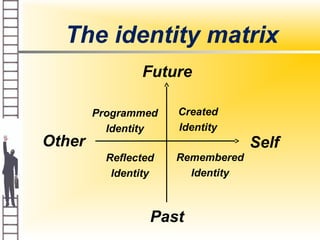
The identity matrix
Future
Self
Past
Other
Programmed
Identity
Created
Identity
Remembered
Identity
Reflected
Identity
Preserving
Who is the you – that you want to preserve?
•What do we want to preserve?
•Gratitude for the past – Frances Hesselbein
•The challenge of executing vs. generating
•Why too much focus on preserving can be a problem
– Kodak
– The old IBM
Eliminating
What part of you – do you want to eliminate?
•Knowing what to eliminate
•Knowing when to eliminate
•The danger of over-commitment
•The challenge of new technology
Accepting
What is it that you – need to learn to accept?
•‘Letting go’ of the past
•Am I willing at this time?
•Forgiving
•Prioritizing
•Accepting environmental limitations
AIWATT
AM I WILLING
AT THIS TIME
TO MAKE THE INVESTMENT REQUIRED
TO MAKE A POSITIVE DIFFERENCE
ON THIS TOPIC?
Becoming the person
we choose to become
Accepting
Preserving
CHANGE
KEEP
+
-
Creating
Eliminating
Inventing
Eradicating
Reducing
Delaying
Maintaining
Making Peace
AddingImproving
Applying this model
• To ourselves
• To our team
• To our function
• To our company
Previous work
on employee engagement
• NAHR presentation
• Recognition, reward programs, training,
compensation, empowerment
• In spite of all previous efforts, global
employee engagement is near an all-time low
• Focus on what the organization can do to
engage you – not what you can do to engage
yourself – JFK in reverse
• The two flight attendants
The great Western disease
I will be happy
when…
The great engagement myth
Employees will be engaged
when…
Daily Question Process
• Why the process works
• How the process works
• Applications on employee
engagement
Active questions vs.
passive questions
• How active questions focus on what
you can do to make a positive
difference for yourself and the world
• How passive questions focus on
what the world needs to do to make
a positive difference for you
The hardest daily question
you can ask yourself
• You write the question.
• You know the answer.
• You believe that it is very important.
• All you have to do to get a high score is
try!
Six active questions
Did I do my best to:
• Be happy?
• Find meaning?
• Be fully engaged?
• Build positive relationships?
• Set clear goals?
• Make progress toward goal
achievement?
That boring meeting!
Imagine that you were going to be tested on:
Did I do my best to:
•Be happy?
•Find meaning?
•Build positive relationships?
•Be fully engaged?
What would you do differently?
The two week study
• You will get an email every day for two
weeks – asking six active questions
• You will receive ‘before and after’
questions
• The daily process takes just a couple of
minutes
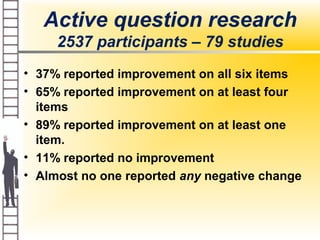
Active question research
2537 participants – 79 studies
• 37% reported improvement on all six items
• 65% reported improvement on at least four
items
• 89% reported improvement on at least one
item.
• 11% reported no improvement
• Almost no one reported any negative change

Presentatie Marshall Goldsmith

  • 1.
    TRIGGERSTRIGGERS Dr. Marshall GoldsmithDr.Marshall Goldsmith Marshall@MarshallGoldsmith.comMarshall@MarshallGoldsmith.com www.MarshallGoldsmith.comwww.MarshallGoldsmith.com Creating Behavior that Lasts - Becoming the Person You Want to Be
  • 2.
    Goals • Understand theconcept of triggers - how we create our world and how it creates us. • Understand why we do not achieve our goals and share practical tools that enable us to use structure to improve lives. • Be ready to practice an integrated approach to planning life and business. • Learn the daily question process and how active questions can be used to help achieve personal goals and increase employee engagement. • Be able to apply key concepts to help you be a better coach, have a better life and experience less shame and regret.
  • 3.
    What happens? • Ifwe know the people that we want to become • Why don’t we become these people? • Millions of employees around the world: – Disengaged – Depressed – Not achieving personal goals • Many teams and organizations are dysfunctional
  • 4.
    Why is changeso difficult? • New Year’s resolutions that are never achieved? • Coaching clients that don’t change? • Our daily failures to do – even the small things – that we plan?
  • 5.
    What is atrigger? TRIGGER – ANY STIMULUS THAT MAY IMPACT OUR BEHAVIOR
  • 6.
    Who is incontrol? External Control Internal Control The world creates me Mutual creation I create the world Random walk High Low High
  • 7.
    Mutual creation I amcreating my world and at the same time triggers in my world are creating me
  • 8.
    Fate vs. choice •Fate – The hand of cards that we have been dealt. • Choice – How we play the hand.
  • 9.
    Changing the impact oftriggers Trigger → Impulse → Behavior Trigger → Impulse → Awareness → Choice → Behavior
  • 10.
    Dealing with triggers •The negative case – correcting driving • The positive case – the hard day
  • 11.
    Triggers: today’s ‘perfectstorm’ for distraction • Emails, cell phones, tablets, texting • On demand TV, movies, games • Social media • Multi-tasking • ‘The dream’
  • 12.
    It is OKto need help and structure • The changing role of coaching – from ‘fixing losers’ to ‘helping winners’ • 27 top executive endorsements • Athletes, movie stars, world leaders • If could have fixed it by yourself, it would probably be fixed by now • ‘I need help and it is OK!’
  • 13.
    The value ofstructure • The Checklist Manifesto • Stakeholder centered coaching process • Alan Mulally process • Six Question process • Daily question process
  • 14.
    Alan Mulally: the Fordturnaround story Establishing clear leadership behavior: •Determining the desired behavior •Communicating across the company •Zero tolerance for behavior violations Getting clear on priorities •The ‘top five’ per person •Red, yellow, green •Complete alignment to the plan
  • 15.
    Alan Mulally: the Fordturnaround story Creating an open, transparent culture •Getting rid of shame •One set of numbers •Sharing at all levels •‘You cannot manage a secret’ •‘The data will set you free’ The leader as ‘facilitator’ not ‘boss’
  • 16.
    The Wheel ofChange Becoming the Person that We Want to Become Accepting Preserving CHANGE KEEP + - Creating Eliminating Inventing Eradicating Reducing Delaying Maintaining Making Peace AddingImproving
  • 17.
    Creating Who is theyou – that you want to create? •Creating that person that you want to become •Blocks to creating •Fears that inhibit creating •The role of identity (self-stereotyping) •Hope for the future •Visualizing the future •Focus on process – not just outcomes
  • 18.
  • 19.
    Preserving Who is theyou – that you want to preserve? •What do we want to preserve? •Gratitude for the past – Frances Hesselbein •The challenge of executing vs. generating •Why too much focus on preserving can be a problem – Kodak – The old IBM
  • 20.
    Eliminating What part ofyou – do you want to eliminate? •Knowing what to eliminate •Knowing when to eliminate •The danger of over-commitment •The challenge of new technology
  • 21.
    Accepting What is itthat you – need to learn to accept? •‘Letting go’ of the past •Am I willing at this time? •Forgiving •Prioritizing •Accepting environmental limitations
  • 22.
    AIWATT AM I WILLING ATTHIS TIME TO MAKE THE INVESTMENT REQUIRED TO MAKE A POSITIVE DIFFERENCE ON THIS TOPIC?
  • 23.
    Becoming the person wechoose to become Accepting Preserving CHANGE KEEP + - Creating Eliminating Inventing Eradicating Reducing Delaying Maintaining Making Peace AddingImproving
  • 24.
    Applying this model •To ourselves • To our team • To our function • To our company
  • 25.
    Previous work on employeeengagement • NAHR presentation • Recognition, reward programs, training, compensation, empowerment • In spite of all previous efforts, global employee engagement is near an all-time low • Focus on what the organization can do to engage you – not what you can do to engage yourself – JFK in reverse • The two flight attendants
  • 26.
    The great Westerndisease I will be happy when…
  • 27.
    The great engagementmyth Employees will be engaged when…
  • 28.
    Daily Question Process •Why the process works • How the process works • Applications on employee engagement
  • 29.
    Active questions vs. passivequestions • How active questions focus on what you can do to make a positive difference for yourself and the world • How passive questions focus on what the world needs to do to make a positive difference for you
  • 30.
    The hardest dailyquestion you can ask yourself • You write the question. • You know the answer. • You believe that it is very important. • All you have to do to get a high score is try!
  • 31.
    Six active questions DidI do my best to: • Be happy? • Find meaning? • Be fully engaged? • Build positive relationships? • Set clear goals? • Make progress toward goal achievement?
  • 32.
    That boring meeting! Imaginethat you were going to be tested on: Did I do my best to: •Be happy? •Find meaning? •Build positive relationships? •Be fully engaged? What would you do differently?
  • 33.
    The two weekstudy • You will get an email every day for two weeks – asking six active questions • You will receive ‘before and after’ questions • The daily process takes just a couple of minutes
  • 34.
    Active question research 2537participants – 79 studies • 37% reported improvement on all six items • 65% reported improvement on at least four items • 89% reported improvement on at least one item. • 11% reported no improvement • Almost no one reported any negative change