By: Dr. Ghulam Dastgeer
+92-333-5111-469
hellodastgeer@gmail.com
Employee Performance and
Motivation
Acknowledgment…
Our Responsibilities
 My responsibilities
 I am here to give you values
 For your money
 For your time
 Your responsibilities
 Be a student…
 Don’t be an evaluator
 All things are working perfectly out there, just disconnect
yourself from all those things.
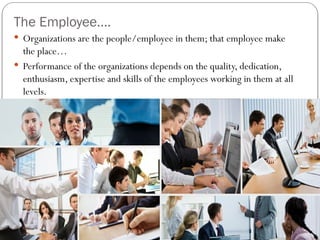
The Employee….
 Organizations are the people/employee in them; that employee make
the place…
 Performance of the organizations depends on the quality, dedication,
enthusiasm, expertise and skills of the employees working in them at all
levels.
• Every individual employee in an organization needs proper:
– Recruitment
– Selection
– Orientation
– Socialization
– Job design
– Pay and Rewards
– Training
– Performance management
– Feedback
– Couching
– Mentoring
– Counseling
– Conflict resolution/management
– Leadership
– Motivation
– Career development
– Safety and Health
– Employee wellbeing
– Employee-Employer Relationships
– Stress management
– Work life and family life balance
– Retirement and old age benefits...etc…
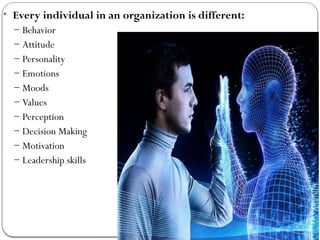
• Every individual in an organization is different:
– Behavior
– Attitude
– Personality
– Emotions
– Moods
– Values
– Perception
– Decision Making
– Motivation
– Leadership skills
 Q: why do certain individuals perform better than others?
or
What factors cause an employee to perform at a certain level?
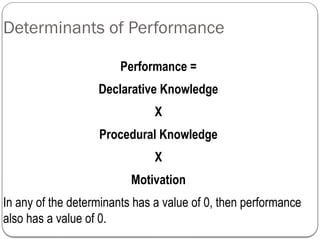
Determinants of Performance
Performance =
Declarative Knowledge
X
Procedural Knowledge
X
Motivation
In any of the determinants has a value of 0, then performance
also has a value of 0.
A. Declarative Knowledge
 Declarative knowledge is information about facts an
things, including information regarding a given task’s
requirements, labels, principles, and goals.
B. Procedural Knowledge
• Procedural knowledge is combination of
knowing what to do and how to do it and
include cognitive and physical skills
C. Motivation
 Motivation involves three types of Choices
 Expenditure of effort (I will go to work today)
 Level of effort (I will put in my best efforts at work)
 Persistence of effort (I will persist no matter what)
Performance Dimensions:
Types of multi-dimensional behaviors:
Two types of behaviors or performance facts
stand out:
 Task performance
 Contextual performance
Task performance
T.P is defined as activities that
 From the perspective of managers: performance on the
job often consist of outcomes.
 Goals/actions, not the activities, that are important.
 Transform raw materials into the goods and services.
 How many sales were made?
 How much was waste reduces?
 How many were made?
Contextual performance
 From the perspective of Employees: it is what workers do day in
and day out on the job (activities on various tasks).
 From this perspective performance consists of behaviors, and
how well those behaviors are executed.
 Behaviors that contribute to organization’s effectiveness and
provide a good environment in which task performance can
occur
 Contextual performance examples:
 Being punctual
 Expending extra efforts on the job
 Suggesting organizational improvements,
 Assisting and helping coworkers and customers
 Following orders and regulations
 Showing respect for authority
 Complying with organizational values and policies
 Organizational loyalty
 Representing the organization favorably to outsiders.
 Q; why both task and contextual performance are important
dimensions to take into account in performance management
systems???
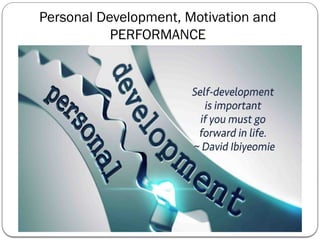
Personal Development, Motivation and
PERFORMANCE
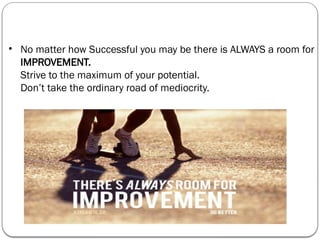
• No matter how Successful you may be there is ALWAYS a room for
IMPROVEMENT.
Strive to the maximum of your potential.
Don’t take the ordinary road of mediocrity.
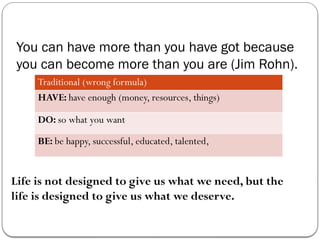
You can have more than you have got because
you can become more than you are (Jim Rohn).
Traditional (wrong formula)
HAVE: have enough (money, resources, things)
DO: so what you want
BE: be happy, successful, educated, talented,
Life is not designed to give us what we need, but the
life is designed to give us what we deserve.
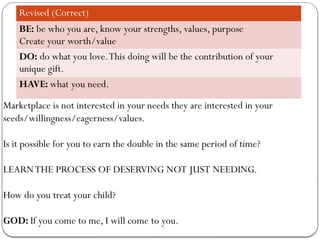
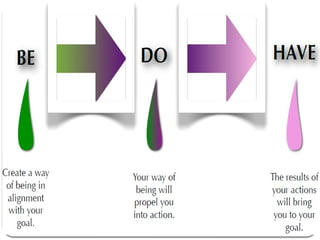
Revised (Correct)
BE: be who you are, know your strengths, values, purpose
Create your worth/value
DO: do what you love.This doing will be the contribution of your
unique gift.
HAVE: what you need.
Marketplace is not interested in your needs they are interested in your
seeds/willingness/eagerness/values.
Is it possible for you to earn the double in the same period of time?
LEARNTHE PROCESS OF DESERVING NOT JUST NEEDING.
How do you treat your child?
GOD: If you come to me, I will come to you.
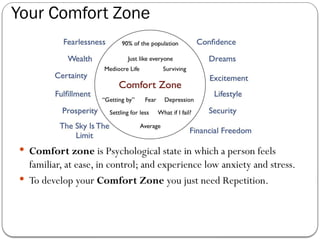
Your Comfort Zone
 Comfort zone is Psychological state in which a person feels
familiar, at ease, in control; and experience low anxiety and stress.
 To develop your Comfort Zone you just need Repetition.
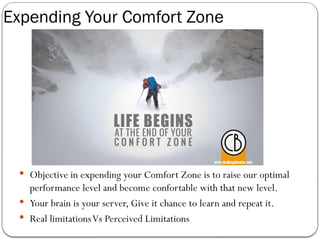
Expending Your Comfort Zone
 Objective in expending your Comfort Zone is to raise our optimal
performance level and become confortable with that new level.
 Your brain is your server, Give it chance to learn and repeat it.
 Real limitationsVs Perceived Limitations
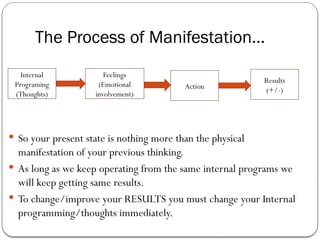
The Process of Manifestation…
 So your present state is nothing more than the physical
manifestation of your previous thinking.
 As long as we keep operating from the same internal programs we
will keep getting same results.
 To change/improve your RESULTS you must change your Internal
programming/thoughts immediately.
Internal
Programing
(Thoughts)
Feelings
(Emotional
involvement)
Action
Results
(+/-)
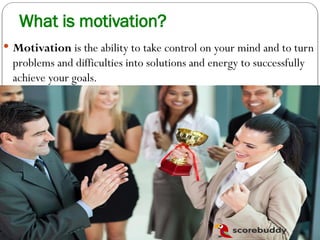
What is motivation?
 Motivation is the ability to take control on your mind and to turn
problems and difficulties into solutions and energy to successfully
achieve your goals.
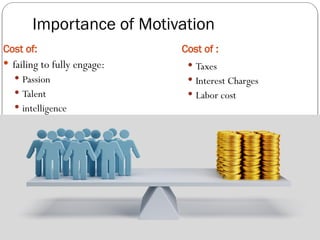
Importance of Motivation
Cost of: Cost of :
 failing to fully engage:
 Passion
 Talent
 intelligence
 Taxes
 Interest Charges
 Labor cost
The Rise and Fall of Motivation
 Motivation 1.0 – presumed that humans were biological creatures,
struggling to obtain our basic needs for food, security. (Extrinsic)
 Motivation 2.0 – presumed that humans also responded to rewards
and punishments.That worked fine for routine tasks but incompatible
with how we organize. (Extrinsic)
 Motivation 3.0 – the upgrade we now need, presumes that humans
also have a drive to learn, to create, and to better the world.
(Intrinsic)
Book: “Drive” by D.Pink
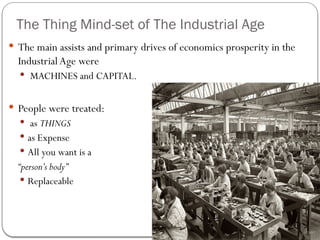
The Thing Mind-set of The Industrial Age
 The main assists and primary drives of economics prosperity in the
IndustrialAge were
 MACHINES and CAPITAL.
 People were treated:
 as THINGS
 as Expense
 All you want is a
“person’s body”
 Replaceable
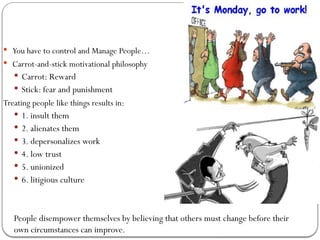
 You have to control and Manage People…
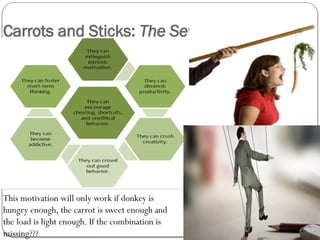
 Carrot-and-stick motivational philosophy
 Carrot: Reward
 Stick: fear and punishment
Treating people like things results in:
 1. insult them
 2. alienates them
 3. depersonalizes work
 4. low trust
 5. unionized
 6. litigious culture
People disempower themselves by believing that others must change before their
own circumstances can improve.
Carrots and Sticks: The Seven Deadly Flaws
This motivation will only work if donkey is
hungry enough, the carrot is sweet enough and
the load is light enough. If the combination is
missing???
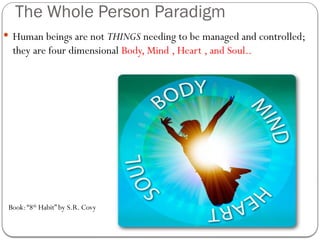
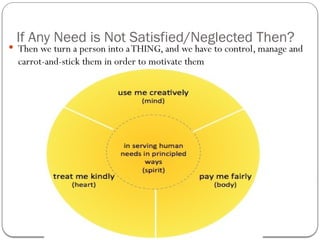
The Whole Person Paradigm
 Human beings are not THINGS needing to be managed and controlled;
they are four dimensional Body, Mind , Heart , and Soul..
Book:“8th
Habit” by S.R. Covy
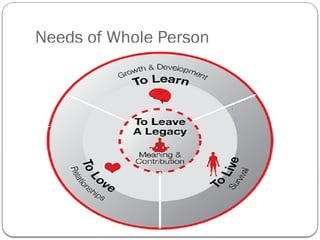
Needs of Whole Person
If Any Need is Not Satisfied/Neglected Then?
 Then we turn a person into aTHING, and we have to control, manage and
carrot-and-stick them in order to motivate them
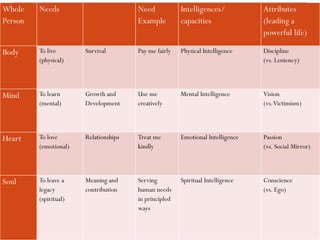
Whole
Person
Needs Need
Example
Intelligences/
capacities
Attributes
(leading a
powerful life)
Body To live
(physical)
Survival Pay me fairly Physical Intelligence Discipline
(vs. Leniency)
Mind To learn
(mental)
Growth and
Development
Use me
creatively
Mental Intelligence Vision
(vs.Victimism)
Heart To love
(emotional)
Relationships Treat me
kindly
Emotional Intelligence Passion
(vs. Social Mirror)
Soul To leave a
legacy
(spiritual)
Meaning and
contribution
Serving
human needs
in principled
ways
Spiritual Intelligence Conscience
(vs. Ego)
Highest manifestations of these four
intelligences
 Vision: to seeing with the mind’s eye what is possible in
people, in projects, in causes and in enterprises, mind’s
capacity to create.
 Discipline: deal with hard, pragmatic, brutal facts of
reality and doing what it takes to make things happen.
 Passion: is the fire, the desire, the strength of conviction and
the drive that sustain the discipline to achieve the vision.
 Conscience: is the inward moral sense of what is right and
what is wrong, the drive towards meaning and contribution.
The guiding force to vision, discipline and passion.
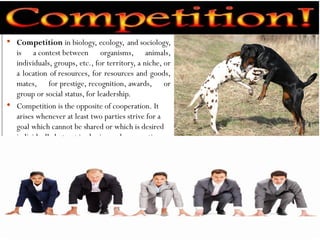
Competition and Motivation
 Competition in biology, ecology, and sociology,
is a contest between organisms, animals,
individuals, groups, etc., for territory, a niche, or
a location of resources, for resources and goods,
mates, for prestige, recognition, awards, or
group or social status, for leadership.
 Competition is the opposite of cooperation. It

arises whenever at least two parties strive for a
goal which cannot be shared or which is desired
individually but not in sharing and cooperation
 Q: what are the outputs/results of COMPETITION?
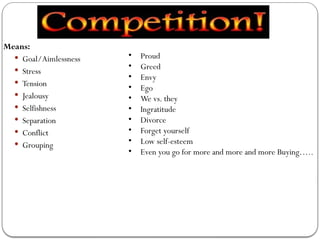
Means:
 Goal/Aimlessness
 Stress
 Tension
 Jealousy
 Selfishness
 Separation
 Conflict
 Grouping
• Proud
• Greed
• Envy
• Ego
• We vs. they
• Ingratitude
• Divorce
• Forget yourself
• Low self-esteem
• Even you go for more and more and more Buying…..
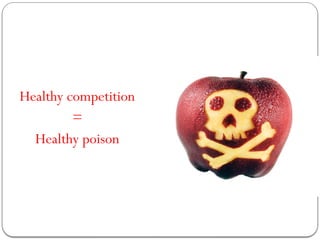
Healthy competition
=
Healthy poison
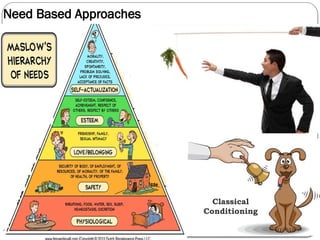
Need Based Approaches
Classical
Conditioning
 Regardless of my environment, education and experience, who is
responsible for my attitude, motivation, mood, results etc….?
 Who has to accept responsibility?
 ME
 Can I change my attitude/mood/motivation regardless of my
environment, education and experience???
Cognitive Approaches
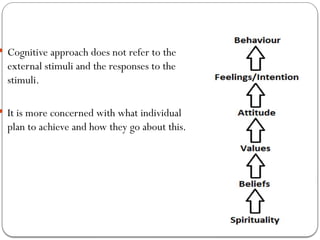
 Cognitive approach does not refer to the
external stimuli and the responses to the
stimuli.
 It is more concerned with what individual
plan to achieve and how they go about this.
Goal-Setting Theory
 Goal-setting theory contends that performance goals play a
key role in motivation.
 The theory proposes that goals can mobilize employee
efforts, direct attention, increase persistence, and affect the
strategies employees use to accomplish tasks.
 Specific, difficult, and employee-accepted goals will lead to
higher levels of performance than easy, vague (such as do
your best) or nonexistent one.
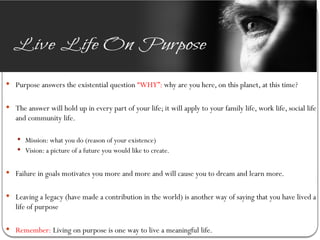
 Purpose answers the existential question “WHY”: why are you here, on this planet, at this time?
 The answer will hold up in every part of your life; it will apply to your family life, work life, social life
and community life.
 Mission: what you do (reason of your existence)
 Vision: a picture of a future you would like to create.
 Failure in goals motivates you more and more and will cause you to dream and learn more.
 Leaving a legacy (have made a contribution in the world) is another way of saying that you have lived a
life of purpose
 Remember: Living on purpose is one way to live a meaningful life.
 A man with purpose can not be molded, stressed, or cursed or
demotivated.
 Always keep the end/goal in mind.
 Until you have objectives you remain young and alive.
 What happens with people after their retirement?
 Why do female look too old even at the age of 40?
 Wise people always know about themselves. Spend some time for you…
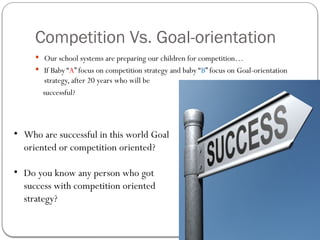
Competition Vs. Goal-orientation
 Our school systems are preparing our children for competition…
 If Baby “A” focus on competition strategy and baby “B” focus on Goal-orientation
strategy, after 20 years who will be
successful?
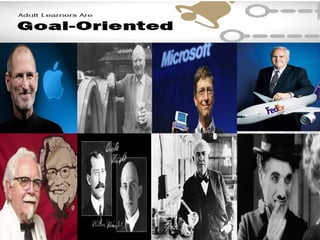
• Who are successful in this world Goal
oriented or competition oriented?
• Do you know any person who got
success with competition oriented
strategy?
The Law of Pain and Gain
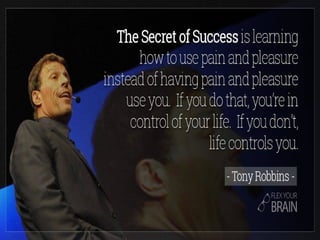
 There are two forces that motivate people to do what they do:
 the desire to avoid pain or
 the desire to gain pleasure.
 The decisions you make, the actions you take, and the habits you
indulge in, are all based upon this principle.
 What drive our behavior is instinctive reaction to pain and
pleasure, not intellectual calculation.
(many times our emotions/the sensations that we link to our
thoughts rather our intellect that really drives us)
 Remember:We all do more to avoid pain than we will to
gain pleasure.
 WHEN DO PEOPLE CHANGE?When cost of no change is
greater than cost of change, people change.
Use of Pain and Gain
 What we can learn from this?
 We can learn to condition our minds, bodies, and emotions to link
massive pain or pleasure to whatever we choose. By changing what we
link pain and pleasure to, we will instantly change our behavior.
 i.e Advertisers clearly understand that what drives us is not so much
our intellect as the sensations that we link to their products.
 When our emotions are at their peak, sensations are their most intense, they flash
an image of their product continuously until we link it to these desired feeling.
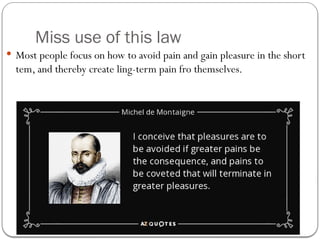
Miss use of this law
 Most people focus on how to avoid pain and gain pleasure in the short
tem, and thereby create ling-term pain fro themselves.
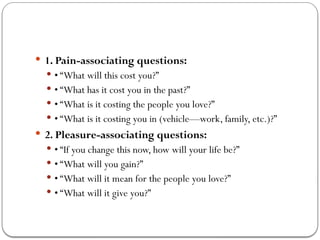
 1. Pain-associating questions:
 • “What will this cost you?”
 • “What has it cost you in the past?”
 • “What is it costing the people you love?”
 • “What is it costing you in (vehicle—work, family, etc.)?”
 2. Pleasure-associating questions:
 • “If you change this now, how will your life be?”
 • “What will you gain?”
 • “What will it mean for the people you love?”
 • “What will it give you?”
Non-Cognitive approaches
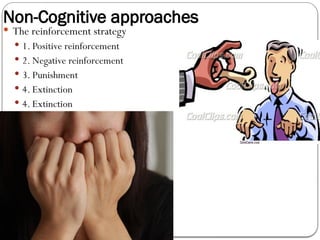
 The reinforcement strategy
 1. Positive reinforcement
 2. Negative reinforcement
 3. Punishment
 4. Extinction
 4. Extinction
Reinforcement theory can be applied using a set of techniques known as
behavior modification.
 1. Positive reinforcement
 Refers to increasing the frequency of a behavior by following the behavior with
a pleasurable consequences
 2. Negative reinforcement
 Increase the frequency of a behavior by removing something displeasureable
after the behavior is performed.
 3. Punishment
 Seeks to decrease the frequency of a behavior by introducing an adverse
consequence immediately after the behavior.
 4. Extinction
 Seeks to decrease the frequency of a behavior by removing the consequence
that is reinforcing it.
Belief Systems: The Power to Create and
The Power to Destroy Motivation
 The most powerful motivation comes from within our belief
system.
 A belief is a “feeling of certainty about something”.
 People will do a lot for money, more for a good leader, but
most for a belief.
 It is not the events of our lives that shapes us, but our beliefs
(the meaning we attach/how interpret to those events).
 Beliefs are guiding forces to tell us what will lead to pain and what will lead to
pleasure.
 Once accepted our beliefs become unquestioned commands to our nervous
system and affect our immune systems and can either give us the resolve to
take action, or weaken and destroy our motivation.
 Beliefs can impact on our emotions, actions and bodies, diseases.
 Our beliefs about the illness and its treatment play more significant role than
the treatment itself (Psychoneuroimmunology; mind body relationship).
 A false or limiting belief is also a belief.
 People so often develop limiting beliefs about who they are and what
they are capable of because they haven’t succeeded in the past.
 What is the difference between Optimistic and Pessimistic people?
 To change Beliefs:
 get your brain to associate massive pain to the old belief the associate
tremendous pleasure to the idea of adopting a new empowering belief.
 Create doubts and start questioning your limiting beliefs… then see the
magic of Motivation….
 Remember: If you want to create long term and consistent changes in
your behavior, you must change the BELIEFS that are holding you back.
Power of Imagination and Motivation
 You can succeed if you imagine something (i.e. your success)
vividly enough just as easily as if you had the actual experiences.
(used in self hypnosis)
 That’s because our brains can’t tell the difference between
something we have vividly imagined and something we have
actually experienced.
 With enough emotional intensity and repetition, our nervous
systems experience something as real, even it hasn’t occurred
yet.
 Intensify and increase number of outputs/results of behavior.
 For example:After completion of my PhD degree I will get;
1. A doctorate degree
2. Word DR. before my name
3. A good job
4. A status and respect in society
5. Handful earning
6. Proud for my parents
7. Making my dreams true
8. Having, home, car, bank balance
9. Opportunity to serve my society, country, religion
10. A happy married life
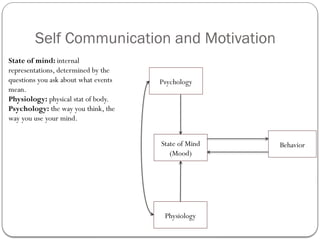
Self Communication and Motivation
Behavior
State of Mind
(Mood)
Psychology
Physiology
State of mind: internal
representations, determined by the
questions you ask about what events
mean.
Physiology: physical stat of body.
Psychology: the way you think, the
way you use your mind.
 Problem Frame in Physiology and Psychology:
 What’s wrong?
 When did it start?
 Whose fault is it?
 Why do these things happen to me only?
 How this problem limits me?
 How long have I had this problem?
 How does this problem cause me to fail?
On average you use 48000-60000 words a day.
Analyze the words you talk to yourself.
Change the way you talk to yourself.
Especially at the beginning of the day.
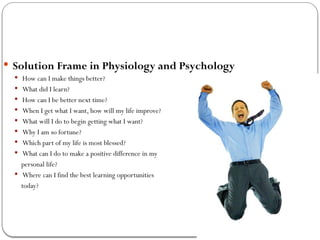
 Solution Frame in Physiology and Psychology
 How can I make things better?
 What did I learn?
 How can I be better next time?
 When I get what I want, how will my life improve?
 What will I do to begin getting what I want?
 Why I am so fortune?
 Which part of my life is most blessed?
 What can I do to make a positive difference in my
personal life?
 Where can I find the best learning opportunities
today?
 Exercise 01:
 Step one:
 Think about something bad/problem.And pretend you are
depressed. Sit, talk, breath like you are depressed.And then feel
the inner feelings and energy level.
 Step two:
 With same thinking, stand up, stretch your body, increase your
voice, hit your chest And then feel the inner feelings and energy
level.
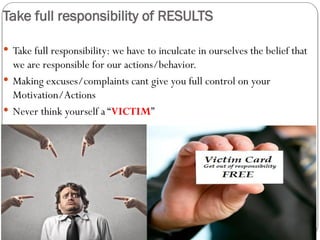
Take full responsibility of RESULTS
 Take full responsibility: we have to inculcate in ourselves the belief that
we are responsible for our actions/behavior.
 Making excuses/complaints cant give you full control on your
Motivation/Actions
 Never think yourself a “VICTIM”
Scare & Grief
Few more ideas to motivate
 1. Live for others.Always focus that what is there in it for
others…
 2. Don’t bother about those things that are not directly
related to you or not under your control.
 3.Take ALLAH (the creator) with you
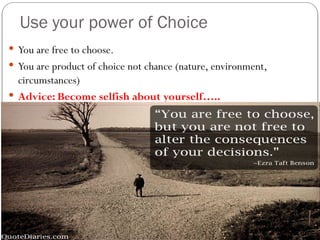
Use your power of Choice
 You are free to choose.
 You are product of choice not chance (nature, environment,
circumstances)
 Advice: Become selfish about yourself…..
Employee Performance and Motivation.pptx

Employee Performance and Motivation.pptx

  • 1.
    By: Dr. GhulamDastgeer +92-333-5111-469 hellodastgeer@gmail.com Employee Performance and Motivation
  • 2.
  • 4.
    Our Responsibilities  Myresponsibilities  I am here to give you values  For your money  For your time  Your responsibilities  Be a student…  Don’t be an evaluator  All things are working perfectly out there, just disconnect yourself from all those things.
  • 5.
    The Employee….  Organizationsare the people/employee in them; that employee make the place…  Performance of the organizations depends on the quality, dedication, enthusiasm, expertise and skills of the employees working in them at all levels.
  • 6.
    • Every individualemployee in an organization needs proper: – Recruitment – Selection – Orientation – Socialization – Job design – Pay and Rewards – Training – Performance management – Feedback – Couching – Mentoring – Counseling – Conflict resolution/management – Leadership – Motivation – Career development – Safety and Health – Employee wellbeing – Employee-Employer Relationships – Stress management – Work life and family life balance – Retirement and old age benefits...etc…
  • 7.
    • Every individualin an organization is different: – Behavior – Attitude – Personality – Emotions – Moods – Values – Perception – Decision Making – Motivation – Leadership skills
  • 8.
     Q: whydo certain individuals perform better than others? or What factors cause an employee to perform at a certain level?
  • 9.
    Determinants of Performance Performance= Declarative Knowledge X Procedural Knowledge X Motivation In any of the determinants has a value of 0, then performance also has a value of 0.
  • 10.
    A. Declarative Knowledge Declarative knowledge is information about facts an things, including information regarding a given task’s requirements, labels, principles, and goals.
  • 11.
    B. Procedural Knowledge •Procedural knowledge is combination of knowing what to do and how to do it and include cognitive and physical skills
  • 12.
    C. Motivation  Motivationinvolves three types of Choices  Expenditure of effort (I will go to work today)  Level of effort (I will put in my best efforts at work)  Persistence of effort (I will persist no matter what)
  • 13.
    Performance Dimensions: Types ofmulti-dimensional behaviors: Two types of behaviors or performance facts stand out:  Task performance  Contextual performance
  • 14.
    Task performance T.P isdefined as activities that  From the perspective of managers: performance on the job often consist of outcomes.  Goals/actions, not the activities, that are important.  Transform raw materials into the goods and services.  How many sales were made?  How much was waste reduces?  How many were made?
  • 15.
    Contextual performance  Fromthe perspective of Employees: it is what workers do day in and day out on the job (activities on various tasks).  From this perspective performance consists of behaviors, and how well those behaviors are executed.  Behaviors that contribute to organization’s effectiveness and provide a good environment in which task performance can occur
  • 16.
     Contextual performanceexamples:  Being punctual  Expending extra efforts on the job  Suggesting organizational improvements,  Assisting and helping coworkers and customers  Following orders and regulations  Showing respect for authority  Complying with organizational values and policies  Organizational loyalty  Representing the organization favorably to outsiders.
  • 17.
     Q; whyboth task and contextual performance are important dimensions to take into account in performance management systems???
  • 18.
  • 19.
    • No matterhow Successful you may be there is ALWAYS a room for IMPROVEMENT. Strive to the maximum of your potential. Don’t take the ordinary road of mediocrity.
  • 20.
    You can havemore than you have got because you can become more than you are (Jim Rohn). Traditional (wrong formula) HAVE: have enough (money, resources, things) DO: so what you want BE: be happy, successful, educated, talented, Life is not designed to give us what we need, but the life is designed to give us what we deserve.
  • 21.
    Revised (Correct) BE: bewho you are, know your strengths, values, purpose Create your worth/value DO: do what you love.This doing will be the contribution of your unique gift. HAVE: what you need. Marketplace is not interested in your needs they are interested in your seeds/willingness/eagerness/values. Is it possible for you to earn the double in the same period of time? LEARNTHE PROCESS OF DESERVING NOT JUST NEEDING. How do you treat your child? GOD: If you come to me, I will come to you.
  • 24.
    Your Comfort Zone Comfort zone is Psychological state in which a person feels familiar, at ease, in control; and experience low anxiety and stress.  To develop your Comfort Zone you just need Repetition.
  • 25.
    Expending Your ComfortZone  Objective in expending your Comfort Zone is to raise our optimal performance level and become confortable with that new level.  Your brain is your server, Give it chance to learn and repeat it.  Real limitationsVs Perceived Limitations
  • 26.
    The Process ofManifestation…  So your present state is nothing more than the physical manifestation of your previous thinking.  As long as we keep operating from the same internal programs we will keep getting same results.  To change/improve your RESULTS you must change your Internal programming/thoughts immediately. Internal Programing (Thoughts) Feelings (Emotional involvement) Action Results (+/-)
  • 27.
    What is motivation? Motivation is the ability to take control on your mind and to turn problems and difficulties into solutions and energy to successfully achieve your goals.
  • 28.
    Importance of Motivation Costof: Cost of :  failing to fully engage:  Passion  Talent  intelligence  Taxes  Interest Charges  Labor cost
  • 29.
    The Rise andFall of Motivation  Motivation 1.0 – presumed that humans were biological creatures, struggling to obtain our basic needs for food, security. (Extrinsic)  Motivation 2.0 – presumed that humans also responded to rewards and punishments.That worked fine for routine tasks but incompatible with how we organize. (Extrinsic)  Motivation 3.0 – the upgrade we now need, presumes that humans also have a drive to learn, to create, and to better the world. (Intrinsic) Book: “Drive” by D.Pink
  • 30.
    The Thing Mind-setof The Industrial Age  The main assists and primary drives of economics prosperity in the IndustrialAge were  MACHINES and CAPITAL.  People were treated:  as THINGS  as Expense  All you want is a “person’s body”  Replaceable
  • 31.
     You haveto control and Manage People…  Carrot-and-stick motivational philosophy  Carrot: Reward  Stick: fear and punishment Treating people like things results in:  1. insult them  2. alienates them  3. depersonalizes work  4. low trust  5. unionized  6. litigious culture People disempower themselves by believing that others must change before their own circumstances can improve.
  • 32.
    Carrots and Sticks:The Seven Deadly Flaws This motivation will only work if donkey is hungry enough, the carrot is sweet enough and the load is light enough. If the combination is missing???
  • 33.
    The Whole PersonParadigm  Human beings are not THINGS needing to be managed and controlled; they are four dimensional Body, Mind , Heart , and Soul.. Book:“8th Habit” by S.R. Covy
  • 34.
  • 35.
    If Any Needis Not Satisfied/Neglected Then?  Then we turn a person into aTHING, and we have to control, manage and carrot-and-stick them in order to motivate them
  • 36.
    Whole Person Needs Need Example Intelligences/ capacities Attributes (leading a powerfullife) Body To live (physical) Survival Pay me fairly Physical Intelligence Discipline (vs. Leniency) Mind To learn (mental) Growth and Development Use me creatively Mental Intelligence Vision (vs.Victimism) Heart To love (emotional) Relationships Treat me kindly Emotional Intelligence Passion (vs. Social Mirror) Soul To leave a legacy (spiritual) Meaning and contribution Serving human needs in principled ways Spiritual Intelligence Conscience (vs. Ego)
  • 37.
    Highest manifestations ofthese four intelligences  Vision: to seeing with the mind’s eye what is possible in people, in projects, in causes and in enterprises, mind’s capacity to create.  Discipline: deal with hard, pragmatic, brutal facts of reality and doing what it takes to make things happen.  Passion: is the fire, the desire, the strength of conviction and the drive that sustain the discipline to achieve the vision.  Conscience: is the inward moral sense of what is right and what is wrong, the drive towards meaning and contribution. The guiding force to vision, discipline and passion.
  • 38.
  • 39.
     Competition inbiology, ecology, and sociology, is a contest between organisms, animals, individuals, groups, etc., for territory, a niche, or a location of resources, for resources and goods, mates, for prestige, recognition, awards, or group or social status, for leadership.  Competition is the opposite of cooperation. It arises whenever at least two parties strive for a goal which cannot be shared or which is desired individually but not in sharing and cooperation
  • 40.
     Q: whatare the outputs/results of COMPETITION?
  • 41.
    Means:  Goal/Aimlessness  Stress Tension  Jealousy  Selfishness  Separation  Conflict  Grouping • Proud • Greed • Envy • Ego • We vs. they • Ingratitude • Divorce • Forget yourself • Low self-esteem • Even you go for more and more and more Buying…..
  • 42.
  • 43.
  • 44.
     Regardless ofmy environment, education and experience, who is responsible for my attitude, motivation, mood, results etc….?  Who has to accept responsibility?  ME  Can I change my attitude/mood/motivation regardless of my environment, education and experience???
  • 45.
  • 46.
     Cognitive approachdoes not refer to the external stimuli and the responses to the stimuli.  It is more concerned with what individual plan to achieve and how they go about this.
  • 47.
    Goal-Setting Theory  Goal-settingtheory contends that performance goals play a key role in motivation.  The theory proposes that goals can mobilize employee efforts, direct attention, increase persistence, and affect the strategies employees use to accomplish tasks.  Specific, difficult, and employee-accepted goals will lead to higher levels of performance than easy, vague (such as do your best) or nonexistent one.
  • 48.
     Purpose answersthe existential question “WHY”: why are you here, on this planet, at this time?  The answer will hold up in every part of your life; it will apply to your family life, work life, social life and community life.  Mission: what you do (reason of your existence)  Vision: a picture of a future you would like to create.  Failure in goals motivates you more and more and will cause you to dream and learn more.  Leaving a legacy (have made a contribution in the world) is another way of saying that you have lived a life of purpose  Remember: Living on purpose is one way to live a meaningful life.
  • 49.
     A manwith purpose can not be molded, stressed, or cursed or demotivated.  Always keep the end/goal in mind.  Until you have objectives you remain young and alive.  What happens with people after their retirement?  Why do female look too old even at the age of 40?  Wise people always know about themselves. Spend some time for you…
  • 50.
    Competition Vs. Goal-orientation Our school systems are preparing our children for competition…  If Baby “A” focus on competition strategy and baby “B” focus on Goal-orientation strategy, after 20 years who will be successful? • Who are successful in this world Goal oriented or competition oriented? • Do you know any person who got success with competition oriented strategy?
  • 52.
    The Law ofPain and Gain
  • 53.
    The Law ofPain and Gain  There are two forces that motivate people to do what they do:  the desire to avoid pain or  the desire to gain pleasure.  The decisions you make, the actions you take, and the habits you indulge in, are all based upon this principle.
  • 54.
     What driveour behavior is instinctive reaction to pain and pleasure, not intellectual calculation. (many times our emotions/the sensations that we link to our thoughts rather our intellect that really drives us)  Remember:We all do more to avoid pain than we will to gain pleasure.  WHEN DO PEOPLE CHANGE?When cost of no change is greater than cost of change, people change.
  • 55.
    Use of Painand Gain  What we can learn from this?  We can learn to condition our minds, bodies, and emotions to link massive pain or pleasure to whatever we choose. By changing what we link pain and pleasure to, we will instantly change our behavior.  i.e Advertisers clearly understand that what drives us is not so much our intellect as the sensations that we link to their products.  When our emotions are at their peak, sensations are their most intense, they flash an image of their product continuously until we link it to these desired feeling.
  • 57.
    Miss use ofthis law  Most people focus on how to avoid pain and gain pleasure in the short tem, and thereby create ling-term pain fro themselves.
  • 58.
     1. Pain-associatingquestions:  • “What will this cost you?”  • “What has it cost you in the past?”  • “What is it costing the people you love?”  • “What is it costing you in (vehicle—work, family, etc.)?”  2. Pleasure-associating questions:  • “If you change this now, how will your life be?”  • “What will you gain?”  • “What will it mean for the people you love?”  • “What will it give you?”
  • 59.
    Non-Cognitive approaches  Thereinforcement strategy  1. Positive reinforcement  2. Negative reinforcement  3. Punishment  4. Extinction  4. Extinction
  • 60.
    Reinforcement theory canbe applied using a set of techniques known as behavior modification.  1. Positive reinforcement  Refers to increasing the frequency of a behavior by following the behavior with a pleasurable consequences  2. Negative reinforcement  Increase the frequency of a behavior by removing something displeasureable after the behavior is performed.  3. Punishment  Seeks to decrease the frequency of a behavior by introducing an adverse consequence immediately after the behavior.  4. Extinction  Seeks to decrease the frequency of a behavior by removing the consequence that is reinforcing it.
  • 61.
    Belief Systems: ThePower to Create and The Power to Destroy Motivation  The most powerful motivation comes from within our belief system.  A belief is a “feeling of certainty about something”.  People will do a lot for money, more for a good leader, but most for a belief.  It is not the events of our lives that shapes us, but our beliefs (the meaning we attach/how interpret to those events).
  • 62.
     Beliefs areguiding forces to tell us what will lead to pain and what will lead to pleasure.  Once accepted our beliefs become unquestioned commands to our nervous system and affect our immune systems and can either give us the resolve to take action, or weaken and destroy our motivation.  Beliefs can impact on our emotions, actions and bodies, diseases.  Our beliefs about the illness and its treatment play more significant role than the treatment itself (Psychoneuroimmunology; mind body relationship).
  • 63.
     A falseor limiting belief is also a belief.  People so often develop limiting beliefs about who they are and what they are capable of because they haven’t succeeded in the past.  What is the difference between Optimistic and Pessimistic people?  To change Beliefs:  get your brain to associate massive pain to the old belief the associate tremendous pleasure to the idea of adopting a new empowering belief.  Create doubts and start questioning your limiting beliefs… then see the magic of Motivation….  Remember: If you want to create long term and consistent changes in your behavior, you must change the BELIEFS that are holding you back.
  • 64.
    Power of Imaginationand Motivation  You can succeed if you imagine something (i.e. your success) vividly enough just as easily as if you had the actual experiences. (used in self hypnosis)  That’s because our brains can’t tell the difference between something we have vividly imagined and something we have actually experienced.  With enough emotional intensity and repetition, our nervous systems experience something as real, even it hasn’t occurred yet.
  • 65.
     Intensify andincrease number of outputs/results of behavior.  For example:After completion of my PhD degree I will get; 1. A doctorate degree 2. Word DR. before my name 3. A good job 4. A status and respect in society 5. Handful earning 6. Proud for my parents 7. Making my dreams true 8. Having, home, car, bank balance 9. Opportunity to serve my society, country, religion 10. A happy married life
  • 66.
    Self Communication andMotivation Behavior State of Mind (Mood) Psychology Physiology State of mind: internal representations, determined by the questions you ask about what events mean. Physiology: physical stat of body. Psychology: the way you think, the way you use your mind.
  • 67.
     Problem Framein Physiology and Psychology:  What’s wrong?  When did it start?  Whose fault is it?  Why do these things happen to me only?  How this problem limits me?  How long have I had this problem?  How does this problem cause me to fail? On average you use 48000-60000 words a day. Analyze the words you talk to yourself. Change the way you talk to yourself. Especially at the beginning of the day.
  • 68.
     Solution Framein Physiology and Psychology  How can I make things better?  What did I learn?  How can I be better next time?  When I get what I want, how will my life improve?  What will I do to begin getting what I want?  Why I am so fortune?  Which part of my life is most blessed?  What can I do to make a positive difference in my personal life?  Where can I find the best learning opportunities today?
  • 69.
     Exercise 01: Step one:  Think about something bad/problem.And pretend you are depressed. Sit, talk, breath like you are depressed.And then feel the inner feelings and energy level.  Step two:  With same thinking, stand up, stretch your body, increase your voice, hit your chest And then feel the inner feelings and energy level.
  • 70.
    Take full responsibilityof RESULTS  Take full responsibility: we have to inculcate in ourselves the belief that we are responsible for our actions/behavior.  Making excuses/complaints cant give you full control on your Motivation/Actions  Never think yourself a “VICTIM”
  • 71.
  • 72.
    Few more ideasto motivate  1. Live for others.Always focus that what is there in it for others…  2. Don’t bother about those things that are not directly related to you or not under your control.  3.Take ALLAH (the creator) with you
  • 73.
    Use your powerof Choice  You are free to choose.  You are product of choice not chance (nature, environment, circumstances)  Advice: Become selfish about yourself…..