Strengths Based Leadership- Manager Review By Tom Rath &  Barry Conchie
Introduction “ I’ve never met a effective leader who wasn’t aware of his talents and working to sharpen them.” -Former NATO Supreme Commander , Wesley Clark In the New York Times Magazine
Introduction The best leaders get to live on Think of the leaders you respect These leaders live on because they shaped your thoughts and beliefs Effective leaders forever alter the course of your life What are the keys to being an effective leader? Gallup reviewed decades of data on leadership 50 years of Gallup polls on most admired leaders Initiated study of 10,000 “followers” around the world
Key Findings of Gallup Research  The most effective leaders are always investing in strengths 73% of Employees are engaged when leadership focuses on strengths The most effective leaders surround themselves with the right people and then maximize their team Best leaders are not well-rounded, the team are The most effective leaders understand their followers’ needs People follow for very specific reasons
Part 1: Investing in your Strengths  “ A leader needs to know his strengths as a carpenter knows his tools, or as a physician knows the instruments at her disposal. What great leaders have in common is that each truly knows his or her strengths – and can call on the right strength at the right time.  This explains why there is no definative list of characteristics that describe all leaders.” -Dr. Donald Clifton-father of strengths psychology
Part 1: Investing in your Strengths  “ If you focus on people’s weaknesses, they lose confidence.” -Mervyn Davies, Chairman Standard Chartered Bank Landmark “self-confidence” study by University of Florida 2008: 7,600 men & women aged 14 – 22 years of age First studied in 1979 Participants followed for 25 years and measured on the following: Career success Education Health
Part 1: Investing in your Strengths  Results of “Self Confidence” study People aware of their strengths and build self-confidence at an earlier age reap a “cumulative advantage” that continues to grow over a lifetime These results highlight the value of leaders knowing their own strengths In addition, reveal the importance of leaders to uncover the strengths of others as early as possible
Part 2: Maximizing Your Team  Effective leaders surround themselves with the right people and build on each person’s strengths. The Four Domains of Leadership Strength Executing Influencing Relationship Building Strategic Thinking
Part 2: Maximizing Your Team – Executing Domain  Leaders with dominant strength in Executing domain know how to make things happen. Implement solutions Ability to “catch” an idea and make it reality Examples: Leader may excel at establishing a quality process using themes: Deliberative, or Discipline Leader may work tirelessly toward a goal with the Achiever theme Leader with strong Arranger may determine the optimal configuration of people to complete project
Part 2: Maximizing Your Team - Executing Themes  Achiever, Arranger, Belief,  Consistency, Deliberative, Discipline,  Focus, Responsibility, Restorative
Part 2: Maximizing Your Team – Influencing Domain  Leaders with dominant strength in Influencing domain help their team reach a much broader audience. Sell team ideas inside & outside organization  Ability to “take charge” and speak up Examples: Leader with Command or Self-Assurance will project authority and win followers Leader using WOO or Communication might get people involved by getting individuals to feel comfortable and connected to the issues at hand
Part 2: Maximizing Your Team – Influencing Themes  Activator, Command, Communication, Competition, Maximizer, Self-Assurance,  Significance, WOO
Part 2: Maximizing Your Team – Relationship Builder Domain  Leaders with dominant strength in Relationship Building are the essential glue that holds a team together. Unique ability to create groups  Minimize distractions Examples: Leader with Positivity or Harmony may work hard to minimize distractions keep team energy high Leader with strong Relator or Developer may be great mentor and guide as  they push others toward bigger and better achievements.
Part 2: Maximizing Your Team – Relationship Builder Themes  Adaptability, Developer, Connectedness, Empathy, Harmony, Includer, Individualization, Positivity, Relator
Part 2: Maximizing Your Team – Strategic Thinking Domain  Leaders with dominant strength in Strategic Thinking are the ones who keep us focused on what  could be Constantly absorbing and analyzing data  Continually stretch our thinking for the future Examples: Leader with Context or Strategic might explain how past events influence present circumstances Leader with strong Ideation or Input may see countless opportunities for growth based on all the information
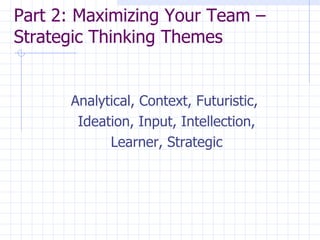
Part 2: Maximizing Your Team – Strategic Thinking Themes  Analytical, Context, Futuristic,  Ideation, Input, Intellection, Learner, Strategic
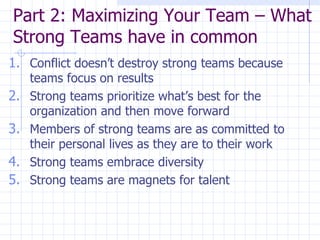
Part 2: Maximizing Your Team – What Strong Teams have in common  Conflict doesn’t destroy strong teams because teams focus on results Strong teams prioritize what’s best for the organization and then move forward Members of strong teams are as committed to their personal lives as they are to their work Strong teams embrace diversity Strong teams are magnets for talent
Part 3: Understanding Why People Follow The most effective leaders rally a broader group of people toward an organization’s goals, mission, and objectives You are a leader only if others follow Leaders are only as strong as the connections they make with each person in their constituency We continue to focus on leaders and ignore their impact on, and the opinions of, the people they lead
Part 3: Why People Follow Gallup conducted a formal study to obtain the average person’s opinion about leadership In sharp contrast to other leadership research, which is primarily based on case studies, interviews, research within one organization,  or convenience samples, this study looked at a true random sample of 10,000 followers After conducting preliminary testing with several questions, Gallup anchored research on the following 2 key questions
Part 3: Why People Follow After conducting preliminary testing with several questions, Gallup anchored research on the following 2 key questions: What leader has the most positive influence in your daily life? Now, please list three words that best describe what this person contributes to your life ____________________________________ ____________________________________ ____________________________________
Part 3: Why People Follow Every word in these questions was selected with extreme care The first part forced each person to identify a specific “leader” who “has the most positive influence” in their daily life The word  positive  was included to ensure we were not studying leaders with negative influence Peter Drucker said,  “The 3 greatest leaders of the 20 th  century were Hitler, Stalin, and Mao.  If that is leadership, I want no part of it.”
Part 3: Why People Follow Upon completion of our survey we studied the 25 most commonly mentioned words To our surprise many of the “usual suspects ”  Purpose, Wisdom, Humor, Humility  were not listed 1,000 people listed the exact same word Followers have a clear picture of what they want and need from the most influential leaders in their lives: Trust  Compassion Stability Hope
Why People Follow - Trust On leader interviewed said,  “The truth is your bond – you die keeping your promises or you send the message that your word is not worth much.” Trust might be the “do or die” foundation for leading The followers we surveyed also cited  honesty, integrity, and respect  as distinct contributions Gallup’s latest research on trust in leadership also suggests that this foundation is closely linked to employee engagement
Why People Follow – Trust Activity Best Buy’s Brad Anderson described trust as  “the most cherished and valuable commodity in a work environment.” Brad Anderson’s key to building trust is being authentic even if that means letting people see his flaws, he feels he has no choice but to be candid even when delivering difficult news How do you convince a person of your honesty? Share out best practices or creative ideas to build trust with our employees
Why People Follow - Compassion Unfortunately, most leaders are hesitant to show genuine compassion for the people they lead, at least in the same way they would with a friend or family member Study shows leaders would be wise to show they care for their employees Caring, friendship, happiness,  and  love  were other frequently mentioned words in survey If people are to truly love their organization, it needs to have a heart
Why People Follow – Compassion Activity What can we do as leaders at Broyhill to show compassion to our employees? Share out current best practices or creative ideas to implement (Insert best practices & ideas here)
Why People Follow - Stability Need a leader who will provide a solid foundation Can count on a leader in times of trouble Need to know your core values are stable While it is critical for organizations to evolve, change, and grow over time, they must also offer employees stability and confidence Employees who have a high confidence in their company’s financial future are  nine times  as likely to be engaged in their jobs when compared to those without confidence in their company
Why People Follow – Stability Activity At a company level, nothing creates stability as quickly as transparency What can we do as leaders at Broyhill to provide stability to our employees? Share out current best practices or creative ideas to implement (Insert best practices & ideas here)
Why People Follow - Hope This higher level need poses an interesting challenge; it appears that followers want stability in the moment  and   hope for the future Other words mention in survey:  direction, faith, guidance When employees responded to the statement, “ feel enthusiastic about the future”  - 69% of those of employees who strongly agreed were engaged in their jobs When hope is absent, people lose confidence, disengage, and often feel helpless
Why People Follow – Hope Activity While solving difficult problems is an essential part of any effective leadership, identifying opportunities for the future plays a much more important role in creating hope and optimism What can we do as leaders at Broyhill to create hope for our employees? Share out current best practices or creative ideas to implement (Insert best practices & ideas here)

Strengths Based Leadership Managers Workshop

  • 1.
    Strengths Based Leadership-Manager Review By Tom Rath & Barry Conchie
  • 2.
    Introduction “ I’venever met a effective leader who wasn’t aware of his talents and working to sharpen them.” -Former NATO Supreme Commander , Wesley Clark In the New York Times Magazine
  • 3.
    Introduction The bestleaders get to live on Think of the leaders you respect These leaders live on because they shaped your thoughts and beliefs Effective leaders forever alter the course of your life What are the keys to being an effective leader? Gallup reviewed decades of data on leadership 50 years of Gallup polls on most admired leaders Initiated study of 10,000 “followers” around the world
  • 4.
    Key Findings ofGallup Research The most effective leaders are always investing in strengths 73% of Employees are engaged when leadership focuses on strengths The most effective leaders surround themselves with the right people and then maximize their team Best leaders are not well-rounded, the team are The most effective leaders understand their followers’ needs People follow for very specific reasons
  • 5.
    Part 1: Investingin your Strengths “ A leader needs to know his strengths as a carpenter knows his tools, or as a physician knows the instruments at her disposal. What great leaders have in common is that each truly knows his or her strengths – and can call on the right strength at the right time. This explains why there is no definative list of characteristics that describe all leaders.” -Dr. Donald Clifton-father of strengths psychology
  • 6.
    Part 1: Investingin your Strengths “ If you focus on people’s weaknesses, they lose confidence.” -Mervyn Davies, Chairman Standard Chartered Bank Landmark “self-confidence” study by University of Florida 2008: 7,600 men & women aged 14 – 22 years of age First studied in 1979 Participants followed for 25 years and measured on the following: Career success Education Health
  • 7.
    Part 1: Investingin your Strengths Results of “Self Confidence” study People aware of their strengths and build self-confidence at an earlier age reap a “cumulative advantage” that continues to grow over a lifetime These results highlight the value of leaders knowing their own strengths In addition, reveal the importance of leaders to uncover the strengths of others as early as possible
  • 8.
    Part 2: MaximizingYour Team Effective leaders surround themselves with the right people and build on each person’s strengths. The Four Domains of Leadership Strength Executing Influencing Relationship Building Strategic Thinking
  • 9.
    Part 2: MaximizingYour Team – Executing Domain Leaders with dominant strength in Executing domain know how to make things happen. Implement solutions Ability to “catch” an idea and make it reality Examples: Leader may excel at establishing a quality process using themes: Deliberative, or Discipline Leader may work tirelessly toward a goal with the Achiever theme Leader with strong Arranger may determine the optimal configuration of people to complete project
  • 10.
    Part 2: MaximizingYour Team - Executing Themes Achiever, Arranger, Belief, Consistency, Deliberative, Discipline, Focus, Responsibility, Restorative
  • 11.
    Part 2: MaximizingYour Team – Influencing Domain Leaders with dominant strength in Influencing domain help their team reach a much broader audience. Sell team ideas inside & outside organization Ability to “take charge” and speak up Examples: Leader with Command or Self-Assurance will project authority and win followers Leader using WOO or Communication might get people involved by getting individuals to feel comfortable and connected to the issues at hand
  • 12.
    Part 2: MaximizingYour Team – Influencing Themes Activator, Command, Communication, Competition, Maximizer, Self-Assurance, Significance, WOO
  • 13.
    Part 2: MaximizingYour Team – Relationship Builder Domain Leaders with dominant strength in Relationship Building are the essential glue that holds a team together. Unique ability to create groups Minimize distractions Examples: Leader with Positivity or Harmony may work hard to minimize distractions keep team energy high Leader with strong Relator or Developer may be great mentor and guide as they push others toward bigger and better achievements.
  • 14.
    Part 2: MaximizingYour Team – Relationship Builder Themes Adaptability, Developer, Connectedness, Empathy, Harmony, Includer, Individualization, Positivity, Relator
  • 15.
    Part 2: MaximizingYour Team – Strategic Thinking Domain Leaders with dominant strength in Strategic Thinking are the ones who keep us focused on what could be Constantly absorbing and analyzing data Continually stretch our thinking for the future Examples: Leader with Context or Strategic might explain how past events influence present circumstances Leader with strong Ideation or Input may see countless opportunities for growth based on all the information
  • 16.
    Part 2: MaximizingYour Team – Strategic Thinking Themes Analytical, Context, Futuristic, Ideation, Input, Intellection, Learner, Strategic
  • 17.
    Part 2: MaximizingYour Team – What Strong Teams have in common Conflict doesn’t destroy strong teams because teams focus on results Strong teams prioritize what’s best for the organization and then move forward Members of strong teams are as committed to their personal lives as they are to their work Strong teams embrace diversity Strong teams are magnets for talent
  • 18.
    Part 3: UnderstandingWhy People Follow The most effective leaders rally a broader group of people toward an organization’s goals, mission, and objectives You are a leader only if others follow Leaders are only as strong as the connections they make with each person in their constituency We continue to focus on leaders and ignore their impact on, and the opinions of, the people they lead
  • 19.
    Part 3: WhyPeople Follow Gallup conducted a formal study to obtain the average person’s opinion about leadership In sharp contrast to other leadership research, which is primarily based on case studies, interviews, research within one organization, or convenience samples, this study looked at a true random sample of 10,000 followers After conducting preliminary testing with several questions, Gallup anchored research on the following 2 key questions
  • 20.
    Part 3: WhyPeople Follow After conducting preliminary testing with several questions, Gallup anchored research on the following 2 key questions: What leader has the most positive influence in your daily life? Now, please list three words that best describe what this person contributes to your life ____________________________________ ____________________________________ ____________________________________
  • 21.
    Part 3: WhyPeople Follow Every word in these questions was selected with extreme care The first part forced each person to identify a specific “leader” who “has the most positive influence” in their daily life The word positive was included to ensure we were not studying leaders with negative influence Peter Drucker said, “The 3 greatest leaders of the 20 th century were Hitler, Stalin, and Mao. If that is leadership, I want no part of it.”
  • 22.
    Part 3: WhyPeople Follow Upon completion of our survey we studied the 25 most commonly mentioned words To our surprise many of the “usual suspects ” Purpose, Wisdom, Humor, Humility were not listed 1,000 people listed the exact same word Followers have a clear picture of what they want and need from the most influential leaders in their lives: Trust Compassion Stability Hope
  • 23.
    Why People Follow- Trust On leader interviewed said, “The truth is your bond – you die keeping your promises or you send the message that your word is not worth much.” Trust might be the “do or die” foundation for leading The followers we surveyed also cited honesty, integrity, and respect as distinct contributions Gallup’s latest research on trust in leadership also suggests that this foundation is closely linked to employee engagement
  • 24.
    Why People Follow– Trust Activity Best Buy’s Brad Anderson described trust as “the most cherished and valuable commodity in a work environment.” Brad Anderson’s key to building trust is being authentic even if that means letting people see his flaws, he feels he has no choice but to be candid even when delivering difficult news How do you convince a person of your honesty? Share out best practices or creative ideas to build trust with our employees
  • 25.
    Why People Follow- Compassion Unfortunately, most leaders are hesitant to show genuine compassion for the people they lead, at least in the same way they would with a friend or family member Study shows leaders would be wise to show they care for their employees Caring, friendship, happiness, and love were other frequently mentioned words in survey If people are to truly love their organization, it needs to have a heart
  • 26.
    Why People Follow– Compassion Activity What can we do as leaders at Broyhill to show compassion to our employees? Share out current best practices or creative ideas to implement (Insert best practices & ideas here)
  • 27.
    Why People Follow- Stability Need a leader who will provide a solid foundation Can count on a leader in times of trouble Need to know your core values are stable While it is critical for organizations to evolve, change, and grow over time, they must also offer employees stability and confidence Employees who have a high confidence in their company’s financial future are nine times as likely to be engaged in their jobs when compared to those without confidence in their company
  • 28.
    Why People Follow– Stability Activity At a company level, nothing creates stability as quickly as transparency What can we do as leaders at Broyhill to provide stability to our employees? Share out current best practices or creative ideas to implement (Insert best practices & ideas here)
  • 29.
    Why People Follow- Hope This higher level need poses an interesting challenge; it appears that followers want stability in the moment and hope for the future Other words mention in survey: direction, faith, guidance When employees responded to the statement, “ feel enthusiastic about the future” - 69% of those of employees who strongly agreed were engaged in their jobs When hope is absent, people lose confidence, disengage, and often feel helpless
  • 30.
    Why People Follow– Hope Activity While solving difficult problems is an essential part of any effective leadership, identifying opportunities for the future plays a much more important role in creating hope and optimism What can we do as leaders at Broyhill to create hope for our employees? Share out current best practices or creative ideas to implement (Insert best practices & ideas here)