1
Digital Transformation
How to disrupt yourself without rocking the
boat
Ken van Ierlant
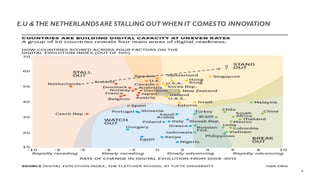
E.U & THE NETHERLANDSARE STALLING OUT WHEN IT COMESTO INNOVATION
6
?
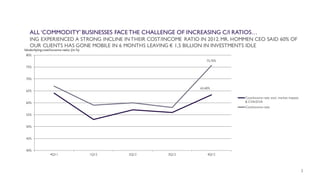
ALL ‘COMMODITY’ BUSINESSES FACE THE CHALLENGE OF INCREASING C/I RATIOS…
ING EXPERIENCED A STRONG INCLINE IN THEIR COST/INCOME RATIO IN 2012. MR. HOMMEN CEO SAID 60% OF
OUR CLIENTS HAS GONE MOBILE IN 6 MONTHS LEAVING € 1,5 BILLION IN INVESTMENTS IDLE
63,40%
75,70%
40%
45%
50%
55%
60%
65%
70%
75%
80%
4Q11 1Q12 2Q12 3Q12 4Q12
Underlying cost/income ratio (in %)
Cost/income ratio excl. market impacts
& CVA/DVA
Cost/income ratio
2
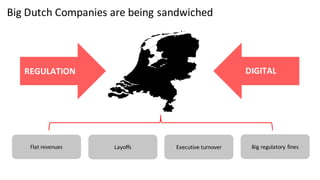
Big	Dutch	Companies	are	being	sandwiched	
REGULATION DIGITAL
Flat	revenues Layoffs Executive	turnover Big	regulatory	fines
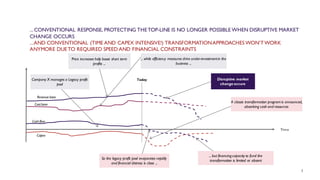
...CONVENTIONAL RESPONSE, PROTECTING THETOP-LINE IS NO LONGER POSSIBLE WHEN DISRUPTIVE MARKET
CHANGE OCCURS
...AND CONVENTIONAL (TIME AND CAPEX INTENSIVE!) TRANSFORMATIONAPPROACHES WON’TWORK
ANYMORE DUETO REQUIRED SPEED AND FINANCIAL CONSTRAINTS
Time
Today
Capex
Cost base
Revenue base
Cash flow
Company X manages a Legacy profit
pool
A classic transformation program is announced,
absorbing cash and resources
Disruptive market
change occurs
... but financing capacity to fund the
transformation is limited or absent
Price increases help boost short term
profits ...
... while efficiency measures drive under-investmentin the
business ...
So the legacy profit pool evaporates rapidly
and financial distress is close ...
3
6
Strategy
Business	Modelling
Directorship
Innovation
Economic	model
Balance	Sheet	Reengineering
C/I	ratio	improvement
Incentive	Structure	Reallignment
Operating	model
IT	transformation
People	
Building
Risk	&	control
Agile	Organization	Design
Predictive	Risk	Management
Culture	of	Integrity
Culture
&	DNA
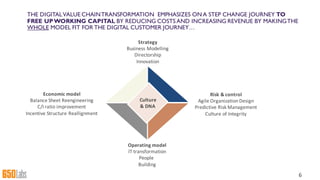
THE DIGITALVALUE CHAINTRANSFORMATION EMPHASIZES ON A STEP CHANGE JOURNEY TO
FREE UPWORKING CAPITAL BY REDUCING COSTS AND INCREASING REVENUE BY MAKINGTHE
WHOLE MODEL FIT FOR THE DIGITAL CUSTOMER JOURNEY…
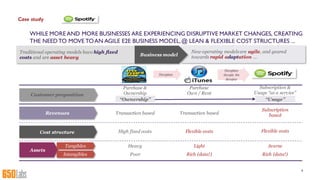
WHILE MORE AND MORE BUSINESSES ARE EXPERIENCING DISRUPTIVE MARKET CHANGES, CREATING
THE NEEDTO MOVE TOAN AGILE E2E BUSINESS MODEL,@ LEAN & FLEXIBLE COST STRUCTURES ...
Traditional operating models have high fixed
costs and are asset heavy
New operating modelsare agile, and geared
towards rapid adaptation ...Business model
Revenues
Cost structure
Assets
Transaction based Transaction based
Subscription
based
High fixed costs Flexible costs Flexible costs
HeavyTangibles
Intangibles Poor
Light
Rich (data!)
Averse
Rich (data!)
Customer proposition
Purchase &
Ownership
Purchase
Own / Rent
Subscription &
Usage “as a service”
“Ownership” “Usage”
Disruption
Disruption
disrupts the
disruptor
4
Case study
Integrated customer journeydesign
Customer lifetime management
Data analytics & machine learning
Product development / R&D
“Vertical” (industry specific) SaaS
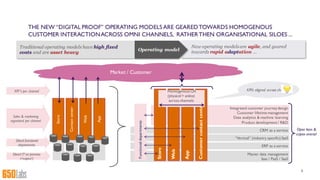
THE NEW “DIGITAL PROOF” OPERATING MODELS ARE GEAREDTOWARDS HOMOGENOUS
CUSTOMER INTERACTIONACROSS OMNI CHANNELS, RATHERTHEN ORGANISATIONAL SILOES ...
Traditional operating models have high fixed
costs and are asset heavy
New operating modelsare agile, and geared
towards rapid adaptation ...Operating model
Store
Contactcenter
Web
App
Siloed functional
departments
Siloed IT on premise
(=capex!)
Sales & marketing
organized per channel
Market / Customer
Master data management
Iaas / PaaS / SaaS
ERP as a service
CRM as a service
Store
Web
App
Customercontactcenter
Functionaldepartments
Homogenous UX
(physical+ online)
across channels
KPI’s aligned across channel
Opex lean &
capex averse!
KPI”s per channel
6
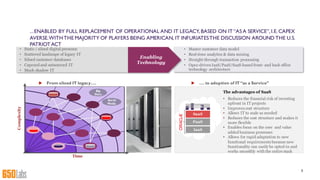
...ENABLED BY FULL REPLACEMENT OF OPERATIONAL AND IT LEGACY, BASED ON IT“AS A SERVICE”, I.E. CAPEX
AVERSE.WITHTHE MAJORITY OF PLAYERS BEING AMERICAN, IT INFURIATESTHE DISCUSSION AROUND THE U.S.
PATRIOTACT
u From siloed IT legacy…. u .... to adoption of IT“as a Service”
Time
Complexity
Big
Data
Social
Media
• Static / siloed digital presence
• Scattered landscape of legacy IT
• Siloed customer databases
• Capexed and outsourced IT
• Much shadow IT
• Master customer data model
• Real-time analytics & data mining
• Straight-through transaction processing
• Opex-driven IaaS/PaaS/SaaS-based front- and back office
technology architecture
Enabling
Technology
8
The advantages of SaaS
• Reduces the financial risk of investing
upfront in IT projects
• Improves cost structure
• Allows IT to scale as needed
• Reduces the cost structure and makes it
more flexible
• Enables focus on the core and value
added business processes
• Allows for rapid adaptation to new
functional requirements because new
functionality can easily be opted-in and
works smoothly with the entire stack
SaaS
PaaS
IaaS
Apps
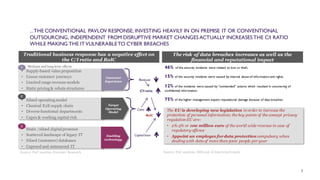
...THE CONVENTIONAL PAVLOV RESPONSE; INVESTING HEAVILY IN ON PREMISE IT OR CONVENTIONAL
OUTSOURCING, INDEPENDENT FROM DISRUPTIVE MARKET CHANGES ACTUALLY INCREASES THE C/I RATIO
WHILE MAKING THE ITVULNERABLETO CYBER BREACHES
5
• Supply-based value proposition
• Linear customer journeys
• Limited range revenue models
• Static pricing & rebate structures
1
• Static /siloed digitalpresence
• Scattered landscape of legacy IT
• Siloed (customer) databases
• Capexed and outsourced IT
• Siloed operating model
• Classical E2E supply chain
• Diverse functional departments
• Capex & working capital rich
3
2
Revenues
Costs
Capital base
C/I ratio
RoIC
Customer
Experience
Target
Operating
Model
Enabling
technology
Traditional business response has a negative effect on
the C/I ratio and RoIC
Source: PwC analysis, Forrester Research
Medium and long term effects
The risk of data breaches increases as well as the
financial and reputational impact
46% of the security incidents were related to loss or theft.
15% of the security incidents were caused by internal abuse of information and rights.
12% of the incidents were caused by “unintended” actions which resulted in uncovering of
confidential information.
75% of the higher management expect reputational damage because of data breaches
The EU is developing new legislation in order to increase the
protection of personal information; the key points of the concept privacy
regulation EU are:
• 2%-5% or 100 million euro of the world wide revenue in case of
regulatory offence
• Appoint an employee fordata protection compulsory when
dealing with data of more than 5000 people per year
Source: PwC analysis, IBM cost of data breach study
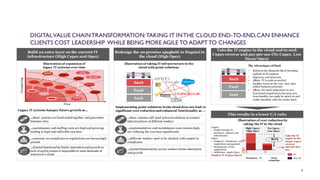
DIGITALVALUE CHAINTRANSFORMATION:TAKING IT INTHE CLOUD END-TO-END,CAN ENHANCE
CLIENTS COST LEADERSHIP WHILE BEING MORE AGILE TO ADAPTTO CHANGES
9
Build an extra layer on the current IT
infrastructure (High Capex and Opex)
Take the IT engine in the cloud end-to-end:
Capex-reverse and pay-per-use (No Capex, Low
linear Opex)
Illustration of expansion of
legacy IT systems over time
Time
Complexity
Legacy IT systems hamper future growth as…
…concerns on compliance to regulations are increasingly
present
…these systems are band-aided together and guarantee
business silos
…maintenance and staffing costs are high and growing,
leading to high and inflexible cost base
…limited functionality limits innovation and growth as
lack of agility makes it impossible to meet demands of
tomorrow’s client
Proprietary IT Cloud
computing
- 80%
Capex
• Capital invested in
hardware, software and
infrastructure
Opex
• Technical-, Functional- and
Application management
• Development of new
applications
• Inefficiency supply chain
Shadow IT (Capex/Opex)
Non-IT
IT
Illustration of cost reduction by
taking the IT in the cloud
The advantages of SaaS
• Reduces the financial risk of investing
upfront in IT projects
• Improves cost structure
• Allows IT to scale as needed
• Enables focus on the core and value
added business processes
• Allows for rapid adaptation to new
functional requirements because new
functionality can easily be opted-in and
works smoothly with the entire stack
FRO
M
TO
High Capex,
High Opex
No Capex,
Low Opex
Take the IT
engine in the
cloud: Capex-
reverse
and pay-per-
use
This results in a lower C/I ratio
SaaS
PaaS
IaaS
Apps
Redesign the on premise spaghetti to linguini in
the cloud (High Opex)
…different vendors need to be checked with respect to
compliance
…these systems still need tailored solutions to connect
infrastructures of different vendors
…implementation and maintenance costs remain high,
not reducing the cost base significantly
…limited functionality across vendors limits innovation
and growth
SaaS
PaaS
IaaS
Apps
Implementing point solutions in the cloud does not lead to
significant cost reduction and enhanced functionality as …
Illustration of taking IT infrastructure in the
cloud with point solutions
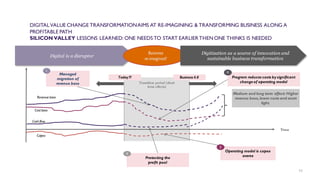
DIGITALVALUE CHANGE TRANSFORMATIONAIMS AT RE-IMAGINING & TRANSFORMING BUSINESS ALONG A
PROFITABLE PATH
SILICON VALLEY LESSONS LEARNED: ONE NEEDS TO START EARLIERTHEN ONE THINKS IS NEEDED
Time
Today??
Capex
Cost base
Revenue base
Cash flow
Program reduces costs by significant
change of operating model
Managed
migration of
revenue base
Operating model is capex
averseProtecting the
profit pool
Digital is a disruptor
Business
re-imagined!
Digitization as a source of innovation and
sustainable business transformation
1 2
3
4
11
Medium and long term effect: Higher
revenue base, lower costs and asset
light.
Transition period (short
term effects)
Business 4.0
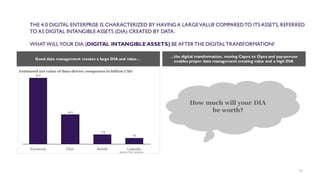
THE 4.0 DIGITAL ENTERPRISE IS CHARACTERIZED BY HAVINGA LARGEVALUE COMPAREDTO ITS ASSETS, REFERRED
TO AS DIGITAL INTANGIBLE ASSETS (DIA) CREATED BY DATA.
WHATWILLYOUR DIA (DIGITAL INTANGIBLE ASSETS) BE AFTERTHE DIGITALTRANSFORMATION?
11
Good data management creates a large DIA and value…
8
13
40
90
Facebook Uber LinkedinAirbnb
Estimated net value of data-driven companies in billion USD
Source: PwC analysis
…the digital transformation, moving Capex to Opex and pay-per-use
enables proper data management creating value and a high DIA
How much will your DIA
be worth?

MBA masterclass AG - Kenny van Ierlant

  • 1.
    1 Digital Transformation How todisrupt yourself without rocking the boat Ken van Ierlant
  • 2.
    E.U & THENETHERLANDSARE STALLING OUT WHEN IT COMESTO INNOVATION 6 ?
  • 3.
    ALL ‘COMMODITY’ BUSINESSESFACE THE CHALLENGE OF INCREASING C/I RATIOS… ING EXPERIENCED A STRONG INCLINE IN THEIR COST/INCOME RATIO IN 2012. MR. HOMMEN CEO SAID 60% OF OUR CLIENTS HAS GONE MOBILE IN 6 MONTHS LEAVING € 1,5 BILLION IN INVESTMENTS IDLE 63,40% 75,70% 40% 45% 50% 55% 60% 65% 70% 75% 80% 4Q11 1Q12 2Q12 3Q12 4Q12 Underlying cost/income ratio (in %) Cost/income ratio excl. market impacts & CVA/DVA Cost/income ratio 2
  • 4.
  • 5.
    ...CONVENTIONAL RESPONSE, PROTECTINGTHETOP-LINE IS NO LONGER POSSIBLE WHEN DISRUPTIVE MARKET CHANGE OCCURS ...AND CONVENTIONAL (TIME AND CAPEX INTENSIVE!) TRANSFORMATIONAPPROACHES WON’TWORK ANYMORE DUETO REQUIRED SPEED AND FINANCIAL CONSTRAINTS Time Today Capex Cost base Revenue base Cash flow Company X manages a Legacy profit pool A classic transformation program is announced, absorbing cash and resources Disruptive market change occurs ... but financing capacity to fund the transformation is limited or absent Price increases help boost short term profits ... ... while efficiency measures drive under-investmentin the business ... So the legacy profit pool evaporates rapidly and financial distress is close ... 3
  • 6.
  • 7.
    WHILE MORE ANDMORE BUSINESSES ARE EXPERIENCING DISRUPTIVE MARKET CHANGES, CREATING THE NEEDTO MOVE TOAN AGILE E2E BUSINESS MODEL,@ LEAN & FLEXIBLE COST STRUCTURES ... Traditional operating models have high fixed costs and are asset heavy New operating modelsare agile, and geared towards rapid adaptation ...Business model Revenues Cost structure Assets Transaction based Transaction based Subscription based High fixed costs Flexible costs Flexible costs HeavyTangibles Intangibles Poor Light Rich (data!) Averse Rich (data!) Customer proposition Purchase & Ownership Purchase Own / Rent Subscription & Usage “as a service” “Ownership” “Usage” Disruption Disruption disrupts the disruptor 4 Case study
  • 8.
    Integrated customer journeydesign Customerlifetime management Data analytics & machine learning Product development / R&D “Vertical” (industry specific) SaaS THE NEW “DIGITAL PROOF” OPERATING MODELS ARE GEAREDTOWARDS HOMOGENOUS CUSTOMER INTERACTIONACROSS OMNI CHANNELS, RATHERTHEN ORGANISATIONAL SILOES ... Traditional operating models have high fixed costs and are asset heavy New operating modelsare agile, and geared towards rapid adaptation ...Operating model Store Contactcenter Web App Siloed functional departments Siloed IT on premise (=capex!) Sales & marketing organized per channel Market / Customer Master data management Iaas / PaaS / SaaS ERP as a service CRM as a service Store Web App Customercontactcenter Functionaldepartments Homogenous UX (physical+ online) across channels KPI’s aligned across channel Opex lean & capex averse! KPI”s per channel 6
  • 9.
    ...ENABLED BY FULLREPLACEMENT OF OPERATIONAL AND IT LEGACY, BASED ON IT“AS A SERVICE”, I.E. CAPEX AVERSE.WITHTHE MAJORITY OF PLAYERS BEING AMERICAN, IT INFURIATESTHE DISCUSSION AROUND THE U.S. PATRIOTACT u From siloed IT legacy…. u .... to adoption of IT“as a Service” Time Complexity Big Data Social Media • Static / siloed digital presence • Scattered landscape of legacy IT • Siloed customer databases • Capexed and outsourced IT • Much shadow IT • Master customer data model • Real-time analytics & data mining • Straight-through transaction processing • Opex-driven IaaS/PaaS/SaaS-based front- and back office technology architecture Enabling Technology 8 The advantages of SaaS • Reduces the financial risk of investing upfront in IT projects • Improves cost structure • Allows IT to scale as needed • Reduces the cost structure and makes it more flexible • Enables focus on the core and value added business processes • Allows for rapid adaptation to new functional requirements because new functionality can easily be opted-in and works smoothly with the entire stack SaaS PaaS IaaS Apps
  • 10.
    ...THE CONVENTIONAL PAVLOVRESPONSE; INVESTING HEAVILY IN ON PREMISE IT OR CONVENTIONAL OUTSOURCING, INDEPENDENT FROM DISRUPTIVE MARKET CHANGES ACTUALLY INCREASES THE C/I RATIO WHILE MAKING THE ITVULNERABLETO CYBER BREACHES 5 • Supply-based value proposition • Linear customer journeys • Limited range revenue models • Static pricing & rebate structures 1 • Static /siloed digitalpresence • Scattered landscape of legacy IT • Siloed (customer) databases • Capexed and outsourced IT • Siloed operating model • Classical E2E supply chain • Diverse functional departments • Capex & working capital rich 3 2 Revenues Costs Capital base C/I ratio RoIC Customer Experience Target Operating Model Enabling technology Traditional business response has a negative effect on the C/I ratio and RoIC Source: PwC analysis, Forrester Research Medium and long term effects The risk of data breaches increases as well as the financial and reputational impact 46% of the security incidents were related to loss or theft. 15% of the security incidents were caused by internal abuse of information and rights. 12% of the incidents were caused by “unintended” actions which resulted in uncovering of confidential information. 75% of the higher management expect reputational damage because of data breaches The EU is developing new legislation in order to increase the protection of personal information; the key points of the concept privacy regulation EU are: • 2%-5% or 100 million euro of the world wide revenue in case of regulatory offence • Appoint an employee fordata protection compulsory when dealing with data of more than 5000 people per year Source: PwC analysis, IBM cost of data breach study
  • 11.
    DIGITALVALUE CHAINTRANSFORMATION:TAKING ITINTHE CLOUD END-TO-END,CAN ENHANCE CLIENTS COST LEADERSHIP WHILE BEING MORE AGILE TO ADAPTTO CHANGES 9 Build an extra layer on the current IT infrastructure (High Capex and Opex) Take the IT engine in the cloud end-to-end: Capex-reverse and pay-per-use (No Capex, Low linear Opex) Illustration of expansion of legacy IT systems over time Time Complexity Legacy IT systems hamper future growth as… …concerns on compliance to regulations are increasingly present …these systems are band-aided together and guarantee business silos …maintenance and staffing costs are high and growing, leading to high and inflexible cost base …limited functionality limits innovation and growth as lack of agility makes it impossible to meet demands of tomorrow’s client Proprietary IT Cloud computing - 80% Capex • Capital invested in hardware, software and infrastructure Opex • Technical-, Functional- and Application management • Development of new applications • Inefficiency supply chain Shadow IT (Capex/Opex) Non-IT IT Illustration of cost reduction by taking the IT in the cloud The advantages of SaaS • Reduces the financial risk of investing upfront in IT projects • Improves cost structure • Allows IT to scale as needed • Enables focus on the core and value added business processes • Allows for rapid adaptation to new functional requirements because new functionality can easily be opted-in and works smoothly with the entire stack FRO M TO High Capex, High Opex No Capex, Low Opex Take the IT engine in the cloud: Capex- reverse and pay-per- use This results in a lower C/I ratio SaaS PaaS IaaS Apps Redesign the on premise spaghetti to linguini in the cloud (High Opex) …different vendors need to be checked with respect to compliance …these systems still need tailored solutions to connect infrastructures of different vendors …implementation and maintenance costs remain high, not reducing the cost base significantly …limited functionality across vendors limits innovation and growth SaaS PaaS IaaS Apps Implementing point solutions in the cloud does not lead to significant cost reduction and enhanced functionality as … Illustration of taking IT infrastructure in the cloud with point solutions
  • 12.
    DIGITALVALUE CHANGE TRANSFORMATIONAIMSAT RE-IMAGINING & TRANSFORMING BUSINESS ALONG A PROFITABLE PATH SILICON VALLEY LESSONS LEARNED: ONE NEEDS TO START EARLIERTHEN ONE THINKS IS NEEDED Time Today?? Capex Cost base Revenue base Cash flow Program reduces costs by significant change of operating model Managed migration of revenue base Operating model is capex averseProtecting the profit pool Digital is a disruptor Business re-imagined! Digitization as a source of innovation and sustainable business transformation 1 2 3 4 11 Medium and long term effect: Higher revenue base, lower costs and asset light. Transition period (short term effects) Business 4.0
  • 13.
    THE 4.0 DIGITALENTERPRISE IS CHARACTERIZED BY HAVINGA LARGEVALUE COMPAREDTO ITS ASSETS, REFERRED TO AS DIGITAL INTANGIBLE ASSETS (DIA) CREATED BY DATA. WHATWILLYOUR DIA (DIGITAL INTANGIBLE ASSETS) BE AFTERTHE DIGITALTRANSFORMATION? 11 Good data management creates a large DIA and value… 8 13 40 90 Facebook Uber LinkedinAirbnb Estimated net value of data-driven companies in billion USD Source: PwC analysis …the digital transformation, moving Capex to Opex and pay-per-use enables proper data management creating value and a high DIA How much will your DIA be worth?