









The Challenges We Face
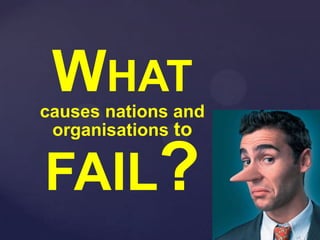
WHAT
causes nations and
organisations to
FAIL?
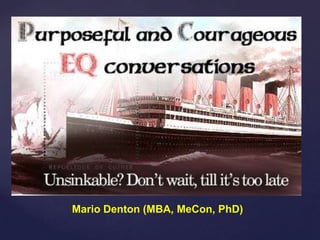
Mario Denton (MBA, MeCon, PhD)
Warning:
The following presentation
contains material
appropriate for passionate
leaders who are serious
about implementing
change starting with
themselves
Mario’s research interest
1. Managerial cataracts and MAD Disorders
2. Executive blind spots/Managerial infertility
3. Professional workplace bullying
4. Toxic and dark side of leadership
5. Signs of ethical collapse and low morale
6. Managerial derailment and Spiritual Leprosy
7. Detoxifying the workplace- Swine viruses
8. Dysfunctions of a team
Thoughts on change
 The first step to effective change is to create
dissatisfaction with the status quo. Change efforts
fail when people aren’t ready for them. So make
haste slowly. Sell the need for change with
everything you’ve got.
 We’re all prisoners of our past. To help people
change, help them see why yesterday’s ways are
inappropriate, and how something new might
make life easier. Encourage them to use their own
and ideas information - that’s the stuff they believe
in - to facilitate the change process.
Thoughts on change
(Continued)
 Change takes time, but quick-fixes are essential to
make it happen
 In a turbulent, fast changing, uncertain
environment, you can’t expect to get every-thing
right. So expect mistakes; don’t be paralysed at
the possibility of making them
 If you wait until all the facts are in, they’ll be
useless
 The biggest risk is to avoid all risk
Thoughts on change
(Continued)
 Doing nothing causes stagnation. What
achievement can you point to today?
 Organisations are change-averse. It takes
deliberate, systematic and sustained efforts to
move them in new directions. The task is always
harder than you think and it always takes longer.
 Change now!!!
Management
simulation
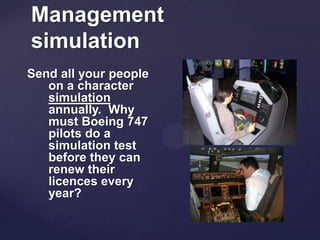
Send all your people
on a character
simulation
annually. Why
must Boeing 747
pilots do a
simulation test
before they can
renew their
licences every
year?
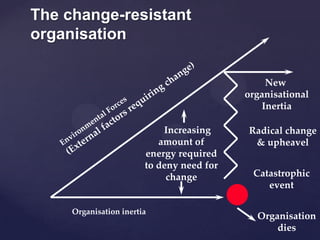
The change-resistant
organisation
Increasing
amount of
energy required
to deny need for
change
Organisation inertia
New
organisational
Inertia
Radical change
& upheavel
Catastrophic
event
Organisation
dies
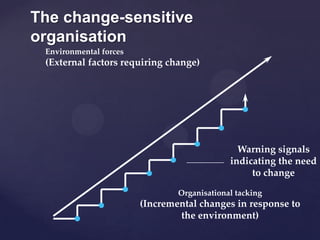
The change-sensitive
organisation
Environmental forces
(External factors requiring change)
Warning signals
indicating the need
to change
Organisational tacking
(Incremental changes in response to
the environment)
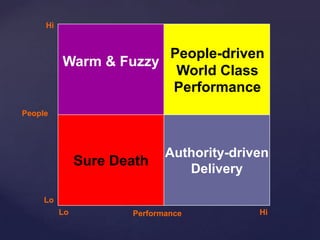
Warm & Fuzzy
Sure Death
Authority-driven
Delivery
People
Performance
Hi
Lo
Lo Hi
People-driven
World Class
Performance
People
Performance
Hi
Lo
Lo Hi
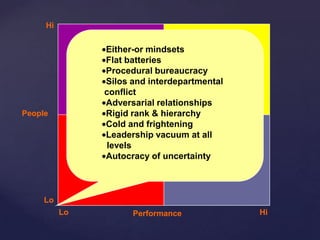
Sure Death
Either-or mindsets
Flat batteries
Procedural bureaucracy
Silos and interdepartmental
conflict
Adversarial relationships
Rigid rank & hierarchy
Cold and frightening
Leadership vacuum at all
levels
Autocracy of uncertainty
Sure Death
People
Performance
Hi
Lo
Lo Hi
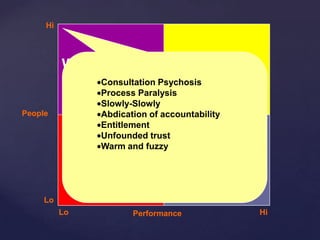
Warm & Fuzzy
Consultation Psychosis
Process Paralysis
Slowly-Slowly
Abdication of accountability
Entitlement
Unfounded trust
Warm and fuzzy
Warm & Fuzzy
Sure Death
People
Performance
Hi
Lo
Lo Hi
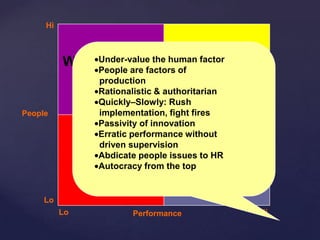
Authority-driven
Delivery
Under-value the human factor
People are factors of
production
Rationalistic & authoritarian
Quickly–Slowly: Rush
implementation, fight fires
Passivity of innovation
Erratic performance without
driven supervision
Abdicate people issues to HR
Autocracy from the top
Warm & Fuzzy
Sure Death
Authority-driven
Delivery
People
Performance
Hi
Lo
Lo Hi
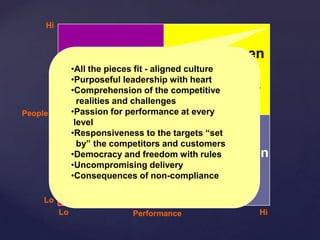
People-driven
World Class
Performance
•All the pieces fit - aligned culture
•Purposeful leadership with heart
•Comprehension of the competitive
realities and challenges
•Passion for performance at every
level
•Responsiveness to the targets “set
by” the competitors and customers
•Democracy and freedom with rules
•Uncompromising delivery
•Consequences of non-compliance
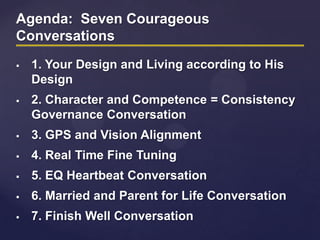
Agenda: Seven Courageous
Conversations
 1. Your Design and Living according to His
Design
 2. Character and Competence = Consistency
Governance Conversation
 3. GPS and Vision Alignment
 4. Real Time Fine Tuning
 5. EQ Heartbeat Conversation
 6. Married and Parent for Life Conversation
 7. Finish Well Conversation
The 18 inch Journey to the Heart of Real Transformation –
Re-engineering Your Business
for the Future
Mario Denton (MBA, MeCon, PhD)
Ritz-Carlton Marina Del Rey
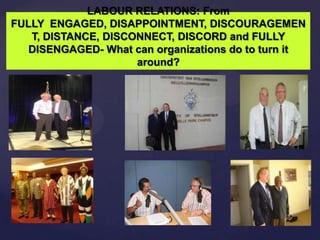
LABOUR RELATIONS: From
FULLY ENGAGED, DISAPPOINTMENT, DISCOURAGEMEN
T, DISTANCE, DISCONNECT, DISCORD and FULLY
DISENGAGED- What can organizations do to turn it
around?
Reasons why entrepreneurs fail
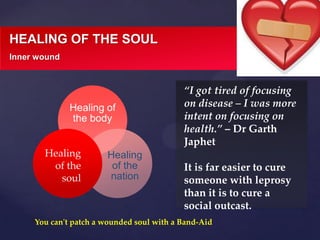
“I got tired of focusing
on disease – I was more
intent on focusing on
health.” – Dr Garth
Japhet
It is far easier to cure
someone with leprosy
than it is to cure a
social outcast.
“You can't patch a wounded soul with a Band-Aid
HEALING OF THE SOUL
Inner wound
Healing of
the body
Healing
of the
nation
Healing
of the
soul
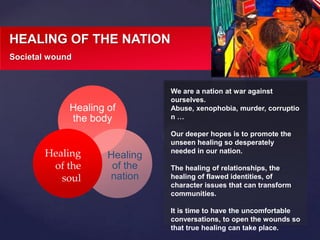
We are a nation at war against
ourselves.
Abuse, xenophobia, murder, corruptio
n …
Our deeper hopes is to promote the
unseen healing so desperately
needed in our nation.
The healing of relationships, the
healing of flawed identities, of
character issues that can transform
communities.
It is time to have the uncomfortable
conversations, to open the wounds so
that true healing can take place.
HEALING OF THE NATION
Societal wound
Healing of
the body
Healing
of the
nation
Healing
of the
soul
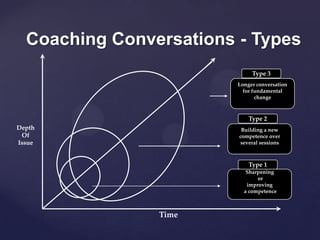
Coaching Conversations - Types
Sharpening
or
improving
a competence
Building a new
competence over
several sessions
Longer conversation
for fundamental
change
Type 2
Depth
Of
Issue
Time
Type 1
Type 3
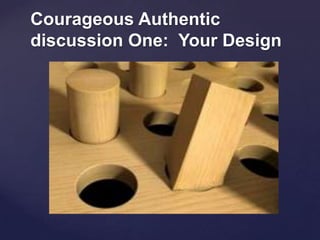
Courageous Authentic
discussion One: Your Design
Career Direct ®
Educational Occupationaland
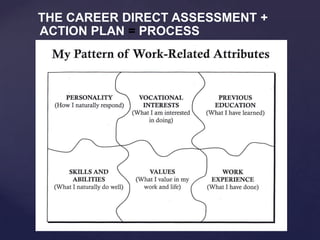
THE CAREER DIRECT ASSESSMENT +
ACTION PLAN = PROCESS
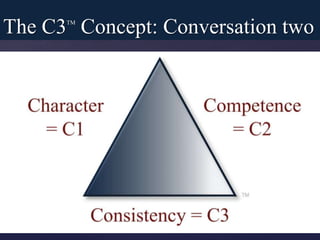
TM
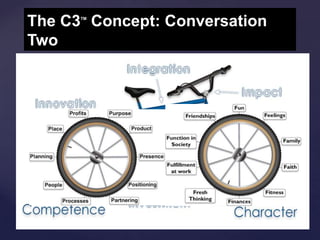
Character
= C1
Competence
= C2
Consistency = C3
The C3TM
Concept: Conversation two
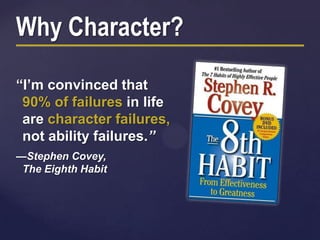
Why Character?
“I’m convinced that
90% of failures in life
are character failures,
not ability failures.”
—Stephen Covey,
The Eighth Habit
The C3TM
Concept: Conversation
Two
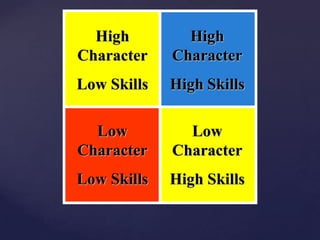
High
Character
Low Skills
High
Character
High Skills
Low
Character
Low Skills
Low
Character
High Skills
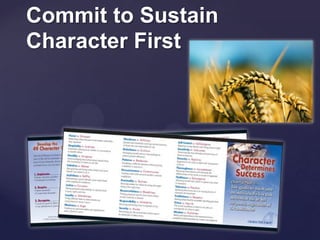
Commit to Sustain
Character First
{
Reflective
Question:
What have you
heard so far?
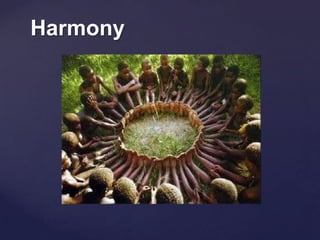
Harmony
Conversation 3: GPS and Vision
Alignment
 What is the vision for the future?
 What is the strategy? How will the strategic
vision be accomplished?
 What are the organization's objectives? What
needs to be done to keep moving in the
strategic direction?
 What are the Critical Success Factors? Where
should the focus be to achieve the vision?
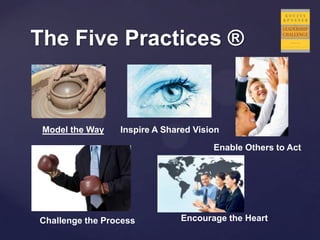
The Five Practices ®
Model the Way Inspire A Shared Vision
Enable Others to Act
Challenge the Process Encourage the Heart
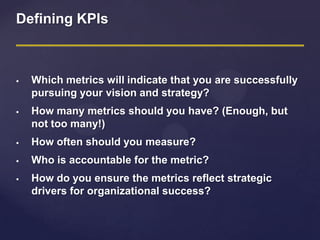
Defining KPIs
 Which metrics will indicate that you are successfully
pursuing your vision and strategy?
 How many metrics should you have? (Enough, but
not too many!)
 How often should you measure?
 Who is accountable for the metric?
 How do you ensure the metrics reflect strategic
drivers for organizational success?
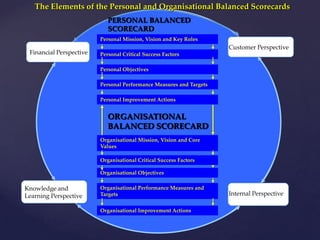
Financial Perspective
Knowledge and
Learning Perspective Internal Perspective
Customer Perspective
The Elements of the Personal and Organisational Balanced Scorecards
PERSONAL BALANCED
SCORECARD
Personal Mission, Vision and Key Roles
Personal Critical Success Factors
Personal Objectives
Personal Performance Measures and Targets
Personal Improvement Actions
Organisational Improvement Actions
Organisational Performance Measures and
Targets
Organisational Objectives
Organisational Critical Success Factors
Organisational Mission, Vision and Core
Values
ORGANISATIONAL
BALANCED SCORECARD
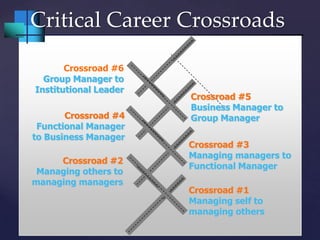
Crossroad #1
Managing self to
managing others
Crossroad #2
Managing others to
managing managers
Crossroad #3
Managing managers to
Functional Manager
Crossroad #4
Functional Manager
to Business Manager
Crossroad #5
Business Manager to
Group Manager
Crossroad #6
Group Manager to
Institutional Leader
Critical Career Crossroads
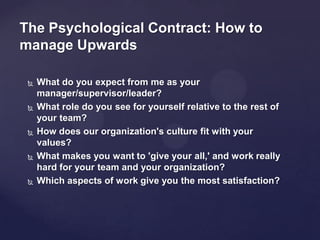
The Psychological Contract: How to
manage Upwards
 What do you expect from me as your
manager/supervisor/leader?
 What role do you see for yourself relative to the rest of
your team?
 How does our organization's culture fit with your
values?
 What makes you want to 'give your all,' and work really
hard for your team and your organization?
 Which aspects of work give you the most satisfaction?
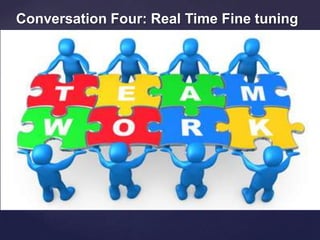
Conversation Four: Real Time Fine tuning
 Performance, Frustration, Conflict and Anger Eye
Ball
 360 performance review
 Power of eye ball sessions
 Energy Wasters, Energy takers and Energy Givers
 Top line Enablers- Have to have
 Bottom line Disablers
 Engagement
Conversation Four: Real Time Fine tuning
 Performance, Frustration, Conflict and Anger log
 360 performance review
 Power of eye ball sessions
 Energy Wasters, Energy takers and Energy Givers
 Top line Enablers- Have to have
 Bottom line Disablers
 Engagement
 Golden, Red Alerts, Rusty, Blue skies
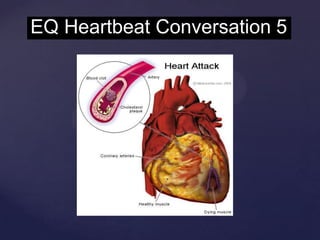
EQ Heartbeat Conversation 5
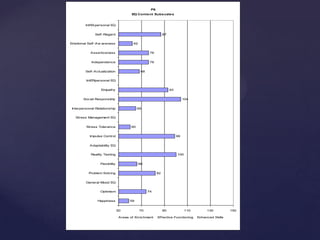
P6
EQ Content Subscales
59
74
0
82
66
100
0
99
60
0
65
104
93
0
68
76
76
62
87
0
50 70 90 110 130 150
Happiness
Optimism
General Mood EQ
Problem Solving
Flexibility
Reality Testing
Adaptability EQ
Impulse Control
Stress Tolerance
Stress Management EQ
Interpersonal Relationship
Social Responsibly
Empathy
IntERpersonal EQ
Self-Actualization
Independence
Assertiveness
Emotional Self-Aw areness
Self-Regard
IntRApersonal EQ
Areas of Enrichment Effective Functioning Enhanced Skills
{
Double-click to
insert company
name
Double-click to insert date
{
{
Authentic Conversations
{
Reflective
Question:
What have you
heard so far?
Conversation Six: Married and Parent For
Life
 Can you merge Career Success and Family
Excellence?
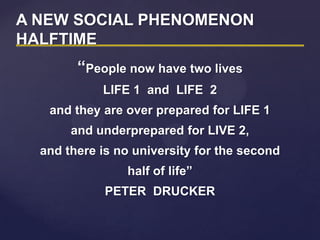
A NEW SOCIAL PHENOMENON
HALFTIME
“People now have two lives
LIFE 1 and LIFE 2
and they are over prepared for LIFE 1
and underprepared for LIVE 2,
and there is no university for the second
half of life”
PETER DRUCKER
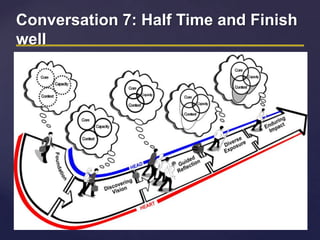
Conversation 7: Half Time and Finish
well
Stage One: Foundation of
Success
 Is there more to life than my current situation?
 What do I consider eternally significant?
 What on earth would give my life meaning?
 How much (stuff, money, advancement) is enough?
 In what way was my first half experience a foundation
for something more significant in my second half?
Stage Two: Inward
 What are my greatest strengths and core
values?
 What am I really passionate about?
 What makes me come alive?
 What is my calling in life?
 What is my personal mission statement?
 Who can help me make sense out of this time
of life?
Stage Three: Awakening
Challenge
 How do I prepare my family and myself for
this transition?
 How will I leave a legacy through my children
and grandchildren
 In what arena should I serve: my church, my
community, or in some very needy area of the
world?
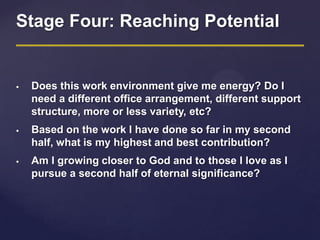
Stage Four: Reaching Potential
 Does this work environment give me energy? Do I
need a different office arrangement, different support
structure, more or less variety, etc?
 Based on the work I have done so far in my second
half, what is my highest and best contribution?
 Am I growing closer to God and to those I love as I
pursue a second half of eternal significance?
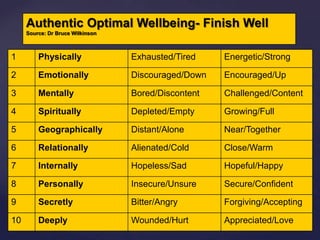
Authentic Optimal Wellbeing- Finish Well
Source: Dr Bruce Wilkinson
1 Physically Exhausted/Tired Energetic/Strong
2 Emotionally Discouraged/Down Encouraged/Up
3 Mentally Bored/Discontent Challenged/Content
4 Spiritually Depleted/Empty Growing/Full
5 Geographically Distant/Alone Near/Together
6 Relationally Alienated/Cold Close/Warm
7 Internally Hopeless/Sad Hopeful/Happy
8 Personally Insecure/Unsure Secure/Confident
9 Secretly Bitter/Angry Forgiving/Accepting
10 Deeply Wounded/Hurt Appreciated/Love
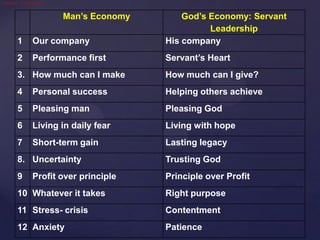
Man’s Economy God’s Economy: Servant
Leadership
1 Our company His company
2 Performance first Servant’s Heart
3. How much can I make How much can I give?
4 Personal success Helping others achieve
5 Pleasing man Pleasing God
6 Living in daily fear Living with hope
7 Short-term gain Lasting legacy
8. Uncertainty Trusting God
9 Profit over principle Principle over Profit
10 Whatever it takes Right purpose
11 Stress- crisis Contentment
12 Anxiety Patience
•Source: Jim Dismore
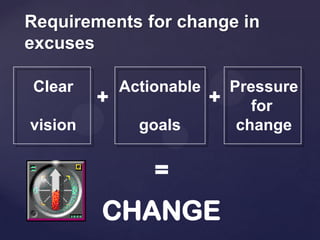
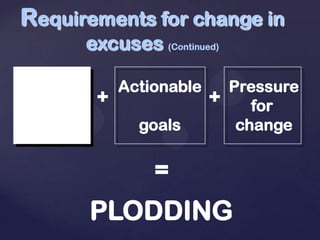
Requirements for change in
excuses
+ +
Clear
vision
Actionable
goals
Pressure
for
change
=
CHANGE
Requirements for change in
excuses (Continued)
+ +
Actionable
goals
Pressure
for
change
=
PLODDING
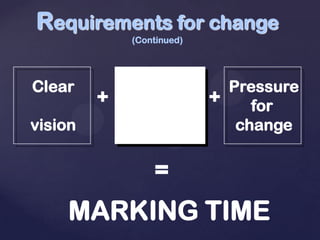
Requirements for change
(Continued)
+ +
Clear
vision
Pressure
for
change
=
MARKING TIME
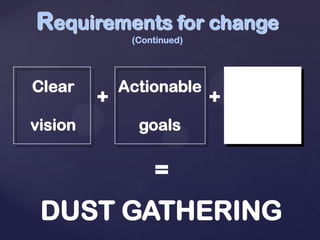
Requirements for change
(Continued)
+ +
Clear
vision
Actionable
goals
=
DUST GATHERING
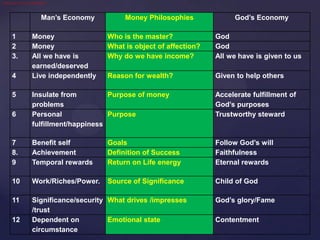
Man’s Economy Money Philosophies God’s Economy
1 Money Who is the master? God
2 Money What is object of affection? God
3. All we have is
earned/deserved
Why do we have income? All we have is given to us
4 Live independently Reason for wealth? Given to help others
5 Insulate from
problems
Purpose of money Accelerate fulfillment of
God’s purposes
6 Personal
fulfillment/happiness
Purpose Trustworthy steward
7 Benefit self Goals Follow God’s will
8. Achievement Definition of Success Faithfulness
9 Temporal rewards Return on Life energy Eternal rewards
10 Work/Riches/Power. Source of Significance Child of God
11 Significance/security
/trust
What drives /impresses God’s glory/Fame
12 Dependent on
circumstance
Emotional state Contentment
•Source: Chuck Bentley
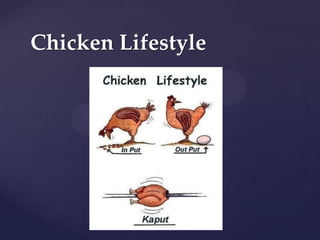
Chicken Lifestyle
{
Reflective
Question:
What are you
going to stop,
start, initiate
and maintain?
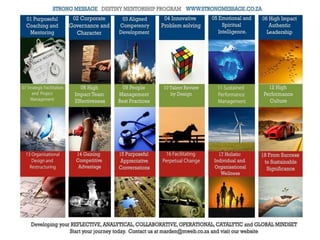
MENTORING THE NEW
GENERATION-THE
DESTINY WAY
Authentic Courageous Conversations

Authentic Courageous Conversations

  • 1.
    The Challenges WeFace WHAT causes nations and organisations to FAIL?
  • 2.
    Mario Denton (MBA,MeCon, PhD)
  • 3.
    Warning: The following presentation containsmaterial appropriate for passionate leaders who are serious about implementing change starting with themselves
  • 4.
    Mario’s research interest 1.Managerial cataracts and MAD Disorders 2. Executive blind spots/Managerial infertility 3. Professional workplace bullying 4. Toxic and dark side of leadership 5. Signs of ethical collapse and low morale 6. Managerial derailment and Spiritual Leprosy 7. Detoxifying the workplace- Swine viruses 8. Dysfunctions of a team
  • 5.
    Thoughts on change The first step to effective change is to create dissatisfaction with the status quo. Change efforts fail when people aren’t ready for them. So make haste slowly. Sell the need for change with everything you’ve got.  We’re all prisoners of our past. To help people change, help them see why yesterday’s ways are inappropriate, and how something new might make life easier. Encourage them to use their own and ideas information - that’s the stuff they believe in - to facilitate the change process.
  • 6.
    Thoughts on change (Continued) Change takes time, but quick-fixes are essential to make it happen  In a turbulent, fast changing, uncertain environment, you can’t expect to get every-thing right. So expect mistakes; don’t be paralysed at the possibility of making them  If you wait until all the facts are in, they’ll be useless  The biggest risk is to avoid all risk
  • 7.
    Thoughts on change (Continued) Doing nothing causes stagnation. What achievement can you point to today?  Organisations are change-averse. It takes deliberate, systematic and sustained efforts to move them in new directions. The task is always harder than you think and it always takes longer.  Change now!!!
  • 8.
    Management simulation Send all yourpeople on a character simulation annually. Why must Boeing 747 pilots do a simulation test before they can renew their licences every year?
  • 9.
    The change-resistant organisation Increasing amount of energyrequired to deny need for change Organisation inertia New organisational Inertia Radical change & upheavel Catastrophic event Organisation dies
  • 10.
    The change-sensitive organisation Environmental forces (Externalfactors requiring change) Warning signals indicating the need to change Organisational tacking (Incremental changes in response to the environment)
  • 11.
    Warm & Fuzzy SureDeath Authority-driven Delivery People Performance Hi Lo Lo Hi People-driven World Class Performance
  • 12.
    People Performance Hi Lo Lo Hi Sure Death Either-ormindsets Flat batteries Procedural bureaucracy Silos and interdepartmental conflict Adversarial relationships Rigid rank & hierarchy Cold and frightening Leadership vacuum at all levels Autocracy of uncertainty
  • 13.
    Sure Death People Performance Hi Lo Lo Hi Warm& Fuzzy Consultation Psychosis Process Paralysis Slowly-Slowly Abdication of accountability Entitlement Unfounded trust Warm and fuzzy
  • 14.
    Warm & Fuzzy SureDeath People Performance Hi Lo Lo Hi Authority-driven Delivery Under-value the human factor People are factors of production Rationalistic & authoritarian Quickly–Slowly: Rush implementation, fight fires Passivity of innovation Erratic performance without driven supervision Abdicate people issues to HR Autocracy from the top
  • 15.
    Warm & Fuzzy SureDeath Authority-driven Delivery People Performance Hi Lo Lo Hi People-driven World Class Performance •All the pieces fit - aligned culture •Purposeful leadership with heart •Comprehension of the competitive realities and challenges •Passion for performance at every level •Responsiveness to the targets “set by” the competitors and customers •Democracy and freedom with rules •Uncompromising delivery •Consequences of non-compliance
  • 16.
    Agenda: Seven Courageous Conversations 1. Your Design and Living according to His Design  2. Character and Competence = Consistency Governance Conversation  3. GPS and Vision Alignment  4. Real Time Fine Tuning  5. EQ Heartbeat Conversation  6. Married and Parent for Life Conversation  7. Finish Well Conversation
  • 17.
    The 18 inchJourney to the Heart of Real Transformation – Re-engineering Your Business for the Future Mario Denton (MBA, MeCon, PhD) Ritz-Carlton Marina Del Rey
  • 18.
    LABOUR RELATIONS: From FULLYENGAGED, DISAPPOINTMENT, DISCOURAGEMEN T, DISTANCE, DISCONNECT, DISCORD and FULLY DISENGAGED- What can organizations do to turn it around?
  • 19.
  • 20.
    “I got tiredof focusing on disease – I was more intent on focusing on health.” – Dr Garth Japhet It is far easier to cure someone with leprosy than it is to cure a social outcast. “You can't patch a wounded soul with a Band-Aid HEALING OF THE SOUL Inner wound Healing of the body Healing of the nation Healing of the soul
  • 21.
    We are anation at war against ourselves. Abuse, xenophobia, murder, corruptio n … Our deeper hopes is to promote the unseen healing so desperately needed in our nation. The healing of relationships, the healing of flawed identities, of character issues that can transform communities. It is time to have the uncomfortable conversations, to open the wounds so that true healing can take place. HEALING OF THE NATION Societal wound Healing of the body Healing of the nation Healing of the soul
  • 26.
    Coaching Conversations -Types Sharpening or improving a competence Building a new competence over several sessions Longer conversation for fundamental change Type 2 Depth Of Issue Time Type 1 Type 3
  • 27.
  • 28.
  • 29.
    THE CAREER DIRECTASSESSMENT + ACTION PLAN = PROCESS
  • 30.
    TM Character = C1 Competence = C2 Consistency= C3 The C3TM Concept: Conversation two
  • 31.
    Why Character? “I’m convincedthat 90% of failures in life are character failures, not ability failures.” —Stephen Covey, The Eighth Habit
  • 32.
  • 37.
  • 38.
  • 39.
  • 40.
  • 41.
    Conversation 3: GPSand Vision Alignment  What is the vision for the future?  What is the strategy? How will the strategic vision be accomplished?  What are the organization's objectives? What needs to be done to keep moving in the strategic direction?  What are the Critical Success Factors? Where should the focus be to achieve the vision?
  • 42.
    The Five Practices® Model the Way Inspire A Shared Vision Enable Others to Act Challenge the Process Encourage the Heart
  • 43.
    Defining KPIs  Whichmetrics will indicate that you are successfully pursuing your vision and strategy?  How many metrics should you have? (Enough, but not too many!)  How often should you measure?  Who is accountable for the metric?  How do you ensure the metrics reflect strategic drivers for organizational success?
  • 44.
    Financial Perspective Knowledge and LearningPerspective Internal Perspective Customer Perspective The Elements of the Personal and Organisational Balanced Scorecards PERSONAL BALANCED SCORECARD Personal Mission, Vision and Key Roles Personal Critical Success Factors Personal Objectives Personal Performance Measures and Targets Personal Improvement Actions Organisational Improvement Actions Organisational Performance Measures and Targets Organisational Objectives Organisational Critical Success Factors Organisational Mission, Vision and Core Values ORGANISATIONAL BALANCED SCORECARD
  • 45.
    Crossroad #1 Managing selfto managing others Crossroad #2 Managing others to managing managers Crossroad #3 Managing managers to Functional Manager Crossroad #4 Functional Manager to Business Manager Crossroad #5 Business Manager to Group Manager Crossroad #6 Group Manager to Institutional Leader Critical Career Crossroads
  • 46.
    The Psychological Contract:How to manage Upwards  What do you expect from me as your manager/supervisor/leader?  What role do you see for yourself relative to the rest of your team?  How does our organization's culture fit with your values?  What makes you want to 'give your all,' and work really hard for your team and your organization?  Which aspects of work give you the most satisfaction?
  • 47.
    Conversation Four: RealTime Fine tuning  Performance, Frustration, Conflict and Anger Eye Ball  360 performance review  Power of eye ball sessions  Energy Wasters, Energy takers and Energy Givers  Top line Enablers- Have to have  Bottom line Disablers  Engagement
  • 48.
    Conversation Four: RealTime Fine tuning  Performance, Frustration, Conflict and Anger log  360 performance review  Power of eye ball sessions  Energy Wasters, Energy takers and Energy Givers  Top line Enablers- Have to have  Bottom line Disablers  Engagement  Golden, Red Alerts, Rusty, Blue skies
  • 49.
  • 50.
    P6 EQ Content Subscales 59 74 0 82 66 100 0 99 60 0 65 104 93 0 68 76 76 62 87 0 5070 90 110 130 150 Happiness Optimism General Mood EQ Problem Solving Flexibility Reality Testing Adaptability EQ Impulse Control Stress Tolerance Stress Management EQ Interpersonal Relationship Social Responsibly Empathy IntERpersonal EQ Self-Actualization Independence Assertiveness Emotional Self-Aw areness Self-Regard IntRApersonal EQ Areas of Enrichment Effective Functioning Enhanced Skills
  • 51.
  • 52.
  • 53.
  • 54.
  • 55.
  • 56.
    Conversation Six: Marriedand Parent For Life  Can you merge Career Success and Family Excellence?
  • 57.
    A NEW SOCIALPHENOMENON HALFTIME “People now have two lives LIFE 1 and LIFE 2 and they are over prepared for LIFE 1 and underprepared for LIVE 2, and there is no university for the second half of life” PETER DRUCKER
  • 58.
    Conversation 7: HalfTime and Finish well
  • 59.
    Stage One: Foundationof Success  Is there more to life than my current situation?  What do I consider eternally significant?  What on earth would give my life meaning?  How much (stuff, money, advancement) is enough?  In what way was my first half experience a foundation for something more significant in my second half?
  • 60.
    Stage Two: Inward What are my greatest strengths and core values?  What am I really passionate about?  What makes me come alive?  What is my calling in life?  What is my personal mission statement?  Who can help me make sense out of this time of life?
  • 61.
    Stage Three: Awakening Challenge How do I prepare my family and myself for this transition?  How will I leave a legacy through my children and grandchildren  In what arena should I serve: my church, my community, or in some very needy area of the world?
  • 62.
    Stage Four: ReachingPotential  Does this work environment give me energy? Do I need a different office arrangement, different support structure, more or less variety, etc?  Based on the work I have done so far in my second half, what is my highest and best contribution?  Am I growing closer to God and to those I love as I pursue a second half of eternal significance?
  • 63.
    Authentic Optimal Wellbeing-Finish Well Source: Dr Bruce Wilkinson 1 Physically Exhausted/Tired Energetic/Strong 2 Emotionally Discouraged/Down Encouraged/Up 3 Mentally Bored/Discontent Challenged/Content 4 Spiritually Depleted/Empty Growing/Full 5 Geographically Distant/Alone Near/Together 6 Relationally Alienated/Cold Close/Warm 7 Internally Hopeless/Sad Hopeful/Happy 8 Personally Insecure/Unsure Secure/Confident 9 Secretly Bitter/Angry Forgiving/Accepting 10 Deeply Wounded/Hurt Appreciated/Love
  • 64.
    Man’s Economy God’sEconomy: Servant Leadership 1 Our company His company 2 Performance first Servant’s Heart 3. How much can I make How much can I give? 4 Personal success Helping others achieve 5 Pleasing man Pleasing God 6 Living in daily fear Living with hope 7 Short-term gain Lasting legacy 8. Uncertainty Trusting God 9 Profit over principle Principle over Profit 10 Whatever it takes Right purpose 11 Stress- crisis Contentment 12 Anxiety Patience •Source: Jim Dismore
  • 65.
    Requirements for changein excuses + + Clear vision Actionable goals Pressure for change = CHANGE
  • 66.
    Requirements for changein excuses (Continued) + + Actionable goals Pressure for change = PLODDING
  • 67.
    Requirements for change (Continued) ++ Clear vision Pressure for change = MARKING TIME
  • 68.
    Requirements for change (Continued) ++ Clear vision Actionable goals = DUST GATHERING
  • 69.
    Man’s Economy MoneyPhilosophies God’s Economy 1 Money Who is the master? God 2 Money What is object of affection? God 3. All we have is earned/deserved Why do we have income? All we have is given to us 4 Live independently Reason for wealth? Given to help others 5 Insulate from problems Purpose of money Accelerate fulfillment of God’s purposes 6 Personal fulfillment/happiness Purpose Trustworthy steward 7 Benefit self Goals Follow God’s will 8. Achievement Definition of Success Faithfulness 9 Temporal rewards Return on Life energy Eternal rewards 10 Work/Riches/Power. Source of Significance Child of God 11 Significance/security /trust What drives /impresses God’s glory/Fame 12 Dependent on circumstance Emotional state Contentment •Source: Chuck Bentley
  • 70.
  • 71.
    { Reflective Question: What are you goingto stop, start, initiate and maintain?
  • 72.

Editor's Notes

  • #31 How do you build trust?