Building 
high-performing teams through 
Team Psychological safety 
Peter Cauwelier 
peter@wialthailand.com 
+66 (0)81 939 7833
High-performance teams ? 
Peter Cauwelier
Peter Cauwelier
Peter Cauwelier
Peter Cauwelier
What leads to high performance ? 
Peter Cauwelier
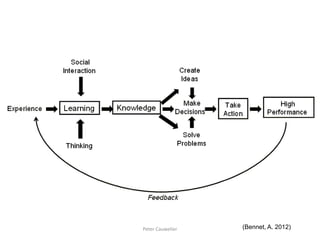
Learning leads to performance … 
Peter Cauwelier
Peter Cauwelier
Peter Cauwelier
Peter Cauwelier
Peter Cauwelier
Peter Cauwelier
Peter Cauwelier
Learning leads to high performance 
Peter Cauwelier
(Bennet, A. 2012) 
Peter Cauwelier
What are the factors affecting learning in a team ? 
Peter Cauwelier
What is Team Psychological Safety … 
Peter Cauwelier
Team learning 
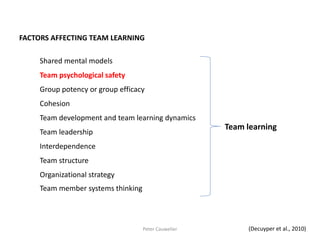
FACTORS AFFECTING TEAM LEARNING 
(Decuyper et al., 2010) 
Shared mental models 
Team psychological safety 
Group potency or group efficacy 
Cohesion 
Team development and team learning dynamics 
Team leadership 
Interdependence 
Team structure 
Organizational strategy 
Team member systems thinking 
Peter Cauwelier
So what is Team Psychological Safety ? 
Peter Cauwelier
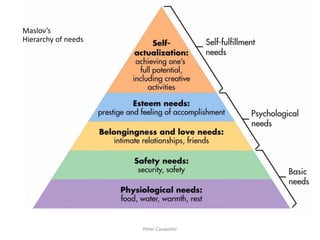
Maslov’s Hierarchy of needs 
Peter Cauwelier
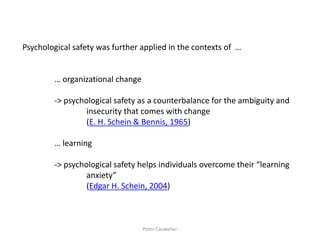
Psychological safety was further applied in the contexts of … 
… organizational change 
-> psychological safety as a counterbalance for the ambiguity and 
insecurity that comes with change 
(E. H. Schein & Bennis, 1965) 
… learning 
-> psychological safety helps individuals overcome their “learning 
anxiety” 
(Edgar H. Schein, 2004) 
Peter Cauwelier
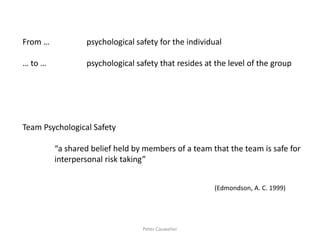
From … psychological safety for the individual 
… to … psychological safety that resides at the level of the group 
Team Psychological Safety 
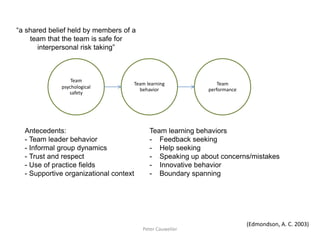
“a shared belief held by members of a team that the team is safe for 
interpersonal risk taking” 
(Edmondson, A. C. 1999) 
Peter Cauwelier
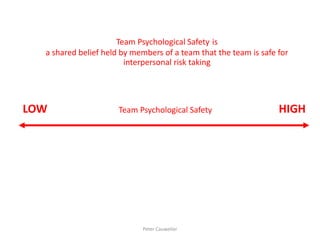
Team Psychological Safety is a shared belief held by members of a team that the team is safe for interpersonal risk taking 
Peter Cauwelier 
LOW Team Psychological Safety HIGH
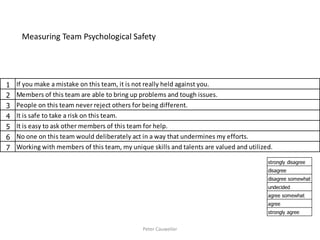
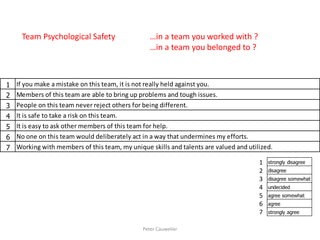
1 If you make a mistake on this team, it is not really held against you. 
2 Members of this team are able to bring up problems and tough issues. 
3 People on this team never reject others for being different. 
4 It is safe to take a risk on this team. 
5 It is easy to ask other members of this team for help. 
6 No one on this team would deliberately act in a way that undermines my efforts. 
7 Working with members of this team, my unique skills and talents are valued and utilized. 
strongly disagree 
disagree 
disagree somewhat 
undecided 
agree somewhat 
agree 
strongly agree 
Measuring Team Psychological Safety 
Peter Cauwelier
1 If you make a mistake on this team, it is not really held against you. 
2 Members of this team are able to bring up problems and tough issues. 
3 People on this team never reject others for being different. 
4 It is safe to take a risk on this team. 
5 It is easy to ask other members of this team for help. 
6 No one on this team would deliberately act in a way that undermines my efforts. 
7 Working with members of this team, my unique skills and talents are valued and utilized. 
strongly disagree 
disagree 
disagree somewhat 
undecided 
agree somewhat 
agree 
strongly agree 
Team Psychological Safety …in a team you worked with ? 
…in a team you belonged to ? 
Peter Cauwelier 
1 
2 
3 
4 
5 
6 
7
(Edmondson, A. C. 2003) 
Team psychological safety 
Team learning 
Team performance 
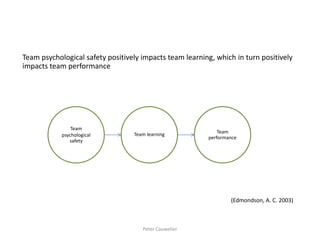
Team psychological safety positively impacts team learning, which in turn positively impacts team performance 
Peter Cauwelier
Examples of where 
Team Psychological Safety 
has been studied 
Peter Cauwelier
Peter Cauwelier
Peter Cauwelier 
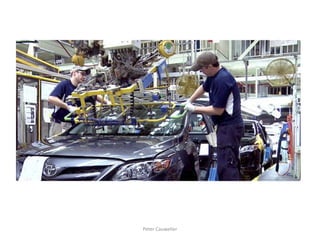
Medication errors Adoption of new cardiac surgery procedures
Peter Cauwelier
What are learning behaviors ? 
Peter Cauwelier
ACTION TEAMS 
vs 
PRODUCTION or SERVICE TEAMS 
Team 
a collection of individuals, interdependent in their tasks, sharing 
responsibility for outcomes, who see themselves and who are seen by 
others as an intact social entity embedded in a larger social system 
(Decuyper, S., et al. 2010) 
Peter Cauwelier
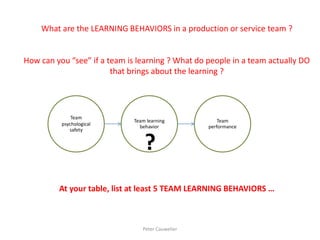
Team psychological safety 
Team learning behavior 
Team performance 
What are the LEARNING BEHAVIORS in a production or service team ? 
How can you “see” if a team is learning ? What do people in a team actually DO that brings about the learning ? 
At your table, list at least 5 TEAM LEARNING BEHAVIORS … 
Peter Cauwelier 
?
(Edmondson, A. C. 2003) 
Team psychological safety 
Team learning behavior 
Team performance 
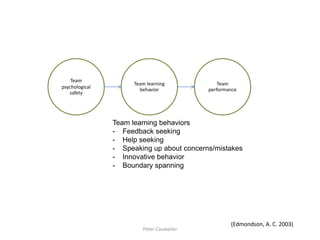
Team learning behaviors 
-Feedback seeking 
-Help seeking 
-Speaking up about concerns/mistakes 
-Innovative behavior 
-Boundary spanning 
Peter Cauwelier
So what leads to the development (or not) of 
Team Psychological Safety 
in a team ? 
Peter Cauwelier
Team psychological safety 
Team learning behavior 
Team performance 
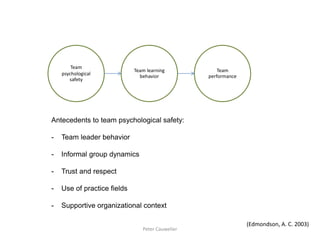
Antecedents to team psychological safety: 
-Team leader behavior 
-Informal group dynamics 
-Trust and respect 
-Use of practice fields 
-Supportive organizational context 
Peter Cauwelier 
(Edmondson, A. C. 2003)
-> leader behavior 
how the leader uses his/her “power” affects the psychological safety in the team, and further impacts … 
+ the team climate in general 
+ the willingness of the team members to share knowledge 
+ motivation for team learning 
-> informal group dynamics 
interplay of roles and “characters” that people assume or are assigned 
-> practice fields (or managerial learning laboratories) 
opportunities for teams to practice and to reflect upon the results, rather than 
to take action 
Peter Cauwelier
-> trust and respect 
between the different pairs of individuals in the team 
-> supportive organizational context 
ease of access to resources and information reduces the level of insecurity 
the team experiences in dealing with their challenge 
Peter Cauwelier
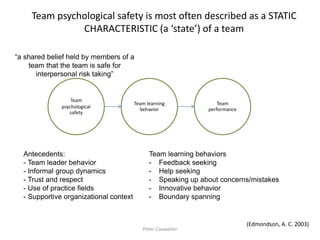
Team psychological safety is most often described as a STATIC CHARACTERISTIC (a ‘state’) of a team 
Peter Cauwelier 
Team psychological safety 
Team learning behavior 
Team performance 
Antecedents: 
- Team leader behavior 
- Informal group dynamics 
- Trust and respect 
- Use of practice fields 
- Supportive organizational context 
Team learning behaviors 
-Feedback seeking 
-Help seeking 
-Speaking up about concerns/mistakes 
-Innovative behavior 
-Boundary spanning 
“a shared belief held by members of a team that the team is safe for interpersonal risk taking” 
(Edmondson, A. C. 2003)
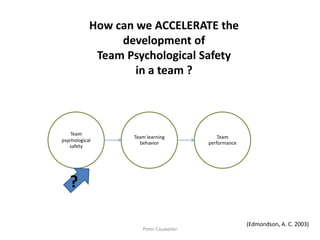
How can we ACCELERATE the development of Team Psychological Safety in a team ? 
Team psychological safety 
Team learning behavior 
Team performance 
Peter Cauwelier 
? 
(Edmondson, A. C. 2003)
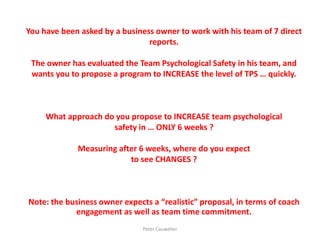
You have been asked by a business owner to work with his team of 7 direct reports. The owner has evaluated the Team Psychological Safety in his team, and wants you to propose a program to INCREASE the level of TPS … quickly. What approach do you propose to INCREASE team psychological safety in … ONLY 6 weeks ? Measuring after 6 weeks, where do you expect to see CHANGES ? Note: the business owner expects a “realistic” proposal, in terms of coach engagement as well as team time commitment. 
Peter Cauwelier
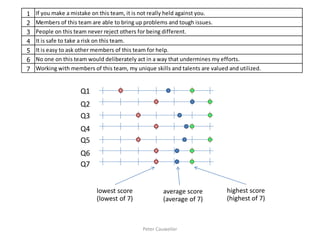
Q1 
Q2 
Q3 
Q4 
Q5 
Q6 
Q7 
1 If you make a mistake on this team, it is not really held against you. 
2 Members of this team are able to bring up problems and tough issues. 
3 People on this team never reject others for being different. 
4 It is safe to take a risk on this team. 
5 It is easy to ask other members of this team for help. 
6 No one on this team would deliberately act in a way that undermines my efforts. 
7 Working with members of this team, my unique skills and talents are valued and utilized. 
lowest score 
(lowest of 7) 
average score 
(average of 7) 
highest score 
(highest of 7) 
Peter Cauwelier
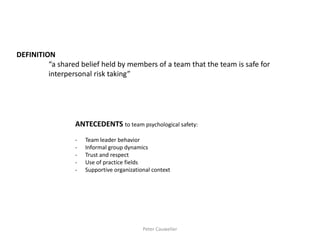
DEFINITION 
“a shared belief held by members of a team that the team is safe for 
interpersonal risk taking” 
ANTECEDENTS to team psychological safety: 
-Team leader behavior 
-Informal group dynamics 
-Trust and respect 
-Use of practice fields 
-Supportive organizational context 
Peter Cauwelier
DEBRIEF and capturing of main ideas/approaches on flipchart 
Peter Cauwelier
A (partial) answer Results of an experiment with Action Learning “A problem solving process with a small group working on real problems, taking action, and learning as individuals and as a team while doing so.” 
Peter Cauwelier
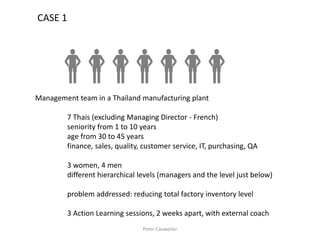
Management team in a Thailand manufacturing plant 
7 Thais (excluding Managing Director - French) 
seniority from 1 to 10 years 
age from 30 to 45 years 
finance, sales, quality, customer service, IT, purchasing, QA 
3 women, 4 men 
different hierarchical levels (managers and the level just below) 
problem addressed: reducing total factory inventory level 
3 Action Learning sessions, 2 weeks apart, with external coach 
 
 
 
 
 
 
 
Peter Cauwelier 
CASE 1
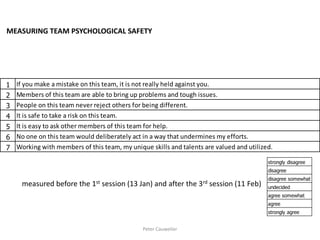
1 If you make a mistake on this team, it is not really held against you. 
2 Members of this team are able to bring up problems and tough issues. 
3 People on this team never reject others for being different. 
4 It is safe to take a risk on this team. 
5 It is easy to ask other members of this team for help. 
6 No one on this team would deliberately act in a way that undermines my efforts. 
7 Working with members of this team, my unique skills and talents are valued and utilized. 
strongly disagree 
disagree 
disagree somewhat 
undecided 
agree somewhat 
agree 
strongly agree 
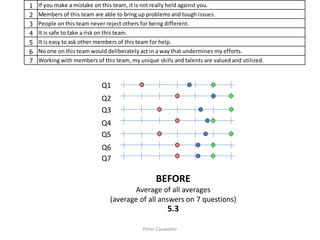
measured before the 1st session (13 Jan) and after the 3rd session (11 Feb) 
Peter Cauwelier 
MEASURING TEAM PSYCHOLOGICAL SAFETY
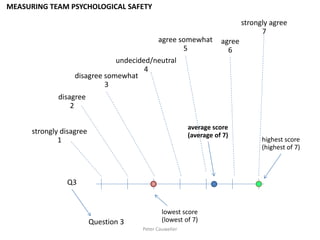
Q3 
Question 3 
strongly disagree 
1 
disagree 
2 
disagree somewhat 
3 
undecided/neutral 4 
agree somewhat 
5 
agree 6 
strongly agree 7 
lowest score (lowest of 7) 
average score 
(average of 7) 
highest score 
(highest of 7) 
Peter Cauwelier 
MEASURING TEAM PSYCHOLOGICAL SAFETY
BEFORE 
Average of all averages 
(average of all answers on 7 questions) 
5.3 
Q1 
Q2 
Q3 
Q4 
Q5 
Q6 
Q7 
1 If you make a mistake on this team, it is not really held against you. 
2 Members of this team are able to bring up problems and tough issues. 
3 People on this team never reject others for being different. 
4 It is safe to take a risk on this team. 
5 It is easy to ask other members of this team for help. 
6 No one on this team would deliberately act in a way that undermines my efforts. 
7 Working with members of this team, my unique skills and talents are valued and utilized. 
Peter Cauwelier
Q1 
Q2 
Q3 
Q4 
Q5 
Q6 
Q7 
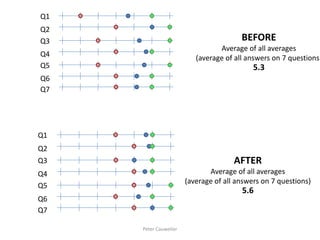
BEFORE 
Average of all averages 
(average of all answers on 7 questions) 
5.3 
Q1 
Q2 
Q3 
Q4 
Q5 
Q6 
Q7 
AFTER 
Average of all averages 
(average of all answers on 7 questions) 
5.6 
Peter Cauwelier
Q1 
Q2 
Q3 
Q4 
Q5 
Q6 
Q7 
1 If you make a mistake on this team, it is not really held against you. 
2 Members of this team are able to bring up problems and tough issues. 
3 People on this team never reject others for being different. 
4 It is safe to take a risk on this team. 
5 It is easy to ask other members of this team for help. 
6 No one on this team would deliberately act in a way that undermines my efforts. 
7 Working with members of this team, my unique skills and talents are valued and utilized. 
Q1 
Q2 
Q3 
Q4 
Q5 
Q6 
Q7 
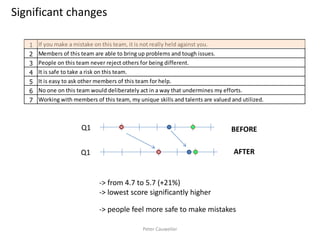
-> from 4.7 to 5.7 (+21%) 
-> lowest score significantly higher 
-> people feel more safe to make mistakes 
Significant changes 
BEFORE 
AFTER 
Peter Cauwelier
Q1 
Q2 
Q3 
Q4 
Q5 
Q6 
Q7 
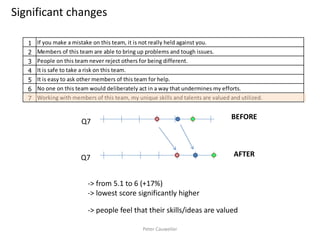
-> from 5.1 to 6 (+17%) 
-> lowest score significantly higher 
-> people feel that their skills/ideas are valued 
Q1 
Q2 
Q3 
Q4 
Q5 
Q6 
Q7 
1 If you make a mistake on this team, it is not really held against you. 
2 Members of this team are able to bring up problems and tough issues. 
3 People on this team never reject others for being different. 
4 It is safe to take a risk on this team. 
5 It is easy to ask other members of this team for help. 
6 No one on this team would deliberately act in a way that undermines my efforts. 
7 Working with members of this team, my unique skills and talents are valued and utilized. 
BEFORE 
AFTER 
Peter Cauwelier 
Significant changes
Peter Cauwelier 
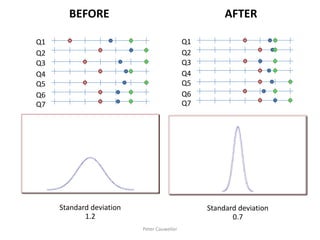
AFTER 
BEFORE 
Standard deviation 
1.2 
Standard deviation 0.7 
Q1 
Q2 
Q3 
Q4 
Q5 
Q6 
Q7 
Q1 
Q2 
Q3 
Q4 
Q5 
Q6 
Q7
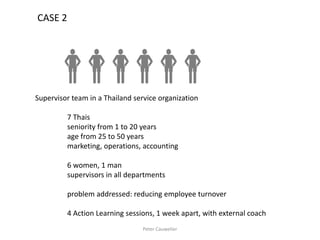
Supervisor team in a Thailand service organization 
7 Thais 
seniority from 1 to 20 years 
age from 25 to 50 years 
marketing, operations, accounting 
6 women, 1 man 
supervisors in all departments 
problem addressed: reducing employee turnover 
4 Action Learning sessions, 1 week apart, with external coach 
 
 
 
 
 
 
Peter Cauwelier 
CASE 2
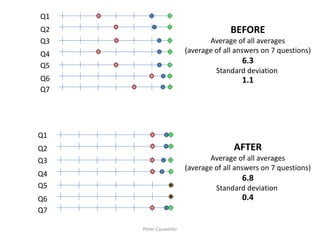
Q1 
Q2 
Q3 
Q4 
Q5 
Q6 
Q7 
BEFORE 
Average of all averages 
(average of all answers on 7 questions) 
6.3 
Standard deviation 
1.1 
Q1 
Q2 
Q3 
Q4 
Q5 
Q6 
Q7 
AFTER 
Average of all averages 
(average of all answers on 7 questions) 
6.8 
Standard deviation 
0.4 
Peter Cauwelier
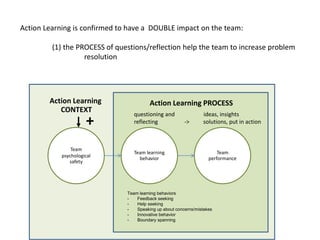
Team psychological safety 
Team learning behavior 
Team performance 
Team learning behaviors 
-Feedback seeking 
-Help seeking 
-Speaking up about concerns/mistakes 
-Innovative behavior 
-Boundary spanning 
questioning and ideas, insights reflecting -> solutions, put in action 
Action Learning PROCESS 
Action Learning 
CONTEXT 
+ 
Action Learning is confirmed to have a DOUBLE impact on the team: (1) the PROCESS of questions/reflection help the team to increase problem resolution (2) the CONTEXT created enhances the psychological safety in the team, which in turn positively impacts the effectiveness of the team learning
IN SUMMARY 
Peter Cauwelier
Peter Cauwelier 
Team psychological safety 
Team learning behavior 
Team performance 
Antecedents: - Team leader behavior - Informal group dynamics - Trust and respect - Use of practice fields - Supportive organizational context 
Team learning behaviors 
-Feedback seeking 
-Help seeking 
-Speaking up about concerns/mistakes 
-Innovative behavior 
-Boundary spanning 
“a shared belief held by members of a team that the team is safe for interpersonal risk taking” 
(Edmondson, A. C. 2003)
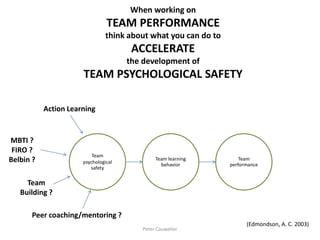
When working on TEAM PERFORMANCE think about what you can do to ACCELERATE the development of TEAM PSYCHOLOGICAL SAFETY 
Team psychological safety 
Team learning behavior 
Team performance 
Peter Cauwelier 
Action Learning 
Peer coaching/mentoring ? 
MBTI ? FIRO ? Belbin ? 
Team Building ? 
(Edmondson, A. C. 2003)
THANK YOU 
ANY QUESTIONS ? 
Peter Cauwelier

Building high performance teams through psychological safety

  • 1.
    Building high-performing teamsthrough Team Psychological safety Peter Cauwelier peter@wialthailand.com +66 (0)81 939 7833
  • 2.
    High-performance teams ? Peter Cauwelier
  • 3.
  • 4.
  • 5.
  • 6.
    What leads tohigh performance ? Peter Cauwelier
  • 7.
    Learning leads toperformance … Peter Cauwelier
  • 8.
  • 9.
  • 10.
  • 11.
  • 12.
  • 13.
  • 14.
    Learning leads tohigh performance Peter Cauwelier
  • 15.
    (Bennet, A. 2012) Peter Cauwelier
  • 16.
    What are thefactors affecting learning in a team ? Peter Cauwelier
  • 17.
    What is TeamPsychological Safety … Peter Cauwelier
  • 18.
    Team learning FACTORSAFFECTING TEAM LEARNING (Decuyper et al., 2010) Shared mental models Team psychological safety Group potency or group efficacy Cohesion Team development and team learning dynamics Team leadership Interdependence Team structure Organizational strategy Team member systems thinking Peter Cauwelier
  • 19.
    So what isTeam Psychological Safety ? Peter Cauwelier
  • 20.
    Maslov’s Hierarchy ofneeds Peter Cauwelier
  • 21.
    Psychological safety wasfurther applied in the contexts of … … organizational change -> psychological safety as a counterbalance for the ambiguity and insecurity that comes with change (E. H. Schein & Bennis, 1965) … learning -> psychological safety helps individuals overcome their “learning anxiety” (Edgar H. Schein, 2004) Peter Cauwelier
  • 22.
    From … psychologicalsafety for the individual … to … psychological safety that resides at the level of the group Team Psychological Safety “a shared belief held by members of a team that the team is safe for interpersonal risk taking” (Edmondson, A. C. 1999) Peter Cauwelier
  • 23.
    Team Psychological Safetyis a shared belief held by members of a team that the team is safe for interpersonal risk taking Peter Cauwelier LOW Team Psychological Safety HIGH
  • 24.
    1 If youmake a mistake on this team, it is not really held against you. 2 Members of this team are able to bring up problems and tough issues. 3 People on this team never reject others for being different. 4 It is safe to take a risk on this team. 5 It is easy to ask other members of this team for help. 6 No one on this team would deliberately act in a way that undermines my efforts. 7 Working with members of this team, my unique skills and talents are valued and utilized. strongly disagree disagree disagree somewhat undecided agree somewhat agree strongly agree Measuring Team Psychological Safety Peter Cauwelier
  • 25.
    1 If youmake a mistake on this team, it is not really held against you. 2 Members of this team are able to bring up problems and tough issues. 3 People on this team never reject others for being different. 4 It is safe to take a risk on this team. 5 It is easy to ask other members of this team for help. 6 No one on this team would deliberately act in a way that undermines my efforts. 7 Working with members of this team, my unique skills and talents are valued and utilized. strongly disagree disagree disagree somewhat undecided agree somewhat agree strongly agree Team Psychological Safety …in a team you worked with ? …in a team you belonged to ? Peter Cauwelier 1 2 3 4 5 6 7
  • 26.
    (Edmondson, A. C.2003) Team psychological safety Team learning Team performance Team psychological safety positively impacts team learning, which in turn positively impacts team performance Peter Cauwelier
  • 27.
    Examples of where Team Psychological Safety has been studied Peter Cauwelier
  • 28.
  • 29.
    Peter Cauwelier Medicationerrors Adoption of new cardiac surgery procedures
  • 30.
  • 31.
    What are learningbehaviors ? Peter Cauwelier
  • 32.
    ACTION TEAMS vs PRODUCTION or SERVICE TEAMS Team a collection of individuals, interdependent in their tasks, sharing responsibility for outcomes, who see themselves and who are seen by others as an intact social entity embedded in a larger social system (Decuyper, S., et al. 2010) Peter Cauwelier
  • 33.
    Team psychological safety Team learning behavior Team performance What are the LEARNING BEHAVIORS in a production or service team ? How can you “see” if a team is learning ? What do people in a team actually DO that brings about the learning ? At your table, list at least 5 TEAM LEARNING BEHAVIORS … Peter Cauwelier ?
  • 34.
    (Edmondson, A. C.2003) Team psychological safety Team learning behavior Team performance Team learning behaviors -Feedback seeking -Help seeking -Speaking up about concerns/mistakes -Innovative behavior -Boundary spanning Peter Cauwelier
  • 35.
    So what leadsto the development (or not) of Team Psychological Safety in a team ? Peter Cauwelier
  • 36.
    Team psychological safety Team learning behavior Team performance Antecedents to team psychological safety: -Team leader behavior -Informal group dynamics -Trust and respect -Use of practice fields -Supportive organizational context Peter Cauwelier (Edmondson, A. C. 2003)
  • 37.
    -> leader behavior how the leader uses his/her “power” affects the psychological safety in the team, and further impacts … + the team climate in general + the willingness of the team members to share knowledge + motivation for team learning -> informal group dynamics interplay of roles and “characters” that people assume or are assigned -> practice fields (or managerial learning laboratories) opportunities for teams to practice and to reflect upon the results, rather than to take action Peter Cauwelier
  • 38.
    -> trust andrespect between the different pairs of individuals in the team -> supportive organizational context ease of access to resources and information reduces the level of insecurity the team experiences in dealing with their challenge Peter Cauwelier
  • 39.
    Team psychological safetyis most often described as a STATIC CHARACTERISTIC (a ‘state’) of a team Peter Cauwelier Team psychological safety Team learning behavior Team performance Antecedents: - Team leader behavior - Informal group dynamics - Trust and respect - Use of practice fields - Supportive organizational context Team learning behaviors -Feedback seeking -Help seeking -Speaking up about concerns/mistakes -Innovative behavior -Boundary spanning “a shared belief held by members of a team that the team is safe for interpersonal risk taking” (Edmondson, A. C. 2003)
  • 40.
    How can weACCELERATE the development of Team Psychological Safety in a team ? Team psychological safety Team learning behavior Team performance Peter Cauwelier ? (Edmondson, A. C. 2003)
  • 41.
    You have beenasked by a business owner to work with his team of 7 direct reports. The owner has evaluated the Team Psychological Safety in his team, and wants you to propose a program to INCREASE the level of TPS … quickly. What approach do you propose to INCREASE team psychological safety in … ONLY 6 weeks ? Measuring after 6 weeks, where do you expect to see CHANGES ? Note: the business owner expects a “realistic” proposal, in terms of coach engagement as well as team time commitment. Peter Cauwelier
  • 42.
    Q1 Q2 Q3 Q4 Q5 Q6 Q7 1 If you make a mistake on this team, it is not really held against you. 2 Members of this team are able to bring up problems and tough issues. 3 People on this team never reject others for being different. 4 It is safe to take a risk on this team. 5 It is easy to ask other members of this team for help. 6 No one on this team would deliberately act in a way that undermines my efforts. 7 Working with members of this team, my unique skills and talents are valued and utilized. lowest score (lowest of 7) average score (average of 7) highest score (highest of 7) Peter Cauwelier
  • 43.
    DEFINITION “a sharedbelief held by members of a team that the team is safe for interpersonal risk taking” ANTECEDENTS to team psychological safety: -Team leader behavior -Informal group dynamics -Trust and respect -Use of practice fields -Supportive organizational context Peter Cauwelier
  • 44.
    DEBRIEF and capturingof main ideas/approaches on flipchart Peter Cauwelier
  • 45.
    A (partial) answerResults of an experiment with Action Learning “A problem solving process with a small group working on real problems, taking action, and learning as individuals and as a team while doing so.” Peter Cauwelier
  • 46.
    Management team ina Thailand manufacturing plant 7 Thais (excluding Managing Director - French) seniority from 1 to 10 years age from 30 to 45 years finance, sales, quality, customer service, IT, purchasing, QA 3 women, 4 men different hierarchical levels (managers and the level just below) problem addressed: reducing total factory inventory level 3 Action Learning sessions, 2 weeks apart, with external coach        Peter Cauwelier CASE 1
  • 47.
    1 If youmake a mistake on this team, it is not really held against you. 2 Members of this team are able to bring up problems and tough issues. 3 People on this team never reject others for being different. 4 It is safe to take a risk on this team. 5 It is easy to ask other members of this team for help. 6 No one on this team would deliberately act in a way that undermines my efforts. 7 Working with members of this team, my unique skills and talents are valued and utilized. strongly disagree disagree disagree somewhat undecided agree somewhat agree strongly agree measured before the 1st session (13 Jan) and after the 3rd session (11 Feb) Peter Cauwelier MEASURING TEAM PSYCHOLOGICAL SAFETY
  • 48.
    Q3 Question 3 strongly disagree 1 disagree 2 disagree somewhat 3 undecided/neutral 4 agree somewhat 5 agree 6 strongly agree 7 lowest score (lowest of 7) average score (average of 7) highest score (highest of 7) Peter Cauwelier MEASURING TEAM PSYCHOLOGICAL SAFETY
  • 49.
    BEFORE Average ofall averages (average of all answers on 7 questions) 5.3 Q1 Q2 Q3 Q4 Q5 Q6 Q7 1 If you make a mistake on this team, it is not really held against you. 2 Members of this team are able to bring up problems and tough issues. 3 People on this team never reject others for being different. 4 It is safe to take a risk on this team. 5 It is easy to ask other members of this team for help. 6 No one on this team would deliberately act in a way that undermines my efforts. 7 Working with members of this team, my unique skills and talents are valued and utilized. Peter Cauwelier
  • 50.
    Q1 Q2 Q3 Q4 Q5 Q6 Q7 BEFORE Average of all averages (average of all answers on 7 questions) 5.3 Q1 Q2 Q3 Q4 Q5 Q6 Q7 AFTER Average of all averages (average of all answers on 7 questions) 5.6 Peter Cauwelier
  • 51.
    Q1 Q2 Q3 Q4 Q5 Q6 Q7 1 If you make a mistake on this team, it is not really held against you. 2 Members of this team are able to bring up problems and tough issues. 3 People on this team never reject others for being different. 4 It is safe to take a risk on this team. 5 It is easy to ask other members of this team for help. 6 No one on this team would deliberately act in a way that undermines my efforts. 7 Working with members of this team, my unique skills and talents are valued and utilized. Q1 Q2 Q3 Q4 Q5 Q6 Q7 -> from 4.7 to 5.7 (+21%) -> lowest score significantly higher -> people feel more safe to make mistakes Significant changes BEFORE AFTER Peter Cauwelier
  • 52.
    Q1 Q2 Q3 Q4 Q5 Q6 Q7 -> from 5.1 to 6 (+17%) -> lowest score significantly higher -> people feel that their skills/ideas are valued Q1 Q2 Q3 Q4 Q5 Q6 Q7 1 If you make a mistake on this team, it is not really held against you. 2 Members of this team are able to bring up problems and tough issues. 3 People on this team never reject others for being different. 4 It is safe to take a risk on this team. 5 It is easy to ask other members of this team for help. 6 No one on this team would deliberately act in a way that undermines my efforts. 7 Working with members of this team, my unique skills and talents are valued and utilized. BEFORE AFTER Peter Cauwelier Significant changes
  • 53.
    Peter Cauwelier AFTER BEFORE Standard deviation 1.2 Standard deviation 0.7 Q1 Q2 Q3 Q4 Q5 Q6 Q7 Q1 Q2 Q3 Q4 Q5 Q6 Q7
  • 54.
    Supervisor team ina Thailand service organization 7 Thais seniority from 1 to 20 years age from 25 to 50 years marketing, operations, accounting 6 women, 1 man supervisors in all departments problem addressed: reducing employee turnover 4 Action Learning sessions, 1 week apart, with external coach       Peter Cauwelier CASE 2
  • 55.
    Q1 Q2 Q3 Q4 Q5 Q6 Q7 BEFORE Average of all averages (average of all answers on 7 questions) 6.3 Standard deviation 1.1 Q1 Q2 Q3 Q4 Q5 Q6 Q7 AFTER Average of all averages (average of all answers on 7 questions) 6.8 Standard deviation 0.4 Peter Cauwelier
  • 56.
    Team psychological safety Team learning behavior Team performance Team learning behaviors -Feedback seeking -Help seeking -Speaking up about concerns/mistakes -Innovative behavior -Boundary spanning questioning and ideas, insights reflecting -> solutions, put in action Action Learning PROCESS Action Learning CONTEXT + Action Learning is confirmed to have a DOUBLE impact on the team: (1) the PROCESS of questions/reflection help the team to increase problem resolution (2) the CONTEXT created enhances the psychological safety in the team, which in turn positively impacts the effectiveness of the team learning
  • 57.
  • 58.
    Peter Cauwelier Teampsychological safety Team learning behavior Team performance Antecedents: - Team leader behavior - Informal group dynamics - Trust and respect - Use of practice fields - Supportive organizational context Team learning behaviors -Feedback seeking -Help seeking -Speaking up about concerns/mistakes -Innovative behavior -Boundary spanning “a shared belief held by members of a team that the team is safe for interpersonal risk taking” (Edmondson, A. C. 2003)
  • 59.
    When working onTEAM PERFORMANCE think about what you can do to ACCELERATE the development of TEAM PSYCHOLOGICAL SAFETY Team psychological safety Team learning behavior Team performance Peter Cauwelier Action Learning Peer coaching/mentoring ? MBTI ? FIRO ? Belbin ? Team Building ? (Edmondson, A. C. 2003)
  • 60.
    THANK YOU ANYQUESTIONS ? Peter Cauwelier