PRESENT TENSES
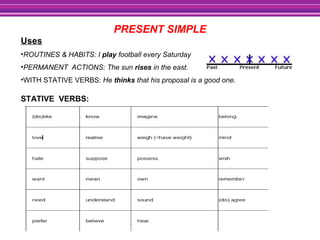
PRESENT SIMPLE
Uses
•ROUTINES & HABITS: I play football every Saturday
•PERMANENT ACTIONS: The sun rises in the east.
•WITH STATIVE VERBS: He thinks that his proposal is a good one.
STATIVE VERBS:
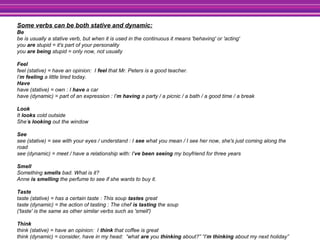
Some verbs can be both stative and dynamic:
Be
be is usually a stative verb, but when it is used in the continuous it means 'behaving' or 'acting'
you are stupid = it's part of your personality
you are being stupid = only now, not usually
Feel
feel (stative) = have an opinion: I feel that Mr. Peters is a good teacher.
I’m feeling a little tired today.
Have
have (stative) = own : I have a car
have (dynamic) = part of an expression : I'm having a party / a picnic / a bath / a good time / a break
Look
It looks cold outside
She’s looking out the window
See
see (stative) = see with your eyes / understand : I see what you mean / I see her now, she's just coming along the
road
see (dynamic) = meet / have a relationship with: I've been seeing my boyfriend for three years
Smell
Something smells bad. What is it?
Anne is smelling the perfume to see if she wants to buy it.
Taste
taste (stative) = has a certain taste : This soup tastes great
taste (dynamic) = the action of tasting : The chef is tasting the soup
('taste' is the same as other similar verbs such as 'smell')
Think
think (stative) = have an opinion: I think that coffee is great
think (dynamic) = consider, have in my head: “what are you thinking about?” “I'm thinking about my next holiday”
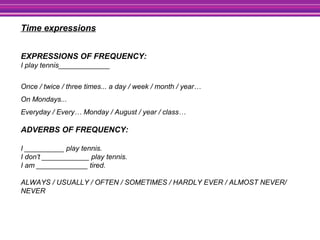
Time expressions
EXPRESSIONS OF FREQUENCY:
I play tennis_____________
Once / twice / three times... a day / week / month / year…
On Mondays...
Everyday / Every… Monday / August / year / class…
ADVERBS OF FREQUENCY:
I __________ play tennis.
I don’t ____________ play tennis.
I am _____________ tired.
ALWAYS / USUALLY / OFTEN / SOMETIMES / HARDLY EVER / ALMOST NEVER/
NEVER
Structure
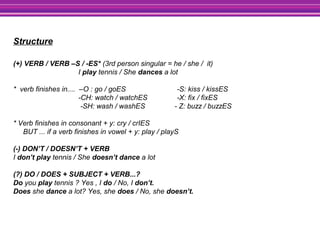
(+) VERB / VERB –S / -ES* (3rd person singular = he / she / it)
I play tennis / She dances a lot
* verb finishes in.... –O : go / goES -S: kiss / kissES
-CH: watch / watchES -X: fix / fixES
-SH: wash / washES - Z: buzz / buzzES
* Verb finishes in consonant + y: cry / crIES
BUT ... if a verb finishes in vowel + y: play / playS
(-) DON’T / DOESN’T + VERB
I don’t play tennis / She doesn’t dance a lot
(?) DO / DOES + SUBJECT + VERB...?
Do you play tennis ? Yes , I do / No, I don’t.
Does she dance a lot? Yes, she does / No, she doesn’t.
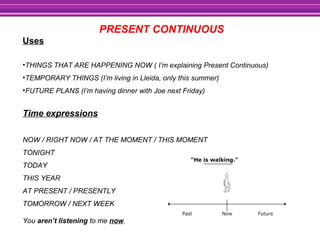
PRESENT CONTINUOUS
Uses
•THINGS THAT ARE HAPPENING NOW ( I’m explaining Present Continuous)
•TEMPORARY THINGS (I’m living in Lleida, only this summer)
•FUTURE PLANS (I’m having dinner with Joe next Friday)
Time expressions
NOW / RIGHT NOW / AT THE MOMENT / THIS MOMENT
TONIGHT
TODAY
THIS YEAR
AT PRESENT / PRESENTLY
TOMORROW / NEXT WEEK
You aren’t listening to me now.
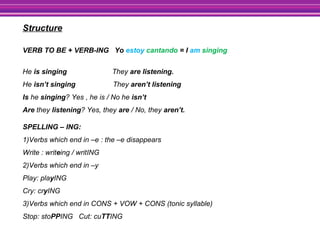
Structure
VERB TO BE + VERB-ING Yo estoy cantando = I am singing
He is singing They are listening.
He isn’t singing They aren’t listening
Is he singing? Yes , he is / No he isn’t
Are they listening? Yes, they are / No, they aren’t.
SPELLING – ING:
1)Verbs which end in –e : the –e disappears
Write : writeing / writING
2)Verbs which end in –y
Play: playING
Cry: cryING
3)Verbs which end in CONS + VOW + CONS (tonic syllable)
Stop: stoPPING Cut: cuTTING

Present tenses

  • 1.
  • 2.
    PRESENT SIMPLE Uses •ROUTINES &HABITS: I play football every Saturday •PERMANENT ACTIONS: The sun rises in the east. •WITH STATIVE VERBS: He thinks that his proposal is a good one. STATIVE VERBS:
  • 3.
    Some verbs canbe both stative and dynamic: Be be is usually a stative verb, but when it is used in the continuous it means 'behaving' or 'acting' you are stupid = it's part of your personality you are being stupid = only now, not usually Feel feel (stative) = have an opinion: I feel that Mr. Peters is a good teacher. I’m feeling a little tired today. Have have (stative) = own : I have a car have (dynamic) = part of an expression : I'm having a party / a picnic / a bath / a good time / a break Look It looks cold outside She’s looking out the window See see (stative) = see with your eyes / understand : I see what you mean / I see her now, she's just coming along the road see (dynamic) = meet / have a relationship with: I've been seeing my boyfriend for three years Smell Something smells bad. What is it? Anne is smelling the perfume to see if she wants to buy it. Taste taste (stative) = has a certain taste : This soup tastes great taste (dynamic) = the action of tasting : The chef is tasting the soup ('taste' is the same as other similar verbs such as 'smell') Think think (stative) = have an opinion: I think that coffee is great think (dynamic) = consider, have in my head: “what are you thinking about?” “I'm thinking about my next holiday”
  • 4.
    Time expressions EXPRESSIONS OFFREQUENCY: I play tennis_____________ Once / twice / three times... a day / week / month / year… On Mondays... Everyday / Every… Monday / August / year / class… ADVERBS OF FREQUENCY: I __________ play tennis. I don’t ____________ play tennis. I am _____________ tired. ALWAYS / USUALLY / OFTEN / SOMETIMES / HARDLY EVER / ALMOST NEVER/ NEVER
  • 5.
    Structure (+) VERB /VERB –S / -ES* (3rd person singular = he / she / it) I play tennis / She dances a lot * verb finishes in.... –O : go / goES -S: kiss / kissES -CH: watch / watchES -X: fix / fixES -SH: wash / washES - Z: buzz / buzzES * Verb finishes in consonant + y: cry / crIES BUT ... if a verb finishes in vowel + y: play / playS (-) DON’T / DOESN’T + VERB I don’t play tennis / She doesn’t dance a lot (?) DO / DOES + SUBJECT + VERB...? Do you play tennis ? Yes , I do / No, I don’t. Does she dance a lot? Yes, she does / No, she doesn’t.
  • 6.
    PRESENT CONTINUOUS Uses •THINGS THATARE HAPPENING NOW ( I’m explaining Present Continuous) •TEMPORARY THINGS (I’m living in Lleida, only this summer) •FUTURE PLANS (I’m having dinner with Joe next Friday) Time expressions NOW / RIGHT NOW / AT THE MOMENT / THIS MOMENT TONIGHT TODAY THIS YEAR AT PRESENT / PRESENTLY TOMORROW / NEXT WEEK You aren’t listening to me now.
  • 7.
    Structure VERB TO BE+ VERB-ING Yo estoy cantando = I am singing He is singing They are listening. He isn’t singing They aren’t listening Is he singing? Yes , he is / No he isn’t Are they listening? Yes, they are / No, they aren’t. SPELLING – ING: 1)Verbs which end in –e : the –e disappears Write : writeing / writING 2)Verbs which end in –y Play: playING Cry: cryING 3)Verbs which end in CONS + VOW + CONS (tonic syllable) Stop: stoPPING Cut: cuTTING