The PresentThe Present
tensestenses
Simple Present and PresentSimple Present and Present
ContinuousContinuous
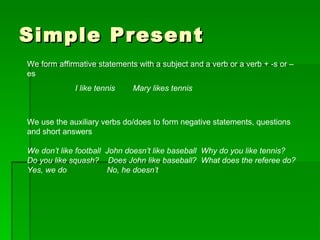
We form affirmative statements with a subject and a verb or a verb + -s or –
es
I like tennis Mary likes tennis
Simple PresentSimple Present
We use the auxiliary verbs do/does to form negative statements, questions
and short answers
We don’t like football John doesn’t like baseball Why do you like tennis?
Do you like squash? Does John like baseball? What does the referee do?
Yes, we do No, he doesn’t
Uses of the presentUses of the present
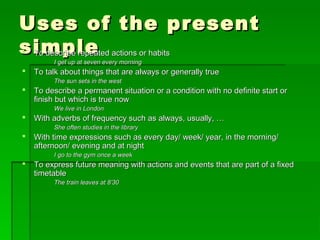
simplesimple To describe repeated actions or habitsTo describe repeated actions or habits
I get up at seven every morningI get up at seven every morning
 To talk about things that are always or generally trueTo talk about things that are always or generally true
The sun sets in the westThe sun sets in the west
 To describe a permanent situation or a condition with no definite start orTo describe a permanent situation or a condition with no definite start or
finish but which is true nowfinish but which is true now
We live in LondonWe live in London
 With adverbs of frequency such as always, usually, …With adverbs of frequency such as always, usually, …
She often studies in the libraryShe often studies in the library
 With time expressions such as every day/ week/ year, in the morning/With time expressions such as every day/ week/ year, in the morning/
afternoon/ evening and at nightafternoon/ evening and at night
I go to the gym once a weekI go to the gym once a week
 To express future meaning with actions and events that are part of a fixedTo express future meaning with actions and events that are part of a fixed
timetabletimetable
The train leaves at 8’30The train leaves at 8’30
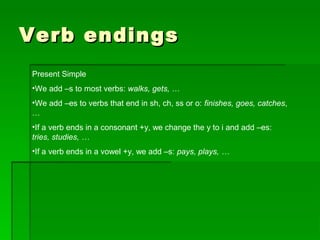
Verb endingsVerb endings
Present Simple
•We add –s to most verbs: walks, gets, …
•We add –es to verbs that end in sh, ch, ss or o: finishes, goes, catches,
…
•If a verb ends in a consonant +y, we change the y to i and add –es:
tries, studies, …
•If a verb ends in a vowel +y, we add –s: pays, plays, …
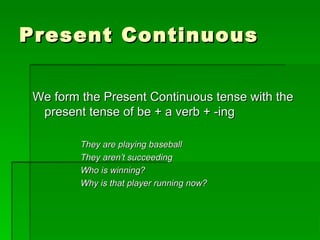
Present ContinuousPresent Continuous
We form the Present Continuous tense with theWe form the Present Continuous tense with the
present tense of be + a verb + -ingpresent tense of be + a verb + -ing
They are playing baseballThey are playing baseball
They aren’t succeedingThey aren’t succeeding
Who is winning?Who is winning?
Why is that player running now?Why is that player running now?
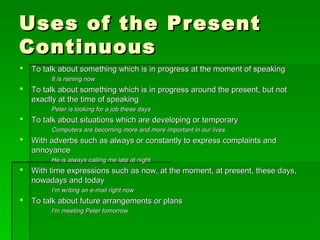
Uses of the PresentUses of the Present
ContinuousContinuous
 To talk about something which is in progress at the moment of speakingTo talk about something which is in progress at the moment of speaking
It is raining nowIt is raining now
 To talk about something which is in progress around the present, but notTo talk about something which is in progress around the present, but not
exactly at the time of speakingexactly at the time of speaking
Peter is looking for a job these daysPeter is looking for a job these days
 To talk about situations which are developing or temporaryTo talk about situations which are developing or temporary
Computers are becoming more and more important in our livesComputers are becoming more and more important in our lives
 With adverbs such as always or constantly to express complaints andWith adverbs such as always or constantly to express complaints and
annoyanceannoyance
He is always calling me late at nightHe is always calling me late at night
 With time expressions such as now, at the moment, at present, these days,With time expressions such as now, at the moment, at present, these days,
nowadays and todaynowadays and today
I’m writing an e-mail right nowI’m writing an e-mail right now
 To talk about future arrangements or plansTo talk about future arrangements or plans
I’m meeting Peter tomorrowI’m meeting Peter tomorrow
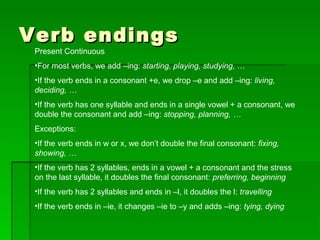
Verb endingsVerb endings
Present Continuous
•For most verbs, we add –ing: starting, playing, studying, …
•If the verb ends in a consonant +e, we drop –e and add –ing: living,
deciding, …
•If the verb has one syllable and ends in a single vowel + a consonant, we
double the consonant and add –ing: stopping, planning, …
Exceptions:
•If the verb ends in w or x, we don’t double the final consonant: fixing,
showing, …
•If the verb has 2 syllables, ends in a vowel + a consonant and the stress
on the last syllable, it doubles the final consonant: preferring, beginning
•If the verb has 2 syllables and ends in –l, it doubles the l: travelling
•If the verb ends in –ie, it changes –ie to –y and adds –ing: tying, dying
Stative and actionStative and action
verbsverbsStative verbsStative verbs
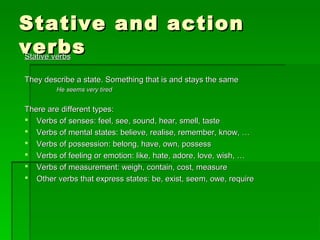
They describe a state. Something that is and stays the sameThey describe a state. Something that is and stays the same
He seems very tiredHe seems very tired
There are different types:There are different types:
 Verbs of senses: feel, see, sound, hear, smell, tasteVerbs of senses: feel, see, sound, hear, smell, taste
 Verbs of mental states: believe, realise, remember, know, …Verbs of mental states: believe, realise, remember, know, …
 Verbs of possession: belong, have, own, possessVerbs of possession: belong, have, own, possess
 Verbs of feeling or emotion: like, hate, adore, love, wish, …Verbs of feeling or emotion: like, hate, adore, love, wish, …
 Verbs of measurement: weigh, contain, cost, measureVerbs of measurement: weigh, contain, cost, measure
 Other verbs that express states: be, exist, seem, owe, requireOther verbs that express states: be, exist, seem, owe, require
Stative and actionStative and action
verbsverbs
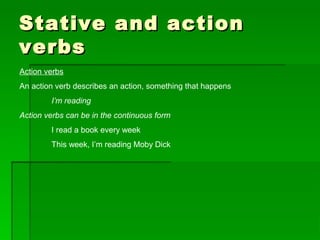
Action verbs
An action verb describes an action, something that happens
I’m reading
Action verbs can be in the continuous form
I read a book every week
This week, I’m reading Moby Dick
Stative and actionStative and action
verbsverbsChange of meaning
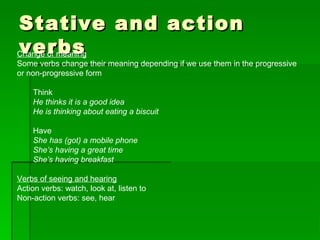
Some verbs change their meaning depending if we use them in the progressive
or non-progressive form
Think
He thinks it is a good idea
He is thinking about eating a biscuit
Have
She has (got) a mobile phone
She’s having a great time
She’s having breakfast
Verbs of seeing and hearing
Action verbs: watch, look at, listen to
Non-action verbs: see, hear

Present simple-versus-present-continuous

  • 1.
    The PresentThe Present tensestenses SimplePresent and PresentSimple Present and Present ContinuousContinuous
  • 2.
    We form affirmativestatements with a subject and a verb or a verb + -s or – es I like tennis Mary likes tennis Simple PresentSimple Present We use the auxiliary verbs do/does to form negative statements, questions and short answers We don’t like football John doesn’t like baseball Why do you like tennis? Do you like squash? Does John like baseball? What does the referee do? Yes, we do No, he doesn’t
  • 3.
    Uses of thepresentUses of the present simplesimple To describe repeated actions or habitsTo describe repeated actions or habits I get up at seven every morningI get up at seven every morning  To talk about things that are always or generally trueTo talk about things that are always or generally true The sun sets in the westThe sun sets in the west  To describe a permanent situation or a condition with no definite start orTo describe a permanent situation or a condition with no definite start or finish but which is true nowfinish but which is true now We live in LondonWe live in London  With adverbs of frequency such as always, usually, …With adverbs of frequency such as always, usually, … She often studies in the libraryShe often studies in the library  With time expressions such as every day/ week/ year, in the morning/With time expressions such as every day/ week/ year, in the morning/ afternoon/ evening and at nightafternoon/ evening and at night I go to the gym once a weekI go to the gym once a week  To express future meaning with actions and events that are part of a fixedTo express future meaning with actions and events that are part of a fixed timetabletimetable The train leaves at 8’30The train leaves at 8’30
  • 4.
    Verb endingsVerb endings PresentSimple •We add –s to most verbs: walks, gets, … •We add –es to verbs that end in sh, ch, ss or o: finishes, goes, catches, … •If a verb ends in a consonant +y, we change the y to i and add –es: tries, studies, … •If a verb ends in a vowel +y, we add –s: pays, plays, …
  • 5.
    Present ContinuousPresent Continuous Weform the Present Continuous tense with theWe form the Present Continuous tense with the present tense of be + a verb + -ingpresent tense of be + a verb + -ing They are playing baseballThey are playing baseball They aren’t succeedingThey aren’t succeeding Who is winning?Who is winning? Why is that player running now?Why is that player running now?
  • 6.
    Uses of thePresentUses of the Present ContinuousContinuous  To talk about something which is in progress at the moment of speakingTo talk about something which is in progress at the moment of speaking It is raining nowIt is raining now  To talk about something which is in progress around the present, but notTo talk about something which is in progress around the present, but not exactly at the time of speakingexactly at the time of speaking Peter is looking for a job these daysPeter is looking for a job these days  To talk about situations which are developing or temporaryTo talk about situations which are developing or temporary Computers are becoming more and more important in our livesComputers are becoming more and more important in our lives  With adverbs such as always or constantly to express complaints andWith adverbs such as always or constantly to express complaints and annoyanceannoyance He is always calling me late at nightHe is always calling me late at night  With time expressions such as now, at the moment, at present, these days,With time expressions such as now, at the moment, at present, these days, nowadays and todaynowadays and today I’m writing an e-mail right nowI’m writing an e-mail right now  To talk about future arrangements or plansTo talk about future arrangements or plans I’m meeting Peter tomorrowI’m meeting Peter tomorrow
  • 7.
    Verb endingsVerb endings PresentContinuous •For most verbs, we add –ing: starting, playing, studying, … •If the verb ends in a consonant +e, we drop –e and add –ing: living, deciding, … •If the verb has one syllable and ends in a single vowel + a consonant, we double the consonant and add –ing: stopping, planning, … Exceptions: •If the verb ends in w or x, we don’t double the final consonant: fixing, showing, … •If the verb has 2 syllables, ends in a vowel + a consonant and the stress on the last syllable, it doubles the final consonant: preferring, beginning •If the verb has 2 syllables and ends in –l, it doubles the l: travelling •If the verb ends in –ie, it changes –ie to –y and adds –ing: tying, dying
  • 8.
    Stative and actionStativeand action verbsverbsStative verbsStative verbs They describe a state. Something that is and stays the sameThey describe a state. Something that is and stays the same He seems very tiredHe seems very tired There are different types:There are different types:  Verbs of senses: feel, see, sound, hear, smell, tasteVerbs of senses: feel, see, sound, hear, smell, taste  Verbs of mental states: believe, realise, remember, know, …Verbs of mental states: believe, realise, remember, know, …  Verbs of possession: belong, have, own, possessVerbs of possession: belong, have, own, possess  Verbs of feeling or emotion: like, hate, adore, love, wish, …Verbs of feeling or emotion: like, hate, adore, love, wish, …  Verbs of measurement: weigh, contain, cost, measureVerbs of measurement: weigh, contain, cost, measure  Other verbs that express states: be, exist, seem, owe, requireOther verbs that express states: be, exist, seem, owe, require
  • 9.
    Stative and actionStativeand action verbsverbs Action verbs An action verb describes an action, something that happens I’m reading Action verbs can be in the continuous form I read a book every week This week, I’m reading Moby Dick
  • 10.
    Stative and actionStativeand action verbsverbsChange of meaning Some verbs change their meaning depending if we use them in the progressive or non-progressive form Think He thinks it is a good idea He is thinking about eating a biscuit Have She has (got) a mobile phone She’s having a great time She’s having breakfast Verbs of seeing and hearing Action verbs: watch, look at, listen to Non-action verbs: see, hear