MODAL VERBSMODAL VERBS
1. They are verbs like can, must, might, etc… which give
certain meanings to main verbs.
You smoke. / You shouldn’t smoke. / You mustn’t smoke.
2. They are followed by either:
– base form of the verb. I should tell him the truth.
– have + past participle form of the verb. I should have told
him the truth.
3. Structure:
(+) We should stay.
(-) We shouldn't stay.
(?) Should we stay?
4. Types of Modal verbs:
ADVICE: should / ought to
OBLIGATION: must / *have to / need to
LACK OF OBLIGATION: don’t have to / don't need to
PROHIBITION: mustn’t
CERTAINTY: must
ABILITY: can / could / *be able to
PERMISSION & REQUEST: can / could / may
PROBABILITY & POSSIBILITY: can / could / may / might
ADVICE: should / ought to
You should / ought to study more for your exams.
You shouldn’t smoke.
* Ought to rarely seen in negatives or questions.
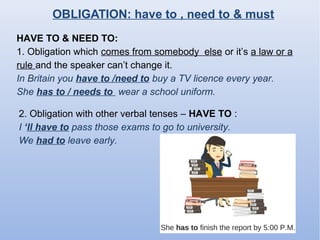
OBLIGATION: have to , need to & must
HAVE TO & NEED TO:
1. Obligation which comes from somebody else or it’s a law or a
rule and the speaker can’t change it.
In Britain you have to /need to buy a TV licence every year.
She has to / needs to wear a school uniform.
2. Obligation with other verbal tenses – HAVE TO :
I ‘ll have to pass those exams to go to university.
We had to leave early.
MUST
1. OBLIGATION which comes from the speaker.
It isn’t a law or a rule.
I must call my dad tonight.
2. Suggestion , recommendation , strong piece of advice:
You must try some of this ice-cream.
●
You don’t have to / need to order your meal now.
●
She doesn’t have to / need to cook dinner tonight.
LACK OF OBLIGATION: don’t have to & don’t need to
PROHIBITION: mustn't
You forbid somebody to do something
You mustn’t drink and drive.
You mustn’t lie.
CERTAINTY: must
You’re % sure about something. You totally believe it.
They must be an item. I’ve seen them kissing.
EXTERNAL OBLIGATION
Have to / Has to
Need to / Needs to
LACK OF OBLIGATION
Don’t have to / don’t need to
Doesn´t have to / doesn’t need to
OBLIGATION WITH OTHER VERBAL
TENSES
Have to (combined with tenses)
PROHIBITION
Mustn’t
INTERNAL OBLIGATION
Must
CERTAINTY
Must
RECOMMENDATION, SUGGESTION…
Must
ADVICE
Should
Shouldn’t
ABILITY : can, could & *be able to
1. Present: can
Two of my friends can play the guitar.
2. Past: could
When he was a child he could ski well.
3. Other tenses: be able to
- There was a fire and I was able to escape out (= I
managed to escape out) of the room. (specific situation in
the past)
- Next week they'll be able to vote. (future)
- We haven't been able to go on holiday this year. (present
perfect)
PERMISSION & REQUEST: can, could & may
Can you help me?
Could you send me your picture?
May I use your phone? (a bit more polite)
POSSIBILITY: could, may & might
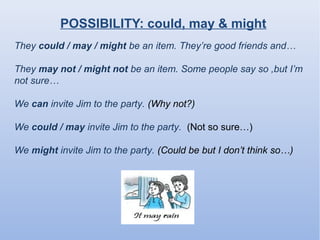
They could / may / might be an item. They’re good friends and…
They may not / might not be an item. Some people say so ,but I’m
not sure…
We can invite Jim to the party. (Why not?)
We could / may invite Jim to the party. (Not so sure…)
We might invite Jim to the party. (Could be but I don’t think so…)

Modal verbs 3rd eso

  • 1.
  • 2.
    1. They areverbs like can, must, might, etc… which give certain meanings to main verbs. You smoke. / You shouldn’t smoke. / You mustn’t smoke. 2. They are followed by either: – base form of the verb. I should tell him the truth. – have + past participle form of the verb. I should have told him the truth. 3. Structure: (+) We should stay. (-) We shouldn't stay. (?) Should we stay?
  • 3.
    4. Types ofModal verbs: ADVICE: should / ought to OBLIGATION: must / *have to / need to LACK OF OBLIGATION: don’t have to / don't need to PROHIBITION: mustn’t CERTAINTY: must ABILITY: can / could / *be able to PERMISSION & REQUEST: can / could / may PROBABILITY & POSSIBILITY: can / could / may / might
  • 4.
    ADVICE: should /ought to You should / ought to study more for your exams. You shouldn’t smoke. * Ought to rarely seen in negatives or questions.
  • 5.
    OBLIGATION: have to, need to & must HAVE TO & NEED TO: 1. Obligation which comes from somebody else or it’s a law or a rule and the speaker can’t change it. In Britain you have to /need to buy a TV licence every year. She has to / needs to wear a school uniform. 2. Obligation with other verbal tenses – HAVE TO : I ‘ll have to pass those exams to go to university. We had to leave early.
  • 6.
    MUST 1. OBLIGATION whichcomes from the speaker. It isn’t a law or a rule. I must call my dad tonight. 2. Suggestion , recommendation , strong piece of advice: You must try some of this ice-cream.
  • 7.
    ● You don’t haveto / need to order your meal now. ● She doesn’t have to / need to cook dinner tonight. LACK OF OBLIGATION: don’t have to & don’t need to
  • 8.
    PROHIBITION: mustn't You forbidsomebody to do something You mustn’t drink and drive. You mustn’t lie.
  • 9.
    CERTAINTY: must You’re %sure about something. You totally believe it. They must be an item. I’ve seen them kissing.
  • 10.
    EXTERNAL OBLIGATION Have to/ Has to Need to / Needs to LACK OF OBLIGATION Don’t have to / don’t need to Doesn´t have to / doesn’t need to OBLIGATION WITH OTHER VERBAL TENSES Have to (combined with tenses) PROHIBITION Mustn’t INTERNAL OBLIGATION Must CERTAINTY Must RECOMMENDATION, SUGGESTION… Must ADVICE Should Shouldn’t
  • 11.
    ABILITY : can,could & *be able to 1. Present: can Two of my friends can play the guitar. 2. Past: could When he was a child he could ski well. 3. Other tenses: be able to - There was a fire and I was able to escape out (= I managed to escape out) of the room. (specific situation in the past) - Next week they'll be able to vote. (future) - We haven't been able to go on holiday this year. (present perfect)
  • 12.
    PERMISSION & REQUEST:can, could & may Can you help me? Could you send me your picture? May I use your phone? (a bit more polite)
  • 13.
    POSSIBILITY: could, may& might They could / may / might be an item. They’re good friends and… They may not / might not be an item. Some people say so ,but I’m not sure… We can invite Jim to the party. (Why not?) We could / may invite Jim to the party. (Not so sure…) We might invite Jim to the party. (Could be but I don’t think so…)