PRESENT TENSES
1. PRESENT SIMPLE

2. PRESENT CONTINUOUS

3. STATIVE VERBS

4. ADVERBS OF FREQUENCY

5. PRESENT PERFECT SIMPLE

6. PRESENT PERFECT CONTINUOUS
1. PRESENT SIMPLE
WE USE THE PRESENT SIMPLE FOR:
- facts and permanent states
e.g.: Ralph works for a plumbing company.
- general truths and laws of nature
e.g.: The Moon revolves around the Earth.
- habits and routines
e.g.: We usually rent films at the weekends.
- timetables and programmes (in the future)

TIME
EXPRESSIONS:

Usually, often,
always, every
day/week/month,
in the morning/
afternoon/

e.g.: My plane lands at 6.05 exactly.

evening,

- sporting commentaries, reviews and

at night/

narrations
e.g.: Lee swings his bat and scores a home run.
- likes and dislikes (opinions)
e.g.: I love Slovenia; it's a beautiful country.

the weekend,
on Fridays, etc.
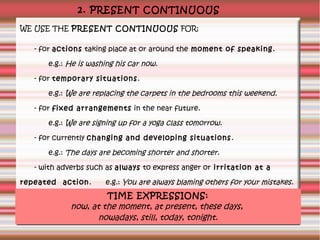
2. PRESENT CONTINUOUS
WE USE THE PRESENT CONTINUOUS FOR:
- for actions taking place at or around the moment of speaking .
e.g.: He is washing his car now.
- for temporary situations .
e.g.: We are replacing the carpets in the bedrooms this weekend.
- for fixed arrangements in the near future.
e.g.: We are signing up for a yoga class tomorrow .
- for currently changing and developing situations .
e.g.: The days are becoming shorter and shorter.
- with adverbs such as always to express anger or irritation at a
repeated action.

e.g.: You are always blaming others for your mistakes.

TIME EXPRESSIONS:
now, at the moment, at present, these days,
nowadays, still, today, tonight.
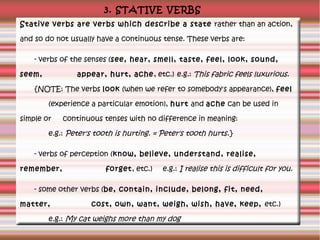
3. STATIVE VERBS
Stative verbs are verbs which describe a state rather than an action,
and so do not usually have a continuous tense. These verbs are:
- verbs of the senses (see, hear, smell, taste, feel, look, sound,
appear, hurt, ache , etc.) e.g.: This fabric feels luxurious.

seem,

{NOTE: The verbs look (when we refer to somebody's appearance), feel
(experience a particular emotion), hurt and ache can be used in
simple or

continuous tenses with no difference in meaning:

e.g.: Peter's tooth is hurting. = Peter's tooth hurts.}
- verbs of perception (know, believe, understand, realise,
remember,

forget, etc.)

e.g.: I realise this is difficult for you.

- some other verbs (be, contain, include, belong, fit, need,
matter,

cost, own, want, weigh, wish, have, keep, etc.)

e.g.: My cat weighs more than my dog
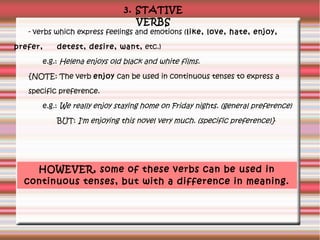
3. STATIVE
VERBS

- verbs which express feelings and emotions (like, love, hate, enjoy,
prefer,

detest, desire, want, etc.)
e.g.: Helena enjoys old black and white films.

{NOTE: The verb enjoy can be used in continuous tenses to express a
specific preference.
e.g.: We really enjoy staying home on Friday nights. (general preference)
BUT: I'm enjoying this novel very much. (specific preference)}

HOWEVER, some of these verbs can be used in
continuous tenses, but with a difference in meaning.
3. STATIVE
VERBS
verb

Present Simple

Present Continuous

THINK

I think she's a very good
listener.
(think = believe)

She is thinking about selling
her PC.
(is thinking = is considering)

HAVE

I am having a fantastic time.
(= am experiencing)
She has a large collection of
She is having a shower.
Elvis memorabilia.
(= is taking)
(= owns, possesses)
He is having breakfast.
(= is eating)

SEE

I can see my home from up
My mother is seeing an ear
here. (= it is visible)
specialist next week.
I can see now that she was
wrong for me.(= understand) (= is meeting)
3. STATIVE
VERBS
verb
TASTE

SMELL

Present Simple

Present Continuous

The chocolate tastes bitter. Connie is tasting the soup
to see if it is spicy.
(= it is, has the flavour of)
(= is testing)
Your breath smells of mint.
(= has the aroma)

I am smelling my roses.
(= am sniffing)

APPEAR

He appears to be a
gentleman. (= seems to be)

I am appearing in a new
Broadway show.
(= performing)

FIT

My dress fits her perfectly.
(= it's the right size)

Frank is fitting an extra lock
at the front door.
(= is attaching)
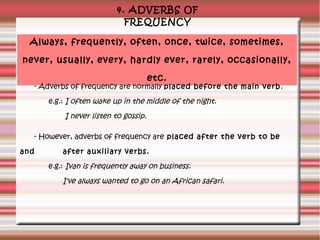
4. ADVERBS OF
FREQUENCY
Always, frequently, often, once, twice, sometimes,
never, usually, every, hardly ever, rarely, occasionally,
etc.

- Adverbs of frequency are normally placed before the main verb .
e.g.: I often wake up in the middle of the night.

I never listen to gossip.
- However, adverbs of frequency are placed after the verb to be
and

after auxiliary verbs.
e.g.: Ivan is frequently away on business.

I've always wanted to go on an African safari.
5. PRESENT PERFECT
SIMPLE

WE USE THE PRESENT PERFECT SIMPLE FOR:
- an action that happened at an unstated time
in

the past. The emphasis

time

is on the action, the

when it occurred is unimportant or unknown.
e.g.: Tina has visited Rome twice.

- an action which started in the past and
continues

up to the present , especially with

stative verbs.
e.g.: I have been a teacher for seven years.
- a recently completed action.
e.g.: I have completed the tax form.
- personal experiences or changes , usually with
a

consequence in the present.
e.g.: She has dyed her hair pink.

TIME
EXPRESSIONS:

For, since, already,
just, ever, never,
so far, today, this
week / month /
year,
how long, lately,
recently, still, yet,
etc.
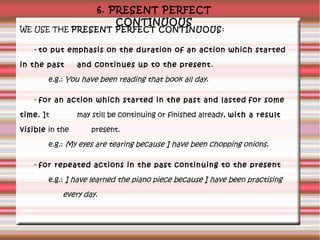
6. PRESENT PERFECT
CONTINUOUS

WE USE THE PRESENT PERFECT CONTINUOUS :
- to put emphasis on the duration of an action which started
in the past

and continues up to the present .

e.g.: You have been reading that book all day.
- for an action which started in the past and lasted for some
time. It

may still be continuing or finished already, with a result

visible in the

present.

e.g.: My eyes are tearing because I have been chopping onions.
- for repeated actions in the past continuing to the present
e.g.: I have learned the piano piece because I have been practising

every day.
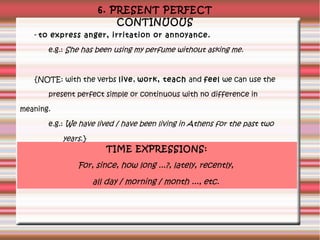
6. PRESENT PERFECT
CONTINUOUS
- to express anger, irritation or annoyance.
e.g.: She has been using my perfume without asking me.

{NOTE: with the verbs live, work, teach and feel we can use the
present perfect simple or continuous with no difference in
meaning.
e.g.: We have lived / have been living in Athens for the past two

years.}

TIME EXPRESSIONS:

For, since, how long ...?, lately, recently,
all day / morning / month ..., etc.

Present tenses

  • 1.
    PRESENT TENSES 1. PRESENTSIMPLE 2. PRESENT CONTINUOUS 3. STATIVE VERBS 4. ADVERBS OF FREQUENCY 5. PRESENT PERFECT SIMPLE 6. PRESENT PERFECT CONTINUOUS
  • 2.
    1. PRESENT SIMPLE WEUSE THE PRESENT SIMPLE FOR: - facts and permanent states e.g.: Ralph works for a plumbing company. - general truths and laws of nature e.g.: The Moon revolves around the Earth. - habits and routines e.g.: We usually rent films at the weekends. - timetables and programmes (in the future) TIME EXPRESSIONS: Usually, often, always, every day/week/month, in the morning/ afternoon/ e.g.: My plane lands at 6.05 exactly. evening, - sporting commentaries, reviews and at night/ narrations e.g.: Lee swings his bat and scores a home run. - likes and dislikes (opinions) e.g.: I love Slovenia; it's a beautiful country. the weekend, on Fridays, etc.
  • 3.
    2. PRESENT CONTINUOUS WEUSE THE PRESENT CONTINUOUS FOR: - for actions taking place at or around the moment of speaking . e.g.: He is washing his car now. - for temporary situations . e.g.: We are replacing the carpets in the bedrooms this weekend. - for fixed arrangements in the near future. e.g.: We are signing up for a yoga class tomorrow . - for currently changing and developing situations . e.g.: The days are becoming shorter and shorter. - with adverbs such as always to express anger or irritation at a repeated action. e.g.: You are always blaming others for your mistakes. TIME EXPRESSIONS: now, at the moment, at present, these days, nowadays, still, today, tonight.
  • 4.
    3. STATIVE VERBS Stativeverbs are verbs which describe a state rather than an action, and so do not usually have a continuous tense. These verbs are: - verbs of the senses (see, hear, smell, taste, feel, look, sound, appear, hurt, ache , etc.) e.g.: This fabric feels luxurious. seem, {NOTE: The verbs look (when we refer to somebody's appearance), feel (experience a particular emotion), hurt and ache can be used in simple or continuous tenses with no difference in meaning: e.g.: Peter's tooth is hurting. = Peter's tooth hurts.} - verbs of perception (know, believe, understand, realise, remember, forget, etc.) e.g.: I realise this is difficult for you. - some other verbs (be, contain, include, belong, fit, need, matter, cost, own, want, weigh, wish, have, keep, etc.) e.g.: My cat weighs more than my dog
  • 5.
    3. STATIVE VERBS - verbswhich express feelings and emotions (like, love, hate, enjoy, prefer, detest, desire, want, etc.) e.g.: Helena enjoys old black and white films. {NOTE: The verb enjoy can be used in continuous tenses to express a specific preference. e.g.: We really enjoy staying home on Friday nights. (general preference) BUT: I'm enjoying this novel very much. (specific preference)} HOWEVER, some of these verbs can be used in continuous tenses, but with a difference in meaning.
  • 6.
    3. STATIVE VERBS verb Present Simple PresentContinuous THINK I think she's a very good listener. (think = believe) She is thinking about selling her PC. (is thinking = is considering) HAVE I am having a fantastic time. (= am experiencing) She has a large collection of She is having a shower. Elvis memorabilia. (= is taking) (= owns, possesses) He is having breakfast. (= is eating) SEE I can see my home from up My mother is seeing an ear here. (= it is visible) specialist next week. I can see now that she was wrong for me.(= understand) (= is meeting)
  • 7.
    3. STATIVE VERBS verb TASTE SMELL Present Simple PresentContinuous The chocolate tastes bitter. Connie is tasting the soup to see if it is spicy. (= it is, has the flavour of) (= is testing) Your breath smells of mint. (= has the aroma) I am smelling my roses. (= am sniffing) APPEAR He appears to be a gentleman. (= seems to be) I am appearing in a new Broadway show. (= performing) FIT My dress fits her perfectly. (= it's the right size) Frank is fitting an extra lock at the front door. (= is attaching)
  • 8.
    4. ADVERBS OF FREQUENCY Always,frequently, often, once, twice, sometimes, never, usually, every, hardly ever, rarely, occasionally, etc. - Adverbs of frequency are normally placed before the main verb . e.g.: I often wake up in the middle of the night. I never listen to gossip. - However, adverbs of frequency are placed after the verb to be and after auxiliary verbs. e.g.: Ivan is frequently away on business. I've always wanted to go on an African safari.
  • 9.
    5. PRESENT PERFECT SIMPLE WEUSE THE PRESENT PERFECT SIMPLE FOR: - an action that happened at an unstated time in the past. The emphasis time is on the action, the when it occurred is unimportant or unknown. e.g.: Tina has visited Rome twice. - an action which started in the past and continues up to the present , especially with stative verbs. e.g.: I have been a teacher for seven years. - a recently completed action. e.g.: I have completed the tax form. - personal experiences or changes , usually with a consequence in the present. e.g.: She has dyed her hair pink. TIME EXPRESSIONS: For, since, already, just, ever, never, so far, today, this week / month / year, how long, lately, recently, still, yet, etc.
  • 10.
    6. PRESENT PERFECT CONTINUOUS WEUSE THE PRESENT PERFECT CONTINUOUS : - to put emphasis on the duration of an action which started in the past and continues up to the present . e.g.: You have been reading that book all day. - for an action which started in the past and lasted for some time. It may still be continuing or finished already, with a result visible in the present. e.g.: My eyes are tearing because I have been chopping onions. - for repeated actions in the past continuing to the present e.g.: I have learned the piano piece because I have been practising every day.
  • 11.
    6. PRESENT PERFECT CONTINUOUS -to express anger, irritation or annoyance. e.g.: She has been using my perfume without asking me. {NOTE: with the verbs live, work, teach and feel we can use the present perfect simple or continuous with no difference in meaning. e.g.: We have lived / have been living in Athens for the past two years.} TIME EXPRESSIONS: For, since, how long ...?, lately, recently, all day / morning / month ..., etc.