WRITING TIPS
• When you are in a writing exam, you shouldn't start writing immediately.
• You must think about the following questions and then plan your time
carefully.
• You should divide your time into three parts:
Part 1 – Planning time
Part 2 – Writing time
Part 3 – Reviewing
• Planning your time
Example: Writing task – 40 minutes:
Part 1: Planning – 10 minutes
Part 2: Writing – 25 minutes
Part 3: Reviewing – 5 minutes
PLANNING
• What do you have to do?
 Read the task carefully and underline the important parts of the
instructions.
 Beware the word limit: You can lose marks if you write too many or too
few words.
• What type of writing is it? Who you are writing for?
 We use different types of language for different types of writing. Choose
the right style and include interesting ideas.
• Brainstorm your ideas
 Before you write, think about the topic and all the ideas related.
 Write them down as quickly as possible.
 Ideas can be single words, you don’t have to write complete sentences.
 Don’t worry about grammar, spelling or the order of ideas.
• Include relevant information and start planning the different paragraphs .
 Compare the essay title with the ideas you brainstormed.
 Underline important ideas and put them in groups.
 Think about the key language to use for this type of writing.
 (If possible) try and summarise your main argument, idea or opinion in 1 or 2
sentences. This , combined with the ideas that support it, is the Thesis
Statement.
 Plan your essay:
OPINION ESSAY
DISCUSSION ESSAY
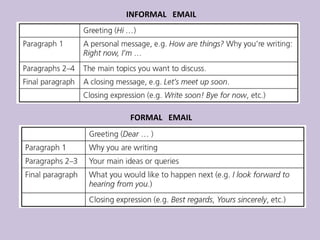
INFORMAL EMAIL
FORMAL EMAIL
NARRATIVE
DESCRIPTIVE ESSAY
WRITING
•INTRODUCTION:
Introduce your topic.
You may use a definition, a rhetorical question, you may explain briefly the
current state of the situation…
Add your Thesis Statement. This is the your opinion / your objective in the
writing and the ideas that support it (Topic sentences) - which are going to be
developed afterwards.
•BODY (1 or 2 paragraphs):
Start each paragraph with a Topic sentence: a general statement which
summarises the main idea of the paragraph.
Give additional information to support the topic sentence (Supporting
sentence).
Give evidence to support the topic sentence: examples, facts, a personal
experience , a physical description of something…
You can give each paragraph a Concluding sentence which sums up the
main idea or connects ideas to the next paragraph.
TOPIC
SENTENCE
SUPPORTING
SENTENCE
EVIDENCE
CONCLUDING
SENTENCE
•CONCLUSION:
Start with a linking phrase (In conclusion / To sum up…).
Don’t copy out the question or the Thesis Statement.
Restate your Thesis statement.
You may add your opinion , recommend a future action or ask a
hypothetical question.
Thesis
Statement
Conclusion
To improve your writing, use:
synonyms or antonyms.
adverbs and adjectives.
pronoun reference
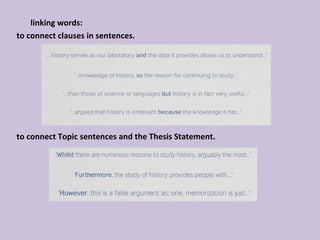
linking words:
to connect clauses in sentences.
to connect Topic sentences and the Thesis Statement.
to connect the Introduction to the Conclusion.
to link paragraphs.
REVIEWING
Check:
•the content (Did you answer the task correctly?).
•the style used.
•the organization
•the vocabulary
•the accuracy (Grammar? Spelling? Punctuation? Word
order? Agreement?)
•the use of simple or complex structures (Conditionals,
Relative clauses, Passive Voice, Modal verbs, etc…?).
•the word count.
Writing tips

Writing tips

  • 1.
  • 2.
    • When youare in a writing exam, you shouldn't start writing immediately. • You must think about the following questions and then plan your time carefully. • You should divide your time into three parts: Part 1 – Planning time Part 2 – Writing time Part 3 – Reviewing • Planning your time Example: Writing task – 40 minutes: Part 1: Planning – 10 minutes Part 2: Writing – 25 minutes Part 3: Reviewing – 5 minutes
  • 3.
  • 4.
    • What doyou have to do?  Read the task carefully and underline the important parts of the instructions.  Beware the word limit: You can lose marks if you write too many or too few words. • What type of writing is it? Who you are writing for?  We use different types of language for different types of writing. Choose the right style and include interesting ideas.
  • 5.
    • Brainstorm yourideas  Before you write, think about the topic and all the ideas related.  Write them down as quickly as possible.  Ideas can be single words, you don’t have to write complete sentences.  Don’t worry about grammar, spelling or the order of ideas.
  • 6.
    • Include relevantinformation and start planning the different paragraphs .  Compare the essay title with the ideas you brainstormed.  Underline important ideas and put them in groups.
  • 7.
     Think aboutthe key language to use for this type of writing.
  • 9.
     (If possible)try and summarise your main argument, idea or opinion in 1 or 2 sentences. This , combined with the ideas that support it, is the Thesis Statement.
  • 11.
  • 12.
  • 13.
  • 14.
  • 15.
  • 16.
    •INTRODUCTION: Introduce your topic. Youmay use a definition, a rhetorical question, you may explain briefly the current state of the situation… Add your Thesis Statement. This is the your opinion / your objective in the writing and the ideas that support it (Topic sentences) - which are going to be developed afterwards.
  • 17.
    •BODY (1 or2 paragraphs): Start each paragraph with a Topic sentence: a general statement which summarises the main idea of the paragraph. Give additional information to support the topic sentence (Supporting sentence). Give evidence to support the topic sentence: examples, facts, a personal experience , a physical description of something… You can give each paragraph a Concluding sentence which sums up the main idea or connects ideas to the next paragraph.
  • 19.
  • 20.
    •CONCLUSION: Start with alinking phrase (In conclusion / To sum up…). Don’t copy out the question or the Thesis Statement. Restate your Thesis statement. You may add your opinion , recommend a future action or ask a hypothetical question. Thesis Statement Conclusion
  • 21.
    To improve yourwriting, use: synonyms or antonyms. adverbs and adjectives. pronoun reference
  • 22.
    linking words: to connectclauses in sentences. to connect Topic sentences and the Thesis Statement.
  • 23.
    to connect theIntroduction to the Conclusion. to link paragraphs.
  • 25.
  • 26.
    Check: •the content (Didyou answer the task correctly?). •the style used. •the organization •the vocabulary •the accuracy (Grammar? Spelling? Punctuation? Word order? Agreement?) •the use of simple or complex structures (Conditionals, Relative clauses, Passive Voice, Modal verbs, etc…?). •the word count.