CONDITIONALS
TIME CLAUSES
WISHES &
REGRETS
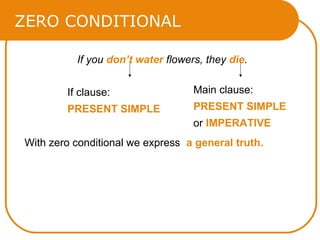
ZERO CONDITIONAL
If you don’t water flowers, they die.
With zero conditional we express a general truth.
If clause:
PRESENT SIMPLE
Main clause:
PRESENT SIMPLE
or IMPERATIVE
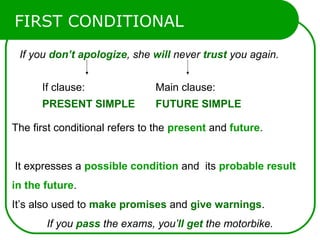
FIRST CONDITIONAL
If you don’t apologize, she will never trust you again.
The first conditional refers to the present and future.
It expresses a possible condition and its probable result
in the future.
It’s also used to make promises and give warnings.
If you pass the exams, you’ll get the motorbike.
If clause:
PRESENT SIMPLE
Main clause:
FUTURE SIMPLE
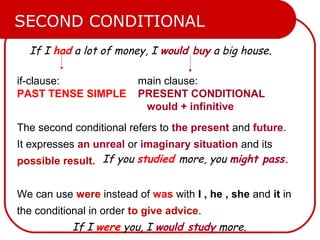
If I had a lot of money, I would buy a big house.
if-clause:
PAST TENSE SIMPLE
main clause:
PRESENT CONDITIONAL
would + infinitive
SECOND CONDITIONAL
The second conditional refers to the present and future.
It expresses an unreal or imaginary situation and its
possible result.
We can use were instead of was with I , he , she and it in
the conditional in order to give advice.
If I were you, I would study more.
If you studied more, you might pass.
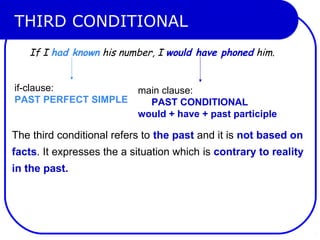
THIRD CONDITIONAL
If I had known his number, I would have phoned him.
if-clause:
PAST PERFECT SIMPLE
main clause:
PAST CONDITIONAL
would + have + past participle
The third conditional refers to the past and it is not based on
facts. It expresses the a situation which is contrary to reality
in the past.
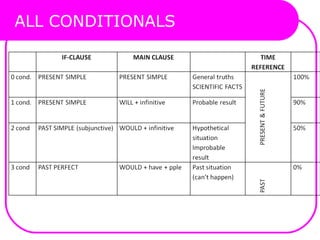
ALL CONDITIONALS
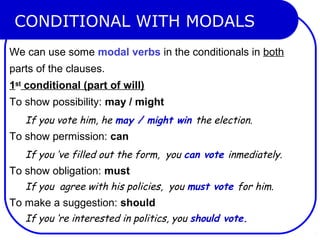
CONDITIONAL WITH MODALS
We can use some modal verbs in the conditionals in both
parts of the clauses.
1st
conditional (part of will)
To show possibility: may / might
If you vote him, he may / might win the election.
To show permission: can
If you ‘ve filled out the form, you can vote inmediately.
To show obligation: must
If you agree with his policies, you must vote for him.
To make a suggestion: should
If you ‘re interested in politics, you should vote.
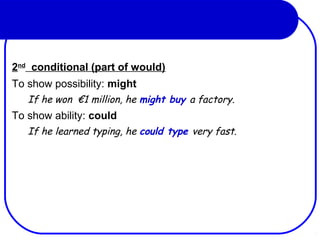
2nd
conditional (part of would)
To show possibility: might
If he won €1 million, he might buy a factory.
To show ability: could
If he learned typing, he could type very fast.
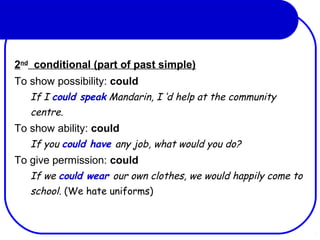
2nd
conditional (part of past simple)
To show possibility: could
If I could speak Mandarin, I ‘d help at the community
centre.
To show ability: could
If you could have any job, what would you do?
To give permission: could
If we could wear our own clothes, we would happily come to
school. (We hate uniforms)
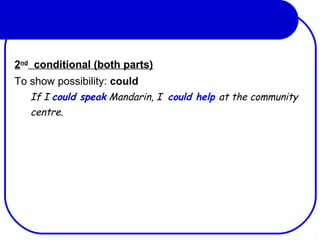
2nd
conditional (both parts)
To show possibility: could
If I could speak Mandarin, I could help at the community
centre.
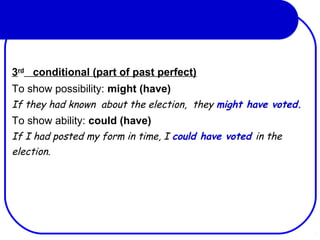
3rd
conditional (part of past perfect)
To show possibility: might (have)
If they had known about the election, they might have voted.
To show ability: could (have)
If I had posted my form in time, I could have voted in the
election.
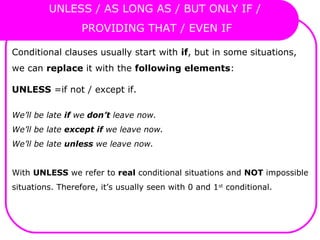
UNLESS / AS LONG AS / BUT ONLY IF /
PROVIDING THAT / EVEN IF
Conditional clauses usually start with if, but in some situations,
we can replace it with the following elements:
UNLESS =if not / except if.
We’ll be late if we don’t leave now.
We’ll be late except if we leave now.
We’ll be late unless we leave now.
With UNLESS we refer to real conditional situations and NOT impossible
situations. Therefore, it’s usually seen with 0 and 1st
conditional.
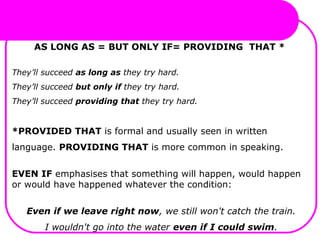
AS LONG AS = BUT ONLY IF= PROVIDING THAT *
They’ll succeed as long as they try hard.
They’ll succeed but only if they try hard.
They’ll succeed providing that they try hard.
*PROVIDED THAT is formal and usually seen in written
language. PROVIDING THAT is more common in speaking.
EVEN IF emphasises that something will happen, would happen
or would have happened whatever the condition:
Even if we leave right now, we still won't catch the train.
I wouldn't go into the water even if I could swim.
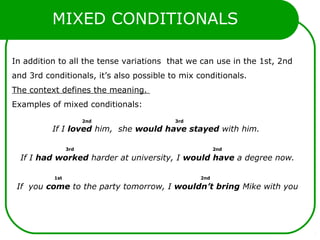
MIXED CONDITIONALS
In addition to all the tense variations that we can use in the 1st, 2nd
and 3rd conditionals, it’s also possible to mix conditionals.
The context defines the meaning.
Examples of mixed conditionals:
2nd 3rd
If I loved him, she would have stayed with him.
3rd 2nd
If I had worked harder at university, I would have a degree now.
1st 2nd
If you come to the party tomorrow, I wouldn’t bring Mike with you
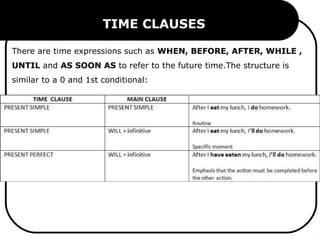
TIME CLAUSES
There are time expressions such as WHEN, BEFORE, AFTER, WHILE ,
UNTIL and AS SOON AS to refer to the future time.The structure is
similar to a 0 and 1st conditional:
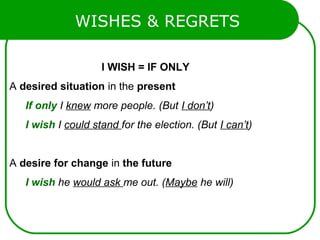
WISHES & REGRETS
I WISH = IF ONLY
A desired situation in the present
If only I knew more people. (But I don’t)
I wish I could stand for the election. (But I can’t)
A desire for change in the future
I wish he would ask me out. (Maybe he will)
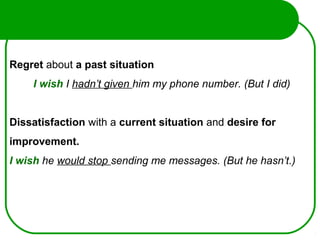
Regret about a past situation
I wish I hadn’t given him my phone number. (But I did)
Dissatisfaction with a current situation and desire for
improvement.
I wish he would stop sending me messages. (But he hasn’t.)

Conditionals + time clauses + wishes bach2

  • 1.
  • 2.
    ZERO CONDITIONAL If youdon’t water flowers, they die. With zero conditional we express a general truth. If clause: PRESENT SIMPLE Main clause: PRESENT SIMPLE or IMPERATIVE
  • 3.
    FIRST CONDITIONAL If youdon’t apologize, she will never trust you again. The first conditional refers to the present and future. It expresses a possible condition and its probable result in the future. It’s also used to make promises and give warnings. If you pass the exams, you’ll get the motorbike. If clause: PRESENT SIMPLE Main clause: FUTURE SIMPLE
  • 4.
    If I hada lot of money, I would buy a big house. if-clause: PAST TENSE SIMPLE main clause: PRESENT CONDITIONAL would + infinitive SECOND CONDITIONAL The second conditional refers to the present and future. It expresses an unreal or imaginary situation and its possible result. We can use were instead of was with I , he , she and it in the conditional in order to give advice. If I were you, I would study more. If you studied more, you might pass.
  • 5.
    THIRD CONDITIONAL If Ihad known his number, I would have phoned him. if-clause: PAST PERFECT SIMPLE main clause: PAST CONDITIONAL would + have + past participle The third conditional refers to the past and it is not based on facts. It expresses the a situation which is contrary to reality in the past.
  • 6.
  • 7.
    CONDITIONAL WITH MODALS Wecan use some modal verbs in the conditionals in both parts of the clauses. 1st conditional (part of will) To show possibility: may / might If you vote him, he may / might win the election. To show permission: can If you ‘ve filled out the form, you can vote inmediately. To show obligation: must If you agree with his policies, you must vote for him. To make a suggestion: should If you ‘re interested in politics, you should vote.
  • 8.
    2nd conditional (part ofwould) To show possibility: might If he won €1 million, he might buy a factory. To show ability: could If he learned typing, he could type very fast.
  • 9.
    2nd conditional (part ofpast simple) To show possibility: could If I could speak Mandarin, I ‘d help at the community centre. To show ability: could If you could have any job, what would you do? To give permission: could If we could wear our own clothes, we would happily come to school. (We hate uniforms)
  • 10.
    2nd conditional (both parts) Toshow possibility: could If I could speak Mandarin, I could help at the community centre.
  • 11.
    3rd conditional (part ofpast perfect) To show possibility: might (have) If they had known about the election, they might have voted. To show ability: could (have) If I had posted my form in time, I could have voted in the election.
  • 12.
    UNLESS / ASLONG AS / BUT ONLY IF / PROVIDING THAT / EVEN IF Conditional clauses usually start with if, but in some situations, we can replace it with the following elements: UNLESS =if not / except if. We’ll be late if we don’t leave now. We’ll be late except if we leave now. We’ll be late unless we leave now. With UNLESS we refer to real conditional situations and NOT impossible situations. Therefore, it’s usually seen with 0 and 1st conditional.
  • 13.
    AS LONG AS= BUT ONLY IF= PROVIDING THAT * They’ll succeed as long as they try hard. They’ll succeed but only if they try hard. They’ll succeed providing that they try hard. *PROVIDED THAT is formal and usually seen in written language. PROVIDING THAT is more common in speaking. EVEN IF emphasises that something will happen, would happen or would have happened whatever the condition: Even if we leave right now, we still won't catch the train. I wouldn't go into the water even if I could swim.
  • 14.
    MIXED CONDITIONALS In additionto all the tense variations that we can use in the 1st, 2nd and 3rd conditionals, it’s also possible to mix conditionals. The context defines the meaning. Examples of mixed conditionals: 2nd 3rd If I loved him, she would have stayed with him. 3rd 2nd If I had worked harder at university, I would have a degree now. 1st 2nd If you come to the party tomorrow, I wouldn’t bring Mike with you
  • 15.
    TIME CLAUSES There aretime expressions such as WHEN, BEFORE, AFTER, WHILE , UNTIL and AS SOON AS to refer to the future time.The structure is similar to a 0 and 1st conditional:
  • 16.
    WISHES & REGRETS IWISH = IF ONLY A desired situation in the present If only I knew more people. (But I don’t) I wish I could stand for the election. (But I can’t) A desire for change in the future I wish he would ask me out. (Maybe he will)
  • 17.
    Regret about apast situation I wish I hadn’t given him my phone number. (But I did) Dissatisfaction with a current situation and desire for improvement. I wish he would stop sending me messages. (But he hasn’t.)