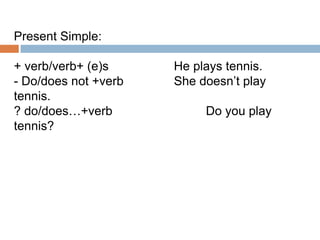
Present Simple:
+ verb/verb+ (e)s
- Do/does not +verb
tennis.
? do/does…+verb
tennis?

He plays tennis.
She doesn’t play
Do you play
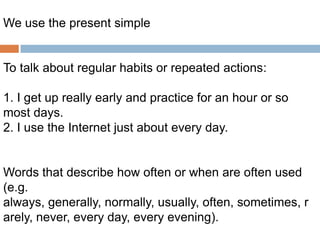
We use the present simple

To talk about regular habits or repeated actions:
1. I get up really early and practice for an hour or so
most days.
2. I use the Internet just about every day.

Words that describe how often or when are often used
(e.g.
always, generally, normally, usually, often, sometimes, r
arely, never, every day, every evening).
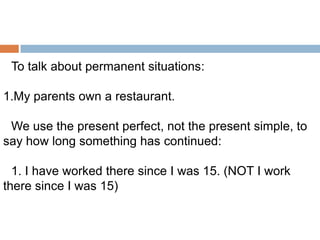
To talk about permanent situations:
1.My parents own a restaurant.
We use the present perfect, not the present simple, to
say how long something has continued:
1. I have worked there since I was 15. (NOT I work
there since I was 15)
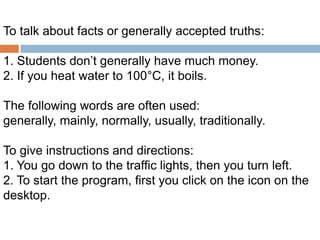
To talk about facts or generally accepted truths:
1. Students don’t generally have much money.
2. If you heat water to 100°C, it boils.
The following words are often used:
generally, mainly, normally, usually, traditionally.
To give instructions and directions:
1. You go down to the traffic lights, then you turn left.
2. To start the program, first you click on the icon on the
desktop.
To tell stories and talk about films, books and plays:
1. In the film, the tea lady falls in love with the Prime
Minister.
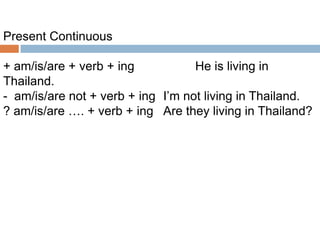
Present Continuous
+ am/is/are + verb + ing
He is living in
Thailand.
- am/is/are not + verb + ing I’m not living in Thailand.
? am/is/are …. + verb + ing Are they living in Thailand?
We use the present continuous
To talk about temporary situations:
1. I am studying really hard for my exams.
2. My cousin is living in Thailand at the moment. (=He
doesn’t normally live there)
Words like: at the moment, currently, now, this
week/month/year are often used.
To talk about actions happening at the moment of
speaking:
1. I am waiting for my friends.

To talk about trends or changing situations:
1. The Internet is making it easier for people to stay in
touch with each other.
2. The price of petrol is ring dramatically.
To talk about things that happen more often than
expected, often to show envy or to criticize with words
like always, constantly, continually, forever:

1. My mum’s always saying I don’t help enough!
(Complaint)
2. He’s always visiting exciting places!
State verbs
The present continuous is not normally used with state
verbs because the meaning of the verb itself is a general
truth rather than something temporary. These verbs
describe thoughts, feelings, senses, possession and
description.
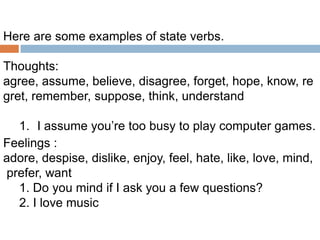
Here are some examples of state verbs.
Thoughts:
agree, assume, believe, disagree, forget, hope, know, re
gret, remember, suppose, think, understand
1. I assume you’re too busy to play computer games.
Feelings :
adore, despise, dislike, enjoy, feel, hate, like, love, mind,
prefer, want
1. Do you mind if I ask you a few questions?
2. I love music
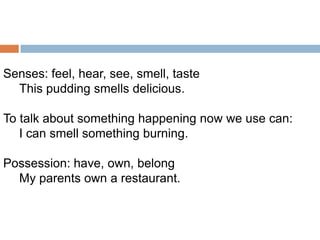
Senses: feel, hear, see, smell, taste
This pudding smells delicious.
To talk about something happening now we use can:
I can smell something burning.
Possession: have, own, belong
My parents own a restaurant.
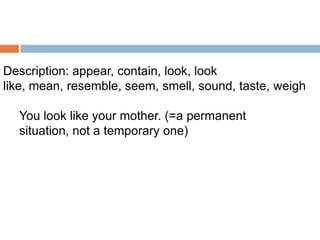
Description: appear, contain, look, look
like, mean, resemble, seem, smell, sound, taste, weigh
You look like your mother. (=a permanent
situation, not a temporary one)
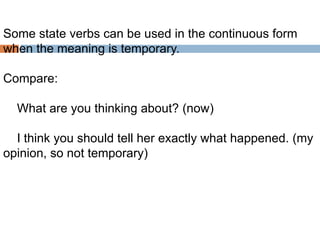
Some state verbs can be used in the continuous form
when the meaning is temporary.

Compare:
What are you thinking about? (now)

I think you should tell her exactly what happened. (my
opinion, so not temporary)
Compare:
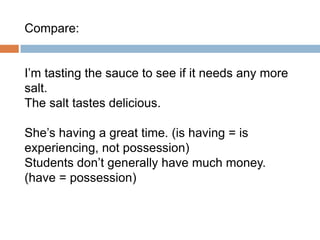
I’m tasting the sauce to see if it needs any more
salt.
The salt tastes delicious.

She’s having a great time. (is having = is
experiencing, not possession)
Students don’t generally have much money.
(have = possession)

Grammar part1

  • 2.
    Present Simple: + verb/verb+(e)s - Do/does not +verb tennis. ? do/does…+verb tennis? He plays tennis. She doesn’t play Do you play
  • 3.
    We use thepresent simple To talk about regular habits or repeated actions: 1. I get up really early and practice for an hour or so most days. 2. I use the Internet just about every day. Words that describe how often or when are often used (e.g. always, generally, normally, usually, often, sometimes, r arely, never, every day, every evening).
  • 4.
    To talk aboutpermanent situations: 1.My parents own a restaurant. We use the present perfect, not the present simple, to say how long something has continued: 1. I have worked there since I was 15. (NOT I work there since I was 15)
  • 5.
    To talk aboutfacts or generally accepted truths: 1. Students don’t generally have much money. 2. If you heat water to 100°C, it boils. The following words are often used: generally, mainly, normally, usually, traditionally. To give instructions and directions: 1. You go down to the traffic lights, then you turn left. 2. To start the program, first you click on the icon on the desktop.
  • 6.
    To tell storiesand talk about films, books and plays: 1. In the film, the tea lady falls in love with the Prime Minister.
  • 7.
    Present Continuous + am/is/are+ verb + ing He is living in Thailand. - am/is/are not + verb + ing I’m not living in Thailand. ? am/is/are …. + verb + ing Are they living in Thailand?
  • 8.
    We use thepresent continuous To talk about temporary situations: 1. I am studying really hard for my exams. 2. My cousin is living in Thailand at the moment. (=He doesn’t normally live there) Words like: at the moment, currently, now, this week/month/year are often used.
  • 9.
    To talk aboutactions happening at the moment of speaking: 1. I am waiting for my friends. To talk about trends or changing situations: 1. The Internet is making it easier for people to stay in touch with each other. 2. The price of petrol is ring dramatically.
  • 10.
    To talk aboutthings that happen more often than expected, often to show envy or to criticize with words like always, constantly, continually, forever: 1. My mum’s always saying I don’t help enough! (Complaint) 2. He’s always visiting exciting places!
  • 11.
    State verbs The presentcontinuous is not normally used with state verbs because the meaning of the verb itself is a general truth rather than something temporary. These verbs describe thoughts, feelings, senses, possession and description.
  • 12.
    Here are someexamples of state verbs. Thoughts: agree, assume, believe, disagree, forget, hope, know, re gret, remember, suppose, think, understand 1. I assume you’re too busy to play computer games. Feelings : adore, despise, dislike, enjoy, feel, hate, like, love, mind, prefer, want 1. Do you mind if I ask you a few questions? 2. I love music
  • 13.
    Senses: feel, hear,see, smell, taste This pudding smells delicious. To talk about something happening now we use can: I can smell something burning. Possession: have, own, belong My parents own a restaurant.
  • 14.
    Description: appear, contain,look, look like, mean, resemble, seem, smell, sound, taste, weigh You look like your mother. (=a permanent situation, not a temporary one)
  • 15.
    Some state verbscan be used in the continuous form when the meaning is temporary. Compare: What are you thinking about? (now) I think you should tell her exactly what happened. (my opinion, so not temporary)
  • 16.
    Compare: I’m tasting thesauce to see if it needs any more salt. The salt tastes delicious. She’s having a great time. (is having = is experiencing, not possession) Students don’t generally have much money. (have = possession)