PRESENT
CONTINUOUS
 M. KATHERINETABORDA C
 SPEAKINTUTOR
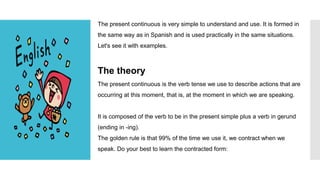
The present continuous is very simple to understand and use. It is formed in
the same way as in Spanish and is used practically in the same situations.
Let's see it with examples.
The theory
The present continuous is the verb tense we use to describe actions that are
occurring at this moment, that is, at the moment in which we are speaking.
It is composed of the verb to be in the present simple plus a verb in gerund
(ending in -ing).
The golden rule is that 99% of the time we use it, we contract when we
speak. Do your best to learn the contracted form:
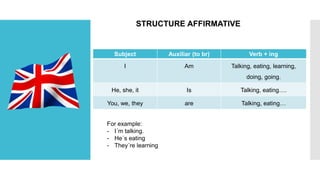
Subject Auxiliar (to br) Verb + ing
I Am Talking, eating, learning,
doing, going.
He, she, it Is Talking, eating….
You, we, they are Talking, eating…
STRUCTURE AFFIRMATIVE
For example:
- I´m talking.
- He´s eating
- They´re learning
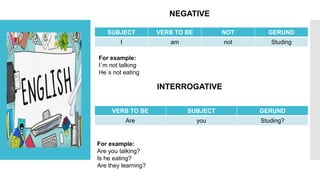
NEGATIVE
SUBJECT VERB TO BE NOT GERUND
I am not Studing
VERB TO BE SUBJECT GERUND
Are you Studing?
INTERROGATIVE
For example:
I´m not talking
He´s not eating
For example:
Are you talking?
Is he eating?
Are they learning?
USES
1- The present continuous is used to talk about something that is happening at
the moment we speak.
For example:
I´m studying now
He´s eating at the moment
Is it raining?
2- We also use it to talk about something that is happening now but not
necessarily when we speak. In this case, time expressions such as "currently",
"lately" or "these days" are used.
For example:
They´re learning English.
She´s currently looking for a job.
Are you working much lately?
3- We use the present continuous to talk about something that is
already decided to be done in the near future. Its use indicates that it
is quite certain that the planned will happen.
For example:
I´m going to the party tonight.
He´s not coming to class tomorrow.
Are you working next week ?
VERBS THAT ARE NOT USED IN
CONTINUOUS TIMES
• Be
• Want
• Need
• Know
• Prefer
• Remember
• Understand
• Care
• See
• Hear
• Smelll
• Believe
• Belong
• Cost
• Seem
• Exist
• Own
• Like
• Dislike
• Love
• Hate
• Fear
• Envy
• Mind
For example:
David needs a ner car
David is needing a new car X
CONTINUOUS
VERB
TENSES
the verbs that we can not use in continuous times. The list is
classified into groups according to type. In general, they are static
verbs and not of activity (dynamic). Some of these verbs can have
two meanings, one of action and another static. If there is more than
one meaning for the same verb, you will find the meaning that we can
not use in the continuous times with the translation into Spanish.
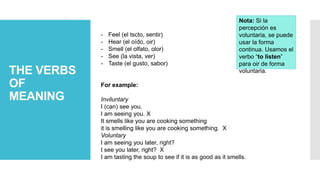
THE VERBS
OF
MEANING
- Feel (el tscto, sentir)
- Hear (el oído, oir)
- Smell (el olfato, olor)
- See (la vista, ver)
- Taste (el gusto, sabor)
For example:
Inviluntary
I (can) see you.
I am seeing you. X
It smells like you are cooking something
it is smelling like you are cooking something. X
Voluntary
I am seeing you later, right?
I see you later, right? X
I am tasting the soup to see if it is as good as it smells.
Nota: Si la
percepción es
voluntaria, se puede
usar la forma
continua. Usamos el
verbo “to listen”
para oir de forma
voluntaria.
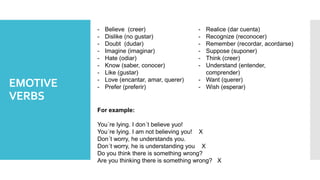
EMOTIVE
VERBS
- Believe (creer)
- Dislike (no gustar)
- Doubt (dudar)
- Imagine (imaginar)
- Hate (odiar)
- Know (saber, conocer)
- Like (gustar)
- Love (encantar, amar, querer)
- Prefer (preferir)
- Realice (dar cuenta)
- Recognize (reconocer)
- Remember (recordar, acordarse)
- Suppose (suponer)
- Think (creer)
- Understand (entender,
comprender)
- Want (querer)
- Wish (esperar)
For example:
You´re lying. I don´t believe yuo!
You´re lying. I am not believing you! X
Don´t worry, he understands you.
Don´t worry, he is understanding you X
Do you think there is something wrong?
Are you thinking there is something wrong? X
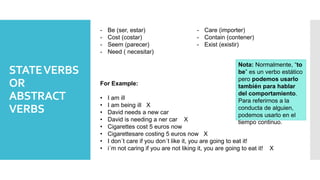
STATEVERBS
OR
ABSTRACT
VERBS
- Be (ser, estar)
- Cost (costar)
- Seem (parecer)
- Need ( necesitar)
- Care (importer)
- Contain (contener)
- Exist (existir)
For Example:
• I am ill
• I am being ill X
• David needs a new car
• David is needing a ner car X
• Cigarettes cost 5 euros now
• Cigarettesare costing 5 euros now X
• I don´t care if you don´t like it, you are going to eat it!
• i´m not caring if you are not liking it, you are going to eat it! X
Nota: Normalmente, “to
be” es un verbo estático
pero podemos usarlo
también para hablar
del comportamiento.
Para referirnos a la
conducta de alguien,
podemos usarlo en el
tiempo continuo.
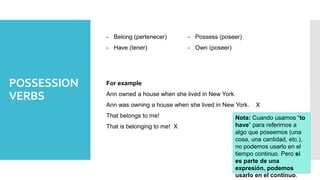
POSSESSION
VERBS
- Belong (pertenecer)
- Have (tener)
- Possess (poseer)
- Own (poseer)
For example
Ann owned a house when she lived in New York.
Ann was owning a house when she lived in New York. X
That belongs to me!
That is belonging to me! X
Nota: Cuando usamos “to
have” para referirnos a
algo que poseemos (una
cosa, una cantidad, etc.),
no podemos usarlo en el
tiempo continuo. Pero si
es parte de una
expresión, podemos
usarlo en el continuo.
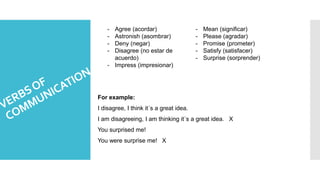
- Agree (acordar)
- Astronish (asombrar)
- Deny (negar)
- Disagree (no estar de
acuerdo)
- Impress (impresionar)
- Mean (significar)
- Please (agradar)
- Promise (prometer)
- Satisfy (satisfacer)
- Surprise (sorprender)
For example:
I disagree, I think it´s a great idea.
I am disagreeing, I am thinking it´s a great idea. X
You surprised me!
You were surprise me! X

Material 6 present continuous

  • 1.
  • 2.
    The present continuousis very simple to understand and use. It is formed in the same way as in Spanish and is used practically in the same situations. Let's see it with examples. The theory The present continuous is the verb tense we use to describe actions that are occurring at this moment, that is, at the moment in which we are speaking. It is composed of the verb to be in the present simple plus a verb in gerund (ending in -ing). The golden rule is that 99% of the time we use it, we contract when we speak. Do your best to learn the contracted form:
  • 3.
    Subject Auxiliar (tobr) Verb + ing I Am Talking, eating, learning, doing, going. He, she, it Is Talking, eating…. You, we, they are Talking, eating… STRUCTURE AFFIRMATIVE For example: - I´m talking. - He´s eating - They´re learning
  • 4.
    NEGATIVE SUBJECT VERB TOBE NOT GERUND I am not Studing VERB TO BE SUBJECT GERUND Are you Studing? INTERROGATIVE For example: I´m not talking He´s not eating For example: Are you talking? Is he eating? Are they learning?
  • 5.
    USES 1- The presentcontinuous is used to talk about something that is happening at the moment we speak. For example: I´m studying now He´s eating at the moment Is it raining? 2- We also use it to talk about something that is happening now but not necessarily when we speak. In this case, time expressions such as "currently", "lately" or "these days" are used. For example: They´re learning English. She´s currently looking for a job. Are you working much lately?
  • 6.
    3- We usethe present continuous to talk about something that is already decided to be done in the near future. Its use indicates that it is quite certain that the planned will happen. For example: I´m going to the party tonight. He´s not coming to class tomorrow. Are you working next week ?
  • 7.
    VERBS THAT ARENOT USED IN CONTINUOUS TIMES • Be • Want • Need • Know • Prefer • Remember • Understand • Care • See • Hear • Smelll • Believe • Belong • Cost • Seem • Exist • Own • Like • Dislike • Love • Hate • Fear • Envy • Mind For example: David needs a ner car David is needing a new car X
  • 8.
    CONTINUOUS VERB TENSES the verbs thatwe can not use in continuous times. The list is classified into groups according to type. In general, they are static verbs and not of activity (dynamic). Some of these verbs can have two meanings, one of action and another static. If there is more than one meaning for the same verb, you will find the meaning that we can not use in the continuous times with the translation into Spanish.
  • 9.
    THE VERBS OF MEANING - Feel(el tscto, sentir) - Hear (el oído, oir) - Smell (el olfato, olor) - See (la vista, ver) - Taste (el gusto, sabor) For example: Inviluntary I (can) see you. I am seeing you. X It smells like you are cooking something it is smelling like you are cooking something. X Voluntary I am seeing you later, right? I see you later, right? X I am tasting the soup to see if it is as good as it smells. Nota: Si la percepción es voluntaria, se puede usar la forma continua. Usamos el verbo “to listen” para oir de forma voluntaria.
  • 10.
    EMOTIVE VERBS - Believe (creer) -Dislike (no gustar) - Doubt (dudar) - Imagine (imaginar) - Hate (odiar) - Know (saber, conocer) - Like (gustar) - Love (encantar, amar, querer) - Prefer (preferir) - Realice (dar cuenta) - Recognize (reconocer) - Remember (recordar, acordarse) - Suppose (suponer) - Think (creer) - Understand (entender, comprender) - Want (querer) - Wish (esperar) For example: You´re lying. I don´t believe yuo! You´re lying. I am not believing you! X Don´t worry, he understands you. Don´t worry, he is understanding you X Do you think there is something wrong? Are you thinking there is something wrong? X
  • 11.
    STATEVERBS OR ABSTRACT VERBS - Be (ser,estar) - Cost (costar) - Seem (parecer) - Need ( necesitar) - Care (importer) - Contain (contener) - Exist (existir) For Example: • I am ill • I am being ill X • David needs a new car • David is needing a ner car X • Cigarettes cost 5 euros now • Cigarettesare costing 5 euros now X • I don´t care if you don´t like it, you are going to eat it! • i´m not caring if you are not liking it, you are going to eat it! X Nota: Normalmente, “to be” es un verbo estático pero podemos usarlo también para hablar del comportamiento. Para referirnos a la conducta de alguien, podemos usarlo en el tiempo continuo.
  • 12.
    POSSESSION VERBS - Belong (pertenecer) -Have (tener) - Possess (poseer) - Own (poseer) For example Ann owned a house when she lived in New York. Ann was owning a house when she lived in New York. X That belongs to me! That is belonging to me! X Nota: Cuando usamos “to have” para referirnos a algo que poseemos (una cosa, una cantidad, etc.), no podemos usarlo en el tiempo continuo. Pero si es parte de una expresión, podemos usarlo en el continuo.
  • 13.
    - Agree (acordar) -Astronish (asombrar) - Deny (negar) - Disagree (no estar de acuerdo) - Impress (impresionar) - Mean (significar) - Please (agradar) - Promise (prometer) - Satisfy (satisfacer) - Surprise (sorprender) For example: I disagree, I think it´s a great idea. I am disagreeing, I am thinking it´s a great idea. X You surprised me! You were surprise me! X