PRESENT SIMPLE
AND
PRESENT CONTINUOUS
For a start, let’s watch some videos…
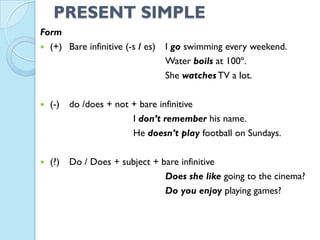
PRESENT SIMPLE
Form
 (+) Bare infinitive (-s / es) I go swimming every weekend.
Water boils at 100º.
She watches TV a lot.
 (-) do /does + not + bare infinitive
I don’t remember his name.
He doesn’t play football on Sundays.
 (?) Do / Does + subject + bare infinitive
Does she like going to the cinema?
Do you enjoy playing games?
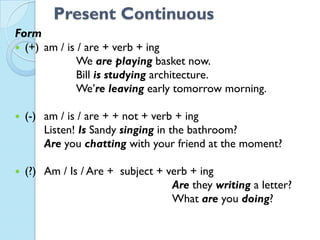
Present Continuous
Form
 (+) am / is / are + verb + ing
We are playing basket now.
Bill is studying architecture.
We’re leaving early tomorrow morning.
 (-) am / is / are + + not + verb + ing
Listen! Is Sandy singing in the bathroom?
Are you chatting with your friend at the moment?
 (?) Am / Is / Are + subject + verb + ing
Are they writing a letter?
What are you doing?
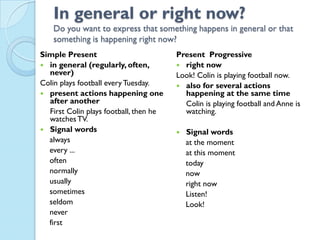
In general or right now?
Do you want to express that something happens in general or that
something is happening right now?
Simple Present
 in general (regularly, often,
never)
Colin plays football everyTuesday.
 present actions happening one
after another
First Colin plays football, then he
watchesTV.
 Signal words
always
every ...
often
normally
usually
sometimes
seldom
never
first
Present Progressive
 right now
Look! Colin is playing football now.
 also for several actions
happening at the same time
Colin is playing football and Anne is
watching.
 Signal words
at the moment
at this moment
today
now
right now
Listen!
Look!
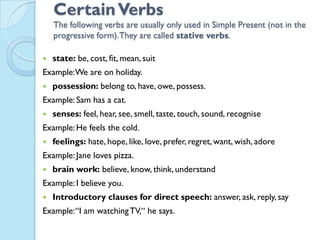
CertainVerbs
The following verbs are usually only used in Simple Present (not in the
progressive form).They are called stative verbs.
 state: be, cost, fit, mean, suit
Example:We are on holiday.
 possession: belong to, have, owe, possess.
Example: Sam has a cat.
 senses: feel, hear, see, smell, taste, touch, sound, recognise
Example: He feels the cold.
 feelings: hate, hope, like, love, prefer, regret, want, wish, adore
Example: Jane loves pizza.
 brain work: believe, know, think, understand
Example: I believe you.
 Introductory clauses for direct speech: answer, ask, reply, say
Example:“I am watchingTV,“ he says.
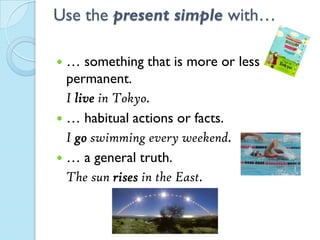
Use the present simple with…
 … something that is more or less
permanent.
I live in Tokyo.
 … habitual actions or facts.
I go swimming every weekend.
 … a general truth.
The sun rises in the East.
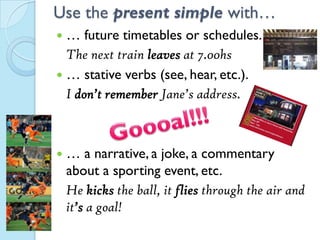
Use the present simple with…
 … future timetables or schedules.
The next train leaves at 7.00hs
 … stative verbs (see, hear, etc.).
I don’t remember Jane’s address.
 … a narrative, a joke, a commentary
about a sporting event, etc.
He kicks the ball, it flies through the air and
it’s a goal!
Use the present continuous
with…
 ... an action that is happening at the
moment of speaking.
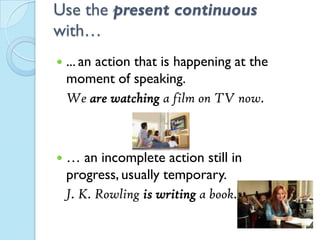
We are watching a film on TV now.
 … an incomplete action still in
progress, usually temporary.
J. K. Rowling is writing a book.
Use the present continuous
with…
 … an arrangement or plan in the near
future.
I’m meeting her at the theatre this evening.
 … with always, forever, constanly, etc., for
an action that happens very often (usually
a criticism or a complaint).
He’s forever arriving late.
More information at:
https://www.youtube.com/watch?v=TDuZNqIeURA&list=PL2383423D9C6BD844

Present simple and present continuous

  • 1.
  • 2.
    For a start,let’s watch some videos…
  • 3.
    PRESENT SIMPLE Form  (+)Bare infinitive (-s / es) I go swimming every weekend. Water boils at 100º. She watches TV a lot.  (-) do /does + not + bare infinitive I don’t remember his name. He doesn’t play football on Sundays.  (?) Do / Does + subject + bare infinitive Does she like going to the cinema? Do you enjoy playing games?
  • 4.
    Present Continuous Form  (+)am / is / are + verb + ing We are playing basket now. Bill is studying architecture. We’re leaving early tomorrow morning.  (-) am / is / are + + not + verb + ing Listen! Is Sandy singing in the bathroom? Are you chatting with your friend at the moment?  (?) Am / Is / Are + subject + verb + ing Are they writing a letter? What are you doing?
  • 5.
    In general orright now? Do you want to express that something happens in general or that something is happening right now? Simple Present  in general (regularly, often, never) Colin plays football everyTuesday.  present actions happening one after another First Colin plays football, then he watchesTV.  Signal words always every ... often normally usually sometimes seldom never first Present Progressive  right now Look! Colin is playing football now.  also for several actions happening at the same time Colin is playing football and Anne is watching.  Signal words at the moment at this moment today now right now Listen! Look!
  • 6.
    CertainVerbs The following verbsare usually only used in Simple Present (not in the progressive form).They are called stative verbs.  state: be, cost, fit, mean, suit Example:We are on holiday.  possession: belong to, have, owe, possess. Example: Sam has a cat.  senses: feel, hear, see, smell, taste, touch, sound, recognise Example: He feels the cold.  feelings: hate, hope, like, love, prefer, regret, want, wish, adore Example: Jane loves pizza.  brain work: believe, know, think, understand Example: I believe you.  Introductory clauses for direct speech: answer, ask, reply, say Example:“I am watchingTV,“ he says.
  • 7.
    Use the presentsimple with…  … something that is more or less permanent. I live in Tokyo.  … habitual actions or facts. I go swimming every weekend.  … a general truth. The sun rises in the East.
  • 8.
    Use the presentsimple with…  … future timetables or schedules. The next train leaves at 7.00hs  … stative verbs (see, hear, etc.). I don’t remember Jane’s address.  … a narrative, a joke, a commentary about a sporting event, etc. He kicks the ball, it flies through the air and it’s a goal!
  • 9.
    Use the presentcontinuous with…  ... an action that is happening at the moment of speaking. We are watching a film on TV now.  … an incomplete action still in progress, usually temporary. J. K. Rowling is writing a book.
  • 10.
    Use the presentcontinuous with…  … an arrangement or plan in the near future. I’m meeting her at the theatre this evening.  … with always, forever, constanly, etc., for an action that happens very often (usually a criticism or a complaint). He’s forever arriving late. More information at: https://www.youtube.com/watch?v=TDuZNqIeURA&list=PL2383423D9C6BD844