VERB TENSES
Present Tenses
(PART 1)
A QUICK REVIEW
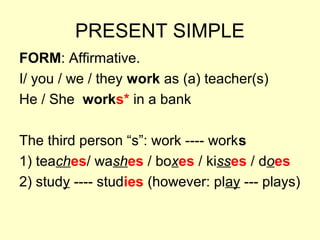
PRESENT SIMPLE
FORM: Affirmative.
I/ you / we / they work as (a) teacher(s)
He / She works* in a bank
The third person “s”: work ---- works
1) teaches/ washes / boxes / kisses / does
2) study ---- studies (however: play --- plays)
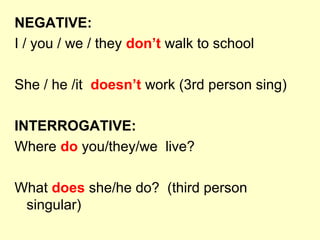
NEGATIVE:
I / you / we / they don’t walk to school
She / he /it doesn’t work (3rd person sing)
INTERROGATIVE:
Where do you/they/we live?
What does she/he do? (third person
singular)
USES
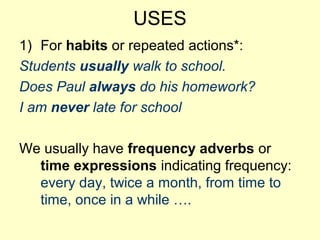
1) For habits or repeated actions*:
Students usually walk to school.
Does Paul always do his homework?
I am never late for school
We usually have frequency adverbs or
time expressions indicating frequency:
every day, twice a month, from time to
time, once in a while ….
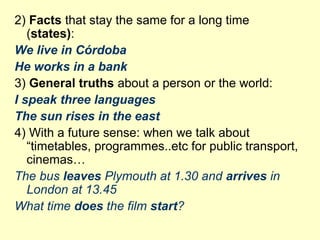
2) Facts that stay the same for a long time
(states):
We live in Córdoba
He works in a bank
3) General truths about a person or the world:
I speak three languages
The sun rises in the east
4) With a future sense: when we talk about
“timetables, programmes..etc for public transport,
cinemas…
The bus leaves Plymouth at 1.30 and arrives in
London at 13.45
What time does the film start?
PRESENT CONTINUOUS
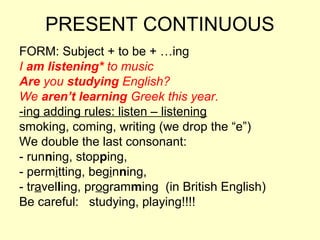
FORM: Subject + to be + …ing
I am listening* to music
Are you studying English?
We aren’t learning Greek this year.
-ing adding rules: listen – listening
smoking, coming, writing (we drop the “e”)
We double the last consonant:
- running, stopping,
- permitting, beginning,
- travelling, programming (in British English)
Be careful: studying, playing!!!!
USES:
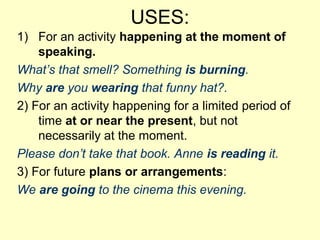
1) For an activity happening at the moment of
speaking.
What’s that smell? Something is burning.
Why are you wearing that funny hat?.
2) For an activity happening for a limited period of
time at or near the present, but not
necessarily at the moment.
Please don’t take that book. Anne is reading it.
3) For future plans or arrangements:
We are going to the cinema this evening.
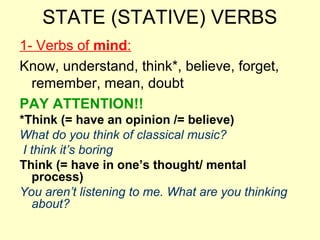
STATE (STATIVE) VERBS
1- Verbs of mind:
Know, understand, think*, believe, forget,
remember, mean, doubt
PAY ATTENTION!!
*Think (= have an opinion /= believe)
What do you think of classical music?
I think it’s boring
Think (= have in one’s thought/ mental
process)
You aren’t listening to me. What are you thinking
about?
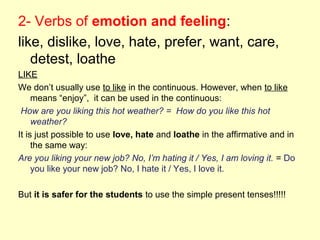
2- Verbs of emotion and feeling:
like, dislike, love, hate, prefer, want, care,
detest, loathe
LIKE
We don’t usually use to like in the continuous. However, when to like
means “enjoy”, it can be used in the continuous:
How are you liking this hot weather? = How do you like this hot
weather?
It is just possible to use love, hate and loathe in the affirmative and in
the same way:
Are you liking your new job? No, I’m hating it / Yes, I am loving it. = Do
you like your new job? No, I hate it / Yes, I love it.
But it is safer for the students to use the simple present tenses!!!!!
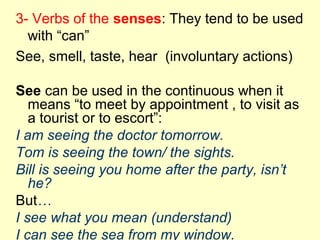
3- Verbs of the senses: They tend to be used
with “can”
See, smell, taste, hear (involuntary actions)
See can be used in the continuous when it
means “to meet by appointment , to visit as
a tourist or to escort”:
I am seeing the doctor tomorrow.
Tom is seeing the town/ the sights.
Bill is seeing you home after the party, isn’t
he?
But…
I see what you mean (understand)
I can see the sea from my window.
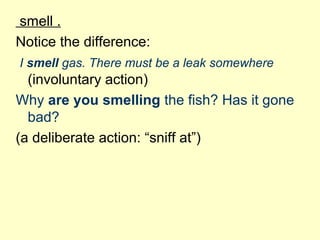
smell .
Notice the difference:
I smell gas. There must be a leak somewhere
(involuntary action)
Why are you smelling the fish? Has it gone
bad?
(a deliberate action: “sniff at”)
feel:
When to feel means “think” (creer/opinar), it cannot be
used in the continuous: I feel the exam was unfair
Or when it means “notice”, it cannot be used in the
continuous: Don’t you feel the house shaking?
However, when to feel is followed by an adjective, such as
well/ill, hot/ cold, tense/relaxed, happy/sad,
nervous/confident, anxious/relieved, angry/pleased, is
normally used in the simple tense, but can be used in the
continuous:
How do you feel? / How are you feeling?
I feel / I’m feeling better /quite well.
He feels/ is feeling much happier now.
4) Verbs of possession:
Have*, own, belong
That book belongs to me.
Have (=Possess)
I have brown hair
Have + noun (it implies activity)
I’m having a bath / We’re having dinner
5) Certain other verbs:
depend, consist, seem
A newspaper costs about 40p.
Be careful! That bottle contains poison.

Verb tenses.present-tenses-part1

  • 1.
  • 2.
    PRESENT SIMPLE FORM: Affirmative. I/you / we / they work as (a) teacher(s) He / She works* in a bank The third person “s”: work ---- works 1) teaches/ washes / boxes / kisses / does 2) study ---- studies (however: play --- plays)
  • 3.
    NEGATIVE: I / you/ we / they don’t walk to school She / he /it doesn’t work (3rd person sing) INTERROGATIVE: Where do you/they/we live? What does she/he do? (third person singular)
  • 4.
    USES 1) For habitsor repeated actions*: Students usually walk to school. Does Paul always do his homework? I am never late for school We usually have frequency adverbs or time expressions indicating frequency: every day, twice a month, from time to time, once in a while ….
  • 5.
    2) Facts thatstay the same for a long time (states): We live in Córdoba He works in a bank 3) General truths about a person or the world: I speak three languages The sun rises in the east 4) With a future sense: when we talk about “timetables, programmes..etc for public transport, cinemas… The bus leaves Plymouth at 1.30 and arrives in London at 13.45 What time does the film start?
  • 6.
    PRESENT CONTINUOUS FORM: Subject+ to be + …ing I am listening* to music Are you studying English? We aren’t learning Greek this year. -ing adding rules: listen – listening smoking, coming, writing (we drop the “e”) We double the last consonant: - running, stopping, - permitting, beginning, - travelling, programming (in British English) Be careful: studying, playing!!!!
  • 7.
    USES: 1) For anactivity happening at the moment of speaking. What’s that smell? Something is burning. Why are you wearing that funny hat?. 2) For an activity happening for a limited period of time at or near the present, but not necessarily at the moment. Please don’t take that book. Anne is reading it. 3) For future plans or arrangements: We are going to the cinema this evening.
  • 8.
    STATE (STATIVE) VERBS 1-Verbs of mind: Know, understand, think*, believe, forget, remember, mean, doubt PAY ATTENTION!! *Think (= have an opinion /= believe) What do you think of classical music? I think it’s boring Think (= have in one’s thought/ mental process) You aren’t listening to me. What are you thinking about?
  • 9.
    2- Verbs ofemotion and feeling: like, dislike, love, hate, prefer, want, care, detest, loathe LIKE We don’t usually use to like in the continuous. However, when to like means “enjoy”, it can be used in the continuous: How are you liking this hot weather? = How do you like this hot weather? It is just possible to use love, hate and loathe in the affirmative and in the same way: Are you liking your new job? No, I’m hating it / Yes, I am loving it. = Do you like your new job? No, I hate it / Yes, I love it. But it is safer for the students to use the simple present tenses!!!!!
  • 10.
    3- Verbs ofthe senses: They tend to be used with “can” See, smell, taste, hear (involuntary actions) See can be used in the continuous when it means “to meet by appointment , to visit as a tourist or to escort”: I am seeing the doctor tomorrow. Tom is seeing the town/ the sights. Bill is seeing you home after the party, isn’t he? But… I see what you mean (understand) I can see the sea from my window.
  • 11.
    smell . Notice thedifference: I smell gas. There must be a leak somewhere (involuntary action) Why are you smelling the fish? Has it gone bad? (a deliberate action: “sniff at”)
  • 12.
    feel: When to feelmeans “think” (creer/opinar), it cannot be used in the continuous: I feel the exam was unfair Or when it means “notice”, it cannot be used in the continuous: Don’t you feel the house shaking? However, when to feel is followed by an adjective, such as well/ill, hot/ cold, tense/relaxed, happy/sad, nervous/confident, anxious/relieved, angry/pleased, is normally used in the simple tense, but can be used in the continuous: How do you feel? / How are you feeling? I feel / I’m feeling better /quite well. He feels/ is feeling much happier now.
  • 13.
    4) Verbs ofpossession: Have*, own, belong That book belongs to me. Have (=Possess) I have brown hair Have + noun (it implies activity) I’m having a bath / We’re having dinner
  • 14.
    5) Certain otherverbs: depend, consist, seem A newspaper costs about 40p. Be careful! That bottle contains poison.