Let’s Learn  English Together!
Present Simple of  be Unit 1
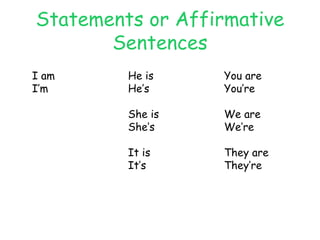
Statements or Affirmative Sentences I am He is You are I’m He’s You’re She is We are She’s We’re It is They are It’s They’re
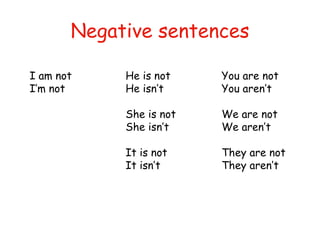
Negative sentences I am not He is not You are not I’m not He isn’t You aren’t She is not We are not   She isn’t  We aren’t It is not They are not It isn’t They aren’t
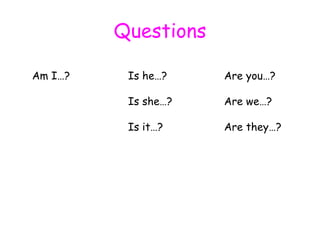
Questions Am I…? Is he…? Are you…? Is she…? Are we…? Is it…? Are they…?
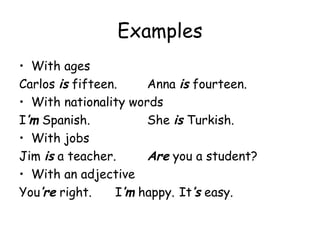
Examples With ages Carlos  is  fifteen. Anna  is  fourteen. With nationality words I ’m   Spanish. She  is  Turkish. With jobs Jim  is  a teacher. Are  you a student? With an adjective You ’re  right. I ’m  happy. It ’s  easy.
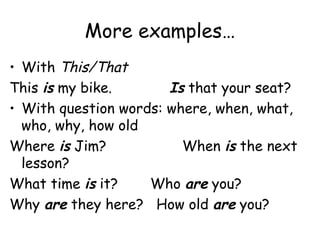
More examples… With  This/That This  is  my bike. Is  that your seat? With question words: where, when, what, who, why, how old Where  is  Jim?   When  is  the next lesson? What time  is  it?   Who  are  you? Why  are  they here?  How old  are  you?
Present Simple: Affirmative Frequency Adverbs Unit 2
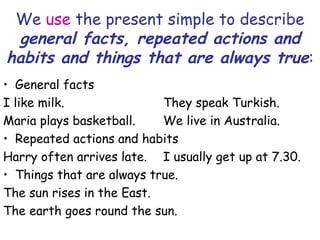
We  use  the present simple to describe  general facts, repeated actions and habits and things that are always true : General facts I like milk. They speak Turkish. Maria plays basketball. We live in Australia. Repeated actions and habits Harry often arrives late. I usually get up at 7.30. Things that are always true. The sun rises in the East. The earth goes round the sun.
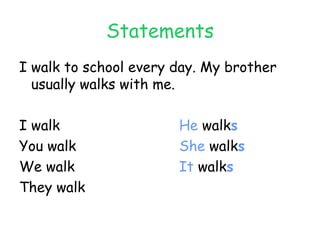
Statements I walk to school every day. My brother usually walks with me. I walk He  walk s You walk She  walk s We walk It  walk s They walk
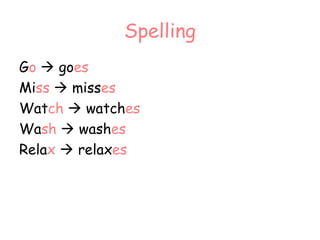
Spelling G o     go es Mi ss    miss es Wat ch     watch es Wa sh     wash es Rela x     relax es
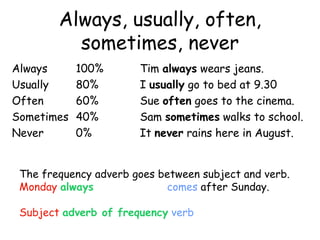
Always, usually, often, sometimes, never Always 100% Tim  always  wears jeans. Usually 80%   I  usually  go to bed at 9.30 Often 60% Sue  often  goes to the cinema. Sometimes 40% Sam  sometimes  walks to school. Never 0% It  never  rains here in August. The frequency adverb goes between subject and verb. Monday   always   comes  after Sunday. Subject   adverb of frequency   verb
Present Simple: negative and questions Unit 3
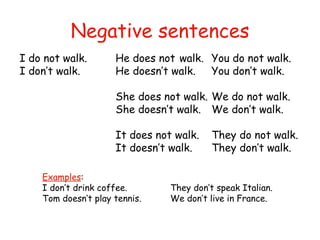
Negative sentences I do not walk. He does not walk. You do not walk. I don’t walk. He doesn’t walk. You don’t walk. She does not walk. We do not walk. She doesn’t walk. We don’t walk. It does not walk. They do not walk. It doesn’t walk. They don’t walk. Examples : I don’t drink coffee. They don’t speak Italian. Tom doesn’t play tennis. We don’t live in France.
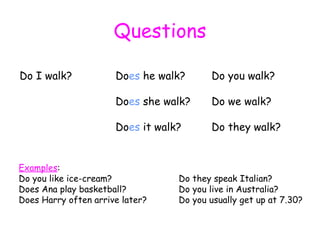
Questions Do I walk? Do es  he walk? Do you walk? Do es  she walk? Do we walk? Do es  it walk? Do they walk? Examples : Do you like ice-cream? Do they speak Italian? Does Ana play basketball? Do you live in Australia? Does Harry often arrive later? Do you usually get up at 7.30?
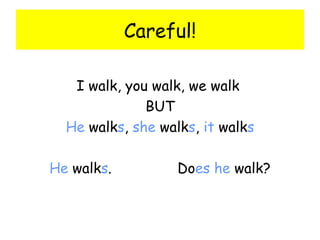
Careful! I walk, you walk, we walk  BUT He  walk s ,  she  walk s ,  it  walk s He  walk s .  Do es   he  walk?
Present Continuous: affirmative Unit 4
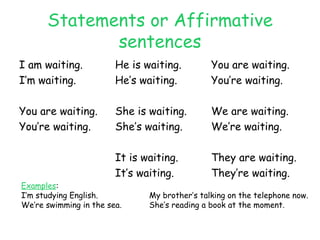
Statements or Affirmative sentences I am waiting. He is waiting. You are waiting. I’m waiting. He’s waiting. You’re waiting. You are waiting. She is waiting. We are waiting. You’re waiting. She’s waiting. We’re waiting. It is waiting. They are waiting. It’s waiting. They’re waiting. Examples : I’m studying English. My brother’s talking on the telephone now. We’re swimming in the sea. She’s reading a book at the moment.
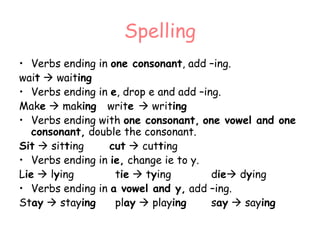
Spelling Verbs ending in  one consonant , add –ing. wai t     wait ing Verbs ending in  e , drop e and add –ing. Mak e     mak ing  writ e    writ ing Verbs ending with  one consonant,   one vowel and one consonant,  double the consonant. Sit     sit t ing  cut     cut t ing Verbs ending in  ie,  change ie to y. L ie     l y ing  t ie     t y ing d ie   d y ing Verbs ending in  a vowel and y,  add –ing. St ay     stay ing pl ay     play ing   s ay     say ing
Present Continuous: negative and questions Unit 5
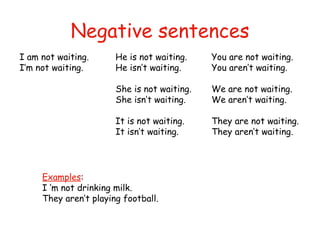
Negative sentences I am not waiting. He is not waiting. You are not waiting. I’m not waiting. He isn’t waiting. You aren’t waiting. She is not waiting. We are not waiting. She isn’t waiting. We aren’t waiting. It is not waiting. They are not waiting. It isn’t waiting. They aren’t waiting. Examples : I ‘m not drinking milk. They aren’t playing football.
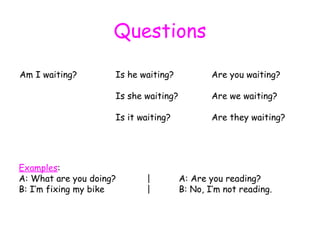
Questions Am I waiting? Is he waiting? Are you waiting? Is she waiting? Are we waiting? Is it waiting? Are they waiting? Examples : A: What are you doing? | A: Are you reading? B: I’m fixing my bike | B: No, I’m not reading.
Present Continuous  and  Present Simple Unit 6
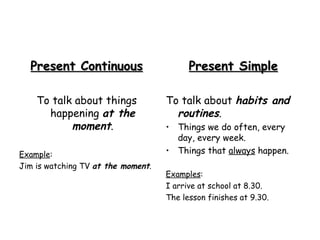
Present Continuous To talk about things happening  at the moment . Example :  Jim is watching TV  at the moment . Present Simple To talk about  habits and routines . Things we do often, every day, every week. Things that  always  happen. Examples : I arrive at school at 8.30. The lesson finishes at 9.30.
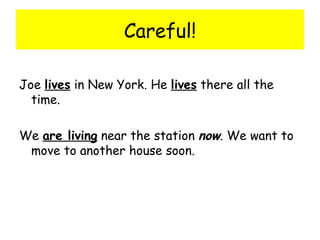
Careful! Joe  lives  in New York. He  lives  there all the time. We  are living  near the station  now . We want to move to another house soon.
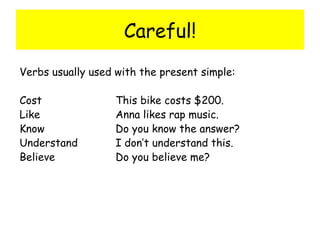
Careful! Verbs usually used with the present simple: Cost This bike costs $200. Like Anna likes rap music. Know Do you know the answer? Understand I don’t understand this. Believe Do you believe me?
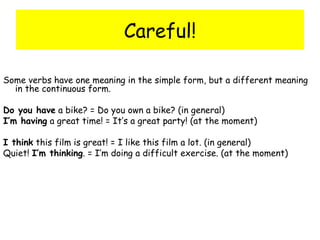
Careful! Some verbs have one meaning in the simple form, but a different meaning in the continuous form. Do you have  a bike? = Do you own a bike? (in general) I’m having  a great time! = It’s a great party! (at the moment) I think  this film is great! = I like this film a lot. (in general) Quiet!  I’m thinking . = I’m doing a difficult exercise. (at the moment)

Present simple

  • 1.
    Let’s Learn English Together!
  • 2.
  • 3.
    Statements or AffirmativeSentences I am He is You are I’m He’s You’re She is We are She’s We’re It is They are It’s They’re
  • 4.
    Negative sentences Iam not He is not You are not I’m not He isn’t You aren’t She is not We are not She isn’t We aren’t It is not They are not It isn’t They aren’t
  • 5.
    Questions Am I…?Is he…? Are you…? Is she…? Are we…? Is it…? Are they…?
  • 6.
    Examples With agesCarlos is fifteen. Anna is fourteen. With nationality words I ’m Spanish. She is Turkish. With jobs Jim is a teacher. Are you a student? With an adjective You ’re right. I ’m happy. It ’s easy.
  • 7.
    More examples… With This/That This is my bike. Is that your seat? With question words: where, when, what, who, why, how old Where is Jim? When is the next lesson? What time is it? Who are you? Why are they here? How old are you?
  • 8.
    Present Simple: AffirmativeFrequency Adverbs Unit 2
  • 9.
    We use the present simple to describe general facts, repeated actions and habits and things that are always true : General facts I like milk. They speak Turkish. Maria plays basketball. We live in Australia. Repeated actions and habits Harry often arrives late. I usually get up at 7.30. Things that are always true. The sun rises in the East. The earth goes round the sun.
  • 10.
    Statements I walkto school every day. My brother usually walks with me. I walk He walk s You walk She walk s We walk It walk s They walk
  • 11.
    Spelling G o  go es Mi ss  miss es Wat ch  watch es Wa sh  wash es Rela x  relax es
  • 12.
    Always, usually, often,sometimes, never Always 100% Tim always wears jeans. Usually 80% I usually go to bed at 9.30 Often 60% Sue often goes to the cinema. Sometimes 40% Sam sometimes walks to school. Never 0% It never rains here in August. The frequency adverb goes between subject and verb. Monday always comes after Sunday. Subject adverb of frequency verb
  • 13.
    Present Simple: negativeand questions Unit 3
  • 14.
    Negative sentences Ido not walk. He does not walk. You do not walk. I don’t walk. He doesn’t walk. You don’t walk. She does not walk. We do not walk. She doesn’t walk. We don’t walk. It does not walk. They do not walk. It doesn’t walk. They don’t walk. Examples : I don’t drink coffee. They don’t speak Italian. Tom doesn’t play tennis. We don’t live in France.
  • 15.
    Questions Do Iwalk? Do es he walk? Do you walk? Do es she walk? Do we walk? Do es it walk? Do they walk? Examples : Do you like ice-cream? Do they speak Italian? Does Ana play basketball? Do you live in Australia? Does Harry often arrive later? Do you usually get up at 7.30?
  • 16.
    Careful! I walk,you walk, we walk BUT He walk s , she walk s , it walk s He walk s . Do es he walk?
  • 17.
  • 18.
    Statements or Affirmativesentences I am waiting. He is waiting. You are waiting. I’m waiting. He’s waiting. You’re waiting. You are waiting. She is waiting. We are waiting. You’re waiting. She’s waiting. We’re waiting. It is waiting. They are waiting. It’s waiting. They’re waiting. Examples : I’m studying English. My brother’s talking on the telephone now. We’re swimming in the sea. She’s reading a book at the moment.
  • 19.
    Spelling Verbs endingin one consonant , add –ing. wai t  wait ing Verbs ending in e , drop e and add –ing. Mak e  mak ing writ e  writ ing Verbs ending with one consonant, one vowel and one consonant, double the consonant. Sit  sit t ing cut  cut t ing Verbs ending in ie, change ie to y. L ie  l y ing t ie  t y ing d ie  d y ing Verbs ending in a vowel and y, add –ing. St ay  stay ing pl ay  play ing s ay  say ing
  • 20.
    Present Continuous: negativeand questions Unit 5
  • 21.
    Negative sentences Iam not waiting. He is not waiting. You are not waiting. I’m not waiting. He isn’t waiting. You aren’t waiting. She is not waiting. We are not waiting. She isn’t waiting. We aren’t waiting. It is not waiting. They are not waiting. It isn’t waiting. They aren’t waiting. Examples : I ‘m not drinking milk. They aren’t playing football.
  • 22.
    Questions Am Iwaiting? Is he waiting? Are you waiting? Is she waiting? Are we waiting? Is it waiting? Are they waiting? Examples : A: What are you doing? | A: Are you reading? B: I’m fixing my bike | B: No, I’m not reading.
  • 23.
    Present Continuous and Present Simple Unit 6
  • 24.
    Present Continuous Totalk about things happening at the moment . Example : Jim is watching TV at the moment . Present Simple To talk about habits and routines . Things we do often, every day, every week. Things that always happen. Examples : I arrive at school at 8.30. The lesson finishes at 9.30.
  • 25.
    Careful! Joe lives in New York. He lives there all the time. We are living near the station now . We want to move to another house soon.
  • 26.
    Careful! Verbs usuallyused with the present simple: Cost This bike costs $200. Like Anna likes rap music. Know Do you know the answer? Understand I don’t understand this. Believe Do you believe me?
  • 27.
    Careful! Some verbshave one meaning in the simple form, but a different meaning in the continuous form. Do you have a bike? = Do you own a bike? (in general) I’m having a great time! = It’s a great party! (at the moment) I think this film is great! = I like this film a lot. (in general) Quiet! I’m thinking . = I’m doing a difficult exercise. (at the moment)