THE PRESENT SIMPLE 1
THE PRESENT SIMPLE: AFFIRMATIVE
We form the present simple with the
 infinitive of the verb:

1) S + infinitive   2) S + infinitive + s/es
  I work               He works
  You work             She works
  We work              It works
  You work
  They work
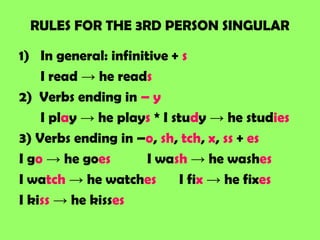
RULES FOR THE 3RD PERSON SINGULAR

1) In general: infinitive + s
    I read → he reads
2) Verbs ending in – y
    I play → he plays * I study → he studies
3) Verbs ending in –o, sh, tch, x, ss + es
I go → he goes        I wash → he washes
I watch → he watches        I fix → he fixes
I kiss → he kisses
USES
To talk about activities we usually do:
      I go to school every day
Time references:
Every day, week, month, year…
On Sundays, at weekend, in summer…
      She studies French in the afternoon
Adverbs of frequency are often used:
Always, usually, often, sometimes, never…
      He never watches TV after lunch
Make affirmative sentences 1 (he/go)


        He goes to school
Make affirmative sentences 2 (They/eat)


           They eat a lot
Make affirmative sentences 3 (She/surf)


         She surfs the Internet
Make affirmative sentences 4 (I/play)


           I play the flute
Make affirmative sentences 5 (She/cry)


              She cries
Negative form
For the negative form:
S+ auxiliary verb (do, does) + not+ infinitive
( contracted forms: don’t/ doesn’t)

I don’t play         He doesn’t read
You don’t dance      She doesn’t study
We don’t eat         It doesn’t sleep
They don’t like
Make negative sentences 1 (They/read)


          They don’t read
Make negative sentences 2 (She/love)


        She doesn’t love him
Make negative sentences 3 (He/drive)


          He doesn’t drive
Make negative sentences 4 (He/work)


         He doesn’t work
Make negative sentences 5 (They/sing)


           They don’t sing
YOUR TURN NOW
Write the affirmative /negative form of the verbs
   in brackets:
1. Dave ……………… (not live) in Madrid.
2. Sue ……………… (study) German at school.
3. My dad ……………… (drive) a red car.
4. We ……………. (not walk) to school.
5. The 34 bus ………………… (not stop) here.
6. Mr Brown …………………. (teach) maths.
7. The children ……………… (play) football.
8. Mary ……………… (wash) the dishes after lunch.

Present simple

  • 1.
  • 2.
    THE PRESENT SIMPLE:AFFIRMATIVE We form the present simple with the infinitive of the verb: 1) S + infinitive 2) S + infinitive + s/es I work He works You work She works We work It works You work They work
  • 3.
    RULES FOR THE3RD PERSON SINGULAR 1) In general: infinitive + s I read → he reads 2) Verbs ending in – y I play → he plays * I study → he studies 3) Verbs ending in –o, sh, tch, x, ss + es I go → he goes I wash → he washes I watch → he watches I fix → he fixes I kiss → he kisses
  • 4.
    USES To talk aboutactivities we usually do: I go to school every day Time references: Every day, week, month, year… On Sundays, at weekend, in summer… She studies French in the afternoon Adverbs of frequency are often used: Always, usually, often, sometimes, never… He never watches TV after lunch
  • 5.
    Make affirmative sentences1 (he/go) He goes to school
  • 6.
    Make affirmative sentences2 (They/eat) They eat a lot
  • 7.
    Make affirmative sentences3 (She/surf) She surfs the Internet
  • 8.
    Make affirmative sentences4 (I/play) I play the flute
  • 9.
    Make affirmative sentences5 (She/cry) She cries
  • 10.
    Negative form For thenegative form: S+ auxiliary verb (do, does) + not+ infinitive ( contracted forms: don’t/ doesn’t) I don’t play He doesn’t read You don’t dance She doesn’t study We don’t eat It doesn’t sleep They don’t like
  • 11.
    Make negative sentences1 (They/read) They don’t read
  • 12.
    Make negative sentences2 (She/love) She doesn’t love him
  • 13.
    Make negative sentences3 (He/drive) He doesn’t drive
  • 14.
    Make negative sentences4 (He/work) He doesn’t work
  • 15.
    Make negative sentences5 (They/sing) They don’t sing
  • 16.
    YOUR TURN NOW Writethe affirmative /negative form of the verbs in brackets: 1. Dave ……………… (not live) in Madrid. 2. Sue ……………… (study) German at school. 3. My dad ……………… (drive) a red car. 4. We ……………. (not walk) to school. 5. The 34 bus ………………… (not stop) here. 6. Mr Brown …………………. (teach) maths. 7. The children ……………… (play) football. 8. Mary ……………… (wash) the dishes after lunch.