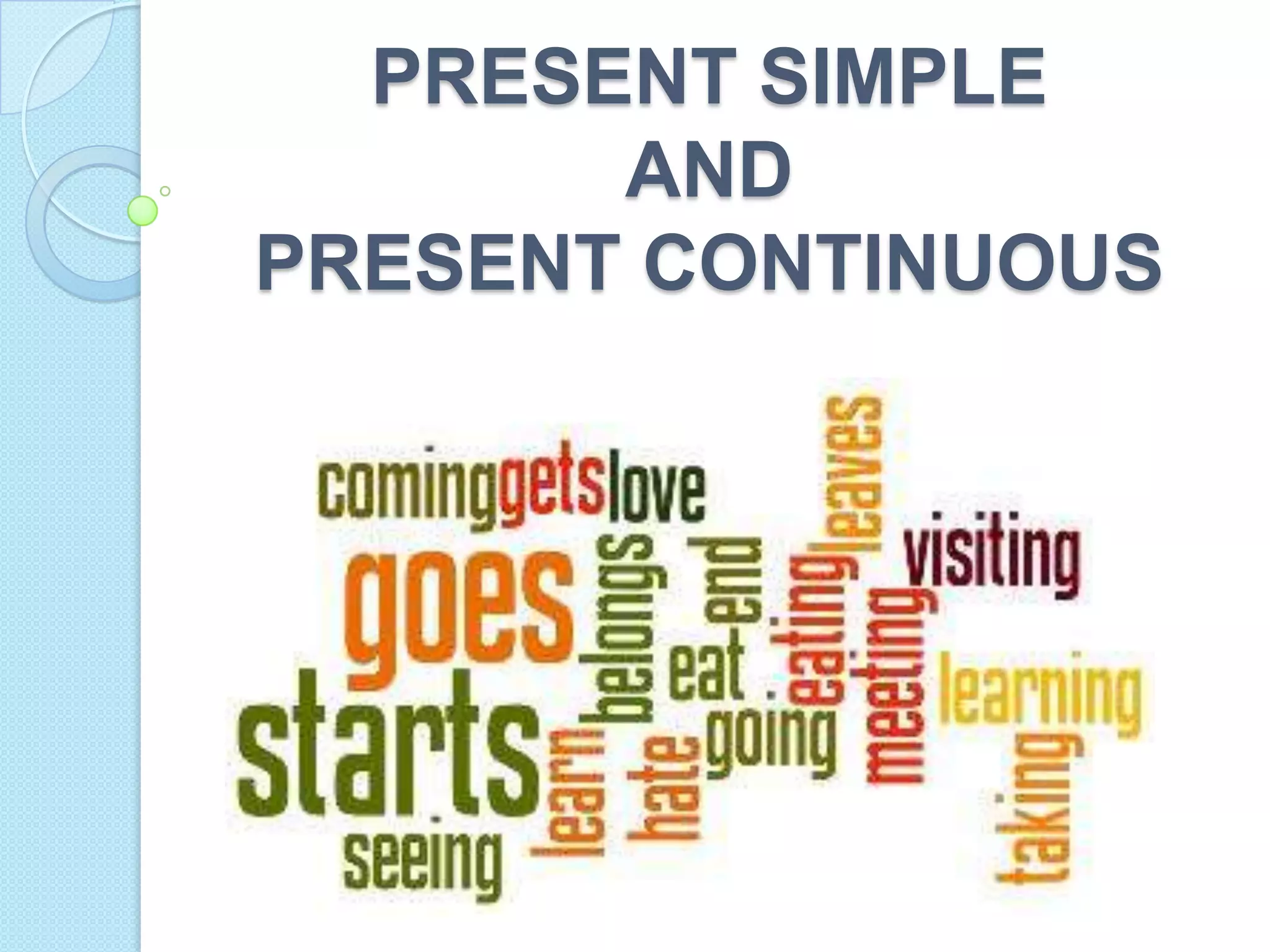
PRESENT SIMPLE
AND
PRESENT CONTINUOUS
Use the present simple with…
 … something that is more or less
permanent.
I live in Tokyo.
 … habitual actions or facts.
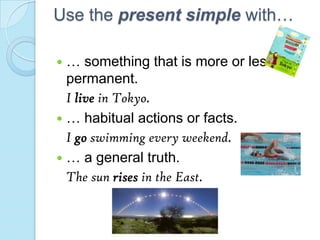
I go swimming every weekend.
 … a general truth.
The sun rises in the East.
Use the present simple with…
 … future timetables or schedules.
The next train leaves at 7.00hs
 … stative verbs (see, hear, etc.).
I don’t remember Jane’s address.
 … a narrative, a joke, a commentary
about a sporting event, etc.
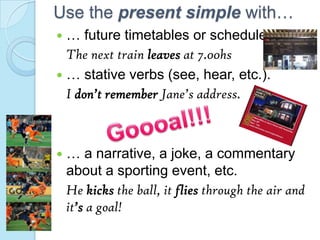
He kicks the ball, it flies through the air and
it’s a goal!
Use the present continuous
with…
 ... an action that is happening at the
moment of speaking.
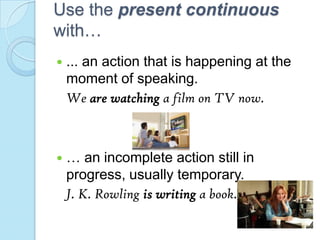
We are watching a film on TV now.
 … an incomplete action still in
progress, usually temporary.
J. K. Rowling is writing a book.
Use the present continuous
with…
 … an arrangement or plan in the near
future.
I’m meeting her at the theatre this evening.
 … with always, forever, constanly,
etc., for an action that happens very
often (usually a criticism or a
complaint).
He’s forever arriving late.
More information at:
https://www.youtube.com/watch?v=TDuZNqIeURA&list=PL2383423D9C6BD844

Present simple and present continuous

  • 1.
  • 2.
    Use the presentsimple with…  … something that is more or less permanent. I live in Tokyo.  … habitual actions or facts. I go swimming every weekend.  … a general truth. The sun rises in the East.
  • 3.
    Use the presentsimple with…  … future timetables or schedules. The next train leaves at 7.00hs  … stative verbs (see, hear, etc.). I don’t remember Jane’s address.  … a narrative, a joke, a commentary about a sporting event, etc. He kicks the ball, it flies through the air and it’s a goal!
  • 4.
    Use the presentcontinuous with…  ... an action that is happening at the moment of speaking. We are watching a film on TV now.  … an incomplete action still in progress, usually temporary. J. K. Rowling is writing a book.
  • 5.
    Use the presentcontinuous with…  … an arrangement or plan in the near future. I’m meeting her at the theatre this evening.  … with always, forever, constanly, etc., for an action that happens very often (usually a criticism or a complaint). He’s forever arriving late. More information at: https://www.youtube.com/watch?v=TDuZNqIeURA&list=PL2383423D9C6BD844