PRESENT SIMPLE VS PRESENT
                CONTINUOUS


What does Rihanna do?            What is Rihanna doing?
She is a singer.                 She is walking on the
                                 stage.


                        By Carme Flores, SI Vallbona,
                        2012
PRESENT SIMPLE
   Uses:       regular habits and routines; things that are
    always true (permanent situations or scientific facts);
    states, not actions; future only with timetabled activities.
   Time-adverbials  Frequency adverbs and
    expressions: always, usually, often, sometimes, rarely,
    seldom/ hardly ever, never; once a week, twice a year,
    three times a day; every day/ week/ summer, etc.
   Form:
    Aff. The sun rises in the east; Mary often wears trainers;
    They play tennis; She is very optimistic; The train leaves
    at 10.15 a.m. Neg. The sun doesn´t rise in the west;
    Mary doesn´t usually wear trainers; They don´t play
    tennis; She isn´t very optimistic; The train doesn´t leave
    at 10 a.m. Q. Does Mary often wear trainers? (Yes, she
    does./ No, she doesn´t.); Do they play tennis? (Yes, they
    do./ No, they don´t.), Is she very optimistic? (Yes, she is.
    / No, she isn´t.)
He/she/it Verb -s/-es
                  SPELLING
 V+-s: likes, walks, drinks, eats, etc.
 V-o +-es: goes, does
 V-ss/-sh/-ch/-x + -es: passes, pushes,
  matches, fixes, etc…
 V+consonant+-y  -ies: studies, cries,
  etc.
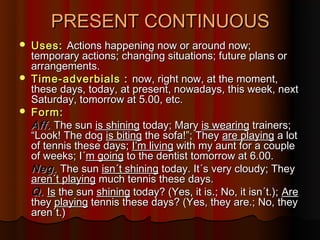
PRESENT CONTINUOUS
   Uses: Actions happening now or around now;
    temporary actions; changing situations; future plans or
    arrangements.
   Time-adverbials : now, right now, at the moment,
    these days, today, at present, nowadays, this week, next
    Saturday, tomorrow at 5.00, etc.
   Form:
    Aff. The sun is shining today; Mary is wearing trainers;
    “Look! The dog is biting the sofa!”; They are playing a lot
    of tennis these days; I’m living with my aunt for a couple
    of weeks; I´m going to the dentist tomorrow at 6.00.
    Neg. The sun isn´t shining today. It´s very cloudy; They
    aren´t playing much tennis these days.
    Q. Is the sun shining today? (Yes, it is.; No, it isn´t.); Are
    they playing tennis these days? (Yes, they are.; No, they
    aren´t.)
V- ing
                        SPELLING
 V-e  live: living; smoke: smoking
 V-ie V-ying         die: dying, lie: lying
 V-CVC* double consonant (except for X,W. Stress
  on last syllable)
  run: running, swim: swimming, refer: referring,
  dub:dubbing, sit: sitting, stop: stopping, also exceptionally in
  British English travel:travelling

*CVC=Consonant Vowel Consonant
STATIVE VERBS
Stative verbs are not usually used with progressive
    tenses (i.e: present continuous, past continuous, etc.)

   Dislike, hate, like, love, prefer, want, wish .
   Believe, doubt, feel (=have an opinion), guess, imagine,
    know, mean, realise, recognize, remember, suppose,
    think (=have an opinion), understand.
   Hear, see, measure (=have length, etc.), taste (=have a
    flavour), smell (=give out a smell), sound, weigh (=have
    weight).
   Belong to, concern, consist of, contain, depend on,
    deserve, fit, include, involve, lack, matter, need, owe,
    possess.
   Appear, resemble, seem.
Compare the progressive or non-
    progressive use of certain stative verbs:
   What are you thinking about? I think you´re right.
   I´m feeling fine. I feel we shouldn´t do it.
   Why are you smelling the meat? Is it bad? The meat
    smells bad.
   `What are you doing with my whisky?´ - `I´m just tasting it.´
   It tastes wonderful.
   The scales broke when I was weighing myself this morning.
   I weighed 68 kilos three months ago – and look at me now!
   Why´s that man measuring the street? I measure 75 cm.
    round the waist.
   I´m seeing philip tomorrow.     I see what you mean.
   I can see a woman wearing a yellow dress.

Present simple vs present continuous

  • 1.
    PRESENT SIMPLE VSPRESENT CONTINUOUS What does Rihanna do? What is Rihanna doing? She is a singer. She is walking on the stage. By Carme Flores, SI Vallbona, 2012
  • 2.
    PRESENT SIMPLE  Uses: regular habits and routines; things that are always true (permanent situations or scientific facts); states, not actions; future only with timetabled activities.  Time-adverbials  Frequency adverbs and expressions: always, usually, often, sometimes, rarely, seldom/ hardly ever, never; once a week, twice a year, three times a day; every day/ week/ summer, etc.  Form: Aff. The sun rises in the east; Mary often wears trainers; They play tennis; She is very optimistic; The train leaves at 10.15 a.m. Neg. The sun doesn´t rise in the west; Mary doesn´t usually wear trainers; They don´t play tennis; She isn´t very optimistic; The train doesn´t leave at 10 a.m. Q. Does Mary often wear trainers? (Yes, she does./ No, she doesn´t.); Do they play tennis? (Yes, they do./ No, they don´t.), Is she very optimistic? (Yes, she is. / No, she isn´t.)
  • 3.
    He/she/it Verb -s/-es SPELLING  V+-s: likes, walks, drinks, eats, etc.  V-o +-es: goes, does  V-ss/-sh/-ch/-x + -es: passes, pushes, matches, fixes, etc…  V+consonant+-y  -ies: studies, cries, etc.
  • 4.
    PRESENT CONTINUOUS  Uses: Actions happening now or around now; temporary actions; changing situations; future plans or arrangements.  Time-adverbials : now, right now, at the moment, these days, today, at present, nowadays, this week, next Saturday, tomorrow at 5.00, etc.  Form: Aff. The sun is shining today; Mary is wearing trainers; “Look! The dog is biting the sofa!”; They are playing a lot of tennis these days; I’m living with my aunt for a couple of weeks; I´m going to the dentist tomorrow at 6.00. Neg. The sun isn´t shining today. It´s very cloudy; They aren´t playing much tennis these days. Q. Is the sun shining today? (Yes, it is.; No, it isn´t.); Are they playing tennis these days? (Yes, they are.; No, they aren´t.)
  • 5.
    V- ing SPELLING  V-e  live: living; smoke: smoking  V-ie V-ying die: dying, lie: lying  V-CVC* double consonant (except for X,W. Stress on last syllable) run: running, swim: swimming, refer: referring, dub:dubbing, sit: sitting, stop: stopping, also exceptionally in British English travel:travelling *CVC=Consonant Vowel Consonant
  • 6.
    STATIVE VERBS Stative verbsare not usually used with progressive tenses (i.e: present continuous, past continuous, etc.)  Dislike, hate, like, love, prefer, want, wish .  Believe, doubt, feel (=have an opinion), guess, imagine, know, mean, realise, recognize, remember, suppose, think (=have an opinion), understand.  Hear, see, measure (=have length, etc.), taste (=have a flavour), smell (=give out a smell), sound, weigh (=have weight).  Belong to, concern, consist of, contain, depend on, deserve, fit, include, involve, lack, matter, need, owe, possess.  Appear, resemble, seem.
  • 7.
    Compare the progressiveor non- progressive use of certain stative verbs:  What are you thinking about? I think you´re right.  I´m feeling fine. I feel we shouldn´t do it.  Why are you smelling the meat? Is it bad? The meat smells bad.  `What are you doing with my whisky?´ - `I´m just tasting it.´  It tastes wonderful.  The scales broke when I was weighing myself this morning.  I weighed 68 kilos three months ago – and look at me now!  Why´s that man measuring the street? I measure 75 cm. round the waist.  I´m seeing philip tomorrow. I see what you mean.  I can see a woman wearing a yellow dress.