Polypharmacy in the Elderly
       Marc Evans M. Abat, M.D., FPCP, FPCGM
           Internal Medicine-Geriatric Medicine
    Head, Center for Healthy Aging, The Medical City
 Clinical Associate Professor, Section of Adult Medicine,
            Department of Medicine, UP-PGH
Objectives
•   Definition of polypharmacy
•   Prevalence
•   Consequences
•   Pharmacology and Aging
•   Specific Examples
•   Interventions
Question: How many drugs must an older
 person take to make him at risk for
 polypharmacy???
  A.   2
  B.   5
  C.   10
  D.   A gazillion
• Polypharmacy
 – The use of more than 5 medications,
   some of which may be clinically
   inappropriate
Prevalence
• As much as 25% of the overall population
  (Chumney et al., 2006)
• For those >65 years old, prevalence
  increases to 50%
• Prevalence may also be dependent on
  comorbidity
  – More drugs among diabetics than age or sex
    matched non-diabetics (Good, 2002)
  – Other predictors include number of starting
    drugs, CAD, diabetes, and use of medications
    without indications (Veehof et al. 2000)
Question: Any substance may have an
 interaction with the following EXCEPT:
  A.   Another drug
  B.   food
  C.   disease
  D.   None of the above
Consequences
Adverse Drug Reactions (ADRs) which may
   include:
    –    Drug-drug interactions
    –    Drug-disease interactions
    –    Drug-food interactions
    –    Drug side effects
    –    Drug toxicity


•       May increase from 7% in those using 2 drugs
        to 50% in those using 5 and 100% in those
        using > 10 (Lin 2003; Brazeau 2001)
Quality of Life
• In ambulatory elderly: 35% of experience
  ADRs and 29% require medical
  intervention
• In nursing facilities: 2/3 of residents
  experience ADRs and 1in 7 of these
  require hospitalization
• Up to 30% of elderly hospital admissions
  involve ADRs
• Linked to preventable geriatric syndromes
                        Fick 2003. Arch Int Med.
Economic
• In 2000: ADRs caused 10,600 deaths
• Annual cost of $85 billion
• $76.6 billion in ambulatory care
• $20 billion in hospitals
• $4 billion in SNF

                    Fick 2003. Arch Int Med.
Pharmacokinetics and Aging
•   characterization and mathematical
    description of the absorption,
    distribution, metabolism, and
    excretion of drugs, their by-products,
    and other substances of biologic interest
    as affected by the elderly body
Question: In which of the following
 situations is drug absorption decreased in
 the elderly?
  A.   Amoxicillin taken with food
  B.   Vitamin B12 in patients with atrophic gastritis
  C.   Calcium carbonate taken with food
  D.   Ferrous sulfate taken while on omeprazole
Absorption
• Age-related gastrointestinal tract and skin
  changes seem to be of minor clinical
  significance for medication usage
  – Decrease in small intestine surface area
  – Increase in gastric pH
• Medical conditions (e.g. achlorhydria), other
  medications or feedings may modify absorption
  – vitamin B12 in atrophic gastritis
  – PPIs with sucralfate
  – Amoxicillin with food
Distribution
• Age-related changes
  –   Decrease in lean body weight
  –   Decrease in total body water(10-15%)
  –   Increased percentage body fat (~15-30%)
  –   Increased fat:water ratio
  –   Decreased plasma proteins, especially albumin
• Occurrence of heart failure, kidney disease with
  resulting water retention
Question: Drugs that are lipophilic tend to
 have:
  A.   Shorter half-lives
  B.   Shorter effects
  C.   Longer effects
  D.   None of the above
• Increase in volume of distribution for
  lipophilic drugs
  – sedatives that penetrate CNS
  – Leads to longer half-lives (Linjakumpu 2003)
• Metabolic capacity of phase I reactions
  decrease
• Phase II reactions are largely unaffected
• Greater, active, free concentration in
  highly protein-bound drugs
Metabolism
• some overall decline in liver metabolic
  capacity due to decreased liver mass and
  hepatic blood flow
  – Highly variable, no good estimation algorithm
  – Minimal clinical manifestations
• Concurrent drug use may affect
  metabolism in both directions
• No formula to estimate this effect
Renal Elimination
• Age-related decrease in renal blood flow
• GFR decreases by 8 mL/min/1.73
  m2/decade
• Decreased lean body mass leads to
  decreased creatinine production
  – Serum creatinine not reliable
  – Need to estimate creatinine clearance and
    adjust medications accordingly (i.e. use
    Cockroft-Gault or MDRD)
Question: In a bedridden, demented, and
 constipated older patient, which agent
 may be more appropriate to use
  A.   Fiber bulking agents (e.g. psyllium)
  B.   bisacodyl
  C.   lactulose
  D.   Commercial enema (e.g. Fleet Enema)
Pharmacodynamics and Aging
• Effect of the drug on the body with regard
  to aging
• Generally, lower drug doses are required
  to achieve the same effect with advancing
  age.
  – Receptor numbers, affinity, or post-receptor
    cellular effects may change.
  – Changes in homeostatic mechanisms can
    increase or decrease drug sensitivity.
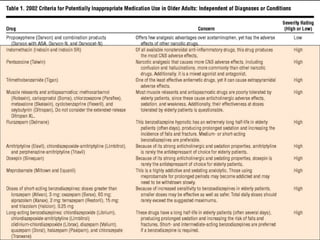
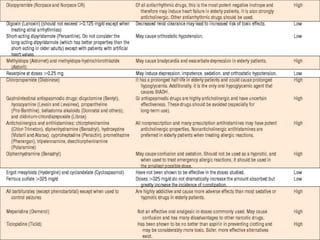
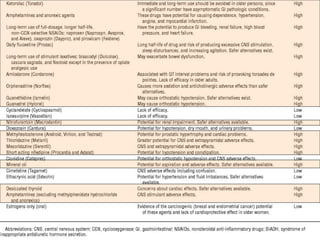
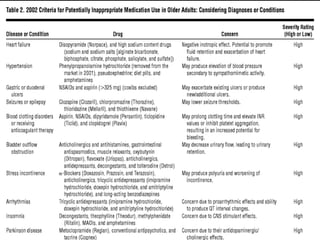
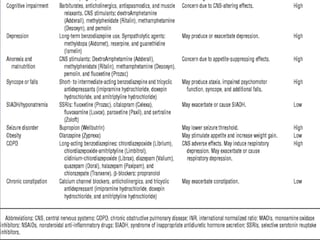
Inappropriate Medications: Beers
Criteria
• One of the most, if not the widely used
  consensus data for inappropriate
  medication use in the elderly
• Latest revision in 2003
• Covers 2 statements regarding drug use
  in elderly:
  – Those inappropriate for the elderly in general
  – Those inappropriate for the elderly with regard
    to specific conditions
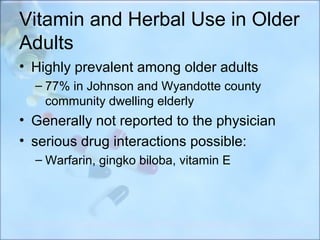
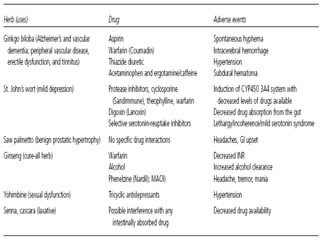
Vitamin and Herbal Use in Older
Adults
• Highly prevalent among older adults
  – 77% in Johnson and Wyandotte county
    community dwelling elderly
• Generally not reported to the physician
• serious drug interactions possible:
  – Warfarin, gingko biloba, vitamin E
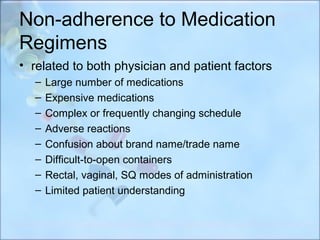
Non-adherence to Medication
Regimens
• related to both physician and patient factors
  –   Large number of medications
  –   Expensive medications
  –   Complex or frequently changing schedule
  –   Adverse reactions
  –   Confusion about brand name/trade name
  –   Difficult-to-open containers
  –   Rectal, vaginal, SQ modes of administration
  –   Limited patient understanding
Geriatric Prescribing Principles
• First consider non-drug therapies
• Match drugs to specific diagnoses
• Try to give medications that will treat more than
  one condition
• Reduce meds whenever possible
• Avoid using a drug to treat side effects of
  another drug
• Review meds regularly (at least q3 months)
• Avoid drugs with similar actions/same class
• Clearly communicate with patient and caregivers
• Consider cost of meds
CARE: Avoiding
Polypharmamcy
• Caution and Compliance
  – Understand side effect profiles
  – Identify risk factors for an ADR
  – Consider a risk to benefit ratio
  – Keep dosing simple- QD or BID
  – Ask about compliance
CARE: Avoiding
Polypharmamcy
• Adjust the Dose
  – Start low and go slow- titrate
  – Consider the pharmacokinetics and
    pharmacodynamics of the medication
CARE: Avoiding
Polypharmamcy
• Review Regimen Regularly
  – Avoid automatic refills
  – Look for other sources of medications- OTC
  – Caution with multiple providers
  – Don’t use medications to treat side effects of
    other meds
  – Choose drugs to discontinue or substitute
    safer medications
CARE: Avoiding
Polypharmamcy
• Educate
  – All medicines, even over-the-counter, have adverse
    effects-report all products used
  – Talk to your patient about potential ADRs
  – Warn them of potential side effects and report
    symptoms
  – Educate the family and caregiver
  – Ask pharmacist for help in identifying interactions
  – Assist your patient in making and updating a
    medication list- personal medical record
  – Avoid seeing multiple physicians
  – Do not use medications from others
Personal Health Record
• It will reduce polypharmacy and ADRs
• Multiple specialist involved in care
• Transitions in care from independent
  living, hospitals, nursing homes and
  assisted living facilities
• Great aid in emergency care
• Provides the patient with more peace of
  mind…
Personal Health Record
Includes:
•   Patient identifying information
•   Doctors contacts
•   Caregiver contacts
•   Past Medical History and Allergies
•   List of all medications, dose, reason they
    are taking it and whether it is new
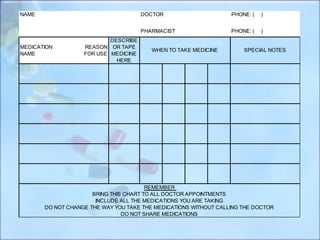
NAME                                  DOCTOR                      PHONE: (   )


                                      PHARMACIST                  PHONE: (   )
                           DESCRIBE
MEDICATION         REASON OR TAPE
                                         WHEN TO TAKE MEDICINE        SPECIAL NOTES
NAME               FOR USE MEDICINE
                             HERE


                                        REMEMBER
                      BRING THIS CHART TO ALL DOCTOR APPOINTMENTS
                       INCLUDE ALL THE MEDICATIONS YOU ARE TAKING
       DO NOT CHANGE THE WAY YOU TAKE THE MEDICATIONS WITHOUT CALLING THE DOCTOR
                                DO NOT SHARE MEDICATIONS
Dami pa dapat
  gawin….

Polypharmacy in the elderly

  • 1.
    Polypharmacy in theElderly Marc Evans M. Abat, M.D., FPCP, FPCGM Internal Medicine-Geriatric Medicine Head, Center for Healthy Aging, The Medical City Clinical Associate Professor, Section of Adult Medicine, Department of Medicine, UP-PGH
  • 2.
    Objectives • Definition of polypharmacy • Prevalence • Consequences • Pharmacology and Aging • Specific Examples • Interventions
  • 3.
    Question: How manydrugs must an older person take to make him at risk for polypharmacy??? A. 2 B. 5 C. 10 D. A gazillion
  • 4.
    • Polypharmacy –The use of more than 5 medications, some of which may be clinically inappropriate
  • 5.
    Prevalence • As muchas 25% of the overall population (Chumney et al., 2006) • For those >65 years old, prevalence increases to 50% • Prevalence may also be dependent on comorbidity – More drugs among diabetics than age or sex matched non-diabetics (Good, 2002) – Other predictors include number of starting drugs, CAD, diabetes, and use of medications without indications (Veehof et al. 2000)
  • 6.
    Question: Any substancemay have an interaction with the following EXCEPT: A. Another drug B. food C. disease D. None of the above
  • 7.
    Consequences Adverse Drug Reactions(ADRs) which may include: – Drug-drug interactions – Drug-disease interactions – Drug-food interactions – Drug side effects – Drug toxicity • May increase from 7% in those using 2 drugs to 50% in those using 5 and 100% in those using > 10 (Lin 2003; Brazeau 2001)
  • 8.
    Quality of Life •In ambulatory elderly: 35% of experience ADRs and 29% require medical intervention • In nursing facilities: 2/3 of residents experience ADRs and 1in 7 of these require hospitalization • Up to 30% of elderly hospital admissions involve ADRs • Linked to preventable geriatric syndromes Fick 2003. Arch Int Med.
  • 9.
    Economic • In 2000:ADRs caused 10,600 deaths • Annual cost of $85 billion • $76.6 billion in ambulatory care • $20 billion in hospitals • $4 billion in SNF Fick 2003. Arch Int Med.
  • 10.
    Pharmacokinetics and Aging • characterization and mathematical description of the absorption, distribution, metabolism, and excretion of drugs, their by-products, and other substances of biologic interest as affected by the elderly body
  • 11.
    Question: In whichof the following situations is drug absorption decreased in the elderly? A. Amoxicillin taken with food B. Vitamin B12 in patients with atrophic gastritis C. Calcium carbonate taken with food D. Ferrous sulfate taken while on omeprazole
  • 12.
    Absorption • Age-related gastrointestinaltract and skin changes seem to be of minor clinical significance for medication usage – Decrease in small intestine surface area – Increase in gastric pH • Medical conditions (e.g. achlorhydria), other medications or feedings may modify absorption – vitamin B12 in atrophic gastritis – PPIs with sucralfate – Amoxicillin with food
  • 13.
    Distribution • Age-related changes – Decrease in lean body weight – Decrease in total body water(10-15%) – Increased percentage body fat (~15-30%) – Increased fat:water ratio – Decreased plasma proteins, especially albumin • Occurrence of heart failure, kidney disease with resulting water retention
  • 14.
    Question: Drugs thatare lipophilic tend to have: A. Shorter half-lives B. Shorter effects C. Longer effects D. None of the above
  • 15.
    • Increase involume of distribution for lipophilic drugs – sedatives that penetrate CNS – Leads to longer half-lives (Linjakumpu 2003) • Metabolic capacity of phase I reactions decrease • Phase II reactions are largely unaffected • Greater, active, free concentration in highly protein-bound drugs
  • 16.
    Metabolism • some overalldecline in liver metabolic capacity due to decreased liver mass and hepatic blood flow – Highly variable, no good estimation algorithm – Minimal clinical manifestations • Concurrent drug use may affect metabolism in both directions • No formula to estimate this effect
  • 17.
    Renal Elimination • Age-relateddecrease in renal blood flow • GFR decreases by 8 mL/min/1.73 m2/decade • Decreased lean body mass leads to decreased creatinine production – Serum creatinine not reliable – Need to estimate creatinine clearance and adjust medications accordingly (i.e. use Cockroft-Gault or MDRD)
  • 18.
    Question: In abedridden, demented, and constipated older patient, which agent may be more appropriate to use A. Fiber bulking agents (e.g. psyllium) B. bisacodyl C. lactulose D. Commercial enema (e.g. Fleet Enema)
  • 19.
    Pharmacodynamics and Aging •Effect of the drug on the body with regard to aging • Generally, lower drug doses are required to achieve the same effect with advancing age. – Receptor numbers, affinity, or post-receptor cellular effects may change. – Changes in homeostatic mechanisms can increase or decrease drug sensitivity.
  • 20.
    Inappropriate Medications: Beers Criteria •One of the most, if not the widely used consensus data for inappropriate medication use in the elderly • Latest revision in 2003 • Covers 2 statements regarding drug use in elderly: – Those inappropriate for the elderly in general – Those inappropriate for the elderly with regard to specific conditions
  • 26.
    Vitamin and HerbalUse in Older Adults • Highly prevalent among older adults – 77% in Johnson and Wyandotte county community dwelling elderly • Generally not reported to the physician • serious drug interactions possible: – Warfarin, gingko biloba, vitamin E
  • 28.
    Non-adherence to Medication Regimens •related to both physician and patient factors – Large number of medications – Expensive medications – Complex or frequently changing schedule – Adverse reactions – Confusion about brand name/trade name – Difficult-to-open containers – Rectal, vaginal, SQ modes of administration – Limited patient understanding
  • 29.
    Geriatric Prescribing Principles •First consider non-drug therapies • Match drugs to specific diagnoses • Try to give medications that will treat more than one condition • Reduce meds whenever possible • Avoid using a drug to treat side effects of another drug • Review meds regularly (at least q3 months) • Avoid drugs with similar actions/same class • Clearly communicate with patient and caregivers • Consider cost of meds
  • 30.
    CARE: Avoiding Polypharmamcy • Cautionand Compliance – Understand side effect profiles – Identify risk factors for an ADR – Consider a risk to benefit ratio – Keep dosing simple- QD or BID – Ask about compliance
  • 31.
    CARE: Avoiding Polypharmamcy • Adjustthe Dose – Start low and go slow- titrate – Consider the pharmacokinetics and pharmacodynamics of the medication
  • 32.
    CARE: Avoiding Polypharmamcy • ReviewRegimen Regularly – Avoid automatic refills – Look for other sources of medications- OTC – Caution with multiple providers – Don’t use medications to treat side effects of other meds – Choose drugs to discontinue or substitute safer medications
  • 33.
    CARE: Avoiding Polypharmamcy • Educate – All medicines, even over-the-counter, have adverse effects-report all products used – Talk to your patient about potential ADRs – Warn them of potential side effects and report symptoms – Educate the family and caregiver – Ask pharmacist for help in identifying interactions – Assist your patient in making and updating a medication list- personal medical record – Avoid seeing multiple physicians – Do not use medications from others
  • 34.
    Personal Health Record •It will reduce polypharmacy and ADRs • Multiple specialist involved in care • Transitions in care from independent living, hospitals, nursing homes and assisted living facilities • Great aid in emergency care • Provides the patient with more peace of mind…
  • 35.
    Personal Health Record Includes: • Patient identifying information • Doctors contacts • Caregiver contacts • Past Medical History and Allergies • List of all medications, dose, reason they are taking it and whether it is new
  • 36.
    NAME DOCTOR PHONE: ( ) PHARMACIST PHONE: ( ) DESCRIBE MEDICATION REASON OR TAPE WHEN TO TAKE MEDICINE SPECIAL NOTES NAME FOR USE MEDICINE HERE REMEMBER BRING THIS CHART TO ALL DOCTOR APPOINTMENTS INCLUDE ALL THE MEDICATIONS YOU ARE TAKING DO NOT CHANGE THE WAY YOU TAKE THE MEDICATIONS WITHOUT CALLING THE DOCTOR DO NOT SHARE MEDICATIONS
  • 37.
    Dami pa dapat gawin….