DR. VANDANA TAYAL
ASSISTANT PROFESSOR
PHARMACOLOGY
Medication in Geriatric
Patients
 Successful pharmacotherapy means using
 the correct drug
 at the correct dose
 for the correct indication
 in an individual patient
TODAY’S TOPICS
Challenges of Geriatric Pharmacotherapy
•Medication use patterns
•Age related changes in Pharmacokinetics &
Pharmacodynamics
Interactions – Drug-drug, Drug-disease
Drugs to avoid
Prescribing Pearls for elderly
MEDICATION USE PATTERN
Extent of Medication use
 Illness is more common in older persons -
Cardiovascular disease, Diabetes Mellitus, Arthritis,
Gastrointestinal disorders, Respiratory diseases, Bladder
dysfunction
 Polypharmacy - Elderly = 12% of population but
32% of prescriptions
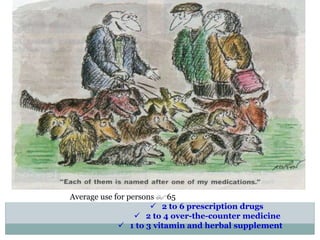
Average use for persons 65
 2 to 6 prescription drugs
 2 to 4 over-the-counter medicine
 1 to 3 vitamin and herbal supplement
 More adverse drug reactions
 Drug Interactions
 Increased cost
 Decreased adherence to drug regimens
Polypharmacy Leads to?
Factors contributing to Non-adherence
 Large number of medications
 Expensive medications
 Complex or frequently changing schedule
 Adverse reactions
 Confusion about brand name/trade name
 Difficult-to-open containers
 Rectal, vaginal, SQ modes of administration
 Limited patient understanding
Age related changes relevant to
drug prescribing
Unique Pharmacokinetics and Pharmacodynamics:
normal part of the aging process
PK
 Absorption
 Distribution
 Metabolism
 Excretion
PD
 Receptor numbers, affinity, or post-receptor
cellular effects
“Start low, go slow”!
Effects of Aging on Absorption
 Rate of absorption may be
delayed
 Lower peak concentration
 Delayed time to peak concentration
 Overall amount absorbed
(bioavailability) is unchanged
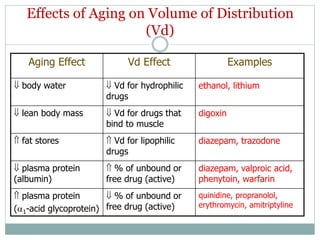
Effects of Aging on Volume of Distribution
(Vd)
Aging Effect Vd Effect Examples
 body water  Vd for hydrophilic
drugs
ethanol, lithium
 lean body mass  Vd for drugs that
bind to muscle
digoxin
 fat stores  Vd for lipophilic
drugs
diazepam, trazodone
 plasma protein
(albumin)
 % of unbound or
free drug (active)
diazepam, valproic acid,
phenytoin, warfarin
 plasma protein
(1-acid glycoprotein)
 % of unbound or
free drug (active)
quinidine, propranolol,
erythromycin, amitriptyline
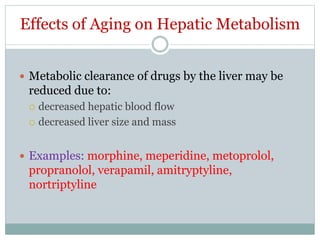
Effects of Aging on Hepatic Metabolism
 Metabolic clearance of drugs by the liver may be
reduced due to:
 decreased hepatic blood flow
 decreased liver size and mass
 Examples: morphine, meperidine, metoprolol,
propranolol, verapamil, amitryptyline,
nortriptyline
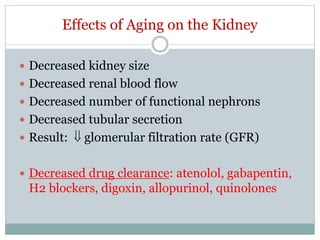
Effects of Aging on the Kidney
 Decreased kidney size
 Decreased renal blood flow
 Decreased number of functional nephrons
 Decreased tubular secretion
 Result:  glomerular filtration rate (GFR)
 Decreased drug clearance: atenolol, gabapentin,
H2 blockers, digoxin, allopurinol, quinolones
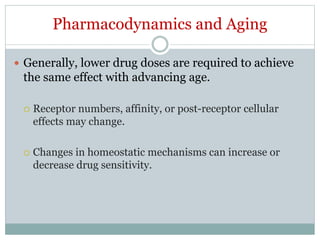
Pharmacodynamics and Aging
 Generally, lower drug doses are required to achieve
the same effect with advancing age.
 Receptor numbers, affinity, or post-receptor cellular
effects may change.
 Changes in homeostatic mechanisms can increase or
decrease drug sensitivity.
Pharmacodynamics
 Some effects are increased
 Fentanyl, diazepam, morphine, theophylline
 Alcohol causes increased drowsiness and
lateral sway in older people than younger
people at same serum levels
 Some effects are decreased
 Diminished response to isoproterenol and
beta -blockers
PK and PD Summary
 PK and PD changes generally result in decreased
clearance and increased sensitivity to medications in
older adults
 Use of lower doses, longer intervals, slower titration
are helpful in decreasing the risk of drug intolerance
and toxicity
 Careful monitoring is necessary to ensure successful
outcomes
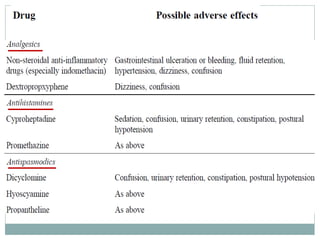
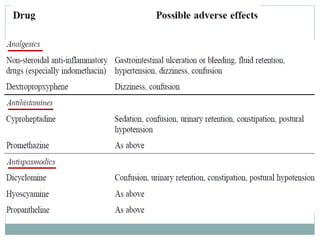
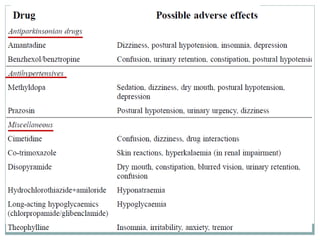
High Risk Medications
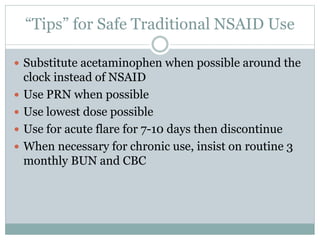
“Tips” for Safe Traditional NSAID Use
 Substitute acetaminophen when possible around the
clock instead of NSAID
 Use PRN when possible
 Use lowest dose possible
 Use for acute flare for 7-10 days then discontinue
 When necessary for chronic use, insist on routine 3
monthly BUN and CBC
Drug-Interactions
 Likelihood  as number of medications 
 May lead to adverse drug events
 Most common DDIs:
 cardiovascular drugs
 psychotropic drugs
 Most common drug interaction effects:
 confusion
 cognitive impairment
 hypotension
 acute renal failure
Drug-Drug Interactions (DDIs)
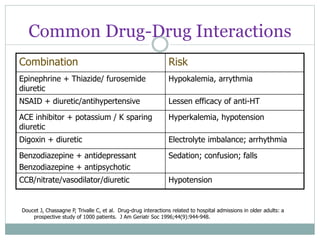
Common Drug-Drug Interactions
Combination Risk
Epinephrine + Thiazide/ furosemide
diuretic
Hypokalemia, arrythmia
NSAID + diuretic/antihypertensive Lessen efficacy of anti-HT
ACE inhibitor + potassium / K sparing
diuretic
Hyperkalemia, hypotension
Digoxin + diuretic Electrolyte imbalance; arrhythmia
Benzodiazepine + antidepressant
Benzodiazepine + antipsychotic
Sedation; confusion; falls
CCB/nitrate/vasodilator/diuretic Hypotension
Doucet J, Chassagne P, Trivalle C, et al. Drug-drug interactions related to hospital admissions in older adults: a
prospective study of 1000 patients. J Am Geriatr Soc 1996;44(9):944-948.
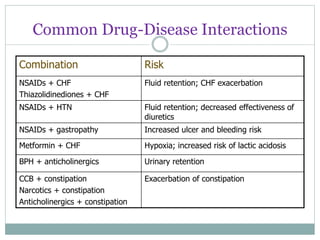
Common Drug-Disease Interactions
Combination Risk
NSAIDs + CHF
Thiazolidinediones + CHF
Fluid retention; CHF exacerbation
NSAIDs + HTN Fluid retention; decreased effectiveness of
diuretics
NSAIDs + gastropathy Increased ulcer and bleeding risk
Metformin + CHF Hypoxia; increased risk of lactic acidosis
BPH + anticholinergics Urinary retention
CCB + constipation
Narcotics + constipation
Anticholinergics + constipation
Exacerbation of constipation
PRINCIPLES OF PRESCRIBING
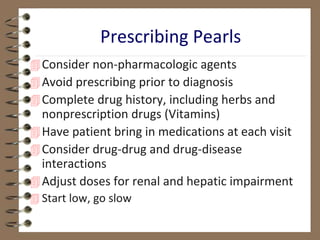
Consider non-pharmacologic agents
Avoid prescribing prior to diagnosis
Complete drug history, including herbs and
nonprescription drugs (Vitamins)
Have patient bring in medications at each visit
Consider drug-drug and drug-disease
interactions
Adjust doses for renal and hepatic impairment
 Start low, go slow
Prescribing Pearls
Prescribing Pearls
Prescribe a drug that will treat more than
one existing problem
Examples:
– calcium channel blocker or beta blocker to
treat both hypertension and angina pectoris
– Alpha-blocker to treat both hypertension and
prostatism
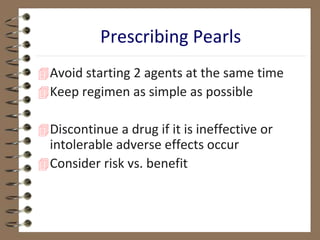
Avoid starting 2 agents at the same time
Keep regimen as simple as possible
Discontinue a drug if it is ineffective or
intolerable adverse effects occur
Consider risk vs. benefit
Prescribing Pearls
Consider the cost
Provide legible written instructions
Instruct caregivers as needed
Prescribing Pearls
Conclusions
Summary
 Successful pharmacotherapy is a challenge in
geriatric population
 Age alters PK and PD
 ADEs are common among the elderly
 Risk of ADEs can be minimized by appropriate
prescribing
THANK YOU

Medication in Geriatrics.pptx

  • 1.
    DR. VANDANA TAYAL ASSISTANTPROFESSOR PHARMACOLOGY Medication in Geriatric Patients
  • 2.
     Successful pharmacotherapymeans using  the correct drug  at the correct dose  for the correct indication  in an individual patient
  • 3.
    TODAY’S TOPICS Challenges ofGeriatric Pharmacotherapy •Medication use patterns •Age related changes in Pharmacokinetics & Pharmacodynamics Interactions – Drug-drug, Drug-disease Drugs to avoid Prescribing Pearls for elderly
  • 4.
  • 5.
    Extent of Medicationuse  Illness is more common in older persons - Cardiovascular disease, Diabetes Mellitus, Arthritis, Gastrointestinal disorders, Respiratory diseases, Bladder dysfunction  Polypharmacy - Elderly = 12% of population but 32% of prescriptions
  • 6.
    Average use forpersons 65  2 to 6 prescription drugs  2 to 4 over-the-counter medicine  1 to 3 vitamin and herbal supplement
  • 7.
     More adversedrug reactions  Drug Interactions  Increased cost  Decreased adherence to drug regimens Polypharmacy Leads to?
  • 8.
    Factors contributing toNon-adherence  Large number of medications  Expensive medications  Complex or frequently changing schedule  Adverse reactions  Confusion about brand name/trade name  Difficult-to-open containers  Rectal, vaginal, SQ modes of administration  Limited patient understanding
  • 9.
    Age related changesrelevant to drug prescribing
  • 10.
    Unique Pharmacokinetics andPharmacodynamics: normal part of the aging process PK  Absorption  Distribution  Metabolism  Excretion PD  Receptor numbers, affinity, or post-receptor cellular effects “Start low, go slow”!
  • 11.
    Effects of Agingon Absorption  Rate of absorption may be delayed  Lower peak concentration  Delayed time to peak concentration  Overall amount absorbed (bioavailability) is unchanged
  • 12.
    Effects of Agingon Volume of Distribution (Vd) Aging Effect Vd Effect Examples  body water  Vd for hydrophilic drugs ethanol, lithium  lean body mass  Vd for drugs that bind to muscle digoxin  fat stores  Vd for lipophilic drugs diazepam, trazodone  plasma protein (albumin)  % of unbound or free drug (active) diazepam, valproic acid, phenytoin, warfarin  plasma protein (1-acid glycoprotein)  % of unbound or free drug (active) quinidine, propranolol, erythromycin, amitriptyline
  • 13.
    Effects of Agingon Hepatic Metabolism  Metabolic clearance of drugs by the liver may be reduced due to:  decreased hepatic blood flow  decreased liver size and mass  Examples: morphine, meperidine, metoprolol, propranolol, verapamil, amitryptyline, nortriptyline
  • 14.
    Effects of Agingon the Kidney  Decreased kidney size  Decreased renal blood flow  Decreased number of functional nephrons  Decreased tubular secretion  Result:  glomerular filtration rate (GFR)  Decreased drug clearance: atenolol, gabapentin, H2 blockers, digoxin, allopurinol, quinolones
  • 15.
    Pharmacodynamics and Aging Generally, lower drug doses are required to achieve the same effect with advancing age.  Receptor numbers, affinity, or post-receptor cellular effects may change.  Changes in homeostatic mechanisms can increase or decrease drug sensitivity.
  • 16.
    Pharmacodynamics  Some effectsare increased  Fentanyl, diazepam, morphine, theophylline  Alcohol causes increased drowsiness and lateral sway in older people than younger people at same serum levels  Some effects are decreased  Diminished response to isoproterenol and beta -blockers
  • 17.
    PK and PDSummary  PK and PD changes generally result in decreased clearance and increased sensitivity to medications in older adults  Use of lower doses, longer intervals, slower titration are helpful in decreasing the risk of drug intolerance and toxicity  Careful monitoring is necessary to ensure successful outcomes
  • 18.
  • 21.
    “Tips” for SafeTraditional NSAID Use  Substitute acetaminophen when possible around the clock instead of NSAID  Use PRN when possible  Use lowest dose possible  Use for acute flare for 7-10 days then discontinue  When necessary for chronic use, insist on routine 3 monthly BUN and CBC
  • 24.
  • 25.
     Likelihood as number of medications   May lead to adverse drug events  Most common DDIs:  cardiovascular drugs  psychotropic drugs  Most common drug interaction effects:  confusion  cognitive impairment  hypotension  acute renal failure Drug-Drug Interactions (DDIs)
  • 26.
    Common Drug-Drug Interactions CombinationRisk Epinephrine + Thiazide/ furosemide diuretic Hypokalemia, arrythmia NSAID + diuretic/antihypertensive Lessen efficacy of anti-HT ACE inhibitor + potassium / K sparing diuretic Hyperkalemia, hypotension Digoxin + diuretic Electrolyte imbalance; arrhythmia Benzodiazepine + antidepressant Benzodiazepine + antipsychotic Sedation; confusion; falls CCB/nitrate/vasodilator/diuretic Hypotension Doucet J, Chassagne P, Trivalle C, et al. Drug-drug interactions related to hospital admissions in older adults: a prospective study of 1000 patients. J Am Geriatr Soc 1996;44(9):944-948.
  • 27.
    Common Drug-Disease Interactions CombinationRisk NSAIDs + CHF Thiazolidinediones + CHF Fluid retention; CHF exacerbation NSAIDs + HTN Fluid retention; decreased effectiveness of diuretics NSAIDs + gastropathy Increased ulcer and bleeding risk Metformin + CHF Hypoxia; increased risk of lactic acidosis BPH + anticholinergics Urinary retention CCB + constipation Narcotics + constipation Anticholinergics + constipation Exacerbation of constipation
  • 28.
  • 29.
    Consider non-pharmacologic agents Avoidprescribing prior to diagnosis Complete drug history, including herbs and nonprescription drugs (Vitamins) Have patient bring in medications at each visit Consider drug-drug and drug-disease interactions Adjust doses for renal and hepatic impairment  Start low, go slow Prescribing Pearls
  • 30.
    Prescribing Pearls Prescribe adrug that will treat more than one existing problem Examples: – calcium channel blocker or beta blocker to treat both hypertension and angina pectoris – Alpha-blocker to treat both hypertension and prostatism
  • 31.
    Avoid starting 2agents at the same time Keep regimen as simple as possible Discontinue a drug if it is ineffective or intolerable adverse effects occur Consider risk vs. benefit Prescribing Pearls
  • 32.
    Consider the cost Providelegible written instructions Instruct caregivers as needed Prescribing Pearls
  • 33.
  • 34.
    Summary  Successful pharmacotherapyis a challenge in geriatric population  Age alters PK and PD  ADEs are common among the elderly  Risk of ADEs can be minimized by appropriate prescribing
  • 35.