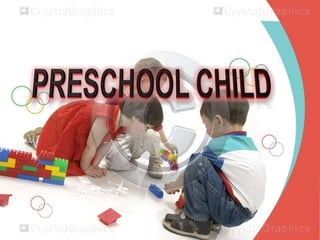
The preschool age period is from 1 to 6 years of age.
At this period, changes occur in children’s rate of
growth and development, continuing maturation of
fine and gross motor skills. Personality development
influences both the amount of food they consume and
also the food acceptable to them.
Characteristics of the Preschool Child
• The rate of growth decrease and as a result appetite
decreases.
• Toddlers (1-2 years old) gain only from 2 to 4kg each
year.
• Preschoolers (3-4 years old) have even a slower growth
averaging from 1 to 2kg each year.
• Children are often disinterest in food and eat very little at
time.
• From ages 3-5, there is a greater increase in height
relative to weight.
• Between ages 1 and 2, children learn to feed themselves
independently.
• By age 5, children can effectively use knives and fork.
Nutrient Allowances
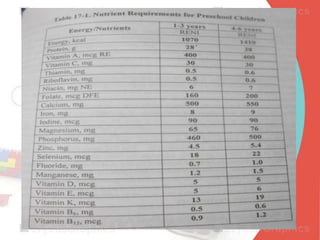
• Energy- requirement must take into consideration basal
metabolism, rate of growth and activity. The average energy
requirement for basal metabolism during the first 12-18
months of life is 55 kcal/ kg body weight. After that, the
requirement on weight specific basis decline to an adult level
of 25-30kcal/kg.
• Protein- is needed for maintenance of tissue, changes in
body composition and synthesis of new tissue. Protein
requirement increases from age 1 to 6 years. Fifty percent
(50%) of protein requirement is used for growth in the first two
months of life. FAO (Food and Agriculture Organization)
recommends 1.5-2g protein/kg body weight, 2/3 of which
should be of high biological value. This amount will provide for
increase in skeletal and muscle tissue and protection against
infection.
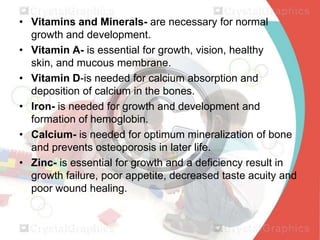
• Vitamins and Minerals- are necessary for normal
growth and development.
• Vitamin A- is essential for growth, vision, healthy
skin, and mucous membrane.
• Vitamin D-is needed for calcium absorption and
deposition of calcium in the bones.
• Iron- is needed for growth and development and
formation of hemoglobin.
• Calcium- is needed for optimum mineralization of bone
and prevents osteoporosis in later life.
• Zinc- is essential for growth and a deficiency result in
growth failure, poor appetite, decreased taste acuity and
poor wound healing.
Common Nutritional Problem among Preschool
age and their Dietary Intervention
The four most common malnutrition problems in the
Philippines

1. Protein-Energy Malnutrition (PEM)- This is
due to lack of energy and protein in the diet.
Preschoolers, particular those who are aged 13 years are vulnerable to PEM that is the most
common and widespread form of malnutrition in
the Philippines.
 PEM is due to a deficiency of protein or of
calories or both.
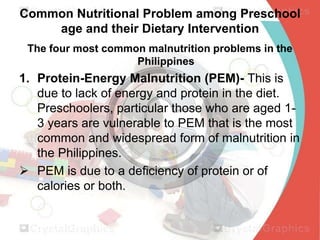
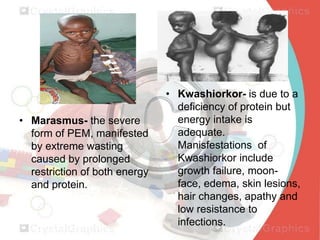
• Marasmus- the severe
form of PEM, manifested
by extreme wasting
caused by prolonged
restriction of both energy
and protein.

• Kwashiorkor- is due to a
deficiency of protein but
energy intake is
adequate.
Manisfestations of
Kwashiorkor include
growth failure, moonface, edema, skin lesions,
hair changes, apathy and
low resistance to
infections.
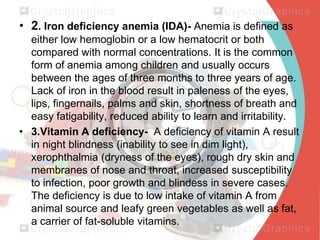
• 2. Iron deficiency anemia (IDA)- Anemia is defined as
either low hemoglobin or a low hematocrit or both
compared with normal concentrations. It is the common
form of anemia among children and usually occurs
between the ages of three months to three years of age.
Lack of iron in the blood result in paleness of the eyes,
lips, fingernails, palms and skin, shortness of breath and
easy fatigability, reduced ability to learn and irritability.
• 3.Vitamin A deficiency- A deficiency of vitamin A result
in night blindness (inability to see in dim light),
xerophthalmia (dryness of the eyes), rough dry skin and
membranes of nose and throat, increased susceptibility
to infection, poor growth and blindess in severe cases.
The deficiency is due to low intake of vitamin A from
animal source and leafy green vegetables as well as fat,
a carrier of fat-soluble vitamins.
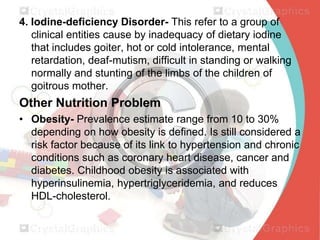
4. Iodine-deficiency Disorder- This refer to a group of
clinical entities cause by inadequacy of dietary iodine
that includes goiter, hot or cold intolerance, mental
retardation, deaf-mutism, difficult in standing or walking
normally and stunting of the limbs of the children of
goitrous mother.

Other Nutrition Problem
• Obesity- Prevalence estimate range from 10 to 30%
depending on how obesity is defined. Is still considered a
risk factor because of its link to hypertension and chronic
conditions such as coronary heart disease, cancer and
diabetes. Childhood obesity is associated with
hyperinsulinemia, hypertriglyceridemia, and reduces
HDL-cholesterol.
• Dental Caries- this is a major problem affecting 98% of
children in the county making it a widespread public
health problem.
Nutrition Assessment
 Anthropometric Assessment the measurement should
be complete for a preschool child.
• Weight- should be record to the nearest 100g (0.1kg or
¼ lb) for preschool.

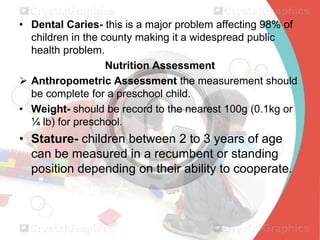
• Stature- children between 2 to 3 years of age
can be measured in a recumbent or standing
position depending on their ability to cooperate.
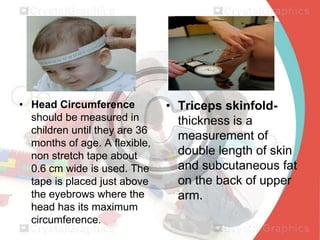
• Head Circumference
should be measured in
children until they are 36
months of age. A flexible,
non stretch tape about
0.6 cm wide is used. The
tape is placed just above
the eyebrows where the
head has its maximum
circumference.

• Triceps skinfoldthickness is a
measurement of
double length of skin
and subcutaneous fat
on the back of upper
arm.
 Biochemical Assessment- Hemoglobin (Hb) or
Hematocrit (Hct) determinations should be done to
determine the presence of anemia.
 Dietary Assessment- is a comprehensive evaluation of
a person's food intake.
Methods of Dietary Assessment
 24 hour recall- this is a method of assessment whereby
an individual is asked to remember everything eaten
during the previous 24 hours.
• It is widely used method because it is easy to
administer, in person or by telephone, and lends itself to
large population studies
• This method is best suited to describing the intakes of
populations, not individual.
• Food record- This is a written record of amount of all
foods and liquids consumed during a set time
period, usually 3 to 7 day, and often includes information
on time, place and situation of eating.
• Food Frequency Questionnaire- This is method of
assessment in which the data collected relate to how
often food are consumed, i.e., daily, once or several
times, a week, monthly or several times a month or
never.
 Clinical Assessment- this consist of a medical history
and a physical examination to detect physical sign and
symptoms associated with malnutrition.
Factors Influencing Food Intake
 Family Environment- the family has the major
influence on the food habits of toddlers and
preschoolers.
 Societal Trends- There are more mother now
who work or are employed outside the home.
Therefore, they do not have time to prepare
meals for their families nor teach their children
about good eating habits.
 Media- Mass media especially television affects children’s
request for attitudes towards food. TV influences eating
habits and the nutritional status of children in several ways:
• TV advertising family food purchases and snacking
patterns of children.
• The use of food as depicted on TV shows food being used
for many activities other than to satisfy hunger.
• The few overweight children used on TV suggests that
inappropriate use of food have no impact on health.
• There is a relationship between increase TV watching and
increase snacking.
• TV encourages inactivity and passive used of leisure time
so it is determine to children’s growth and development.
 Illness or Disease- Children who are ill have decreased
appetite and limited food intake.
Feeding the Preschool Child
• When a child is tired, they should be allowed to rest
before meals.
• Also, snack should not be given 1 to 1-1/2 hour before
meal because this reduces appetite
• Too much attention by parent can also be a cause for
refusal to eat.
• Children should eat their meals at the family table so
they will have an opportunity to learn table manner and
interact with family.
Feeding Problem
•
•
•
•
•
•
•
•

Complain about what is served
Refuses food especially vegetables and fruits
Refuses food like meat
Pushes, hides or throws food during mealtime
Eats slowly or holds food in the mouth
Eats the same food for all the meal
Eats snack instead of meals
Throws tantrum at mealtime

Preschool age

  • 2.
    The preschool ageperiod is from 1 to 6 years of age. At this period, changes occur in children’s rate of growth and development, continuing maturation of fine and gross motor skills. Personality development influences both the amount of food they consume and also the food acceptable to them.
  • 3.
    Characteristics of thePreschool Child • The rate of growth decrease and as a result appetite decreases. • Toddlers (1-2 years old) gain only from 2 to 4kg each year. • Preschoolers (3-4 years old) have even a slower growth averaging from 1 to 2kg each year. • Children are often disinterest in food and eat very little at time. • From ages 3-5, there is a greater increase in height relative to weight. • Between ages 1 and 2, children learn to feed themselves independently. • By age 5, children can effectively use knives and fork.
  • 4.
    Nutrient Allowances • Energy-requirement must take into consideration basal metabolism, rate of growth and activity. The average energy requirement for basal metabolism during the first 12-18 months of life is 55 kcal/ kg body weight. After that, the requirement on weight specific basis decline to an adult level of 25-30kcal/kg. • Protein- is needed for maintenance of tissue, changes in body composition and synthesis of new tissue. Protein requirement increases from age 1 to 6 years. Fifty percent (50%) of protein requirement is used for growth in the first two months of life. FAO (Food and Agriculture Organization) recommends 1.5-2g protein/kg body weight, 2/3 of which should be of high biological value. This amount will provide for increase in skeletal and muscle tissue and protection against infection.
  • 5.
    • Vitamins andMinerals- are necessary for normal growth and development. • Vitamin A- is essential for growth, vision, healthy skin, and mucous membrane. • Vitamin D-is needed for calcium absorption and deposition of calcium in the bones. • Iron- is needed for growth and development and formation of hemoglobin. • Calcium- is needed for optimum mineralization of bone and prevents osteoporosis in later life. • Zinc- is essential for growth and a deficiency result in growth failure, poor appetite, decreased taste acuity and poor wound healing.
  • 7.
    Common Nutritional Problemamong Preschool age and their Dietary Intervention The four most common malnutrition problems in the Philippines 1. Protein-Energy Malnutrition (PEM)- This is due to lack of energy and protein in the diet. Preschoolers, particular those who are aged 13 years are vulnerable to PEM that is the most common and widespread form of malnutrition in the Philippines.  PEM is due to a deficiency of protein or of calories or both.
  • 8.
    • Marasmus- thesevere form of PEM, manifested by extreme wasting caused by prolonged restriction of both energy and protein. • Kwashiorkor- is due to a deficiency of protein but energy intake is adequate. Manisfestations of Kwashiorkor include growth failure, moonface, edema, skin lesions, hair changes, apathy and low resistance to infections.
  • 9.
    • 2. Irondeficiency anemia (IDA)- Anemia is defined as either low hemoglobin or a low hematocrit or both compared with normal concentrations. It is the common form of anemia among children and usually occurs between the ages of three months to three years of age. Lack of iron in the blood result in paleness of the eyes, lips, fingernails, palms and skin, shortness of breath and easy fatigability, reduced ability to learn and irritability. • 3.Vitamin A deficiency- A deficiency of vitamin A result in night blindness (inability to see in dim light), xerophthalmia (dryness of the eyes), rough dry skin and membranes of nose and throat, increased susceptibility to infection, poor growth and blindess in severe cases. The deficiency is due to low intake of vitamin A from animal source and leafy green vegetables as well as fat, a carrier of fat-soluble vitamins.
  • 10.
    4. Iodine-deficiency Disorder-This refer to a group of clinical entities cause by inadequacy of dietary iodine that includes goiter, hot or cold intolerance, mental retardation, deaf-mutism, difficult in standing or walking normally and stunting of the limbs of the children of goitrous mother. Other Nutrition Problem • Obesity- Prevalence estimate range from 10 to 30% depending on how obesity is defined. Is still considered a risk factor because of its link to hypertension and chronic conditions such as coronary heart disease, cancer and diabetes. Childhood obesity is associated with hyperinsulinemia, hypertriglyceridemia, and reduces HDL-cholesterol.
  • 11.
    • Dental Caries-this is a major problem affecting 98% of children in the county making it a widespread public health problem. Nutrition Assessment  Anthropometric Assessment the measurement should be complete for a preschool child. • Weight- should be record to the nearest 100g (0.1kg or ¼ lb) for preschool. • Stature- children between 2 to 3 years of age can be measured in a recumbent or standing position depending on their ability to cooperate.
  • 12.
    • Head Circumference shouldbe measured in children until they are 36 months of age. A flexible, non stretch tape about 0.6 cm wide is used. The tape is placed just above the eyebrows where the head has its maximum circumference. • Triceps skinfoldthickness is a measurement of double length of skin and subcutaneous fat on the back of upper arm.
  • 13.
     Biochemical Assessment-Hemoglobin (Hb) or Hematocrit (Hct) determinations should be done to determine the presence of anemia.  Dietary Assessment- is a comprehensive evaluation of a person's food intake. Methods of Dietary Assessment  24 hour recall- this is a method of assessment whereby an individual is asked to remember everything eaten during the previous 24 hours. • It is widely used method because it is easy to administer, in person or by telephone, and lends itself to large population studies • This method is best suited to describing the intakes of populations, not individual.
  • 14.
    • Food record-This is a written record of amount of all foods and liquids consumed during a set time period, usually 3 to 7 day, and often includes information on time, place and situation of eating. • Food Frequency Questionnaire- This is method of assessment in which the data collected relate to how often food are consumed, i.e., daily, once or several times, a week, monthly or several times a month or never.  Clinical Assessment- this consist of a medical history and a physical examination to detect physical sign and symptoms associated with malnutrition.
  • 15.
    Factors Influencing FoodIntake  Family Environment- the family has the major influence on the food habits of toddlers and preschoolers.  Societal Trends- There are more mother now who work or are employed outside the home. Therefore, they do not have time to prepare meals for their families nor teach their children about good eating habits.
  • 16.
     Media- Massmedia especially television affects children’s request for attitudes towards food. TV influences eating habits and the nutritional status of children in several ways: • TV advertising family food purchases and snacking patterns of children. • The use of food as depicted on TV shows food being used for many activities other than to satisfy hunger. • The few overweight children used on TV suggests that inappropriate use of food have no impact on health. • There is a relationship between increase TV watching and increase snacking. • TV encourages inactivity and passive used of leisure time so it is determine to children’s growth and development.  Illness or Disease- Children who are ill have decreased appetite and limited food intake.
  • 17.
    Feeding the PreschoolChild • When a child is tired, they should be allowed to rest before meals. • Also, snack should not be given 1 to 1-1/2 hour before meal because this reduces appetite • Too much attention by parent can also be a cause for refusal to eat. • Children should eat their meals at the family table so they will have an opportunity to learn table manner and interact with family.
  • 18.
    Feeding Problem • • • • • • • • Complain aboutwhat is served Refuses food especially vegetables and fruits Refuses food like meat Pushes, hides or throws food during mealtime Eats slowly or holds food in the mouth Eats the same food for all the meal Eats snack instead of meals Throws tantrum at mealtime