PREGNANT WOMEN WITH HIV/AIDS:
CARE DURING ANTENATAL,
INTRANATAL & POSTNATAL PERIOD.
PPTCT-VTCT.
INTRODUCTION:
 Acquired Immunodeficiency Syndrome (AIDS) is caused
by the Human Immunodeficiency Virus (HIV) of strains
HIV 1 & HIV 2.
 The first HIV virus was discovered in 1983 by Barre -
Sinoussi & colleagues in Paris.
 Around 6 lakh children become infected worldwide each
year.
 Almost all is because of the infection derived from the
mother.
 In India, nearly 4 million people are infected with HIV.
More than 50% of them are women & children.
MODE OF TRANSMISSION:
 Sexual intercourse
 Transfusion of contaminated blood or blood
products
 Use of contaminated needles or needle stick
injuries
 Breast feeding
 Perinatal transmission:
a. antenatal- through placental transfer.
b. Intranatal- by contaminated secretions
c. Postnatal- through breast feeding
PATHOLOGY:
The target for HIV is CD 4 receptor molecule.
These molecules are found in certain cells within
the immune system like T lymphocytes,
monocytes, macrophages, etc.
HIV infection results in a progressive decline in
the number & function of these cells.
This results in profound immunodeficiency state
with clinical manifestations in nearly all systems
of the body.
CD 4 counts greater than 800 cells/mm3 are
considered normal.
In early stage of disease: CD 4 >500 cells/mm3
In intermediate stage: CD 4 is between 200-
500 cells/mm3 .
In advanced stage: CD 4 < 200 cells/mm3 .
(now it is called as AIDS)
The duration of time from initial infection to
AIDS can vary from 3 yrs to several decades.
CLINICAL PRESENTATION:
Following exposure to HIV, a patient develops
antibodies against HIV in about 8-12 wks.
Later starts the acute infection syndrome
characterized by flu like symptoms, skin rash,
lymphadenopathy diarrhoea, mouth ulcer,
gingivitis, etc.
Initial stage patient remains asymptomatic. As
CD 4 level falls symptoms occur in nearly all the
body systems.
Infection in genital tract: vag candidiasis, PID,
Neoplasms, etc. develops.
DIAGNOSIS:
The diagnosis of HIV infection requires
identification of antibodies to HIV & decreased
CD 4 count.
ELISA test (Enzyme Linked Immuno Sorbent
Assay): detects antibodies against HIV-1 & 2.
Antibodies are detected after 4-12 weeks after
infection. (window period). It is easy, cheap &
less time consuming.
Western blot test: highly specific but time
consuming, expensive & complicated.
TREATMENT:
A. Antenatal period:
 Prevention: use of condoms, avoid needle stick
injury, infusion of screened blood, maintenance of
proper techniques of disposal of wastes.
 Counselling & support
 Antiretroviral therapy: Zidovudine is the drug of
choice. Several combination therapies can also be
used which includes drug like Delvirdine, Ritonavir,
etc. combination therapy is called as HAART
(Highly Active Antiretroviral Therapy).
 These combinations increase the CD 4 count &
reduces the virus load, as monotherapy causes
drug resistance.
 ZDV therapy is started anytime between 14 to 34 wks &
then continued throughout pregnancy, labour &
puerperium.
 ZDV 100 mg given 5 times daily PO can reduce perinatal
transmission from 25 % to 7%
B. Intrapartum care:
 ZDV is given IV inf. at onset of labour in vaginal
delivery or 4 hrs before CS.
 Loading dose: 2 mg/kg/hr
 Maintenance dose: 1 mg/kg/hr until cord is clamped.
 Elective CS-reduces risk of vertical transmission by
50%.
 Cord should be clamped as early as possible & baby
should be bathed immediately.
 Amniotomy & attachment of scalp electrode should be
avoided.
 During delivery caps, masks, gown, protective eye wear
(goggles) & double gloves should be worn.
 Washing off any blood or secretions contamination off
the skin immediately
 Midwives should be very careful to avoid needle prick.
 Post exposure prophylaxis with ZDV 200mg thrice daily
for 4 wks-in case exposure to infected blood occurs.
 Thorough theatre disinfection after operation.
C. Post partum care:
 Breast feeding: should be avoided. But
when alternative forms of infant nutrition
are not safe, the minor risk associated
with breast feeding may be accepted.
 ZDV syrup: 2 mg/kg, is given to neonate
4 times daily for first 6 wks of life.
 Contraception: barrier methods like use
of condoms is encouraged
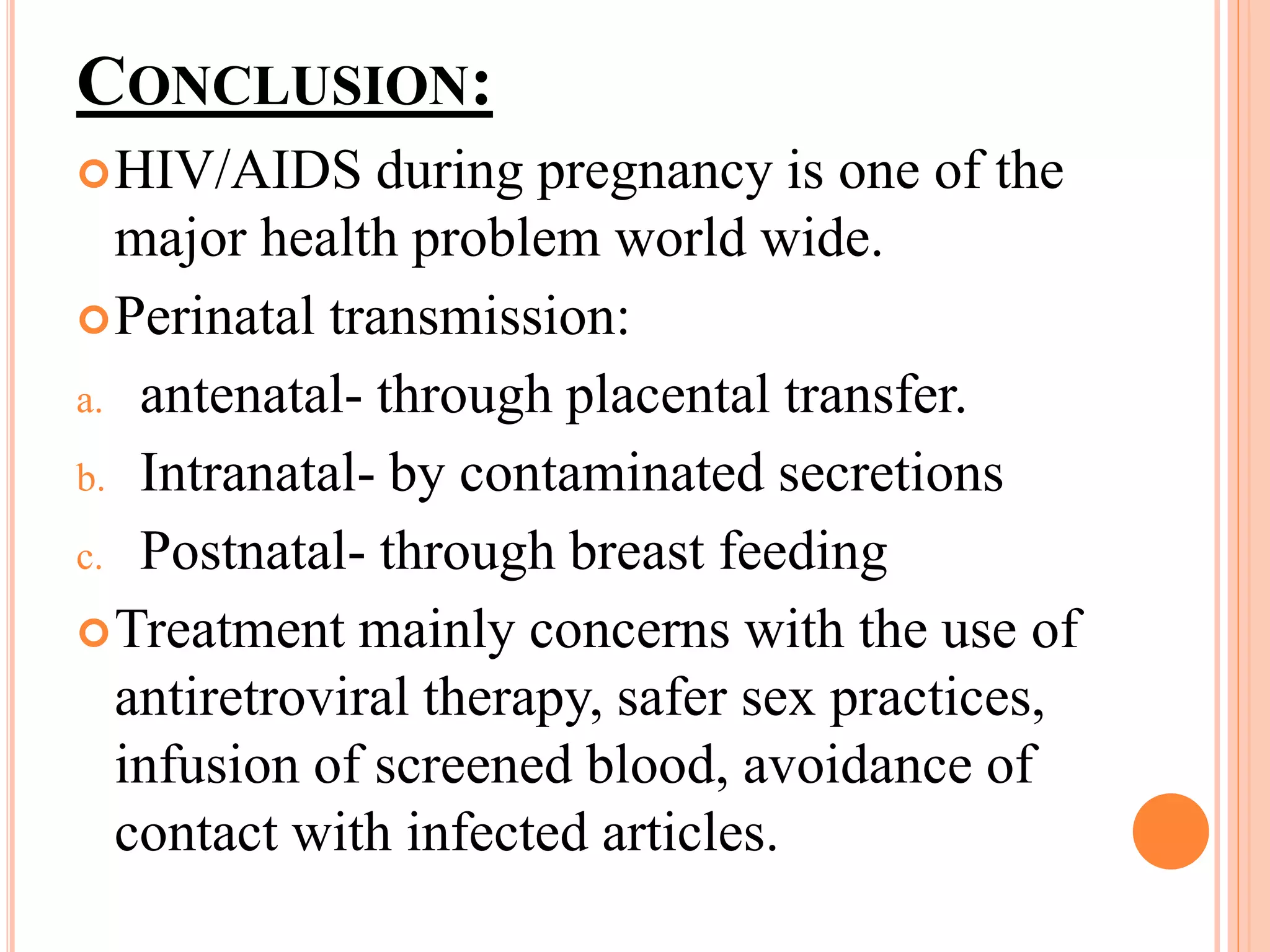
CONCLUSION:
HIV/AIDS during pregnancy is one of the
major health problem world wide.
Perinatal transmission:
a. antenatal- through placental transfer.
b. Intranatal- by contaminated secretions
c. Postnatal- through breast feeding
Treatment mainly concerns with the use of
antiretroviral therapy, safer sex practices,
infusion of screened blood, avoidance of
contact with infected articles.
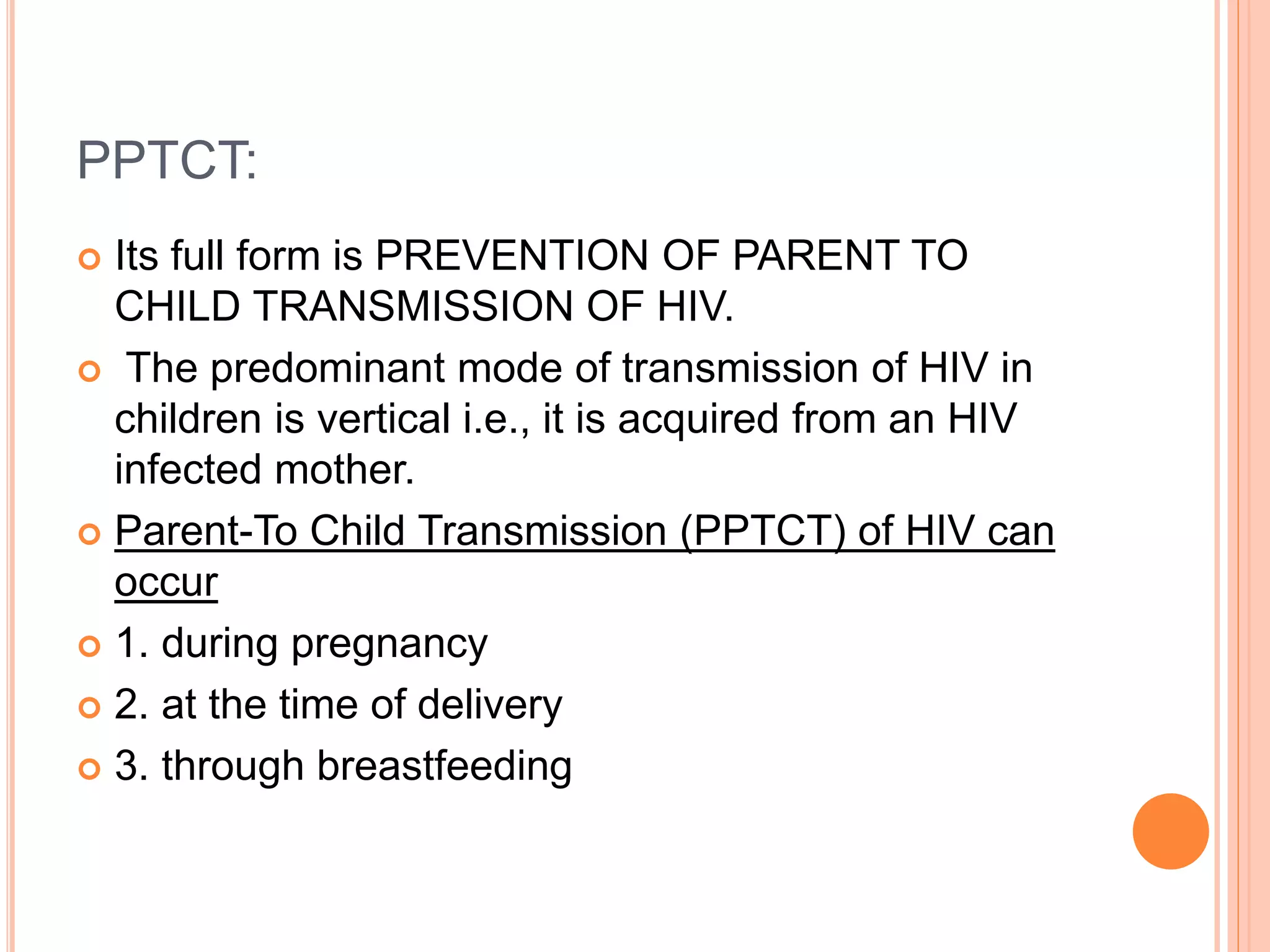
PPTCT:
 Its full form is PREVENTION OF PARENT TO
CHILD TRANSMISSION OF HIV.
 The predominant mode of transmission of HIV in
children is vertical i.e., it is acquired from an HIV
infected mother.
 Parent-To Child Transmission (PPTCT) of HIV can
occur
 1. during pregnancy
 2. at the time of delivery
 3. through breastfeeding
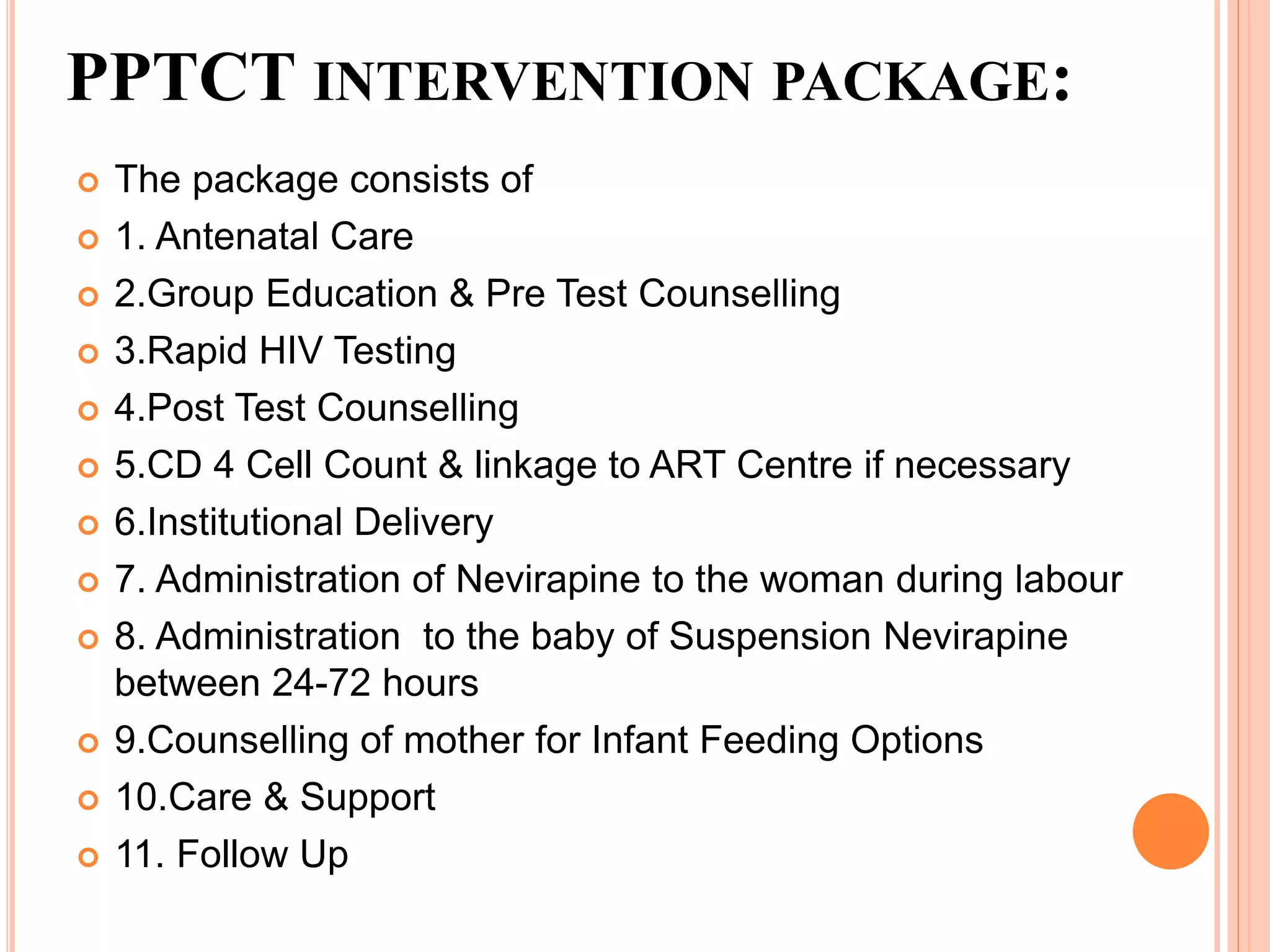
PPTCT INTERVENTION PACKAGE:
 The package consists of
 1. Antenatal Care
 2.Group Education & Pre Test Counselling
 3.Rapid HIV Testing
 4.Post Test Counselling
 5.CD 4 Cell Count & linkage to ART Centre if necessary
 6.Institutional Delivery
 7. Administration of Nevirapine to the woman during labour
 8. Administration to the baby of Suspension Nevirapine
between 24-72 hours
 9.Counselling of mother for Infant Feeding Options
 10.Care & Support
 11. Follow Up
ELEMENTS OF PPTCT PROGRAMME:
 Promotion and provision of free, subsidized or
commercially marketed condoms, provide diagnosis for
treatment of STDs and behaviour change
communication efforts to reduce behaviour that place
individuals at risk, and information about risks of PTCT
during pregnancy, delivery, breastfeeding &
encouragement to see VCT counselor(voluntary
counselling & testing) or health provider for information
on how to prevent HIV/AIDS among infants & young
children.
 Prevention of unintended pregnancies in HIV positive
women through reproductive health services, which
include family planning.
Prevention of transmission from an
HIV positive women to her infant
through anti-retroviral (ARV)
prophylaxis and safer delivery
practices
Care and support services to HIV-
infected women who are enrolled with
the programme and to their children
and families, including counseling on
infant feeding.
Hiv aids (1)

Hiv aids (1)

  • 1.
    PREGNANT WOMEN WITHHIV/AIDS: CARE DURING ANTENATAL, INTRANATAL & POSTNATAL PERIOD. PPTCT-VTCT.
  • 2.
    INTRODUCTION:  Acquired ImmunodeficiencySyndrome (AIDS) is caused by the Human Immunodeficiency Virus (HIV) of strains HIV 1 & HIV 2.  The first HIV virus was discovered in 1983 by Barre - Sinoussi & colleagues in Paris.  Around 6 lakh children become infected worldwide each year.  Almost all is because of the infection derived from the mother.  In India, nearly 4 million people are infected with HIV. More than 50% of them are women & children.
  • 3.
    MODE OF TRANSMISSION: Sexual intercourse  Transfusion of contaminated blood or blood products  Use of contaminated needles or needle stick injuries  Breast feeding  Perinatal transmission: a. antenatal- through placental transfer. b. Intranatal- by contaminated secretions c. Postnatal- through breast feeding
  • 4.
    PATHOLOGY: The target forHIV is CD 4 receptor molecule. These molecules are found in certain cells within the immune system like T lymphocytes, monocytes, macrophages, etc. HIV infection results in a progressive decline in the number & function of these cells. This results in profound immunodeficiency state with clinical manifestations in nearly all systems of the body. CD 4 counts greater than 800 cells/mm3 are considered normal.
  • 5.
    In early stageof disease: CD 4 >500 cells/mm3 In intermediate stage: CD 4 is between 200- 500 cells/mm3 . In advanced stage: CD 4 < 200 cells/mm3 . (now it is called as AIDS) The duration of time from initial infection to AIDS can vary from 3 yrs to several decades.
  • 6.
    CLINICAL PRESENTATION: Following exposureto HIV, a patient develops antibodies against HIV in about 8-12 wks. Later starts the acute infection syndrome characterized by flu like symptoms, skin rash, lymphadenopathy diarrhoea, mouth ulcer, gingivitis, etc. Initial stage patient remains asymptomatic. As CD 4 level falls symptoms occur in nearly all the body systems. Infection in genital tract: vag candidiasis, PID, Neoplasms, etc. develops.
  • 7.
    DIAGNOSIS: The diagnosis ofHIV infection requires identification of antibodies to HIV & decreased CD 4 count. ELISA test (Enzyme Linked Immuno Sorbent Assay): detects antibodies against HIV-1 & 2. Antibodies are detected after 4-12 weeks after infection. (window period). It is easy, cheap & less time consuming. Western blot test: highly specific but time consuming, expensive & complicated.
  • 8.
    TREATMENT: A. Antenatal period: Prevention: use of condoms, avoid needle stick injury, infusion of screened blood, maintenance of proper techniques of disposal of wastes.  Counselling & support  Antiretroviral therapy: Zidovudine is the drug of choice. Several combination therapies can also be used which includes drug like Delvirdine, Ritonavir, etc. combination therapy is called as HAART (Highly Active Antiretroviral Therapy).  These combinations increase the CD 4 count & reduces the virus load, as monotherapy causes drug resistance.
  • 9.
     ZDV therapyis started anytime between 14 to 34 wks & then continued throughout pregnancy, labour & puerperium.  ZDV 100 mg given 5 times daily PO can reduce perinatal transmission from 25 % to 7% B. Intrapartum care:  ZDV is given IV inf. at onset of labour in vaginal delivery or 4 hrs before CS.  Loading dose: 2 mg/kg/hr  Maintenance dose: 1 mg/kg/hr until cord is clamped.  Elective CS-reduces risk of vertical transmission by 50%.  Cord should be clamped as early as possible & baby should be bathed immediately.
  • 10.
     Amniotomy &attachment of scalp electrode should be avoided.  During delivery caps, masks, gown, protective eye wear (goggles) & double gloves should be worn.  Washing off any blood or secretions contamination off the skin immediately  Midwives should be very careful to avoid needle prick.  Post exposure prophylaxis with ZDV 200mg thrice daily for 4 wks-in case exposure to infected blood occurs.  Thorough theatre disinfection after operation.
  • 11.
    C. Post partumcare:  Breast feeding: should be avoided. But when alternative forms of infant nutrition are not safe, the minor risk associated with breast feeding may be accepted.  ZDV syrup: 2 mg/kg, is given to neonate 4 times daily for first 6 wks of life.  Contraception: barrier methods like use of condoms is encouraged
  • 12.
    CONCLUSION: HIV/AIDS during pregnancyis one of the major health problem world wide. Perinatal transmission: a. antenatal- through placental transfer. b. Intranatal- by contaminated secretions c. Postnatal- through breast feeding Treatment mainly concerns with the use of antiretroviral therapy, safer sex practices, infusion of screened blood, avoidance of contact with infected articles.
  • 13.
    PPTCT:  Its fullform is PREVENTION OF PARENT TO CHILD TRANSMISSION OF HIV.  The predominant mode of transmission of HIV in children is vertical i.e., it is acquired from an HIV infected mother.  Parent-To Child Transmission (PPTCT) of HIV can occur  1. during pregnancy  2. at the time of delivery  3. through breastfeeding
  • 14.
    PPTCT INTERVENTION PACKAGE: The package consists of  1. Antenatal Care  2.Group Education & Pre Test Counselling  3.Rapid HIV Testing  4.Post Test Counselling  5.CD 4 Cell Count & linkage to ART Centre if necessary  6.Institutional Delivery  7. Administration of Nevirapine to the woman during labour  8. Administration to the baby of Suspension Nevirapine between 24-72 hours  9.Counselling of mother for Infant Feeding Options  10.Care & Support  11. Follow Up
  • 15.
    ELEMENTS OF PPTCTPROGRAMME:  Promotion and provision of free, subsidized or commercially marketed condoms, provide diagnosis for treatment of STDs and behaviour change communication efforts to reduce behaviour that place individuals at risk, and information about risks of PTCT during pregnancy, delivery, breastfeeding & encouragement to see VCT counselor(voluntary counselling & testing) or health provider for information on how to prevent HIV/AIDS among infants & young children.  Prevention of unintended pregnancies in HIV positive women through reproductive health services, which include family planning.
  • 16.
    Prevention of transmissionfrom an HIV positive women to her infant through anti-retroviral (ARV) prophylaxis and safer delivery practices Care and support services to HIV- infected women who are enrolled with the programme and to their children and families, including counseling on infant feeding.