



MANAGEMENT OF
DM: DIET AND
NUTRITION
Educational Slides
Sponsored by WDF06-195 and
BADAS
For proper management of DM, one
should follow the following rules
Dietary modifications
Exercise
Drug, if necessary
Monitoring of blood glucose
Education for every step
Discipline
THE MAIN AIMS OF TREATING
THE PATIENTS
Making the patients symptom free
Free from acute or chronic complications
Providing basic diabetic education so that
they can cover themselves in any
emergency situation, diet and nutrition,
sick day managements, foot care etc.
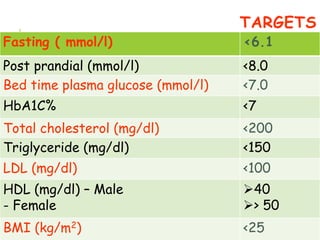
TARGETS
Fasting ( mmol/l) <6.1
Post prandial (mmol/l) <8.0
Bed time plasma glucose (mmol/l) <7.0
HbA1C% <7
Total cholesterol (mg/dl) <200
Triglyceride (mg/dl) <150
LDL (mg/dl) <100
HDL (mg/dl) – Male
- Female
40
> 50
BMI (kg/m2) <25
LESS STRICT CONTROL OF
BLOOD GLUCOSE
Very young children
Older people
Persons with history of severe or
repeated hypoglycemia
Limited life expectancy
Presence of comorbid conditions
GOALS OF DIETARY
MODIFICATION
1. Eat a balanced meal
2. Take meals regularly
3. Attain & maintain desirable body weight
4. Maintain blood glucose, lipid profile in the
normal range
5. Maintain blood pressure in target level
6. Produce adequate energy to ensure normal
growth and development for children
GOALS OF DIETARY
MODIFICATION
7. Change eating habits that will reduce
insulin resistance in type 2DM
8. Provide adequate energy and nutrients for
optimum outcome of pregnant and lactating
mother
9. Provide nutritional support for older
patients
10.Prevent hypoglycemia in individual treated
with antidiabetic drugs
11.Prevent and treat chronic complications of
diabetes
Dietary modification should not any word
like ‘diet control’. All people should have
‘healthy diet’. For a diabetic patient it is a
‘balanced diet’.
A balanced diet is a combination of
carbohydrates, fats, proteins and fibers
appropriate for the individual.
DIET OF DM PATIENTS
DEPENDS ON
Age
Gender
Type of diabetes
Patients present weight
Physical activity
Presence or absence of complications/
other diseases
Pregnancy
lactation
PROXIMATE PRINCIPLES
OF FOOD
Carbohydrate, such as rice, bread,
etc
Protein, such as fish, meat, milk, etc
Fat, such as butter, oil etc
PLANNING OF DIET
DEPENDS ON
Calorie values of food
Glycaemic index
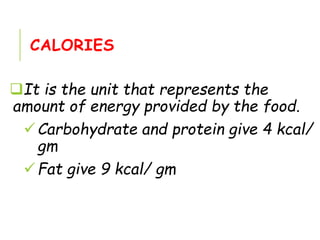
CALORIES
It is the unit that represents the
amount of energy provided by the food.
Carbohydrate and protein give 4 kcal/
gm
Fat give 9 kcal/ gm
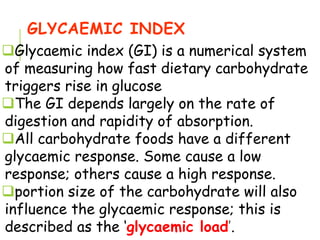
GLYCAEMIC INDEX
Glycaemic index (GI) is a numerical system
of measuring how fast dietary carbohydrate
triggers rise in glucose
The GI depends largely on the rate of
digestion and rapidity of absorption.
All carbohydrate foods have a different
glycaemic response. Some cause a low
response; others cause a high response.
portion size of the carbohydrate will also
influence the glycaemic response; this is
described as the ‘glycaemic load’.
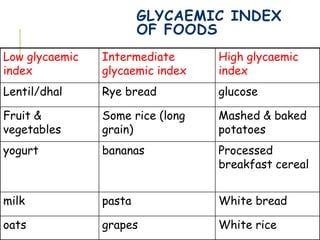
GLYCAEMIC INDEX
OF FOODS
Low glycaemic
index
Intermediate
glycaemic index
High glycaemic
index
Lentil/dhal Rye bread glucose
Fruit &
vegetables
Some rice (long
grain)
Mashed & baked
potatoes
yogurt bananas Processed
breakfast cereal
milk pasta White bread
oats grapes White rice
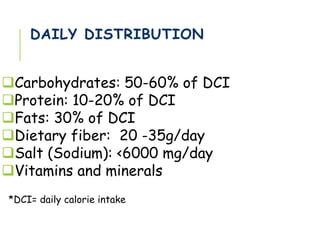
DAILY DISTRIBUTION
Carbohydrates: 50-60% of DCI
Protein: 10-20% of DCI
Fats: 30% of DCI
Dietary fiber: 20 -35g/day
Salt (Sodium): <6000 mg/day
Vitamins and minerals
*DCI= daily calorie intake
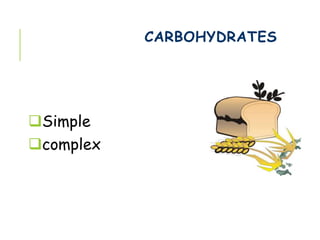
CARBOHYDRATES
Simple
complex
Refined & simple carbohydrates- sugar,
glucose, soft drinks, jam, honey,
marmalade, sweets, cakes, chocolate etc
Complex carbohydrates- rice, wheat,
bread, potatoes, and maize
Difference-
Refined and simple sugars are quickly
digested, absorbed and causes sudden
rise in blood sugar. These types of
food should be avoided.
Complex carbohydrates are more
suitable, they have less glycaemic index.
They are digested more slowly and cause
less rapid rise in blood glucose level.
Sources of protein
- Animal source – provides better quality protein.
Egg, milk, meat, fish, poultry
- Plant source-provides less good quality protein.
Pulses, cereals, nuts are the source of plant
protein.
Functions of protein
-To build blood cells
-To build body tissues, hormones, muscle and other
important substances
PROTEIN
FAT
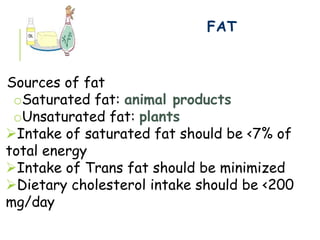
Sources of fat
oSaturated fat: animal products
oUnsaturated fat: plants
Intake of saturated fat should be <7% of
total energy
Intake of Trans fat should be minimized
Dietary cholesterol intake should be <200
mg/day
FAT
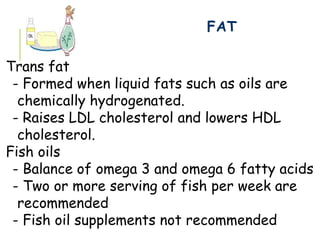
Trans fat
- Formed when liquid fats such as oils are
chemically hydrogenated.
- Raises LDL cholesterol and lowers HDL
cholesterol.
Fish oils
- Balance of omega 3 and omega 6 fatty acids
- Two or more serving of fish per week are
recommended
- Fish oil supplements not recommended
OTHERS
Dietary fiber
Vitamins and anti oxidants
Minerals and trace elements
Salt
Law calorie sweetener
DIETARY EDUCATION TO
YOUR PATIENT
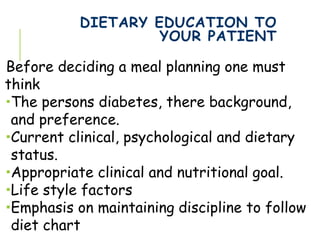
Before deciding a meal planning one must
think
The persons diabetes, there background,
and preference.
Current clinical, psychological and dietary
status.
Appropriate clinical and nutritional goal.
Life style factors
Emphasis on maintaining discipline to follow
diet chart
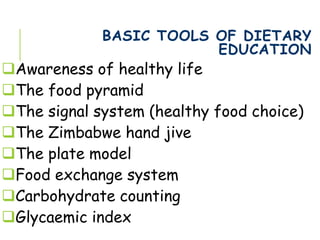
BASIC TOOLS OF DIETARY
EDUCATION
Awareness of healthy life
The food pyramid
The signal system (healthy food choice)
The Zimbabwe hand jive
The plate model
Food exchange system
Carbohydrate counting
Glycaemic index
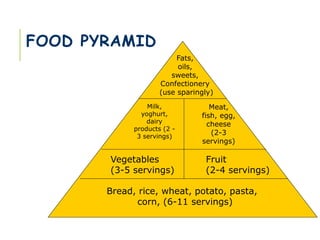
FOOD PYRAMID
Bread, rice, wheat, potato, pasta,
corn, (6-11 servings)
Fruit
(2-4 servings)
Vegetables
(3-5 servings)
Meat,
fish, egg,
cheese
(2-3
servings)
Milk,
yoghurt,
dairy
products (2 -
3 servings)
Fats,
oils,
sweets,
Confectionery
(use sparingly)
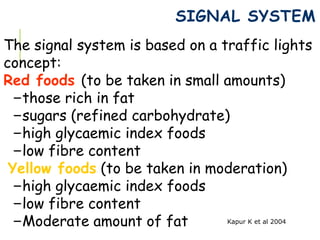
SIGNAL SYSTEM
The signal system is based on a traffic lights
concept:
Red foods (to be taken in small amounts)
–those rich in fat
–sugars (refined carbohydrate)
–high glycaemic index foods
–low fibre content
Yellow foods (to be taken in moderation)
–high glycaemic index foods
–low fibre content
–Moderate amount of fat Kapur K et al 2004
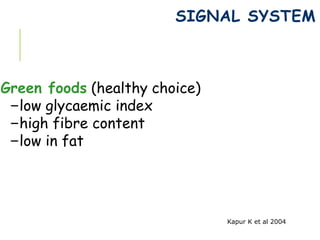
SIGNAL SYSTEM
Green foods (healthy choice)
–low glycaemic index
–high fibre content
–low in fat
Kapur K et al 2004
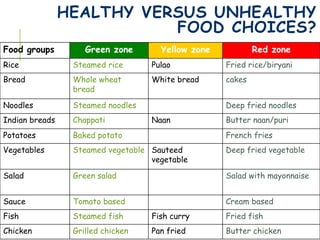
HEALTHY VERSUS UNHEALTHY
FOOD CHOICES?
Food groups Green zone Yellow zone Red zone
Rice Steamed rice Pulao Fried rice/biryani
Bread Whole wheat
bread
White bread cakes
Noodles Steamed noodles Deep fried noodles
Indian breads Chappati Naan Butter naan/puri
Potatoes Baked potato French fries
Vegetables Steamed vegetable Sauteed
vegetable
Deep fried vegetable
Salad Green salad Salad with mayonnaise
Sauce Tomato based Cream based
Fish Steamed fish Fish curry Fried fish
Chicken Grilled chicken Pan fried Butter chicken
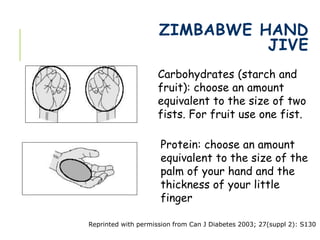
ZIMBABWE HAND
JIVE
Carbohydrates (starch and
fruit): choose an amount
equivalent to the size of two
fists. For fruit use one fist.
Protein: choose an amount
equivalent to the size of the
palm of your hand and the
thickness of your little
finger
Reprinted with permission from Can J Diabetes 2003; 27(suppl 2): S130
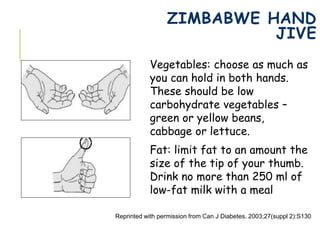
ZIMBABWE HAND
JIVE
Vegetables: choose as much as
you can hold in both hands.
These should be low
carbohydrate vegetables –
green or yellow beans,
cabbage or lettuce.
Fat: limit fat to an amount the
size of the tip of your thumb.
Drink no more than 250 ml of
low-fat milk with a meal
Reprinted with permission from Can J Diabetes. 2003;27(suppl 2):S130
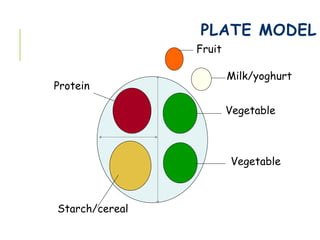
PLATE MODEL
Vegetable
Milk/yoghurt
Fruit
Vegetable
Protein
Starch/cereal
ADVANCED EDUCATION
TOOLS
Food exchanges
Carbohydrate counting
Glycaemic index and load
FOOD EXCHANGES
Carbohydrate exchange
Cereal and pulse exchange
Fat/oil exchange
Protein exchange
Milk exchange
Fruit exchange
Vegetable exchange
FOOD EXCHANGES
Similar food types placed in exchange
groups
Within groups, a single food based on
weight/measure/size has the same
carbohydrate or kcal value as another and
can be interchanged
In the case of cereal exchanges: 1 slice
of bread can be exchanged for 1/3 cup
rice
Foods from different groups cannot be
CARBOHYDRATE COUNTING
Carbohydrate counting means
carbohydrate content of a particular food.
Carbohydrate is measuring in grams.
One carbohydrate serving equals to 15 gm
carbohydrate.
Carbohydrate counting helps to determine
the amount of carbohydrate in a different
food, so that the foods can be interchanged
accordingly.
MEAL PLAN
3 major meals
2- 3 snacks
Timing and amount of food will depend on
type of diabetes, type of medication,
insulin and life style
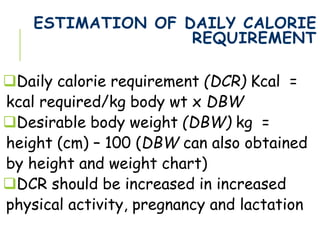
ESTIMATION OF DAILY CALORIE
REQUIREMENT
Daily calorie requirement (DCR) Kcal =
kcal required/kg body wt x DBW
Desirable body weight (DBW) kg =
height (cm) – 100 (DBW can also obtained
by height and weight chart)
DCR should be increased in increased
physical activity, pregnancy and lactation
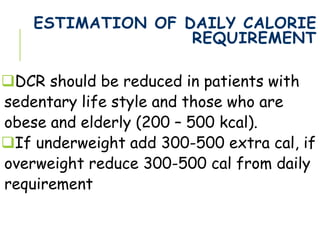
ESTIMATION OF DAILY CALORIE
REQUIREMENT
DCR should be reduced in patients with
sedentary life style and those who are
obese and elderly (200 – 500 kcal).
If underweight add 300-500 extra cal, if
overweight reduce 300-500 cal from daily
requirement
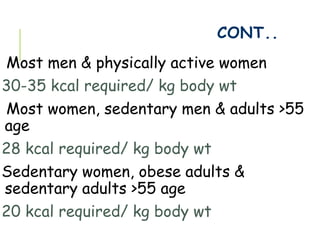
CONT..
Most men & physically active women
30-35 kcal required/ kg body wt
Most women, sedentary men & adults >55
age
28 kcal required/ kg body wt
Sedentary women, obese adults &
sedentary adults >55 age
20 kcal required/ kg body wt
DISCUSSION

Dietary management in DM

  • 1.
    MANAGEMENT OF DM: DIETAND NUTRITION Educational Slides Sponsored by WDF06-195 and BADAS
  • 2.
    For proper managementof DM, one should follow the following rules Dietary modifications Exercise Drug, if necessary Monitoring of blood glucose Education for every step Discipline
  • 3.
    THE MAIN AIMSOF TREATING THE PATIENTS Making the patients symptom free Free from acute or chronic complications Providing basic diabetic education so that they can cover themselves in any emergency situation, diet and nutrition, sick day managements, foot care etc.
  • 4.
    TARGETS Fasting ( mmol/l)<6.1 Post prandial (mmol/l) <8.0 Bed time plasma glucose (mmol/l) <7.0 HbA1C% <7 Total cholesterol (mg/dl) <200 Triglyceride (mg/dl) <150 LDL (mg/dl) <100 HDL (mg/dl) – Male - Female 40 > 50 BMI (kg/m2) <25
  • 5.
    LESS STRICT CONTROLOF BLOOD GLUCOSE Very young children Older people Persons with history of severe or repeated hypoglycemia Limited life expectancy Presence of comorbid conditions
  • 6.
    GOALS OF DIETARY MODIFICATION 1.Eat a balanced meal 2. Take meals regularly 3. Attain & maintain desirable body weight 4. Maintain blood glucose, lipid profile in the normal range 5. Maintain blood pressure in target level 6. Produce adequate energy to ensure normal growth and development for children
  • 7.
    GOALS OF DIETARY MODIFICATION 7.Change eating habits that will reduce insulin resistance in type 2DM 8. Provide adequate energy and nutrients for optimum outcome of pregnant and lactating mother 9. Provide nutritional support for older patients 10.Prevent hypoglycemia in individual treated with antidiabetic drugs 11.Prevent and treat chronic complications of diabetes
  • 8.
    Dietary modification shouldnot any word like ‘diet control’. All people should have ‘healthy diet’. For a diabetic patient it is a ‘balanced diet’. A balanced diet is a combination of carbohydrates, fats, proteins and fibers appropriate for the individual.
  • 9.
    DIET OF DMPATIENTS DEPENDS ON Age Gender Type of diabetes Patients present weight Physical activity Presence or absence of complications/ other diseases Pregnancy lactation
  • 10.
    PROXIMATE PRINCIPLES OF FOOD Carbohydrate,such as rice, bread, etc Protein, such as fish, meat, milk, etc Fat, such as butter, oil etc
  • 11.
    PLANNING OF DIET DEPENDSON Calorie values of food Glycaemic index
  • 12.
    CALORIES It is theunit that represents the amount of energy provided by the food. Carbohydrate and protein give 4 kcal/ gm Fat give 9 kcal/ gm
  • 13.
    GLYCAEMIC INDEX Glycaemic index(GI) is a numerical system of measuring how fast dietary carbohydrate triggers rise in glucose The GI depends largely on the rate of digestion and rapidity of absorption. All carbohydrate foods have a different glycaemic response. Some cause a low response; others cause a high response. portion size of the carbohydrate will also influence the glycaemic response; this is described as the ‘glycaemic load’.
  • 14.
    GLYCAEMIC INDEX OF FOODS Lowglycaemic index Intermediate glycaemic index High glycaemic index Lentil/dhal Rye bread glucose Fruit & vegetables Some rice (long grain) Mashed & baked potatoes yogurt bananas Processed breakfast cereal milk pasta White bread oats grapes White rice
  • 15.
    DAILY DISTRIBUTION Carbohydrates: 50-60%of DCI Protein: 10-20% of DCI Fats: 30% of DCI Dietary fiber: 20 -35g/day Salt (Sodium): <6000 mg/day Vitamins and minerals *DCI= daily calorie intake
  • 16.
  • 17.
    Refined & simplecarbohydrates- sugar, glucose, soft drinks, jam, honey, marmalade, sweets, cakes, chocolate etc Complex carbohydrates- rice, wheat, bread, potatoes, and maize Difference- Refined and simple sugars are quickly digested, absorbed and causes sudden rise in blood sugar. These types of food should be avoided.
  • 18.
    Complex carbohydrates aremore suitable, they have less glycaemic index. They are digested more slowly and cause less rapid rise in blood glucose level.
  • 19.
    Sources of protein -Animal source – provides better quality protein. Egg, milk, meat, fish, poultry - Plant source-provides less good quality protein. Pulses, cereals, nuts are the source of plant protein. Functions of protein -To build blood cells -To build body tissues, hormones, muscle and other important substances PROTEIN
  • 20.
    FAT Sources of fat oSaturatedfat: animal products oUnsaturated fat: plants Intake of saturated fat should be <7% of total energy Intake of Trans fat should be minimized Dietary cholesterol intake should be <200 mg/day
  • 21.
    FAT Trans fat - Formedwhen liquid fats such as oils are chemically hydrogenated. - Raises LDL cholesterol and lowers HDL cholesterol. Fish oils - Balance of omega 3 and omega 6 fatty acids - Two or more serving of fish per week are recommended - Fish oil supplements not recommended
  • 22.
    OTHERS Dietary fiber Vitamins andanti oxidants Minerals and trace elements Salt Law calorie sweetener
  • 23.
    DIETARY EDUCATION TO YOURPATIENT Before deciding a meal planning one must think The persons diabetes, there background, and preference. Current clinical, psychological and dietary status. Appropriate clinical and nutritional goal. Life style factors Emphasis on maintaining discipline to follow diet chart
  • 24.
    BASIC TOOLS OFDIETARY EDUCATION Awareness of healthy life The food pyramid The signal system (healthy food choice) The Zimbabwe hand jive The plate model Food exchange system Carbohydrate counting Glycaemic index
  • 25.
    FOOD PYRAMID Bread, rice,wheat, potato, pasta, corn, (6-11 servings) Fruit (2-4 servings) Vegetables (3-5 servings) Meat, fish, egg, cheese (2-3 servings) Milk, yoghurt, dairy products (2 - 3 servings) Fats, oils, sweets, Confectionery (use sparingly)
  • 26.
    SIGNAL SYSTEM The signalsystem is based on a traffic lights concept: Red foods (to be taken in small amounts) –those rich in fat –sugars (refined carbohydrate) –high glycaemic index foods –low fibre content Yellow foods (to be taken in moderation) –high glycaemic index foods –low fibre content –Moderate amount of fat Kapur K et al 2004
  • 27.
    SIGNAL SYSTEM Green foods(healthy choice) –low glycaemic index –high fibre content –low in fat Kapur K et al 2004
  • 28.
    HEALTHY VERSUS UNHEALTHY FOODCHOICES? Food groups Green zone Yellow zone Red zone Rice Steamed rice Pulao Fried rice/biryani Bread Whole wheat bread White bread cakes Noodles Steamed noodles Deep fried noodles Indian breads Chappati Naan Butter naan/puri Potatoes Baked potato French fries Vegetables Steamed vegetable Sauteed vegetable Deep fried vegetable Salad Green salad Salad with mayonnaise Sauce Tomato based Cream based Fish Steamed fish Fish curry Fried fish Chicken Grilled chicken Pan fried Butter chicken
  • 29.
    ZIMBABWE HAND JIVE Carbohydrates (starchand fruit): choose an amount equivalent to the size of two fists. For fruit use one fist. Protein: choose an amount equivalent to the size of the palm of your hand and the thickness of your little finger Reprinted with permission from Can J Diabetes 2003; 27(suppl 2): S130
  • 30.
    ZIMBABWE HAND JIVE Vegetables: chooseas much as you can hold in both hands. These should be low carbohydrate vegetables – green or yellow beans, cabbage or lettuce. Fat: limit fat to an amount the size of the tip of your thumb. Drink no more than 250 ml of low-fat milk with a meal Reprinted with permission from Can J Diabetes. 2003;27(suppl 2):S130
  • 31.
  • 32.
  • 33.
    FOOD EXCHANGES Carbohydrate exchange Cerealand pulse exchange Fat/oil exchange Protein exchange Milk exchange Fruit exchange Vegetable exchange
  • 34.
    FOOD EXCHANGES Similar foodtypes placed in exchange groups Within groups, a single food based on weight/measure/size has the same carbohydrate or kcal value as another and can be interchanged In the case of cereal exchanges: 1 slice of bread can be exchanged for 1/3 cup rice Foods from different groups cannot be
  • 35.
    CARBOHYDRATE COUNTING Carbohydrate countingmeans carbohydrate content of a particular food. Carbohydrate is measuring in grams. One carbohydrate serving equals to 15 gm carbohydrate. Carbohydrate counting helps to determine the amount of carbohydrate in a different food, so that the foods can be interchanged accordingly.
  • 36.
    MEAL PLAN 3 majormeals 2- 3 snacks Timing and amount of food will depend on type of diabetes, type of medication, insulin and life style
  • 37.
    ESTIMATION OF DAILYCALORIE REQUIREMENT Daily calorie requirement (DCR) Kcal = kcal required/kg body wt x DBW Desirable body weight (DBW) kg = height (cm) – 100 (DBW can also obtained by height and weight chart) DCR should be increased in increased physical activity, pregnancy and lactation
  • 38.
    ESTIMATION OF DAILYCALORIE REQUIREMENT DCR should be reduced in patients with sedentary life style and those who are obese and elderly (200 – 500 kcal). If underweight add 300-500 extra cal, if overweight reduce 300-500 cal from daily requirement
  • 39.
    CONT.. Most men &physically active women 30-35 kcal required/ kg body wt Most women, sedentary men & adults >55 age 28 kcal required/ kg body wt Sedentary women, obese adults & sedentary adults >55 age 20 kcal required/ kg body wt
  • 40.