NDD 10603
INFANT NUTRITION
DR. SHARIFAH WAJIHAH WAFA BTE SST WAFA
School of Nutrition and Dietetics
Faculty of Health Sciences
sharifahwajihah@unisza.edu.my
KNOWLEDGE FOR THE BENEFIT OF HUMANITY
SCHOOL OF NUTRITION AND DIETETICS . FACULTY OF HEALTH SCIENCES
TOPIC LEARNING OUTCOMES
• At the end of this lecture, the students should
be able to:
1. Identify the assessment for infant’s physical
growth.
2. Discuss the energy and nutrients needs of
infants.
3. Explain the nutrition-related problems that
affect the infants.
SCHOOL OF NUTRITION AND DIETETICS . FACULTY OF HEALTH SCIENCES
A newborn infant, or neonate, is a child
under 28 days of age. During these first 28
days of life, the child is at highest risk of
dying. It is thus crucial that appropriate
feeding and care are provided during this
period, both to improve the child’s chances
of survival and to lay the foundations for a
healthy life. (WHO
SCHOOL OF NUTRITION AND DIETETICS . FACULTY OF HEALTH SCIENCES
Course Outline
1. Birthweight and infant mortality
2. Motor and cognitive development
3. Energy and nutrient needs
4. Physical growth assessment
5. Infant feeding skills
6. Common Nutritional Problems and Concerns
SCHOOL OF NUTRITION AND DIETETICS . FACULTY OF HEALTH SCIENCES
Assessing Newborn Health
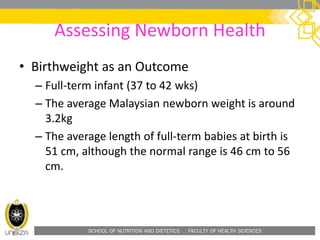
• Birthweight as an Outcome
– Full-term infant (37 to 42 wks)
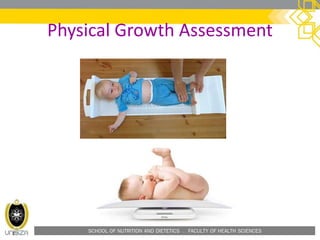
– The average Malaysian newborn weight is around
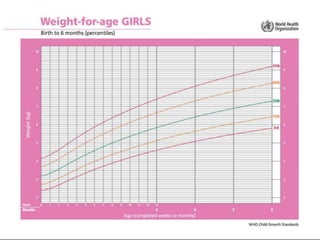
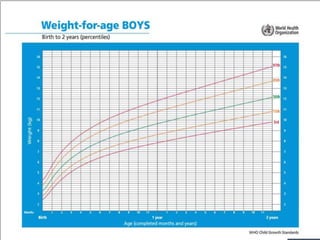
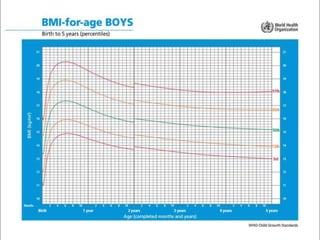
3.2kg
– The average length of full-term babies at birth is
51 cm, although the normal range is 46 cm to 56
cm.
SCHOOL OF NUTRITION AND DIETETICS . FACULTY OF HEALTH SCIENCES
Assessing Newborn Health
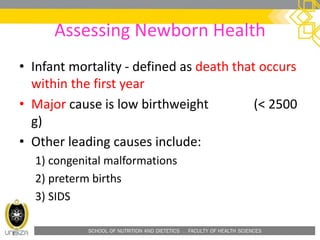
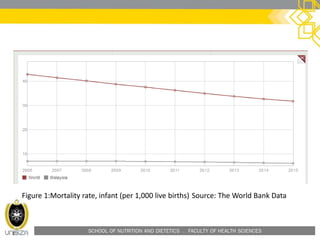
• Infant mortality - defined as death that occurs
within the first year
• Major cause is low birthweight (< 2500
g)
• Other leading causes include:
1) congenital malformations
2) preterm births
3) SIDS
SCHOOL OF NUTRITION AND DIETETICS . FACULTY OF HEALTH SCIENCES
Assessing Newborn Health
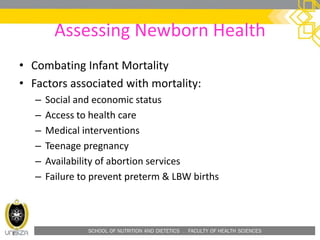
• Combating Infant Mortality
• Factors associated with mortality:
– Social and economic status
– Access to health care
– Medical interventions
– Teenage pregnancy
– Availability of abortion services
– Failure to prevent preterm & LBW births
SCHOOL OF NUTRITION AND DIETETICS . FACULTY OF HEALTH SCIENCES
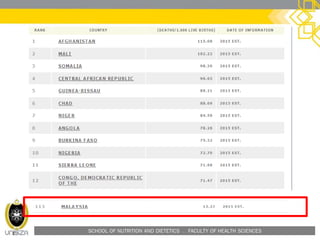
Source: The World Bank DataFigure 1:Mortality rate, infant (per 1,000 live births)
SCHOOL OF NUTRITION AND DIETETICS . FACULTY OF HEALTH SCIENCES
Assessing Newborn Health
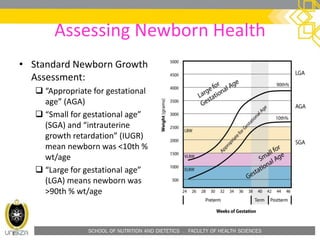
• Standard Newborn Growth
Assessment:
 “Appropriate for gestational
age” (AGA)
 “Small for gestational age”
(SGA) and “intrauterine
growth retardation” (IUGR)
mean newborn was <10th %
wt/age
 “Large for gestational age”
(LGA) means newborn was
>90th % wt/age
SCHOOL OF NUTRITION AND DIETETICS . FACULTY OF HEALTH SCIENCES
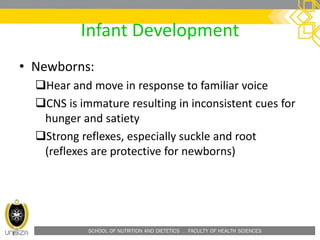
Infant Development
• Newborns:
Hear and move in response to familiar voice
CNS is immature resulting in inconsistent cues for
hunger and satiety
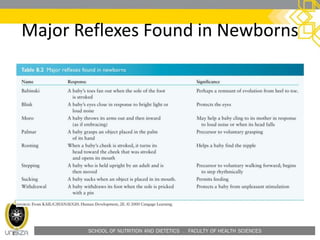
Strong reflexes, especially suckle and root
(reflexes are protective for newborns)
SCHOOL OF NUTRITION AND DIETETICS . FACULTY OF HEALTH SCIENCES
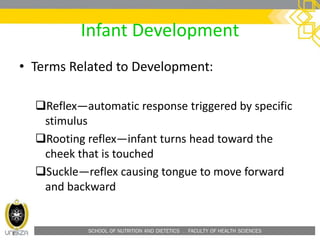
Infant Development
• Terms Related to Development:
Reflex—automatic response triggered by specific
stimulus
Rooting reflex—infant turns head toward the
cheek that is touched
Suckle—reflex causing tongue to move forward
and backward
SCHOOL OF NUTRITION AND DIETETICS . FACULTY OF HEALTH SCIENCES
Major Reflexes Found in Newborns
SCHOOL OF NUTRITION AND DIETETICS . FACULTY OF HEALTH SCIENCES
Nine Reflexes of Baby
SCHOOL OF NUTRITION AND DIETETICS . FACULTY OF HEALTH SCIENCES
Infant Development
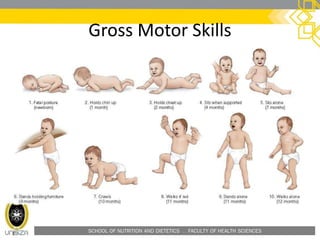
1. Motor development: ability to control
voluntary muscles
• Motor development is top down— controls
head first and lower legs last
2. Muscle development from central to
peripheral
• Influences ability to feed self & the amount of
energy expended
SCHOOL OF NUTRITION AND DIETETICS . FACULTY OF HEALTH SCIENCES
Gross Motor Skills
SCHOOL OF NUTRITION AND DIETETICS . FACULTY OF HEALTH SCIENCES
Infant Development
• Critical periods
– A fixed period of time in which certain behaviors
or developments emerge
– Necessary for sequential behaviors or
developments
– If the critical period is missed, there may be
difficulty later on
SCHOOL OF NUTRITION AND DIETETICS . FACULTY OF HEALTH SCIENCES
Infant Development
3. Cognitive Development
• Factors that impact cognition
– Sensorimotor development
– Interactions with the environment
– Adequate energy and protein
– Stimulation of social and emotional growth
– Genetics
SCHOOL OF NUTRITION AND DIETETICS . FACULTY OF HEALTH SCIENCES
Sensorimotor Stage of
Development
The sensorimotor stage is divided into 6 substages:
1. Simple reflexes (Birth - 1 Month Old)
2. Primary circular reactions (1-4 Months Old
3. Secondary circular reactions( 4-8 Months Old)
4. Coordination of secondary circular reactions(8-12 Months
Old)
5. Tertiary circular reactions (12-18 Months Old)
6. Internalization of schemes(18-24 Months Old) A shift to
symbolic thinking
SCHOOL OF NUTRITION AND DIETETICS . FACULTY OF HEALTH SCIENCES
Sensorimotor Stage of
Development
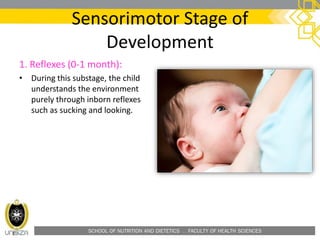
1. Reflexes (0-1 month):
• During this substage, the child
understands the environment
purely through inborn reflexes
such as sucking and looking.
SCHOOL OF NUTRITION AND DIETETICS . FACULTY OF HEALTH SCIENCES
Sensorimotor Stage of
Development
2. Primary Circular Reactions
(1-4 months):
• This substage involves
coordinating sensation and new
schemas.
• For example, a child may such his
or her thumb by accident and
then later intentionally repeat the
action.
• These actions are repeated
because the infant finds them
pleasurable.
SCHOOL OF NUTRITION AND DIETETICS . FACULTY OF HEALTH SCIENCES
Sensorimotor Stage of
Development
3. Secondary Circular
Reactions (4-8 months):
• During this substage, the child
becomes more focused on the
world and begins to intentionally
repeat an action in order to
trigger a response in the
environment.
• For example, a child will
purposefully pick up a toy in
order to put it in his or her
mouth.
SCHOOL OF NUTRITION AND DIETETICS . FACULTY OF HEALTH SCIENCES
Sensorimotor Stage of
Development
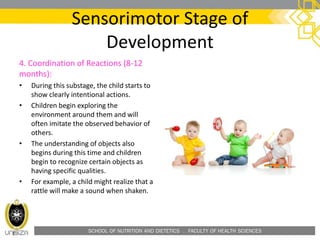
4. Coordination of Reactions (8-12
months):
• During this substage, the child starts to
show clearly intentional actions.
• Children begin exploring the
environment around them and will
often imitate the observed behavior of
others.
• The understanding of objects also
begins during this time and children
begin to recognize certain objects as
having specific qualities.
• For example, a child might realize that a
rattle will make a sound when shaken.
SCHOOL OF NUTRITION AND DIETETICS . FACULTY OF HEALTH SCIENCES
Sensorimotor Stage of
Development
5. Tertiary Circular Reactions
(12-18 months):
• Children begin a period of trial-
and-error experimentation during
the fifth substage.
• For example, a child may try out
different sounds or actions as a
way of getting attention from a
caregiver.
SCHOOL OF NUTRITION AND DIETETICS . FACULTY OF HEALTH SCIENCES
Sensorimotor Stage of
Development
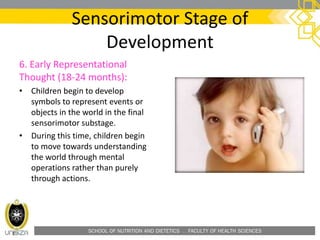
6. Early Representational
Thought (18-24 months):
• Children begin to develop
symbols to represent events or
objects in the world in the final
sensorimotor substage.
• During this time, children begin
to move towards understanding
the world through mental
operations rather than purely
through actions.
SCHOOL OF NUTRITION AND DIETETICS . FACULTY OF HEALTH SCIENCES
Infant Development
4. Digestive System Development
– Fetus swallows amniotic fluid which stimulates
intestinal maturation and growth
– At birth the healthy newborn can digest fats,
protein and simple sugars.
– Common problems include gastroesophageal
reflux (GER), diarrhea, and constipation
SCHOOL OF NUTRITION AND DIETETICS . FACULTY OF HEALTH SCIENCES
Infant Development
• Factors that impact rate of food passage in
colon
– Osmolarity of foods or liquids
– Colon bacterial flora
– Water and fluid balance in the body
SCHOOL OF NUTRITION AND DIETETICS . FACULTY OF HEALTH SCIENCES
Infant Development
• Parenting
• New parents must learn:
– Infant’s cues of hunger and satiety
– Temperament of infant
– How to respond to infant cues
SCHOOL OF NUTRITION AND DIETETICS . FACULTY OF HEALTH SCIENCES
Baby’s Language
SCHOOL OF NUTRITION AND DIETETICS . FACULTY OF HEALTH SCIENCES
Why is Nutrition Important?
• Energy of daily living
• Maintenance of all body functions
• Vital to growth and development
• Therapeutic benefits
– Healing
– Prevention
SCHOOL OF NUTRITION AND DIETETICS . FACULTY OF HEALTH SCIENCES
Energy and Nutrient Needs
• The recommendations for infants are from the
Dietary Reference Intakes (DRI), National Academy of
Medicine, AAP and the Academy of Nutrition and
Dietetics
– Energy needs
– Protein needs
– Fats
– Metabolic rate, calories, fats and protein—how do
they all tie together?
SCHOOL OF NUTRITION AND DIETETICS . FACULTY OF HEALTH SCIENCES
Energy and Nutrient Needs
• Energy (Calories):
– 108 kcal/kg/day from birth to 6 months (range from 80 to
120)
– 98 kcal/kg/day from 6 to 12 months
• Factors that influence calorie needs
– Weight and growth rate
– Sleep/wake cycle
– Temperature and climate
– Physical activity
– Metabolic response to food
– Health status/recovery from illness
SCHOOL OF NUTRITION AND DIETETICS . FACULTY OF HEALTH SCIENCES
Energy and Nutrient Needs
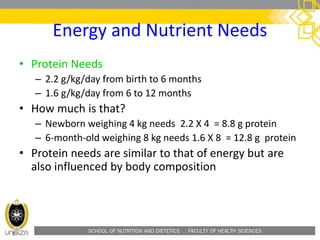
• Protein Needs
– 2.2 g/kg/day from birth to 6 months
– 1.6 g/kg/day from 6 to 12 months
• How much is that?
– Newborn weighing 4 kg needs 2.2 X 4 = 8.8 g protein
– 6-month-old weighing 8 kg needs 1.6 X 8 = 12.8 g protein
• Protein needs are similar to that of energy but are
also influenced by body composition
SCHOOL OF NUTRITION AND DIETETICS . FACULTY OF HEALTH SCIENCES
Energy and Nutrient Needs
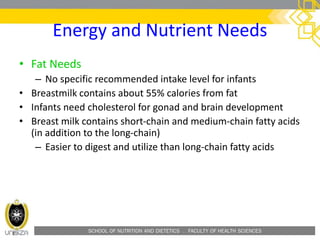
• Fat Needs
– No specific recommended intake level for infants
• Breastmilk contains about 55% calories from fat
• Infants need cholesterol for gonad and brain development
• Breast milk contains short-chain and medium-chain fatty acids
(in addition to the long-chain)
– Easier to digest and utilize than long-chain fatty acids
SCHOOL OF NUTRITION AND DIETETICS . FACULTY OF HEALTH SCIENCES
Energy and Nutrient Needs
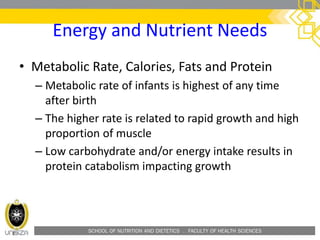
• Metabolic Rate, Calories, Fats and Protein
– Metabolic rate of infants is highest of any time
after birth
– The higher rate is related to rapid growth and high
proportion of muscle
– Low carbohydrate and/or energy intake results in
protein catabolism impacting growth
SCHOOL OF NUTRITION AND DIETETICS . FACULTY OF HEALTH SCIENCES
Energy and Nutrient Needs
• Other Nutrients and Nonnutrients
– Fluoride—0.1 - 0.5 mg/d depending on age (too
much may cause tooth discoloration)
– Vitamin D—400 IU/day
– Sodium—120-200 mg/day
– Iron – 11 mg for infants 7-12 months
– Fiber—no recommendations
– Lead—None—may be toxic
SCHOOL OF NUTRITION AND DIETETICS . FACULTY OF HEALTH SCIENCES
Energy and Nutrient Needs
• Other Nutrients and Nonnutrients
– Fluoride—0.1 - 0.5 mg/d depending on age (too
much may cause tooth discoloration)
– Vitamin D—400 IU/day
– Sodium—120-200 mg/day
– Iron – 11 mg for infants 7-12 months
– Fiber—no recommendations
– Lead—None—may be toxic
SCHOOL OF NUTRITION AND DIETETICS . FACULTY OF HEALTH SCIENCES
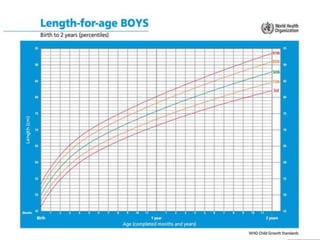
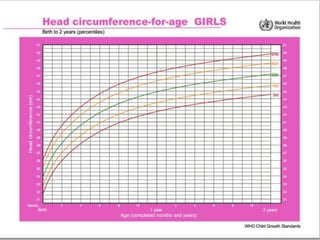
Physical Growth Assessment
• Newborns grow faster than any other time of
life
• Growth reflects:
– Nutritional adequacy
– Health status
– Economic & environmental adequacy
– There is a wide range of growth =normal
– Calibrated scales & recumbent length
measurement board required for accurate
measures
SCHOOL OF NUTRITION AND DIETETICS . FACULTY OF HEALTH SCIENCES
Physical Growth Assessment
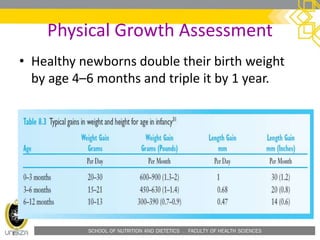
• Healthy newborns double their birth weight
by age 4–6 months and triple it by 1 year.
SCHOOL OF NUTRITION AND DIETETICS . FACULTY OF HEALTH SCIENCES
Physical Growth Assessment
SCHOOL OF NUTRITION AND DIETETICS . FACULTY OF HEALTH SCIENCES
Physical Growth Assessment
SCHOOL OF NUTRITION AND DIETETICS . FACULTY OF HEALTH SCIENCES
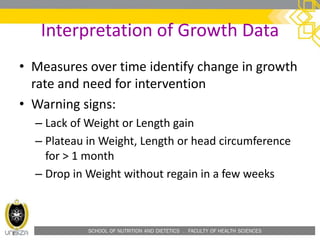
Interpretation of Growth Data
• Measures over time identify change in growth
rate and need for intervention
• Warning signs:
– Lack of Weight or Length gain
– Plateau in Weight, Length or head circumference
for > 1 month
– Drop in Weight without regain in a few weeks
SCHOOL OF NUTRITION AND DIETETICS . FACULTY OF HEALTH SCIENCES
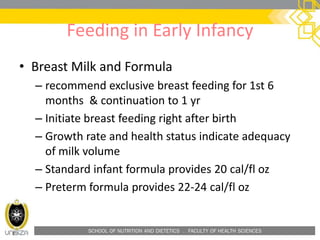
Feeding in Early Infancy
• Breast Milk and Formula
– recommend exclusive breast feeding for 1st 6
months & continuation to 1 yr
– Initiate breast feeding right after birth
– Growth rate and health status indicate adequacy
of milk volume
– Standard infant formula provides 20 cal/fl oz
– Preterm formula provides 22-24 cal/fl oz
SCHOOL OF NUTRITION AND DIETETICS . FACULTY OF HEALTH SCIENCES
How Infant Formulas Are Modified
Compared to Breast Milk
Breast Milk
• 7% of calories from Protein
• 38% calories from carbs
• 55% calories from fat
Cow’s Milk-Based Formula
• 9-12% calories from Protein
• 41-43% calories from carbs
• 48-50% calories from fat
SCHOOL OF NUTRITION AND DIETETICS . FACULTY OF HEALTH SCIENCES
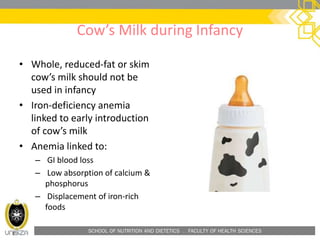
Cow’s Milk during Infancy
• Whole, reduced-fat or skim
cow’s milk should not be
used in infancy
• Iron-deficiency anemia
linked to early introduction
of cow’s milk
• Anemia linked to:
– GI blood loss
– Low absorption of calcium &
phosphorus
– Displacement of iron-rich
foods
SCHOOL OF NUTRITION AND DIETETICS . FACULTY OF HEALTH SCIENCES
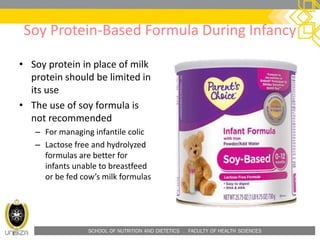
Soy Protein-Based Formula During Infancy
• Soy protein in place of milk
protein should be limited in
its use
• The use of soy formula is
not recommended
– For managing infantile colic
– Lactose free and hydrolyzed
formulas are better for
infants unable to breastfeed
or be fed cow’s milk formulas
SCHOOL OF NUTRITION AND DIETETICS . FACULTY OF HEALTH SCIENCES
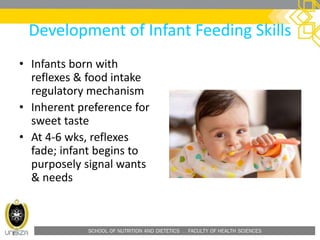
Development of Infant Feeding Skills
• Infants born with
reflexes & food intake
regulatory mechanism
• Inherent preference for
sweet taste
• At 4-6 wks, reflexes
fade; infant begins to
purposely signal wants
& needs
SCHOOL OF NUTRITION AND DIETETICS . FACULTY OF HEALTH SCIENCES
Development of Infant Feeding Skills
• Cues infants may give for feeding readiness include:
– Watching the food being opened in anticipation of eating
– Tight fists or reaching for spoon
– Irritation if feeding too slow or stops temporarily
– Playing with food or spoon
– Slowing intake or turning away when full
– Stop eating or spit out food when full
SCHOOL OF NUTRITION AND DIETETICS . FACULTY OF HEALTH SCIENCES
Introduction of Solid Foods
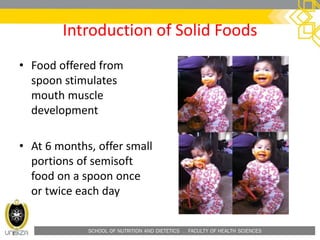
• Food offered from
spoon stimulates
mouth muscle
development
• At 6 months, offer small
portions of semisoft
food on a spoon once
or twice each day
SCHOOL OF NUTRITION AND DIETETICS . FACULTY OF HEALTH SCIENCES
Recommendations for Introduction of
Solid Foods
• Infant should not be overly tired or hungry
• Use small spoon with shallow bowl
• Allow infant to open mouth & extend tongue
• Place spoon on front of tongue with gentle pressure
• Avoid scraping spoon on infant’s gums
• Pace feeding to allow infant to swallow
• First meals may be 5-6 spoons over 10 minutes
SCHOOL OF NUTRITION AND DIETETICS . FACULTY OF HEALTH SCIENCES
The Importance of Infant
Feeding Position
• Improper positioning may cause choking, discomfort,
and ear infections
• Position young bottle-fed infants in a semi-upright
position
• Spoon-feeding should be with infant seated with
back and feet supported
• Adults feeding infants should be directly in front of
infant making eye contact
SCHOOL OF NUTRITION AND DIETETICS . FACULTY OF HEALTH SCIENCES
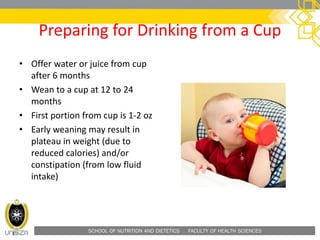
Preparing for Drinking from a Cup
• Offer water or juice from cup
after 6 months
• Wean to a cup at 12 to 24
months
• First portion from cup is 1-2 oz
• Early weaning may result in
plateau in weight (due to
reduced calories) and/or
constipation (from low fluid
intake)
SCHOOL OF NUTRITION AND DIETETICS . FACULTY OF HEALTH SCIENCES
Preparing for Drinking from a Cup
• Changing from a bottle to a covered “sippy”
cup with a small spout is not the same
developmental step as weaning to an open
cup
• Open cup drinking skills also encourage
speech development
SCHOOL OF NUTRITION AND DIETETICS . FACULTY OF HEALTH SCIENCES
“They say fingers were
made before forks and
hands before knives.”
Jonathan Swift
SCHOOL OF NUTRITION AND DIETETICS . FACULTY OF HEALTH SCIENCES
Food Texture and Development
• Can swallow pureed foods at 6 months
• Early introduction of lumpy foods may cause
choking
• Can swallow very soft, lumpy foods at 6-8
months
• By 8-10 months, can eat soft mashed foods
SCHOOL OF NUTRITION AND DIETETICS . FACULTY OF HEALTH SCIENCES
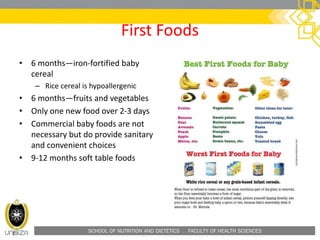
First Foods
• 6 months—iron-fortified baby
cereal
– Rice cereal is hypoallergenic
• 6 months—fruits and vegetables
• Only one new food over 2-3 days
• Commercial baby foods are not
necessary but do provide sanitary
and convenient choices
• 9-12 months soft table foods
SCHOOL OF NUTRITION AND DIETETICS . FACULTY OF HEALTH SCIENCES
Water
• Breast milk or formula provide adequate water for
healthy infants up to 6 months
• All forms of fluids contribute to water intake
• Additional plain water needed in hot, humid climates
• Dehydration is common in infants
SCHOOL OF NUTRITION AND DIETETICS . FACULTY OF HEALTH SCIENCES
Water
• Pedialyte or sports drinks provide electrolytes but
lower in calories than formula or breast milk
• Limit juice
• AAP recommends juice is not needed to meet the
fluid needs before the age of 6 months
• Avoid colas and tea
SCHOOL OF NUTRITION AND DIETETICS . FACULTY OF HEALTH SCIENCES
How Much Food is Enough for
Infants?
• Infants vary in temperament
• Crying or fussiness may be interpreted as hunger
resulting in overfeeding
• First foods may appear to be rejected due to
immature tongue movement
SCHOOL OF NUTRITION AND DIETETICS . FACULTY OF HEALTH SCIENCES
How Much Food is Enough for
Infants?
• Infants learn food preferences based on experiences
with foods
• Flavor of breast milk influenced by mother’s diet
• Genetic predisposition to sweet taste
• Food preference from infancy sets stage for lifelong
food habits
SCHOOL OF NUTRITION AND DIETETICS . FACULTY OF HEALTH SCIENCES
Common Nutritional Problems and
Concerns
• Failure to thrive,
• Colic,
• Iron-deficiency anemia,
• Constipation,
• Dental caries, and
• Food allergies
SCHOOL OF NUTRITION AND DIETETICS . FACULTY OF HEALTH SCIENCES
Common Nutritional Problems and
Concerns
• Failure to thrive (FTT)
– Inadequate weight or height gain
– Energy deficit is suspected
• Organic FTT:
– Inadequate weight or height gain resulting from a health problem,
such as iron-deficiency anemia or a cardiac or genetic disease.
• Nonorganic FTT:
– Inadequate weight or height gain without an identifiable biological
cause, so that an environmental cause is suspected (maternal
depression, mental illness, alcohol or drug abuse in the home, feeding
delegated to siblings or others unable to respond to the infant, and
overdilution of formula)
SCHOOL OF NUTRITION AND DIETETICS . FACULTY OF HEALTH SCIENCES
Common Nutritional Problems and
Concerns
• Colic - the sudden onset of irritability, fussiness or
crying
– Episodes may appear at the same time each day
– Disappear at 3rd or 4th month
– Cause unknown but associated with GI upset, infant
feeding practices
SCHOOL OF NUTRITION AND DIETETICS . FACULTY OF HEALTH SCIENCES
Common Nutritional Problems and
Concerns
• Iron-deficiency Anemia
– Less common in infants than in toddlers
– Iron stores in the infant reflect the iron stores of the
mother
– More common in low-income families
– Breastfed infants may be given iron supplements and iron-
fortified cereals at 6 months
– Iron-fortified versus “Low-iron” formula
SCHOOL OF NUTRITION AND DIETETICS . FACULTY OF HEALTH SCIENCES
Common Nutritional Problems and
Concerns
• Diarrhea and Constipation
– Infants typically have 2-6 stools per day
• Causes of diarrhea & constipation:
– Viral and bacterial infections
– Food intolerance
– Changes in fluid intake
• To avoid constipation assure adequate fluids
• Continue to feed the usual diet during diarrhea
SCHOOL OF NUTRITION AND DIETETICS . FACULTY OF HEALTH SCIENCES
Common Nutritional Problems and
Concerns
• Prevention of Baby Bottle Caries and Ear Infections
– Are linked to feeding practices
– Risk for ear infections is also correlated with excessive use
of a baby bottle as a bedtime practice, as a result of the
feeding position.
– Feeding techniques to reduce caries and ear infections
• Limit use of bedtime bottle
• Offer juice in cup
• Only give water bottles at bedtime
• Examine and clean emerging teeth
SCHOOL OF NUTRITION AND DIETETICS . FACULTY OF HEALTH SCIENCES
Common Nutritional Problems and
Concerns
• Food Allergies and Intolerances
– About 6-8% of children < 4 yrs have allergies
– Absorption of intact proteins causes allergic
reactions
– Common symptoms are wheezing or skin rashes
– Treatment may consist of formula with hydrolyzed
proteins
SCHOOL OF NUTRITION AND DIETETICS . FACULTY OF HEALTH SCIENCES
Common Nutritional Problems and
Concerns
• Lactose Intolerance
– Inability to digest the disaccharide lactose
– Characterized by cramps, nausea and pain and
alternating diarrhea and constipation
– Lactose intolerance in uncommon and tends to be
overestimated
SCHOOL OF NUTRITION AND DIETETICS . FACULTY OF HEALTH SCIENCES
Key Points
1. Infants born full-term and preterm infants born between 34
weeks and 38 weeks of gestation are the same in their
milestones of growth, development, and feeding in the first
year of life.
2. The ability of infants to feed and eat is based on
developmental skills that show readiness for the next step;
parents learn to read the signals of readiness from their
infants over time.
3. Energy and nutrient needs of infants are modulated by
individual differences in sleep/wake cycle, exposure to
temperatures, and state of health, among other factors
SCHOOL OF NUTRITION AND DIETETICS . FACULTY OF HEALTH SCIENCES
Key Points
4. The priority is energy needs first; protein and carbohydrates
will be converted to meet energy needs if sufficient calories
are not consumed, slowing growth over time.
5. Growth as weight, length, and head circumference accretion
is monitored and interpreted over the first year.
6. Introduction of solid foods is also a developmental stage for
parents in learning to read signs of hunger, fullness, and food
preferences in their infants and to know safe food choices.
SCHOOL OF NUTRITION AND DIETETICS . FACULTY OF HEALTH SCIENCES
Key Points
7. Common nutrition problems in the first year such as failure
to thrive, colic, iron deficiency anemia, and baby bottle caries
are usually solved by combining parent educational,
nutritional, and medical approaches.
SCHOOL OF NUTRITION AND DIETETICS . FACULTY OF HEALTH SCIENCES
THANK YOU

INFANT NUTRITION

  • 1.
    NDD 10603 INFANT NUTRITION DR.SHARIFAH WAJIHAH WAFA BTE SST WAFA School of Nutrition and Dietetics Faculty of Health Sciences sharifahwajihah@unisza.edu.my KNOWLEDGE FOR THE BENEFIT OF HUMANITY
  • 2.
    SCHOOL OF NUTRITIONAND DIETETICS . FACULTY OF HEALTH SCIENCES TOPIC LEARNING OUTCOMES • At the end of this lecture, the students should be able to: 1. Identify the assessment for infant’s physical growth. 2. Discuss the energy and nutrients needs of infants. 3. Explain the nutrition-related problems that affect the infants.
  • 3.
    SCHOOL OF NUTRITIONAND DIETETICS . FACULTY OF HEALTH SCIENCES A newborn infant, or neonate, is a child under 28 days of age. During these first 28 days of life, the child is at highest risk of dying. It is thus crucial that appropriate feeding and care are provided during this period, both to improve the child’s chances of survival and to lay the foundations for a healthy life. (WHO
  • 4.
    SCHOOL OF NUTRITIONAND DIETETICS . FACULTY OF HEALTH SCIENCES Course Outline 1. Birthweight and infant mortality 2. Motor and cognitive development 3. Energy and nutrient needs 4. Physical growth assessment 5. Infant feeding skills 6. Common Nutritional Problems and Concerns
  • 5.
    SCHOOL OF NUTRITIONAND DIETETICS . FACULTY OF HEALTH SCIENCES Assessing Newborn Health • Birthweight as an Outcome – Full-term infant (37 to 42 wks) – The average Malaysian newborn weight is around 3.2kg – The average length of full-term babies at birth is 51 cm, although the normal range is 46 cm to 56 cm.
  • 6.
    SCHOOL OF NUTRITIONAND DIETETICS . FACULTY OF HEALTH SCIENCES Assessing Newborn Health • Infant mortality - defined as death that occurs within the first year • Major cause is low birthweight (< 2500 g) • Other leading causes include: 1) congenital malformations 2) preterm births 3) SIDS
  • 7.
    SCHOOL OF NUTRITIONAND DIETETICS . FACULTY OF HEALTH SCIENCES Assessing Newborn Health • Combating Infant Mortality • Factors associated with mortality: – Social and economic status – Access to health care – Medical interventions – Teenage pregnancy – Availability of abortion services – Failure to prevent preterm & LBW births
  • 8.
    SCHOOL OF NUTRITIONAND DIETETICS . FACULTY OF HEALTH SCIENCES
  • 9.
    SCHOOL OF NUTRITIONAND DIETETICS . FACULTY OF HEALTH SCIENCES Source: The World Bank DataFigure 1:Mortality rate, infant (per 1,000 live births)
  • 10.
    SCHOOL OF NUTRITIONAND DIETETICS . FACULTY OF HEALTH SCIENCES Assessing Newborn Health • Standard Newborn Growth Assessment:  “Appropriate for gestational age” (AGA)  “Small for gestational age” (SGA) and “intrauterine growth retardation” (IUGR) mean newborn was <10th % wt/age  “Large for gestational age” (LGA) means newborn was >90th % wt/age
  • 11.
    SCHOOL OF NUTRITIONAND DIETETICS . FACULTY OF HEALTH SCIENCES Infant Development • Newborns: Hear and move in response to familiar voice CNS is immature resulting in inconsistent cues for hunger and satiety Strong reflexes, especially suckle and root (reflexes are protective for newborns)
  • 12.
    SCHOOL OF NUTRITIONAND DIETETICS . FACULTY OF HEALTH SCIENCES Infant Development • Terms Related to Development: Reflex—automatic response triggered by specific stimulus Rooting reflex—infant turns head toward the cheek that is touched Suckle—reflex causing tongue to move forward and backward
  • 13.
    SCHOOL OF NUTRITIONAND DIETETICS . FACULTY OF HEALTH SCIENCES Major Reflexes Found in Newborns
  • 14.
    SCHOOL OF NUTRITIONAND DIETETICS . FACULTY OF HEALTH SCIENCES Nine Reflexes of Baby
  • 15.
    SCHOOL OF NUTRITIONAND DIETETICS . FACULTY OF HEALTH SCIENCES Infant Development 1. Motor development: ability to control voluntary muscles • Motor development is top down— controls head first and lower legs last 2. Muscle development from central to peripheral • Influences ability to feed self & the amount of energy expended
  • 16.
    SCHOOL OF NUTRITIONAND DIETETICS . FACULTY OF HEALTH SCIENCES Gross Motor Skills
  • 17.
    SCHOOL OF NUTRITIONAND DIETETICS . FACULTY OF HEALTH SCIENCES Infant Development • Critical periods – A fixed period of time in which certain behaviors or developments emerge – Necessary for sequential behaviors or developments – If the critical period is missed, there may be difficulty later on
  • 18.
    SCHOOL OF NUTRITIONAND DIETETICS . FACULTY OF HEALTH SCIENCES Infant Development 3. Cognitive Development • Factors that impact cognition – Sensorimotor development – Interactions with the environment – Adequate energy and protein – Stimulation of social and emotional growth – Genetics
  • 19.
    SCHOOL OF NUTRITIONAND DIETETICS . FACULTY OF HEALTH SCIENCES Sensorimotor Stage of Development The sensorimotor stage is divided into 6 substages: 1. Simple reflexes (Birth - 1 Month Old) 2. Primary circular reactions (1-4 Months Old 3. Secondary circular reactions( 4-8 Months Old) 4. Coordination of secondary circular reactions(8-12 Months Old) 5. Tertiary circular reactions (12-18 Months Old) 6. Internalization of schemes(18-24 Months Old) A shift to symbolic thinking
  • 20.
    SCHOOL OF NUTRITIONAND DIETETICS . FACULTY OF HEALTH SCIENCES Sensorimotor Stage of Development 1. Reflexes (0-1 month): • During this substage, the child understands the environment purely through inborn reflexes such as sucking and looking.
  • 21.
    SCHOOL OF NUTRITIONAND DIETETICS . FACULTY OF HEALTH SCIENCES Sensorimotor Stage of Development 2. Primary Circular Reactions (1-4 months): • This substage involves coordinating sensation and new schemas. • For example, a child may such his or her thumb by accident and then later intentionally repeat the action. • These actions are repeated because the infant finds them pleasurable.
  • 22.
    SCHOOL OF NUTRITIONAND DIETETICS . FACULTY OF HEALTH SCIENCES Sensorimotor Stage of Development 3. Secondary Circular Reactions (4-8 months): • During this substage, the child becomes more focused on the world and begins to intentionally repeat an action in order to trigger a response in the environment. • For example, a child will purposefully pick up a toy in order to put it in his or her mouth.
  • 23.
    SCHOOL OF NUTRITIONAND DIETETICS . FACULTY OF HEALTH SCIENCES Sensorimotor Stage of Development 4. Coordination of Reactions (8-12 months): • During this substage, the child starts to show clearly intentional actions. • Children begin exploring the environment around them and will often imitate the observed behavior of others. • The understanding of objects also begins during this time and children begin to recognize certain objects as having specific qualities. • For example, a child might realize that a rattle will make a sound when shaken.
  • 24.
    SCHOOL OF NUTRITIONAND DIETETICS . FACULTY OF HEALTH SCIENCES Sensorimotor Stage of Development 5. Tertiary Circular Reactions (12-18 months): • Children begin a period of trial- and-error experimentation during the fifth substage. • For example, a child may try out different sounds or actions as a way of getting attention from a caregiver.
  • 25.
    SCHOOL OF NUTRITIONAND DIETETICS . FACULTY OF HEALTH SCIENCES Sensorimotor Stage of Development 6. Early Representational Thought (18-24 months): • Children begin to develop symbols to represent events or objects in the world in the final sensorimotor substage. • During this time, children begin to move towards understanding the world through mental operations rather than purely through actions.
  • 26.
    SCHOOL OF NUTRITIONAND DIETETICS . FACULTY OF HEALTH SCIENCES Infant Development 4. Digestive System Development – Fetus swallows amniotic fluid which stimulates intestinal maturation and growth – At birth the healthy newborn can digest fats, protein and simple sugars. – Common problems include gastroesophageal reflux (GER), diarrhea, and constipation
  • 27.
    SCHOOL OF NUTRITIONAND DIETETICS . FACULTY OF HEALTH SCIENCES Infant Development • Factors that impact rate of food passage in colon – Osmolarity of foods or liquids – Colon bacterial flora – Water and fluid balance in the body
  • 28.
    SCHOOL OF NUTRITIONAND DIETETICS . FACULTY OF HEALTH SCIENCES Infant Development • Parenting • New parents must learn: – Infant’s cues of hunger and satiety – Temperament of infant – How to respond to infant cues
  • 29.
    SCHOOL OF NUTRITIONAND DIETETICS . FACULTY OF HEALTH SCIENCES Baby’s Language
  • 30.
    SCHOOL OF NUTRITIONAND DIETETICS . FACULTY OF HEALTH SCIENCES Why is Nutrition Important? • Energy of daily living • Maintenance of all body functions • Vital to growth and development • Therapeutic benefits – Healing – Prevention
  • 31.
    SCHOOL OF NUTRITIONAND DIETETICS . FACULTY OF HEALTH SCIENCES Energy and Nutrient Needs • The recommendations for infants are from the Dietary Reference Intakes (DRI), National Academy of Medicine, AAP and the Academy of Nutrition and Dietetics – Energy needs – Protein needs – Fats – Metabolic rate, calories, fats and protein—how do they all tie together?
  • 32.
    SCHOOL OF NUTRITIONAND DIETETICS . FACULTY OF HEALTH SCIENCES Energy and Nutrient Needs • Energy (Calories): – 108 kcal/kg/day from birth to 6 months (range from 80 to 120) – 98 kcal/kg/day from 6 to 12 months • Factors that influence calorie needs – Weight and growth rate – Sleep/wake cycle – Temperature and climate – Physical activity – Metabolic response to food – Health status/recovery from illness
  • 33.
    SCHOOL OF NUTRITIONAND DIETETICS . FACULTY OF HEALTH SCIENCES Energy and Nutrient Needs • Protein Needs – 2.2 g/kg/day from birth to 6 months – 1.6 g/kg/day from 6 to 12 months • How much is that? – Newborn weighing 4 kg needs 2.2 X 4 = 8.8 g protein – 6-month-old weighing 8 kg needs 1.6 X 8 = 12.8 g protein • Protein needs are similar to that of energy but are also influenced by body composition
  • 34.
    SCHOOL OF NUTRITIONAND DIETETICS . FACULTY OF HEALTH SCIENCES Energy and Nutrient Needs • Fat Needs – No specific recommended intake level for infants • Breastmilk contains about 55% calories from fat • Infants need cholesterol for gonad and brain development • Breast milk contains short-chain and medium-chain fatty acids (in addition to the long-chain) – Easier to digest and utilize than long-chain fatty acids
  • 35.
    SCHOOL OF NUTRITIONAND DIETETICS . FACULTY OF HEALTH SCIENCES Energy and Nutrient Needs • Metabolic Rate, Calories, Fats and Protein – Metabolic rate of infants is highest of any time after birth – The higher rate is related to rapid growth and high proportion of muscle – Low carbohydrate and/or energy intake results in protein catabolism impacting growth
  • 36.
    SCHOOL OF NUTRITIONAND DIETETICS . FACULTY OF HEALTH SCIENCES Energy and Nutrient Needs • Other Nutrients and Nonnutrients – Fluoride—0.1 - 0.5 mg/d depending on age (too much may cause tooth discoloration) – Vitamin D—400 IU/day – Sodium—120-200 mg/day – Iron – 11 mg for infants 7-12 months – Fiber—no recommendations – Lead—None—may be toxic
  • 37.
    SCHOOL OF NUTRITIONAND DIETETICS . FACULTY OF HEALTH SCIENCES Energy and Nutrient Needs • Other Nutrients and Nonnutrients – Fluoride—0.1 - 0.5 mg/d depending on age (too much may cause tooth discoloration) – Vitamin D—400 IU/day – Sodium—120-200 mg/day – Iron – 11 mg for infants 7-12 months – Fiber—no recommendations – Lead—None—may be toxic
  • 38.
    SCHOOL OF NUTRITIONAND DIETETICS . FACULTY OF HEALTH SCIENCES Physical Growth Assessment • Newborns grow faster than any other time of life • Growth reflects: – Nutritional adequacy – Health status – Economic & environmental adequacy – There is a wide range of growth =normal – Calibrated scales & recumbent length measurement board required for accurate measures
  • 39.
    SCHOOL OF NUTRITIONAND DIETETICS . FACULTY OF HEALTH SCIENCES Physical Growth Assessment • Healthy newborns double their birth weight by age 4–6 months and triple it by 1 year.
  • 40.
    SCHOOL OF NUTRITIONAND DIETETICS . FACULTY OF HEALTH SCIENCES Physical Growth Assessment
  • 41.
    SCHOOL OF NUTRITIONAND DIETETICS . FACULTY OF HEALTH SCIENCES Physical Growth Assessment
  • 47.
    SCHOOL OF NUTRITIONAND DIETETICS . FACULTY OF HEALTH SCIENCES Interpretation of Growth Data • Measures over time identify change in growth rate and need for intervention • Warning signs: – Lack of Weight or Length gain – Plateau in Weight, Length or head circumference for > 1 month – Drop in Weight without regain in a few weeks
  • 48.
    SCHOOL OF NUTRITIONAND DIETETICS . FACULTY OF HEALTH SCIENCES Feeding in Early Infancy • Breast Milk and Formula – recommend exclusive breast feeding for 1st 6 months & continuation to 1 yr – Initiate breast feeding right after birth – Growth rate and health status indicate adequacy of milk volume – Standard infant formula provides 20 cal/fl oz – Preterm formula provides 22-24 cal/fl oz
  • 49.
    SCHOOL OF NUTRITIONAND DIETETICS . FACULTY OF HEALTH SCIENCES How Infant Formulas Are Modified Compared to Breast Milk Breast Milk • 7% of calories from Protein • 38% calories from carbs • 55% calories from fat Cow’s Milk-Based Formula • 9-12% calories from Protein • 41-43% calories from carbs • 48-50% calories from fat
  • 50.
    SCHOOL OF NUTRITIONAND DIETETICS . FACULTY OF HEALTH SCIENCES Cow’s Milk during Infancy • Whole, reduced-fat or skim cow’s milk should not be used in infancy • Iron-deficiency anemia linked to early introduction of cow’s milk • Anemia linked to: – GI blood loss – Low absorption of calcium & phosphorus – Displacement of iron-rich foods
  • 51.
    SCHOOL OF NUTRITIONAND DIETETICS . FACULTY OF HEALTH SCIENCES Soy Protein-Based Formula During Infancy • Soy protein in place of milk protein should be limited in its use • The use of soy formula is not recommended – For managing infantile colic – Lactose free and hydrolyzed formulas are better for infants unable to breastfeed or be fed cow’s milk formulas
  • 52.
    SCHOOL OF NUTRITIONAND DIETETICS . FACULTY OF HEALTH SCIENCES Development of Infant Feeding Skills • Infants born with reflexes & food intake regulatory mechanism • Inherent preference for sweet taste • At 4-6 wks, reflexes fade; infant begins to purposely signal wants & needs
  • 53.
    SCHOOL OF NUTRITIONAND DIETETICS . FACULTY OF HEALTH SCIENCES Development of Infant Feeding Skills • Cues infants may give for feeding readiness include: – Watching the food being opened in anticipation of eating – Tight fists or reaching for spoon – Irritation if feeding too slow or stops temporarily – Playing with food or spoon – Slowing intake or turning away when full – Stop eating or spit out food when full
  • 54.
    SCHOOL OF NUTRITIONAND DIETETICS . FACULTY OF HEALTH SCIENCES Introduction of Solid Foods • Food offered from spoon stimulates mouth muscle development • At 6 months, offer small portions of semisoft food on a spoon once or twice each day
  • 55.
    SCHOOL OF NUTRITIONAND DIETETICS . FACULTY OF HEALTH SCIENCES Recommendations for Introduction of Solid Foods • Infant should not be overly tired or hungry • Use small spoon with shallow bowl • Allow infant to open mouth & extend tongue • Place spoon on front of tongue with gentle pressure • Avoid scraping spoon on infant’s gums • Pace feeding to allow infant to swallow • First meals may be 5-6 spoons over 10 minutes
  • 56.
    SCHOOL OF NUTRITIONAND DIETETICS . FACULTY OF HEALTH SCIENCES The Importance of Infant Feeding Position • Improper positioning may cause choking, discomfort, and ear infections • Position young bottle-fed infants in a semi-upright position • Spoon-feeding should be with infant seated with back and feet supported • Adults feeding infants should be directly in front of infant making eye contact
  • 57.
    SCHOOL OF NUTRITIONAND DIETETICS . FACULTY OF HEALTH SCIENCES Preparing for Drinking from a Cup • Offer water or juice from cup after 6 months • Wean to a cup at 12 to 24 months • First portion from cup is 1-2 oz • Early weaning may result in plateau in weight (due to reduced calories) and/or constipation (from low fluid intake)
  • 58.
    SCHOOL OF NUTRITIONAND DIETETICS . FACULTY OF HEALTH SCIENCES Preparing for Drinking from a Cup • Changing from a bottle to a covered “sippy” cup with a small spout is not the same developmental step as weaning to an open cup • Open cup drinking skills also encourage speech development
  • 59.
    SCHOOL OF NUTRITIONAND DIETETICS . FACULTY OF HEALTH SCIENCES “They say fingers were made before forks and hands before knives.” Jonathan Swift
  • 60.
    SCHOOL OF NUTRITIONAND DIETETICS . FACULTY OF HEALTH SCIENCES Food Texture and Development • Can swallow pureed foods at 6 months • Early introduction of lumpy foods may cause choking • Can swallow very soft, lumpy foods at 6-8 months • By 8-10 months, can eat soft mashed foods
  • 61.
    SCHOOL OF NUTRITIONAND DIETETICS . FACULTY OF HEALTH SCIENCES First Foods • 6 months—iron-fortified baby cereal – Rice cereal is hypoallergenic • 6 months—fruits and vegetables • Only one new food over 2-3 days • Commercial baby foods are not necessary but do provide sanitary and convenient choices • 9-12 months soft table foods
  • 62.
    SCHOOL OF NUTRITIONAND DIETETICS . FACULTY OF HEALTH SCIENCES Water • Breast milk or formula provide adequate water for healthy infants up to 6 months • All forms of fluids contribute to water intake • Additional plain water needed in hot, humid climates • Dehydration is common in infants
  • 63.
    SCHOOL OF NUTRITIONAND DIETETICS . FACULTY OF HEALTH SCIENCES Water • Pedialyte or sports drinks provide electrolytes but lower in calories than formula or breast milk • Limit juice • AAP recommends juice is not needed to meet the fluid needs before the age of 6 months • Avoid colas and tea
  • 64.
    SCHOOL OF NUTRITIONAND DIETETICS . FACULTY OF HEALTH SCIENCES How Much Food is Enough for Infants? • Infants vary in temperament • Crying or fussiness may be interpreted as hunger resulting in overfeeding • First foods may appear to be rejected due to immature tongue movement
  • 65.
    SCHOOL OF NUTRITIONAND DIETETICS . FACULTY OF HEALTH SCIENCES How Much Food is Enough for Infants? • Infants learn food preferences based on experiences with foods • Flavor of breast milk influenced by mother’s diet • Genetic predisposition to sweet taste • Food preference from infancy sets stage for lifelong food habits
  • 66.
    SCHOOL OF NUTRITIONAND DIETETICS . FACULTY OF HEALTH SCIENCES Common Nutritional Problems and Concerns • Failure to thrive, • Colic, • Iron-deficiency anemia, • Constipation, • Dental caries, and • Food allergies
  • 67.
    SCHOOL OF NUTRITIONAND DIETETICS . FACULTY OF HEALTH SCIENCES Common Nutritional Problems and Concerns • Failure to thrive (FTT) – Inadequate weight or height gain – Energy deficit is suspected • Organic FTT: – Inadequate weight or height gain resulting from a health problem, such as iron-deficiency anemia or a cardiac or genetic disease. • Nonorganic FTT: – Inadequate weight or height gain without an identifiable biological cause, so that an environmental cause is suspected (maternal depression, mental illness, alcohol or drug abuse in the home, feeding delegated to siblings or others unable to respond to the infant, and overdilution of formula)
  • 68.
    SCHOOL OF NUTRITIONAND DIETETICS . FACULTY OF HEALTH SCIENCES Common Nutritional Problems and Concerns • Colic - the sudden onset of irritability, fussiness or crying – Episodes may appear at the same time each day – Disappear at 3rd or 4th month – Cause unknown but associated with GI upset, infant feeding practices
  • 69.
    SCHOOL OF NUTRITIONAND DIETETICS . FACULTY OF HEALTH SCIENCES Common Nutritional Problems and Concerns • Iron-deficiency Anemia – Less common in infants than in toddlers – Iron stores in the infant reflect the iron stores of the mother – More common in low-income families – Breastfed infants may be given iron supplements and iron- fortified cereals at 6 months – Iron-fortified versus “Low-iron” formula
  • 70.
    SCHOOL OF NUTRITIONAND DIETETICS . FACULTY OF HEALTH SCIENCES Common Nutritional Problems and Concerns • Diarrhea and Constipation – Infants typically have 2-6 stools per day • Causes of diarrhea & constipation: – Viral and bacterial infections – Food intolerance – Changes in fluid intake • To avoid constipation assure adequate fluids • Continue to feed the usual diet during diarrhea
  • 71.
    SCHOOL OF NUTRITIONAND DIETETICS . FACULTY OF HEALTH SCIENCES Common Nutritional Problems and Concerns • Prevention of Baby Bottle Caries and Ear Infections – Are linked to feeding practices – Risk for ear infections is also correlated with excessive use of a baby bottle as a bedtime practice, as a result of the feeding position. – Feeding techniques to reduce caries and ear infections • Limit use of bedtime bottle • Offer juice in cup • Only give water bottles at bedtime • Examine and clean emerging teeth
  • 72.
    SCHOOL OF NUTRITIONAND DIETETICS . FACULTY OF HEALTH SCIENCES Common Nutritional Problems and Concerns • Food Allergies and Intolerances – About 6-8% of children < 4 yrs have allergies – Absorption of intact proteins causes allergic reactions – Common symptoms are wheezing or skin rashes – Treatment may consist of formula with hydrolyzed proteins
  • 73.
    SCHOOL OF NUTRITIONAND DIETETICS . FACULTY OF HEALTH SCIENCES Common Nutritional Problems and Concerns • Lactose Intolerance – Inability to digest the disaccharide lactose – Characterized by cramps, nausea and pain and alternating diarrhea and constipation – Lactose intolerance in uncommon and tends to be overestimated
  • 74.
    SCHOOL OF NUTRITIONAND DIETETICS . FACULTY OF HEALTH SCIENCES Key Points 1. Infants born full-term and preterm infants born between 34 weeks and 38 weeks of gestation are the same in their milestones of growth, development, and feeding in the first year of life. 2. The ability of infants to feed and eat is based on developmental skills that show readiness for the next step; parents learn to read the signals of readiness from their infants over time. 3. Energy and nutrient needs of infants are modulated by individual differences in sleep/wake cycle, exposure to temperatures, and state of health, among other factors
  • 75.
    SCHOOL OF NUTRITIONAND DIETETICS . FACULTY OF HEALTH SCIENCES Key Points 4. The priority is energy needs first; protein and carbohydrates will be converted to meet energy needs if sufficient calories are not consumed, slowing growth over time. 5. Growth as weight, length, and head circumference accretion is monitored and interpreted over the first year. 6. Introduction of solid foods is also a developmental stage for parents in learning to read signs of hunger, fullness, and food preferences in their infants and to know safe food choices.
  • 76.
    SCHOOL OF NUTRITIONAND DIETETICS . FACULTY OF HEALTH SCIENCES Key Points 7. Common nutrition problems in the first year such as failure to thrive, colic, iron deficiency anemia, and baby bottle caries are usually solved by combining parent educational, nutritional, and medical approaches.
  • 77.
    SCHOOL OF NUTRITIONAND DIETETICS . FACULTY OF HEALTH SCIENCES THANK YOU