THE BASE OF
NUTRITIONAL STATUS:
PEDIATRIC NUTRITION


                            BY:
             MRS MITALI BHINDE
When it comes to choosing a colour for
the child: IT’S ALWAYS A BLUE FOR
BOYS & PINK FOR GIRLS.

 Butwhen it comes to Nutrition for a Child,
 these differences fade away.

 There is no other time in life when the
 provision of appropriate nutrition is of greater
 importance than during infancy and childhood.

 Thus understanding the importance of
 Pediatric Nutrition and implementing correct
 nutritional guidelines at the right age becomes
 very essential.
UNDERSTANDING THE IMPORTANCE OF
APPROPRIATE NUTRITION DURING
DIFFERENT AGE GROUPS
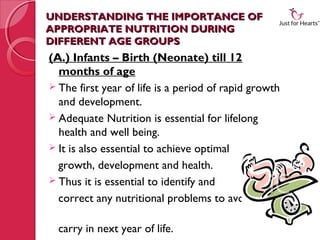
(A.) Infants – Birth (Neonate) till 12
  months of age
 The first year of life is a period of rapid growth
  and development.
 Adequate Nutrition is essential for lifelong
  health and well being.
 It is also essential to achieve optimal
  growth, development and health.
 Thus it is essential to identify and
  correct any nutritional problems to avoid it to

  carry in next year of life.
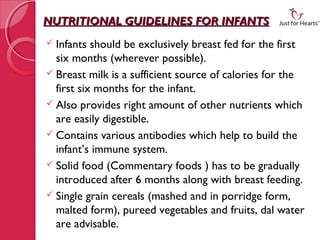
NUTRITIONAL GUIDELINES FOR INFANTS
 Infants  should be exclusively breast fed for the first
  six months (wherever possible).
 Breast milk is a sufficient source of calories for the
  first six months for the infant.
 Also provides right amount of other nutrients which
  are easily digestible.
 Contains various antibodies which help to build the
  infant’s immune system.
 Solid food (Commentary foods ) has to be gradually
  introduced after 6 months along with breast feeding.
 Single grain cereals (mashed and in porridge form,
  malted form), pureed vegetables and fruits, dal water
  are advisable.
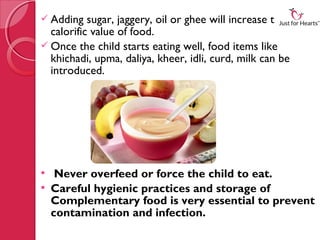
 Adding   sugar, jaggery, oil or ghee will increase the
  calorific value of food.
 Once the child starts eating well, food items like
  khichadi, upma, daliya, kheer, idli, curd, milk can be
  introduced.


  Never overfeed or force the child to eat.
 Careful hygienic practices and storage of
  Complementary food is very essential to prevent
  contamination and infection.
(B.) Toddlers and preschoolers (1-6 years )
 Several developmental changes in brain, body and
  organ occur at this time.
 Best time for Visual development.
 Vitamins and minerals are very important
for bone health, brain development and to
strengthen the immune system.

 NUTRITIONAL GUIDELINES FOR TODDLERS
 Introduce new foods at regular intervals to
  increase acceptance of new food.
 Provide a variety of food using the Food Guide
  Pyramid for children.
 Provide them with small frequent meals rather
  than three large meals.
 Provide adequate green leafy vegetable, other
  vegetables and fruits for goods sources of vitamins,
  minerals (specially Iron) and fibre.
 Provide enough dairy sources for calcium intake.
 Provide food in a colourful and appealing way.
 Encourage the child to play actively each day. 


 Don't force to eat or bribe
the child with sweets or treats.
 Limit television watching
to 1 to 2 hours a day
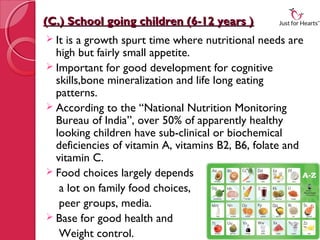
(C.) School going children (6-12 years )
 It is a growth spurt time where nutritional needs are
  high but fairly small appetite.
 Important for good development for cognitive
  skills,bone mineralization and life long eating
  patterns.
 According to the “National Nutrition Monitoring
  Bureau of India”, over 50% of apparently healthy
  looking children have sub-clinical or biochemical
  deficiencies of vitamin A, vitamins B2, B6, folate and
  vitamin C. 
 Food choices largely depends
   a lot on family food choices,
   peer groups, media.
 Base for good health and
   Weight control.
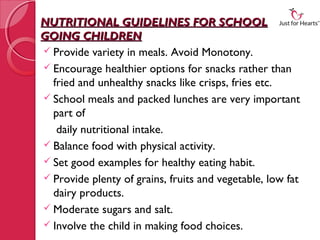
NUTRITIONAL GUIDELINES FOR SCHOOL
GOING CHILDREN
 Provide variety in meals. Avoid Monotony.
 Encourage healthier options for snacks rather than
  fried and unhealthy snacks like crisps, fries etc.
 School meals and packed lunches are very important
  part of
   daily nutritional intake.
 Balance food with physical activity.
 Set good examples for healthy eating habit.
 Provide plenty of grains, fruits and vegetable, low fat
  dairy products.
 Moderate sugars and salt.
 Involve the child in making food choices.
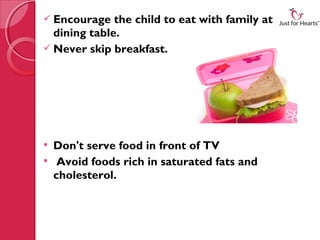
 Encourage   the child to eat with family at the
  dining table.
 Never skip breakfast.


 Don't serve food in front of TV
 Avoid foods rich in saturated fats and
  cholesterol.
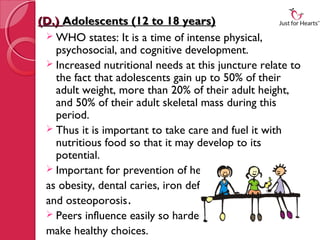
(D.) Adolescents (12 to 18 years)
  WHO states: It is a time of intense physical,
   psychosocial, and cognitive development.
  Increased nutritional needs at this juncture relate to
   the fact that adolescents gain up to 50% of their
   adult weight, more than 20% of their adult height,
   and 50% of their adult skeletal mass during this
   period.
  Thus it is important to take care and fuel it with
   nutritious food so that it may develop to its
   potential.
  Important for prevention of health problems such
 as obesity, dental caries, iron deficiency,
 and osteoporosis.
  Peers influence easily so harder to
 make healthy choices.
NUTRITIONAL GUIDELINES FOR
ADOLESCENTS
 Consume    balanced and small frequent meals with lot
  of variety in them.
 Teach adequate portion sizes of foods from all food
  groups.
 Choosing the diet with plenty of grains, vegetables,
  pulses, dairy products.
 Choosing the diet low in salt, sugar, fat (saturated
  fats).
 Provide with readily available healthy food choices
  even while eating outside food.
 Involve the adolescent in making good choices as
  well as preparations oh healthy food.
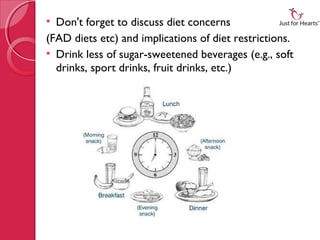
 Don't forget to discuss diet concerns
(FAD diets etc) and implications of diet restrictions.
 Drink less of sugar-sweetened beverages (e.g., soft
  drinks, sport drinks, fruit drinks, etc.) 
CHILDREN’S ORAL HEALTH

"Oral health is an important part of overall
 health, and good oral health starts with baby
 teeth. If your baby's mouth isn't healthy, then
 your baby is not going to be healthy."
                                           Dr. Russell Maier
                 Family physician, University of Washington

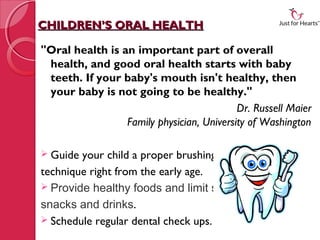
 Guide your child a proper brushing
technique right from the early age.
 Provide healthy foods and limit sweet
snacks and drinks.
 Schedule regular dental check ups.
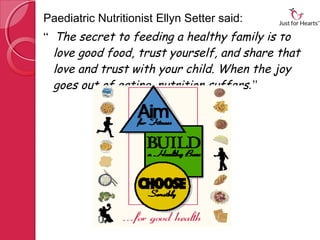
Paediatric Nutritionist Ellyn Setter said:
“ The secret to feeding a healthy family is to
  love good food, trust yourself, and share that
  love and trust with your child. When the joy
  goes out of eating, nutrition suffers .”
Follow us on…


                www.justforhearts.org

Pediatric nutrition

  • 1.
    THE BASE OF NUTRITIONALSTATUS: PEDIATRIC NUTRITION BY: MRS MITALI BHINDE
  • 2.
    When it comesto choosing a colour for the child: IT’S ALWAYS A BLUE FOR BOYS & PINK FOR GIRLS.  Butwhen it comes to Nutrition for a Child, these differences fade away.  There is no other time in life when the provision of appropriate nutrition is of greater importance than during infancy and childhood.  Thus understanding the importance of Pediatric Nutrition and implementing correct nutritional guidelines at the right age becomes very essential.
  • 3.
    UNDERSTANDING THE IMPORTANCEOF APPROPRIATE NUTRITION DURING DIFFERENT AGE GROUPS (A.) Infants – Birth (Neonate) till 12 months of age  The first year of life is a period of rapid growth and development.  Adequate Nutrition is essential for lifelong health and well being.  It is also essential to achieve optimal growth, development and health.  Thus it is essential to identify and correct any nutritional problems to avoid it to carry in next year of life.
  • 4.
    NUTRITIONAL GUIDELINES FORINFANTS  Infants should be exclusively breast fed for the first six months (wherever possible).  Breast milk is a sufficient source of calories for the first six months for the infant.  Also provides right amount of other nutrients which are easily digestible.  Contains various antibodies which help to build the infant’s immune system.  Solid food (Commentary foods ) has to be gradually introduced after 6 months along with breast feeding.  Single grain cereals (mashed and in porridge form, malted form), pureed vegetables and fruits, dal water are advisable.
  • 5.
     Adding sugar, jaggery, oil or ghee will increase the calorific value of food.  Once the child starts eating well, food items like khichadi, upma, daliya, kheer, idli, curd, milk can be introduced.  Never overfeed or force the child to eat.  Careful hygienic practices and storage of Complementary food is very essential to prevent contamination and infection.
  • 6.
    (B.) Toddlers andpreschoolers (1-6 years )  Several developmental changes in brain, body and organ occur at this time.  Best time for Visual development.  Vitamins and minerals are very important for bone health, brain development and to strengthen the immune system. NUTRITIONAL GUIDELINES FOR TODDLERS  Introduce new foods at regular intervals to increase acceptance of new food.  Provide a variety of food using the Food Guide Pyramid for children.
  • 7.
     Provide themwith small frequent meals rather than three large meals.  Provide adequate green leafy vegetable, other vegetables and fruits for goods sources of vitamins, minerals (specially Iron) and fibre.  Provide enough dairy sources for calcium intake.  Provide food in a colourful and appealing way.  Encourage the child to play actively each day.   Don't force to eat or bribe the child with sweets or treats.  Limit television watching to 1 to 2 hours a day
  • 8.
    (C.) School goingchildren (6-12 years )  It is a growth spurt time where nutritional needs are high but fairly small appetite.  Important for good development for cognitive skills,bone mineralization and life long eating patterns.  According to the “National Nutrition Monitoring Bureau of India”, over 50% of apparently healthy looking children have sub-clinical or biochemical deficiencies of vitamin A, vitamins B2, B6, folate and vitamin C.   Food choices largely depends a lot on family food choices, peer groups, media.  Base for good health and Weight control.
  • 9.
    NUTRITIONAL GUIDELINES FORSCHOOL GOING CHILDREN  Provide variety in meals. Avoid Monotony.  Encourage healthier options for snacks rather than fried and unhealthy snacks like crisps, fries etc.  School meals and packed lunches are very important part of daily nutritional intake.  Balance food with physical activity.  Set good examples for healthy eating habit.  Provide plenty of grains, fruits and vegetable, low fat dairy products.  Moderate sugars and salt.  Involve the child in making food choices.
  • 10.
     Encourage the child to eat with family at the dining table.  Never skip breakfast.  Don't serve food in front of TV  Avoid foods rich in saturated fats and cholesterol.
  • 11.
    (D.) Adolescents (12to 18 years)  WHO states: It is a time of intense physical, psychosocial, and cognitive development.  Increased nutritional needs at this juncture relate to the fact that adolescents gain up to 50% of their adult weight, more than 20% of their adult height, and 50% of their adult skeletal mass during this period.  Thus it is important to take care and fuel it with nutritious food so that it may develop to its potential.  Important for prevention of health problems such as obesity, dental caries, iron deficiency, and osteoporosis.  Peers influence easily so harder to make healthy choices.
  • 12.
    NUTRITIONAL GUIDELINES FOR ADOLESCENTS Consume balanced and small frequent meals with lot of variety in them.  Teach adequate portion sizes of foods from all food groups.  Choosing the diet with plenty of grains, vegetables, pulses, dairy products.  Choosing the diet low in salt, sugar, fat (saturated fats).  Provide with readily available healthy food choices even while eating outside food.  Involve the adolescent in making good choices as well as preparations oh healthy food.
  • 13.
     Don't forgetto discuss diet concerns (FAD diets etc) and implications of diet restrictions.  Drink less of sugar-sweetened beverages (e.g., soft drinks, sport drinks, fruit drinks, etc.) 
  • 14.
    CHILDREN’S ORAL HEALTH "Oralhealth is an important part of overall health, and good oral health starts with baby teeth. If your baby's mouth isn't healthy, then your baby is not going to be healthy." Dr. Russell Maier Family physician, University of Washington  Guide your child a proper brushing technique right from the early age.  Provide healthy foods and limit sweet snacks and drinks.  Schedule regular dental check ups.
  • 15.
    Paediatric Nutritionist Ellyn Settersaid: “ The secret to feeding a healthy family is to love good food, trust yourself, and share that love and trust with your child. When the joy goes out of eating, nutrition suffers .”
  • 16.
    Follow us on… www.justforhearts.org