DR.SUNIL BHOYE
MPH(NUTRITION)
NUTRITION IN INFANCY
1
2
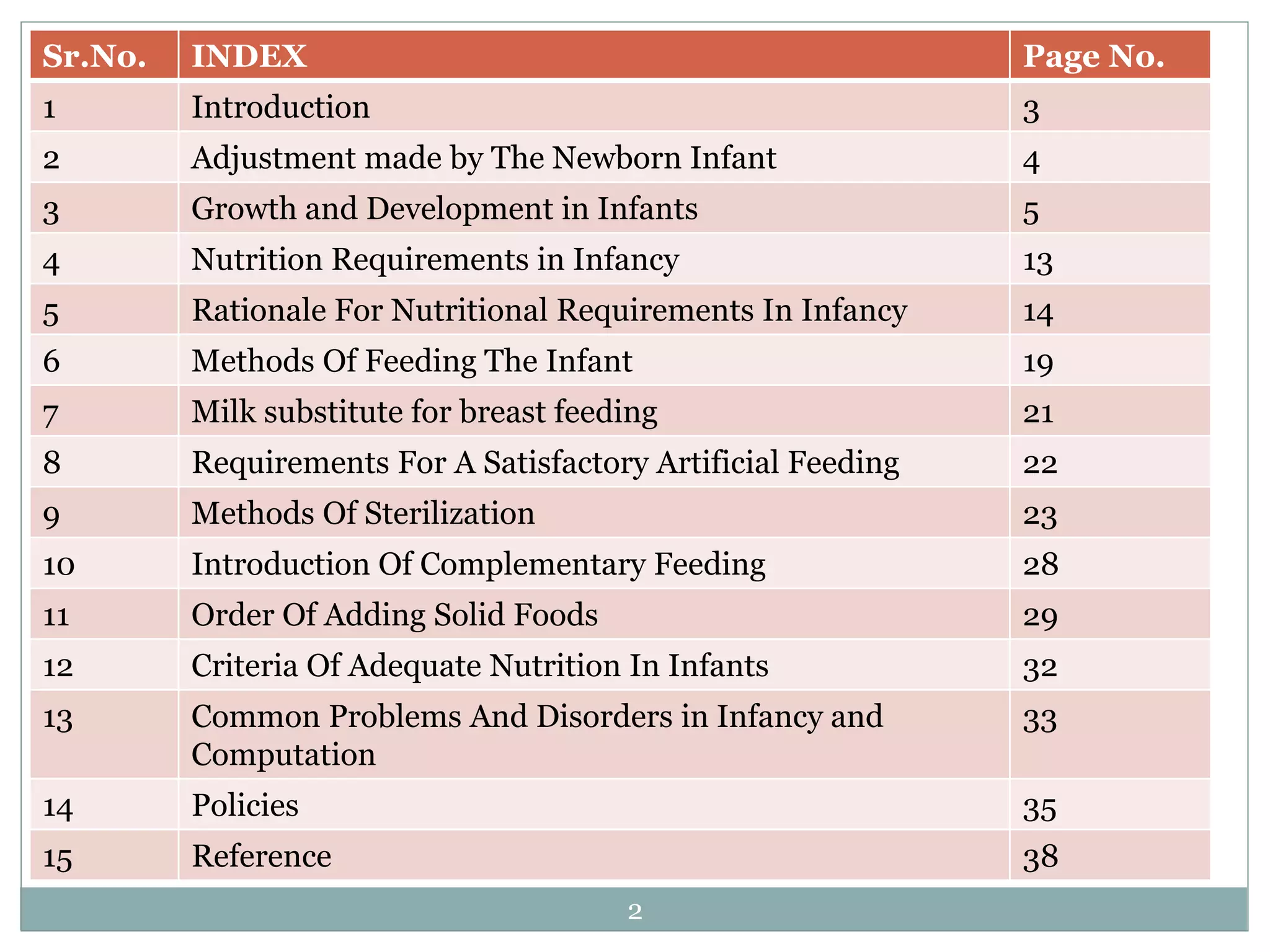
Sr.No. INDEX Page No.
1 Introduction 3
2 Adjustment made by The Newborn Infant 4
3 Growth and Development in Infants 5
4 Nutrition Requirements in Infancy 13
5 Rationale For Nutritional Requirements In Infancy 14
6 Methods Of Feeding The Infant 19
7 Milk substitute for breast feeding 21
8 Requirements For A Satisfactory Artificial Feeding 22
9 Methods Of Sterilization 23
10 Introduction Of Complementary Feeding 28
11 Order Of Adding Solid Foods 29
12 Criteria Of Adequate Nutrition In Infants 32
13 Common Problems And Disorders in Infancy and
Computation
33
14 Policies 35
15 Reference 38
INTRODUCTION
3
 In 2019, the infant mortality rate in India was at about
28.3 deaths per 1,000 live births, a significant decrease
from previous years. Infant mortality rate in India
2019. (Published by H. Plecher, Oct 20, 2020)
 Globally, the infant mortality rate has shrunk from 63
infant deaths per 1,000 live births to 27 since 1990 and is
forecast to drop to 8 infant deaths per 1,000 live births by
the year 2100.
 India’s Rural Problem - With 32 infant deaths per 1,000
live births, India is neither among the countries with
the highest nor among those with the lowest infant
mortality rate.
ADJUSTMENT MADE BY THE NEWBORN
INFANT
 All the needs, nutritional, biological and physiological, of
the fetus is provided by the uterus during conception.
 After birth, the infant must carry out essential functions
on his own:
1) respiration
2) temperature control
3) changes in blood circulation
4) with the first feeding infant is responsible for his
own digestion, absorption, assimilation and excretion
4
GROWTH AND DEVELOPMENT IN
INFANCY
1. 1ST year is critical as infant grows in weight and height
- NB: about 6-7 lbs. (2.7-3.2kg) & 18-20 in. (48-51cm)
- 1st year: fastest growth until adolescence:
BW is doubled by 5-6 months. & tripled by 12 months;
birth length is increased by 24cm by the end of the year.
5
GROWTH AND DEVELOPMENT IN
INFANCY
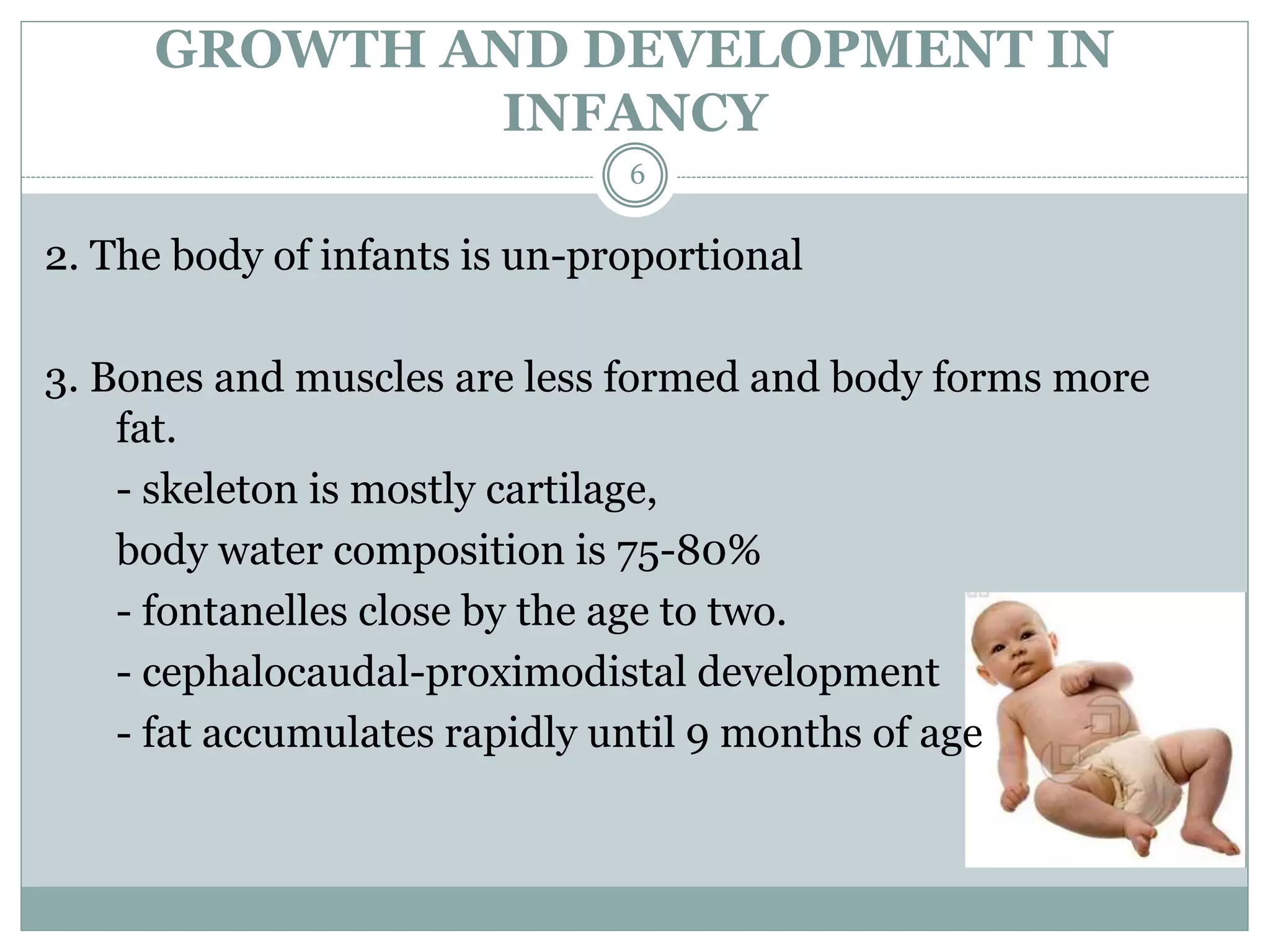
2. The body of infants is un-proportional
3. Bones and muscles are less formed and body forms more
fat.
- skeleton is mostly cartilage,
body water composition is 75-80%
- fontanelles close by the age to two.
- cephalocaudal-proximodistal development
- fat accumulates rapidly until 9 months of age
6
GROWTH AND DEVELOPMENT IN
INFANCY
4. Brain development: fastest in the first two years.
- brain development is faster than any other system up
to age one
- brain is 25% of its adult weight
at birth will reach 70-75% of its
adult size by age 24 months.
5. Teeth: 20 baby teeth
will erupt, 6-12 months.
Teething is complete at age 3.
7
GROWTH AND DEVELOPMENT IN
INFANCY
6. Digestion and absorption
- stomach capacity, 20ml at birth – 300ml by one year
of age
- ↓ salivary and pancreatic amylase, first month after
birth
- lactase, sucrose & maltase are well established at birth
- proteolytic activity in infancy is the same as in
adulthood (total qty digested per hour)
- ↓ pancreatic lipase in the NB, bile acid pool is ½ of
that of the adult
8
GROWTH AND DEVELOPMENT IN
INFANCY
7. Renal function: the NB has functionally immature
kidneys
- ↓glomerular filtration and reabsortion
8. Neuromuscular development
Motor development is the development of control over
bodily movements thru the coordinated activity of the
nerves and the muscles.
- suckles and smiles, 0-1 month age
- vocalizes & controls head, 2-3 months
- controls & rolls over, 4-5 months
- sits briefly & crawls, 6-7 months
- grasps & pulls up, 8-9 months
9
GROWTH AND DEVELOPMENT IN
INFANCY
- walks with support & stands alone, 10-11 months
- starts to walk alone, 12 month++
The infant has a number of reflexes that work together to
permit the intake of food
- Rooting reflex, causes the infant to turn his head when
cheek is touched & to seek the nipple with his mouth
- Sucking reflex, vertical moments of the tongue and
mandible to create negative pressure
- Extrusion reflex, anything that is put on the anterior
part of the tongue is pushed out of the mouth
10
GROWTH AND DEVELOPMENT IN
INFANCY
- Swallowing reflex, initially involves posterior part of the
tongue and later develops to include the whole tongue.
- Rooting and extrusion ↓ until 3-4 months of age
- With ↑ age, there is gradual development of control
over the lips, tongue and mandible, allows drinking
from a cup with a little loss of liquid.
- Large & fine muscular maturation are important to the
development of self-feeding; use of hands becomes
more efficient from reaching or grasping with palms
and whole hand to thumb-finger position.
11
PROGRESS OF GROWTH
12
NUTRITIONAL REQUIREMENTS IN
INFANCY
1. Nutritive needs
- based on estimates of amounts supplied by breast
milk or amounts laid down during growth
- based on 750ml breast milk multiplied by its content
- for older infants, the RNI is based in the amount of
nutrient provided by both the breast milk and
complementary foods.
(refer to RENI for infants, FNRI-DOST, 2002)
13
RATIONALE FOR NUTRITIONAL
REQUIREMENTS IN INFANCY
A. Energy: the energy requirements per unit of body size in
an infant’s first few months of life is very high but
declines as the rate of growth ↓
 Energy requirements per unit body of body rate is high
because of the larger body surface area of infants
compared to adults.
 The early months are characterized by high need of
energy for growth and increased activity
 Breast milk will adequately meet the needs of infants
below 6 months of age, after which complementation
with other foods become necessary.
14
RATIONALE FOR NUTRITIONAL
REQUIREMENTS IN INFANCY
B. Protein: the need for CHON during the period of rapid
skeletal and muscle growth of early infancy is relatively
high; infants’ amino acid requirements are higher than
those of adults.
 In addition to the 8 essential amino acids for adults,
histidine is essential for infants;
 No adjustments for NPU are made for infants, since the
dietary recommendation is in terms of breast milk
15
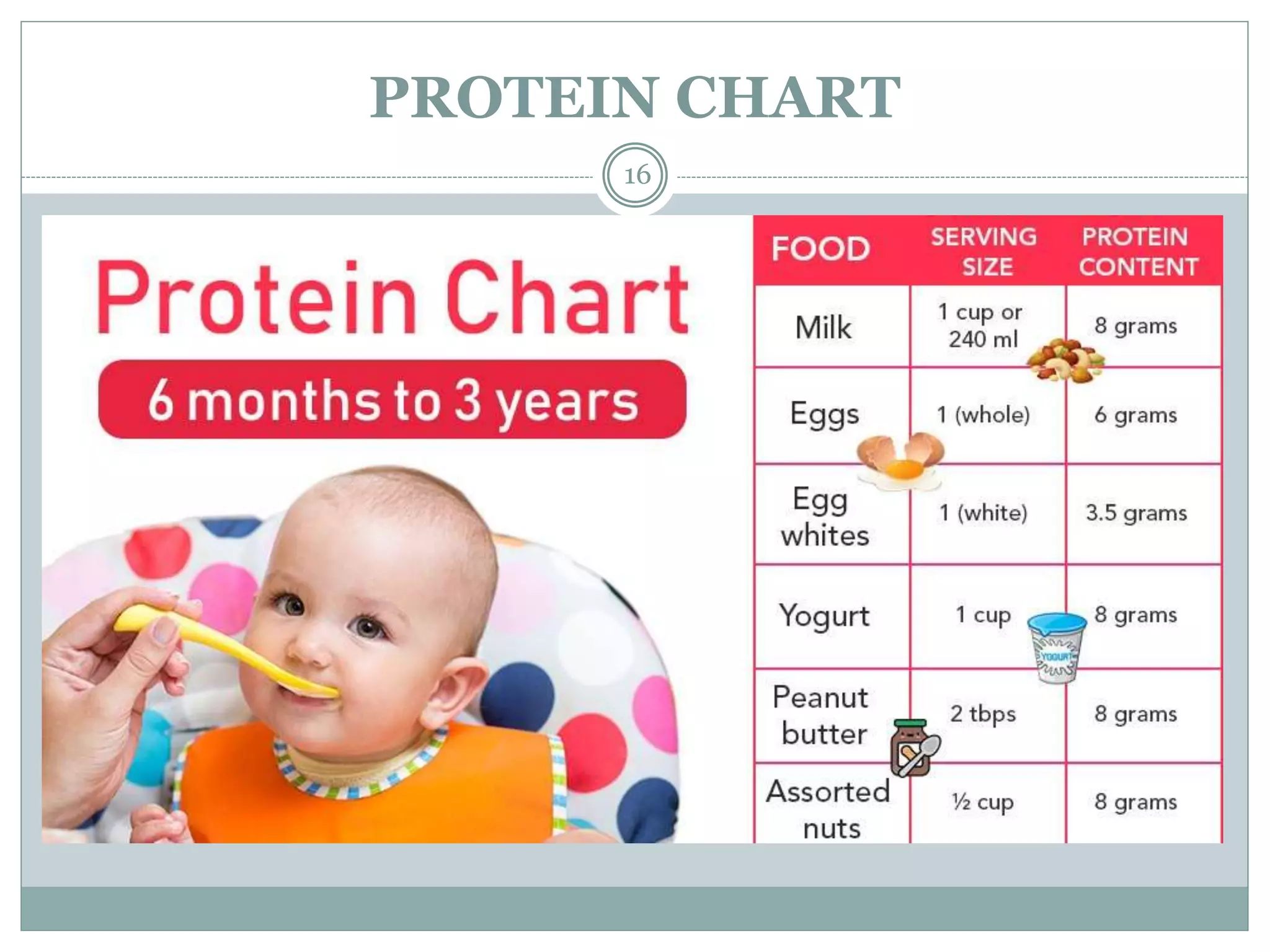
PROTEIN CHART
16
RATIONALE FOR NUTRITIONAL
REQUIREMENTS IN INFANCY
C. Fat soluble vitamins
 Healthy NB enters life with reserve of Vit A in the liver.
 RDA of 375 mg RE/day of Vit. A
 Vitamin D dietary intake should be assured
 Vit K usually is given at birth, 1mg/kbw per day (FAO,
2002)
D. Water-soluble vitamins: breast milk usually provides the
RDA of water-soluble vits. If the mother’s diet is
adequate.
17
RATIONALE FOR NUTRITIONAL
REQUIREMENTS IN INFANCY
E. Minerals:
 Ca:P ratio for infants is 1.3:1
 The Fe content of a normal infant at birth is 75 mg/kg,
biggest portion is found in the RBC
 Fe is accumulated in utero, in proportion to body size
F. Water: Infants need about 1.5mL/kcal of energy
expenditure; this need corresponds to the water-energy
ratio in human milk.
 The min daily requirements for water is 800 & 1000mL
in the 1st & 2nd months of life, respectfully
18
EXCLUSIVE BREASTFEEDING
ADVANTAGE
19
 Breast milk provides the ideal nutrition for infants.
 Breast milk contains antibodies that help your baby fight
off viruses and bacteria.
 Breastfeeding lowers your baby's risk of
having asthma or allergies. Plus, babies who are
breastfed exclusively for the first 6 months, without any
formula, have fewer ear infections, respiratory illnesses,
and bouts of diarrhea.
 The AAP says breastfeeding also plays a role in the
prevention of SIDS (sudden infant death syndrome).
MILK SUBSTITUTE FOR BREAST
FEEDING
1. Breast milk substitutes:
- cow’s milk
- goat’s milk
- mixtures containing no milk
2. Ways of stimulating human milk:
- dilution with water or cereal water
- boiling or any process to produce smaller curds
- addition of weak acid (lactic acid, acetic acid, citric acid,
etc.) to produce smaller curds and speed up protein
digestion.
3. Proper sterilization is important ensure that the formula is
free from contamination.
20
REQUIREMENTS FOR A SATISFACTORY
ARTIFICIAL FEEDING
1. Sufficient energy for infant’s n needs
2. Sufficient CHON, VITS and water for growth and
regulating body functions
21
METHODS OF STERILIZATION
a. Standard aseptic method
b. baby’s satisfied, 15-20 minutes feeding time
c. Fall asleep promptly after each feeding, sleeps for
3-4 hours.
d. Gain wt satisfactory, from week to week at about
142-227 grams per wk in the 5 month and then 113-
142 grams per wk for the remaining month of the
year
22
WEANING(Complementary Feeding)
23
 If you're breastfeeding, feeding only breast milk up to
around 6 months of age will help protect your baby against
illness and infections.
 Waiting until around 6 months gives your baby time to
develop so they can cope fully with solid foods. This
includes solid foods made into purées, cereals and baby rice
added to milk.
 Your baby will be more able to feed themselves.
 Your baby will be better at moving food around their
mouth, chewing and swallowing it.
WEANING(Complementary Feeding)
24
 Signs
They'll be able to:
 stay in a sitting position and hold their head steady
 co-ordinate their eyes, hands and mouth so they can look at
the food, pick it up and put it in their mouth by themselves
 swallow food (rather than spit it back out)
The following behaviors can be mistaken by parents as signs
that their baby's ready for solid foods:
 chewing their fists
 waking up in the night (more than usual)
 wanting extra milk feeds
WEANING(Complementary Feeding)
25
 Weaning an infant is a gradual process. The American
Academy of Pediatrics (AAP) recommends feeding infants
only breast milk for the first 6 months after birth. After 6
months, the AAP recommends a combination of solid foods
and breast milk until the infant is at least 1 year old
 Starting solid foods too soon can be hazardous, so an infant
should not be fed solid food until he or she is physically
ready.
WEANING(Complementary Feeding)
26
 Start solid feedings (1 or 2 tablespoons) of iron-fortified
infant rice cereal mixed with breast milk or formula, stirred
to a thin consistency.
 Once the infant is eating rice cereal regularly, you may
introduce other iron-fortified instant cereals.
 Only introduce one new cereal per week so that intolerance
or possible allergies can be monitored.
INTRODUCTION OF COMPLEMENTARY
FEEDING
 BEIKOST (German word for “foods other than milk or
formula”)
- nutrition: 6 month age, nutritional insufficiency of milk diet
- physiological readiness: ability to handle food other than
milk is dependent
* secretion of enzymes for digestion of starch & un-
emulsified fats
* gastric acidity is increased
* maturity of the kidney function
27
ORDER OF ADDING SOLID FOODS
1. Cereals:
- first solid food
- approx 6 months
- must be well-cooked, well strained
- a portion of the formula may be added
- crisp toast, biscuits may be given when teeth begin to
appear
2. Fruits:
- mashed ripe bananas, ripe papaya, ripe mango (6 months)
for chewing
28
ORDER OF ADDING SOLID FOODS
3. Vegetables:
- cooked very soft, mashed or passed thru a sieve
- on the 7th months
- carrots, squash, potatoes.
4. Eggs: egg yolk 7th month, 11th month whole egg
5. Mango, dried beans, veggie soft & strained, 6th month
6. meat, fish and poultry, mechanical diet, 6th month
7. Other foods: custards, plain ice cream.8 month
29
FOODS FOR BABIES
30
CRITERIA OF ADEQUATE NUTRITION IN
INFANTS
 Has steady gain in weight & height
 Has firm, full flesh, bright eyes and pinkish cheeks and
nails
 Is happy and active when awake
 Sleeps well
 Has normal elimination
31
COMMON PROBS AND DISORDERS IN
INFANCY
 REGURGITATION
 COLIC
 DIARRHEA
 FOOD ALLERGY
 Fe DEFICIENCY ANEMIA
32
COMPUTATION:
DBW: (Age in months / 2) + 3 = Kg
TER: (DBW) (120) for 1-6 months
(DBW) (110) for 7-12 months
1. 2-months old infant 2. 11-months old infant
DBW= 2/2=1 + 3 = 4 Kg DBW = 11/2 = 5.5 + 3 =8.5
TER = 4 (120) = 480 cal =9k
TER = 9 (110) = 990 cal
33
POLICIES
34
 The Infant Milk Substitutes, Feeding Bottles and Infant
Foods (Regulation of Production, Supply and Distribution)
Act, 1992 as amended in 2003 (called the IMS Act) covers
the different aspects of advertising, promoting and sale of
milk substitute products.
 Infant Young Child Feeding(IYCF).
 MAA(Mother's Absolute Affection) August 2016.
 Breast Feeding Promotion Network Of India.3rd December
1991
 Integrated child development services(ICDS).2nd October
1975.
POLICIES
35
 Janani Shishu Suraksha Karyakaram (JSSK)
 Rashtriya Kishor Swasthya Karyakram(RKSK)
 Rashtriya Bal SwasthyaKaryakram (RBSK)
 Universal Immunisation Programme
 Mission Indradhanush / Intensified Misson Indradhanush
 Janani Suraksha Yojana (JSY)
 Pradhan Mantri Surakshit Matritva Abhiyan (PMSMA)
 NavjaatShishu Suraksha Karyakram (NSSK)
 National Programme for Family planning
POLICIES
36
 National Iodine Deficiency Disorders
Control Programme
 MAA (Mothers’ Absolute Affection) Programme for
Infant and Young Child Feeding
 National Programme for Prevention and Control of
Fluorosis (NPPCF)
 National Iron Plus Initiative for Anaemia Control
 National Vitamin A prophylaxis Programe
 Integrated Child Development Services (ICDS)
 Mid-Day Meal Programme
REFERENCES
37
 WHO
 Global Nutritional Report
 Kanjilal B, Mazumdar PG, Mukherjee M, Rahman MH.
Nutritional status of children in India: household socio-
economic condition as the contextual determinant. Int J
Equity Health. 2010;9:19. Published 2010 Aug 11.
doi:10.1186/1475-9276-9-19
 Infant mortality rate in India 2019.Published by H.
Plecher, Oct 20, 2020.
 National Health Mission
 K park

Nutrition in infancy

  • 1.
  • 2.
    2 Sr.No. INDEX PageNo. 1 Introduction 3 2 Adjustment made by The Newborn Infant 4 3 Growth and Development in Infants 5 4 Nutrition Requirements in Infancy 13 5 Rationale For Nutritional Requirements In Infancy 14 6 Methods Of Feeding The Infant 19 7 Milk substitute for breast feeding 21 8 Requirements For A Satisfactory Artificial Feeding 22 9 Methods Of Sterilization 23 10 Introduction Of Complementary Feeding 28 11 Order Of Adding Solid Foods 29 12 Criteria Of Adequate Nutrition In Infants 32 13 Common Problems And Disorders in Infancy and Computation 33 14 Policies 35 15 Reference 38
  • 3.
    INTRODUCTION 3  In 2019,the infant mortality rate in India was at about 28.3 deaths per 1,000 live births, a significant decrease from previous years. Infant mortality rate in India 2019. (Published by H. Plecher, Oct 20, 2020)  Globally, the infant mortality rate has shrunk from 63 infant deaths per 1,000 live births to 27 since 1990 and is forecast to drop to 8 infant deaths per 1,000 live births by the year 2100.  India’s Rural Problem - With 32 infant deaths per 1,000 live births, India is neither among the countries with the highest nor among those with the lowest infant mortality rate.
  • 4.
    ADJUSTMENT MADE BYTHE NEWBORN INFANT  All the needs, nutritional, biological and physiological, of the fetus is provided by the uterus during conception.  After birth, the infant must carry out essential functions on his own: 1) respiration 2) temperature control 3) changes in blood circulation 4) with the first feeding infant is responsible for his own digestion, absorption, assimilation and excretion 4
  • 5.
    GROWTH AND DEVELOPMENTIN INFANCY 1. 1ST year is critical as infant grows in weight and height - NB: about 6-7 lbs. (2.7-3.2kg) & 18-20 in. (48-51cm) - 1st year: fastest growth until adolescence: BW is doubled by 5-6 months. & tripled by 12 months; birth length is increased by 24cm by the end of the year. 5
  • 6.
    GROWTH AND DEVELOPMENTIN INFANCY 2. The body of infants is un-proportional 3. Bones and muscles are less formed and body forms more fat. - skeleton is mostly cartilage, body water composition is 75-80% - fontanelles close by the age to two. - cephalocaudal-proximodistal development - fat accumulates rapidly until 9 months of age 6
  • 7.
    GROWTH AND DEVELOPMENTIN INFANCY 4. Brain development: fastest in the first two years. - brain development is faster than any other system up to age one - brain is 25% of its adult weight at birth will reach 70-75% of its adult size by age 24 months. 5. Teeth: 20 baby teeth will erupt, 6-12 months. Teething is complete at age 3. 7
  • 8.
    GROWTH AND DEVELOPMENTIN INFANCY 6. Digestion and absorption - stomach capacity, 20ml at birth – 300ml by one year of age - ↓ salivary and pancreatic amylase, first month after birth - lactase, sucrose & maltase are well established at birth - proteolytic activity in infancy is the same as in adulthood (total qty digested per hour) - ↓ pancreatic lipase in the NB, bile acid pool is ½ of that of the adult 8
  • 9.
    GROWTH AND DEVELOPMENTIN INFANCY 7. Renal function: the NB has functionally immature kidneys - ↓glomerular filtration and reabsortion 8. Neuromuscular development Motor development is the development of control over bodily movements thru the coordinated activity of the nerves and the muscles. - suckles and smiles, 0-1 month age - vocalizes & controls head, 2-3 months - controls & rolls over, 4-5 months - sits briefly & crawls, 6-7 months - grasps & pulls up, 8-9 months 9
  • 10.
    GROWTH AND DEVELOPMENTIN INFANCY - walks with support & stands alone, 10-11 months - starts to walk alone, 12 month++ The infant has a number of reflexes that work together to permit the intake of food - Rooting reflex, causes the infant to turn his head when cheek is touched & to seek the nipple with his mouth - Sucking reflex, vertical moments of the tongue and mandible to create negative pressure - Extrusion reflex, anything that is put on the anterior part of the tongue is pushed out of the mouth 10
  • 11.
    GROWTH AND DEVELOPMENTIN INFANCY - Swallowing reflex, initially involves posterior part of the tongue and later develops to include the whole tongue. - Rooting and extrusion ↓ until 3-4 months of age - With ↑ age, there is gradual development of control over the lips, tongue and mandible, allows drinking from a cup with a little loss of liquid. - Large & fine muscular maturation are important to the development of self-feeding; use of hands becomes more efficient from reaching or grasping with palms and whole hand to thumb-finger position. 11
  • 12.
  • 13.
    NUTRITIONAL REQUIREMENTS IN INFANCY 1.Nutritive needs - based on estimates of amounts supplied by breast milk or amounts laid down during growth - based on 750ml breast milk multiplied by its content - for older infants, the RNI is based in the amount of nutrient provided by both the breast milk and complementary foods. (refer to RENI for infants, FNRI-DOST, 2002) 13
  • 14.
    RATIONALE FOR NUTRITIONAL REQUIREMENTSIN INFANCY A. Energy: the energy requirements per unit of body size in an infant’s first few months of life is very high but declines as the rate of growth ↓  Energy requirements per unit body of body rate is high because of the larger body surface area of infants compared to adults.  The early months are characterized by high need of energy for growth and increased activity  Breast milk will adequately meet the needs of infants below 6 months of age, after which complementation with other foods become necessary. 14
  • 15.
    RATIONALE FOR NUTRITIONAL REQUIREMENTSIN INFANCY B. Protein: the need for CHON during the period of rapid skeletal and muscle growth of early infancy is relatively high; infants’ amino acid requirements are higher than those of adults.  In addition to the 8 essential amino acids for adults, histidine is essential for infants;  No adjustments for NPU are made for infants, since the dietary recommendation is in terms of breast milk 15
  • 16.
  • 17.
    RATIONALE FOR NUTRITIONAL REQUIREMENTSIN INFANCY C. Fat soluble vitamins  Healthy NB enters life with reserve of Vit A in the liver.  RDA of 375 mg RE/day of Vit. A  Vitamin D dietary intake should be assured  Vit K usually is given at birth, 1mg/kbw per day (FAO, 2002) D. Water-soluble vitamins: breast milk usually provides the RDA of water-soluble vits. If the mother’s diet is adequate. 17
  • 18.
    RATIONALE FOR NUTRITIONAL REQUIREMENTSIN INFANCY E. Minerals:  Ca:P ratio for infants is 1.3:1  The Fe content of a normal infant at birth is 75 mg/kg, biggest portion is found in the RBC  Fe is accumulated in utero, in proportion to body size F. Water: Infants need about 1.5mL/kcal of energy expenditure; this need corresponds to the water-energy ratio in human milk.  The min daily requirements for water is 800 & 1000mL in the 1st & 2nd months of life, respectfully 18
  • 19.
    EXCLUSIVE BREASTFEEDING ADVANTAGE 19  Breastmilk provides the ideal nutrition for infants.  Breast milk contains antibodies that help your baby fight off viruses and bacteria.  Breastfeeding lowers your baby's risk of having asthma or allergies. Plus, babies who are breastfed exclusively for the first 6 months, without any formula, have fewer ear infections, respiratory illnesses, and bouts of diarrhea.  The AAP says breastfeeding also plays a role in the prevention of SIDS (sudden infant death syndrome).
  • 20.
    MILK SUBSTITUTE FORBREAST FEEDING 1. Breast milk substitutes: - cow’s milk - goat’s milk - mixtures containing no milk 2. Ways of stimulating human milk: - dilution with water or cereal water - boiling or any process to produce smaller curds - addition of weak acid (lactic acid, acetic acid, citric acid, etc.) to produce smaller curds and speed up protein digestion. 3. Proper sterilization is important ensure that the formula is free from contamination. 20
  • 21.
    REQUIREMENTS FOR ASATISFACTORY ARTIFICIAL FEEDING 1. Sufficient energy for infant’s n needs 2. Sufficient CHON, VITS and water for growth and regulating body functions 21
  • 22.
    METHODS OF STERILIZATION a.Standard aseptic method b. baby’s satisfied, 15-20 minutes feeding time c. Fall asleep promptly after each feeding, sleeps for 3-4 hours. d. Gain wt satisfactory, from week to week at about 142-227 grams per wk in the 5 month and then 113- 142 grams per wk for the remaining month of the year 22
  • 23.
    WEANING(Complementary Feeding) 23  Ifyou're breastfeeding, feeding only breast milk up to around 6 months of age will help protect your baby against illness and infections.  Waiting until around 6 months gives your baby time to develop so they can cope fully with solid foods. This includes solid foods made into purées, cereals and baby rice added to milk.  Your baby will be more able to feed themselves.  Your baby will be better at moving food around their mouth, chewing and swallowing it.
  • 24.
    WEANING(Complementary Feeding) 24  Signs They'llbe able to:  stay in a sitting position and hold their head steady  co-ordinate their eyes, hands and mouth so they can look at the food, pick it up and put it in their mouth by themselves  swallow food (rather than spit it back out) The following behaviors can be mistaken by parents as signs that their baby's ready for solid foods:  chewing their fists  waking up in the night (more than usual)  wanting extra milk feeds
  • 25.
    WEANING(Complementary Feeding) 25  Weaningan infant is a gradual process. The American Academy of Pediatrics (AAP) recommends feeding infants only breast milk for the first 6 months after birth. After 6 months, the AAP recommends a combination of solid foods and breast milk until the infant is at least 1 year old  Starting solid foods too soon can be hazardous, so an infant should not be fed solid food until he or she is physically ready.
  • 26.
    WEANING(Complementary Feeding) 26  Startsolid feedings (1 or 2 tablespoons) of iron-fortified infant rice cereal mixed with breast milk or formula, stirred to a thin consistency.  Once the infant is eating rice cereal regularly, you may introduce other iron-fortified instant cereals.  Only introduce one new cereal per week so that intolerance or possible allergies can be monitored.
  • 27.
    INTRODUCTION OF COMPLEMENTARY FEEDING BEIKOST (German word for “foods other than milk or formula”) - nutrition: 6 month age, nutritional insufficiency of milk diet - physiological readiness: ability to handle food other than milk is dependent * secretion of enzymes for digestion of starch & un- emulsified fats * gastric acidity is increased * maturity of the kidney function 27
  • 28.
    ORDER OF ADDINGSOLID FOODS 1. Cereals: - first solid food - approx 6 months - must be well-cooked, well strained - a portion of the formula may be added - crisp toast, biscuits may be given when teeth begin to appear 2. Fruits: - mashed ripe bananas, ripe papaya, ripe mango (6 months) for chewing 28
  • 29.
    ORDER OF ADDINGSOLID FOODS 3. Vegetables: - cooked very soft, mashed or passed thru a sieve - on the 7th months - carrots, squash, potatoes. 4. Eggs: egg yolk 7th month, 11th month whole egg 5. Mango, dried beans, veggie soft & strained, 6th month 6. meat, fish and poultry, mechanical diet, 6th month 7. Other foods: custards, plain ice cream.8 month 29
  • 30.
  • 31.
    CRITERIA OF ADEQUATENUTRITION IN INFANTS  Has steady gain in weight & height  Has firm, full flesh, bright eyes and pinkish cheeks and nails  Is happy and active when awake  Sleeps well  Has normal elimination 31
  • 32.
    COMMON PROBS ANDDISORDERS IN INFANCY  REGURGITATION  COLIC  DIARRHEA  FOOD ALLERGY  Fe DEFICIENCY ANEMIA 32
  • 33.
    COMPUTATION: DBW: (Age inmonths / 2) + 3 = Kg TER: (DBW) (120) for 1-6 months (DBW) (110) for 7-12 months 1. 2-months old infant 2. 11-months old infant DBW= 2/2=1 + 3 = 4 Kg DBW = 11/2 = 5.5 + 3 =8.5 TER = 4 (120) = 480 cal =9k TER = 9 (110) = 990 cal 33
  • 34.
    POLICIES 34  The InfantMilk Substitutes, Feeding Bottles and Infant Foods (Regulation of Production, Supply and Distribution) Act, 1992 as amended in 2003 (called the IMS Act) covers the different aspects of advertising, promoting and sale of milk substitute products.  Infant Young Child Feeding(IYCF).  MAA(Mother's Absolute Affection) August 2016.  Breast Feeding Promotion Network Of India.3rd December 1991  Integrated child development services(ICDS).2nd October 1975.
  • 35.
    POLICIES 35  Janani ShishuSuraksha Karyakaram (JSSK)  Rashtriya Kishor Swasthya Karyakram(RKSK)  Rashtriya Bal SwasthyaKaryakram (RBSK)  Universal Immunisation Programme  Mission Indradhanush / Intensified Misson Indradhanush  Janani Suraksha Yojana (JSY)  Pradhan Mantri Surakshit Matritva Abhiyan (PMSMA)  NavjaatShishu Suraksha Karyakram (NSSK)  National Programme for Family planning
  • 36.
    POLICIES 36  National IodineDeficiency Disorders Control Programme  MAA (Mothers’ Absolute Affection) Programme for Infant and Young Child Feeding  National Programme for Prevention and Control of Fluorosis (NPPCF)  National Iron Plus Initiative for Anaemia Control  National Vitamin A prophylaxis Programe  Integrated Child Development Services (ICDS)  Mid-Day Meal Programme
  • 37.
    REFERENCES 37  WHO  GlobalNutritional Report  Kanjilal B, Mazumdar PG, Mukherjee M, Rahman MH. Nutritional status of children in India: household socio- economic condition as the contextual determinant. Int J Equity Health. 2010;9:19. Published 2010 Aug 11. doi:10.1186/1475-9276-9-19  Infant mortality rate in India 2019.Published by H. Plecher, Oct 20, 2020.  National Health Mission  K park

Editor's Notes

  • #5 Assimilation – digestion and absorption of nutrients
  • #7 Cartilage – usually translucent/elastic tissue
  • #16 Histidine- both essential and non-essential; for good mental and physical health; can cause eczema to 3mos old infants or less if deprived