Prefixes and Suffixes
By Group 8
Members
1. Widya Kurnia Arizona
2. Devi Mayasari Kusuma W
3. Puput Haryanto
4. Yuliarofi
Prefixes and Suffixes
There are 3 processes of word formation in English:
affixation- addition of prefixes and sufixes;
conversion- use of the word in another class without
any changes; and compounding- joining 2 words to
form another.
Prefixes and suffixes are sets of letters that are
added to the beginning or end of another word.
They are not words in their own right and cannot
stand on their own in a sentence: if they are printed
on their own they have a hyphen before or after
them.
Prefixes
Prefixes are added to the beginning of an existing
word in order to create a new word with a different
meaning.
The following is an list of medical prefixes along
with their meanings, origin, and an English
example.
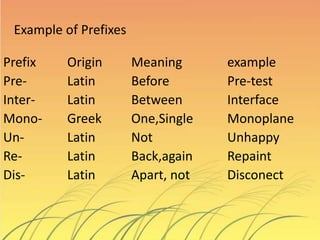
Example of Prefixes
Prefix Origin Meaning example
Pre- Latin Before Pre-test
Inter- Latin Between Interface
Mono- Greek One,Single Monoplane
Un- Latin Not Unhappy
Re- Latin Back,again Repaint
Dis- Latin Apart, not Disconect
Adding the prefix to the noun can turn it into a verb.
Prefix Noun verb
En- joy enjoy
Dis- cover discover
Mis- judge misjudje
Un- load unload
Adding the prefix to the verb remains a verb, but with a
different meaning
Prefix verb verb
Re- adjust readjust
Un- burden unburden
Dis- like dislike
Mis- hear mishear
Suffixes
A suffix is a group of letters placed at the end of a
word to make a new word.
This example Suffixes :
Suffixes meaning example
-ment condition of goverment
-ness state of being darkness
-ion state of being prohibition
-er Subject of an dancer
action
Suffixes meaning example
-en become hasten
-ize become memorize
-able capable of being eatable
-al pertaining to natural
-less without endless
A Suffix can make a new word in one of two ways
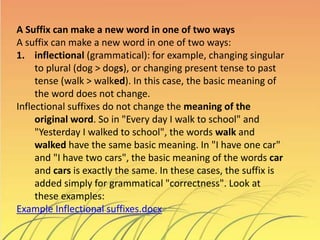
A suffix can make a new word in one of two ways:
1. inflectional (grammatical): for example, changing singular
to plural (dog > dogs), or changing present tense to past
tense (walk > walked). In this case, the basic meaning of
the word does not change.
Inflectional suffixes do not change the meaning of the
original word. So in "Every day I walk to school" and
"Yesterday I walked to school", the words walk and
walked have the same basic meaning. In "I have one car"
and "I have two cars", the basic meaning of the words car
and cars is exactly the same. In these cases, the suffix is
added simply for grammatical "correctness". Look at
these examples:
Example Inflectional suffixes.docx
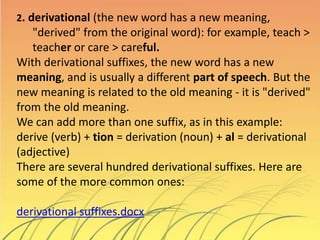
2. derivational (the new word has a new meaning,
"derived" from the original word): for example, teach >
teacher or care > careful.
With derivational suffixes, the new word has a new
meaning, and is usually a different part of speech. But the
new meaning is related to the old meaning - it is "derived"
from the old meaning.
We can add more than one suffix, as in this example:
derive (verb) + tion = derivation (noun) + al = derivational
(adjective)
There are several hundred derivational suffixes. Here are
some of the more common ones:
derivational suffixes.docx
Study the suffix rules in the following boxes.
Rule 1
When adding the suffixes -ness and -ly to a word, the spelling of the
word does not change.
Examples:
dark + ness = darkness
scholar + ly = scholarly
Exceptions to Rule 1
When the word ends in y, change the y to i before adding -ness and -ly.
Examples:
ready + ly = readily
happy + ness = happiness
Rule 2
When the suffix begins with a vowel, drop the silent e in the root word.
Examples:
care + ing = caring
use + able = usable
Exceptions to Rule 2
When the word ends in ce or ge, keep the silent e if the suffix begins with a or o.
Examples:
replace + able = replaceable
courage + ous = courageous
Rule 3
When the suffix begins with a consonant, keep the silent e in the original word.
Examples:
care + ful = careful
care + less = careless
Exceptions to Rule 3
Examples:
true + ly = truly
argue + ment = argument
Rule 4
When the word ends in a consonant plus y, change the y to i before any suffix not
beginning with i.
Examples:
sunny + er = sunnier
hurry + ing = hurrying
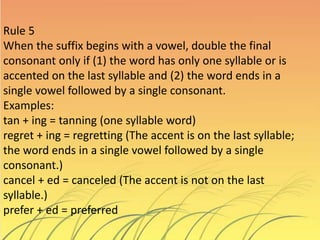
Rule 5
When the suffix begins with a vowel, double the final
consonant only if (1) the word has only one syllable or is
accented on the last syllable and (2) the word ends in a
single vowel followed by a single consonant.
Examples:
tan + ing = tanning (one syllable word)
regret + ing = regretting (The accent is on the last syllable;
the word ends in a single vowel followed by a single
consonant.)
cancel + ed = canceled (The accent is not on the last
syllable.)
prefer + ed = preferred
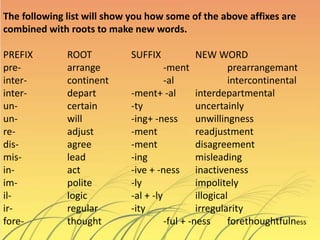
The following list will show you how some of the above affixes are
combined with roots to make new words.
PREFIX ROOT SUFFIX NEW WORD
pre- arrange -ment prearrangemant
inter- continent -al intercontinental
inter- depart -ment+ -al interdepartmental
un- certain -ty uncertainly
un- will -ing+ -ness unwillingness
re- adjust -ment readjustment
dis- agree -ment disagreement
mis- lead -ing misleading
in- act -ive + -ness inactiveness
im- polite -ly impolitely
il- logic -al + -ly illogical
ir- regular -ity irregularity
fore- thought -ful + -ness forethoughtfulness
Prefixes and Suffixes

Prefixes and Suffixes

  • 1.
    Prefixes and Suffixes ByGroup 8 Members 1. Widya Kurnia Arizona 2. Devi Mayasari Kusuma W 3. Puput Haryanto 4. Yuliarofi
  • 2.
    Prefixes and Suffixes Thereare 3 processes of word formation in English: affixation- addition of prefixes and sufixes; conversion- use of the word in another class without any changes; and compounding- joining 2 words to form another. Prefixes and suffixes are sets of letters that are added to the beginning or end of another word. They are not words in their own right and cannot stand on their own in a sentence: if they are printed on their own they have a hyphen before or after them.
  • 3.
    Prefixes Prefixes are addedto the beginning of an existing word in order to create a new word with a different meaning. The following is an list of medical prefixes along with their meanings, origin, and an English example.
  • 4.
    Example of Prefixes PrefixOrigin Meaning example Pre- Latin Before Pre-test Inter- Latin Between Interface Mono- Greek One,Single Monoplane Un- Latin Not Unhappy Re- Latin Back,again Repaint Dis- Latin Apart, not Disconect
  • 5.
    Adding the prefixto the noun can turn it into a verb. Prefix Noun verb En- joy enjoy Dis- cover discover Mis- judge misjudje Un- load unload Adding the prefix to the verb remains a verb, but with a different meaning Prefix verb verb Re- adjust readjust Un- burden unburden Dis- like dislike Mis- hear mishear
  • 6.
    Suffixes A suffix isa group of letters placed at the end of a word to make a new word. This example Suffixes : Suffixes meaning example -ment condition of goverment -ness state of being darkness -ion state of being prohibition -er Subject of an dancer action
  • 7.
    Suffixes meaning example -enbecome hasten -ize become memorize -able capable of being eatable -al pertaining to natural -less without endless
  • 8.
    A Suffix canmake a new word in one of two ways A suffix can make a new word in one of two ways: 1. inflectional (grammatical): for example, changing singular to plural (dog > dogs), or changing present tense to past tense (walk > walked). In this case, the basic meaning of the word does not change. Inflectional suffixes do not change the meaning of the original word. So in "Every day I walk to school" and "Yesterday I walked to school", the words walk and walked have the same basic meaning. In "I have one car" and "I have two cars", the basic meaning of the words car and cars is exactly the same. In these cases, the suffix is added simply for grammatical "correctness". Look at these examples: Example Inflectional suffixes.docx
  • 9.
    2. derivational (thenew word has a new meaning, "derived" from the original word): for example, teach > teacher or care > careful. With derivational suffixes, the new word has a new meaning, and is usually a different part of speech. But the new meaning is related to the old meaning - it is "derived" from the old meaning. We can add more than one suffix, as in this example: derive (verb) + tion = derivation (noun) + al = derivational (adjective) There are several hundred derivational suffixes. Here are some of the more common ones: derivational suffixes.docx
  • 10.
    Study the suffixrules in the following boxes. Rule 1 When adding the suffixes -ness and -ly to a word, the spelling of the word does not change. Examples: dark + ness = darkness scholar + ly = scholarly Exceptions to Rule 1 When the word ends in y, change the y to i before adding -ness and -ly. Examples: ready + ly = readily happy + ness = happiness Rule 2 When the suffix begins with a vowel, drop the silent e in the root word. Examples: care + ing = caring use + able = usable
  • 11.
    Exceptions to Rule2 When the word ends in ce or ge, keep the silent e if the suffix begins with a or o. Examples: replace + able = replaceable courage + ous = courageous Rule 3 When the suffix begins with a consonant, keep the silent e in the original word. Examples: care + ful = careful care + less = careless Exceptions to Rule 3 Examples: true + ly = truly argue + ment = argument Rule 4 When the word ends in a consonant plus y, change the y to i before any suffix not beginning with i. Examples: sunny + er = sunnier hurry + ing = hurrying
  • 12.
    Rule 5 When thesuffix begins with a vowel, double the final consonant only if (1) the word has only one syllable or is accented on the last syllable and (2) the word ends in a single vowel followed by a single consonant. Examples: tan + ing = tanning (one syllable word) regret + ing = regretting (The accent is on the last syllable; the word ends in a single vowel followed by a single consonant.) cancel + ed = canceled (The accent is not on the last syllable.) prefer + ed = preferred
  • 13.
    The following listwill show you how some of the above affixes are combined with roots to make new words. PREFIX ROOT SUFFIX NEW WORD pre- arrange -ment prearrangemant inter- continent -al intercontinental inter- depart -ment+ -al interdepartmental un- certain -ty uncertainly un- will -ing+ -ness unwillingness re- adjust -ment readjustment dis- agree -ment disagreement mis- lead -ing misleading in- act -ive + -ness inactiveness im- polite -ly impolitely il- logic -al + -ly illogical ir- regular -ity irregularity fore- thought -ful + -ness forethoughtfulness