 With the adding of derivational suffixes, the new word
  has a new meaning and is usually a different word
  class.
 But the new meaning is related to the old meaning
  which it is "derived" from the old meaning.
EXAMPLES
 explore (v)   + -ation = exploration (n)
 accident (n) + -al = accidental (adj)
 helpful (adj) + -ly = helpfully (adv)
 Terror (n)     + -ize = terrorize (v)
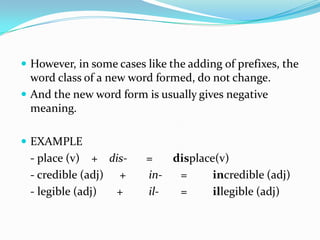
 However, in some cases like the adding of prefixes, the
  word class of a new word formed, do not change.
 And the new word form is usually gives negative
  meaning.

 EXAMPLE
 - place (v) + dis-      =   displace(v)
 - credible (adj) +      in-  =      incredible (adj)
 - legible (adj)  +      il-  =      illegible (adj)
SPELLING RULES IN FORMING
   DERIVATIONAL WORDS
Rule I. Final "e" followed by a Vowel.
 Final “e” of a word is dropped on taking a suffix
  beginning with a vowel

EXAMPLE:
   blame + able = blamable
   guide + ance = guidance
   Come + ing = coming
   force + ible = forcible
   obscure + ity = obscurity
EXCEPTION 1
 Words ending in “ge” or “ce” usually retain the “e”
  before a suffix beginning with “a” or “o” for the reason
  that “c” and “g” would have the hard sound if the “e”
  were dropped
 Peace + able = peaceable
 Change + able = changeable
 Courage + ous = courageous.
EXCEPTION 2
 Words ending in “oe” retain the “e” to preserve the
    sound of the root
    Shoe + ing = shoeing
    hoe + ing = hoeing
    The “e” is retained in a few words to prevent their
    being confounded with similar words
    Singe + ing = singeing (to prevent its being
    confounded with singing).
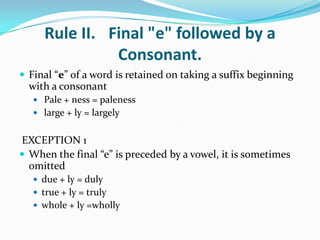
Rule II. Final "e" followed by a
               Consonant.
 Final “e” of a word is retained on taking a suffix beginning
  with a consonant
    Pale + ness = paleness
    large + ly = largely


EXCEPTION 1
 When the final “e” is preceded by a vowel, it is sometimes
  omitted
    due + ly = duly
    true + ly = truly
    whole + ly =wholly
EXCEPTION 2.

 A few words ending in “e” drop the “e” before a suffix
 beginning with a consonant
   Judge + ment = judgment
   lodge + ment = lodgment
   abridge + ment = abridgment
Rule III: Final "y" preceded by a Consonant
 Final “y” of a primitive word, when preceded by a
  consonant, is generally into “I” on the addition of a
  suffix.
EXCEPTION 1
 Before “ing” or “ish”, the final “y” is retained to prevent
  the doubling of the “I”
    pity + ing = pitying
EXCEPTION 2
 Words ending in “ie” and dropping the “e”, by Rule I.
  change the “I” into “y” to prevent the doubling of the
  “I”
   die +ing = dying
   lie + ing = lying.


EXCEPTION 3
 Final “y” is sometimes changed into “e”
   duty + ous = duteous
   beauty + ous = beauteous
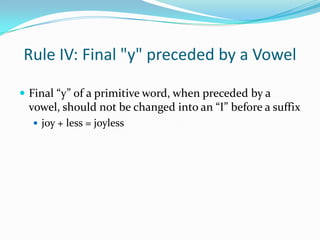
Rule IV: Final "y" preceded by a Vowel

 Final “y” of a primitive word, when preceded by a
 vowel, should not be changed into an “I” before a suffix
   joy + less = joyless
Rule V: Doubling
 Monosyllables and other words accented on the last
    syllable, when they end with a single consonant,
    preceded by a single vowel, or by a vowel after “qu”,
    double their final letter before a suffix beginning with
    a vowel.
   rob + ed = robbed
   fop + ish = foppish
   squat + er = squatter
   prefer' +ing = prefer'ring
EXCEPTIONS
 “X” final, being equivalent to “ks”, is never doubled;
  and when the derivative does not retain the accent of
  the root, the final consonant is not always doubled
 prefer' + ence = preference
Rule VI: No Doubling
 A final consonant, when it is not preceded by a single
 vowel, or when the accent is not on the last syllable,
 should remain single before an additional syllable
   toil + ing = toiling
   cheat + ed = cheated
   murmur+ ing = murmuring.
Derivational suffixes

Derivational suffixes

  • 2.
     With theadding of derivational suffixes, the new word has a new meaning and is usually a different word class.  But the new meaning is related to the old meaning which it is "derived" from the old meaning.
  • 3.
    EXAMPLES  explore (v) + -ation = exploration (n)  accident (n) + -al = accidental (adj)  helpful (adj) + -ly = helpfully (adv)  Terror (n) + -ize = terrorize (v)
  • 4.
     However, insome cases like the adding of prefixes, the word class of a new word formed, do not change.  And the new word form is usually gives negative meaning.  EXAMPLE - place (v) + dis- = displace(v) - credible (adj) + in- = incredible (adj) - legible (adj) + il- = illegible (adj)
  • 5.
    SPELLING RULES INFORMING DERIVATIONAL WORDS
  • 6.
    Rule I. Final"e" followed by a Vowel.  Final “e” of a word is dropped on taking a suffix beginning with a vowel EXAMPLE:  blame + able = blamable  guide + ance = guidance  Come + ing = coming  force + ible = forcible  obscure + ity = obscurity
  • 7.
    EXCEPTION 1  Wordsending in “ge” or “ce” usually retain the “e” before a suffix beginning with “a” or “o” for the reason that “c” and “g” would have the hard sound if the “e” were dropped  Peace + able = peaceable  Change + able = changeable  Courage + ous = courageous.
  • 8.
    EXCEPTION 2  Wordsending in “oe” retain the “e” to preserve the sound of the root  Shoe + ing = shoeing  hoe + ing = hoeing  The “e” is retained in a few words to prevent their being confounded with similar words  Singe + ing = singeing (to prevent its being confounded with singing).
  • 9.
    Rule II. Final"e" followed by a Consonant.  Final “e” of a word is retained on taking a suffix beginning with a consonant  Pale + ness = paleness  large + ly = largely EXCEPTION 1  When the final “e” is preceded by a vowel, it is sometimes omitted  due + ly = duly  true + ly = truly  whole + ly =wholly
  • 10.
    EXCEPTION 2.  Afew words ending in “e” drop the “e” before a suffix beginning with a consonant  Judge + ment = judgment  lodge + ment = lodgment  abridge + ment = abridgment
  • 11.
    Rule III: Final"y" preceded by a Consonant  Final “y” of a primitive word, when preceded by a consonant, is generally into “I” on the addition of a suffix. EXCEPTION 1  Before “ing” or “ish”, the final “y” is retained to prevent the doubling of the “I”  pity + ing = pitying
  • 12.
    EXCEPTION 2  Wordsending in “ie” and dropping the “e”, by Rule I. change the “I” into “y” to prevent the doubling of the “I”  die +ing = dying  lie + ing = lying. EXCEPTION 3  Final “y” is sometimes changed into “e”  duty + ous = duteous  beauty + ous = beauteous
  • 13.
    Rule IV: Final"y" preceded by a Vowel  Final “y” of a primitive word, when preceded by a vowel, should not be changed into an “I” before a suffix  joy + less = joyless
  • 14.
    Rule V: Doubling Monosyllables and other words accented on the last syllable, when they end with a single consonant, preceded by a single vowel, or by a vowel after “qu”, double their final letter before a suffix beginning with a vowel.  rob + ed = robbed  fop + ish = foppish  squat + er = squatter  prefer' +ing = prefer'ring
  • 15.
    EXCEPTIONS  “X” final,being equivalent to “ks”, is never doubled; and when the derivative does not retain the accent of the root, the final consonant is not always doubled  prefer' + ence = preference
  • 16.
    Rule VI: NoDoubling  A final consonant, when it is not preceded by a single vowel, or when the accent is not on the last syllable, should remain single before an additional syllable  toil + ing = toiling  cheat + ed = cheated  murmur+ ing = murmuring.