for 2nd BAT students 
by Pepa Mut 
Suffixes
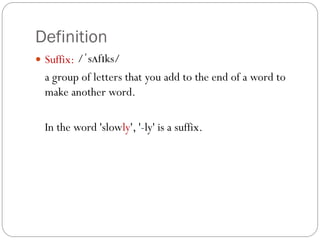
Definition 
Suffix: 
a group of letters that you add to the end of a word to make another word. 
In the word 'slowly', '-ly' is a suffix. 
/ˈsʌfɪks/
Noun suffixes 
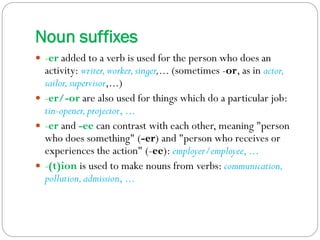
-er added to a verb is used for the person who does an activity: writer, worker, singer,... (sometimes -or, as in actor, sailor, supervisor,...) 
-er/-or are also used for things which do a particular job: tin-opener, projector, ... 
-er and -ee can contrast with each other, meaning "person who does something" (-er) and "person who receives or experiences the action" (-ee): employer/employee, ... 
-(t)ion is used to make nouns from verbs: communication, pollution, admission, ...
Noun suffixes 
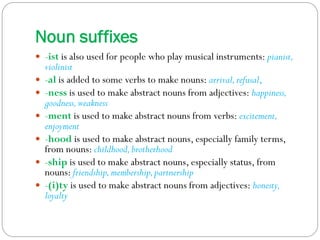
-ist is also used for people who play musical instruments: pianist, violinist 
-al is added to some verbs to make nouns: arrival, refusal, 
-ness is used to make abstract nouns from adjectives: happiness, goodness, weakness 
-ment is used to make abstract nouns from verbs: excitement, enjoyment 
-hood is used to make abstract nouns, especially family terms, from nouns: childhood, brotherhood 
-ship is used to make abstract nouns, especially status, from nouns: friendship, membership, partnership 
-(i)ty is used to make abstract nouns from adjectives: honesty, loyalty
Adjective suffixes 
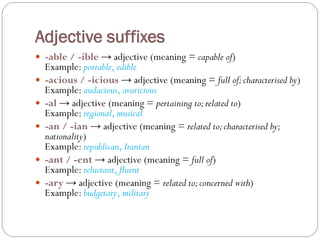
-able / -ible → adjective (meaning = capable of) Example: portable, edible 
-acious / -icious → adjective (meaning = full of; characterised by) Example: audacious, avaricious 
-al → adjective (meaning = pertaining to; related to) Example: regional, musical 
-an / -ian → adjective (meaning = related to; characterised by; nationality) Example: republican, Iranian 
-ant / -ent → adjective (meaning = full of) Example: reluctant, fluent 
-ary → adjective (meaning = related to; concerned with) Example: budgetary, military
Adjective suffixes 
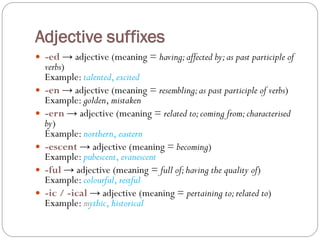
-ed → adjective (meaning = having; affected by; as past participle of verbs) Example: talented, excited 
-en → adjective (meaning = resembling; as past participle of verbs) Example: golden, mistaken 
-ern → adjective (meaning = related to; coming from; characterised by) Example: northern, eastern 
-escent → adjective (meaning = becoming) Example: pubescent, evanescent 
-ful → adjective (meaning = full of; having the quality of) Example: colourful, restful 
-ic / -ical → adjective (meaning = pertaining to; related to) Example: mythic, historical
Adjective suffixes 
-ing → adjective (meaning = having the quality of; as present participle of verbs) Example: interesting, moving 
-ish → adjective (meaning = like; having the quality of; nationality) Example: childish, Swedish 
-ive → adjective (meaning = concerned with; having the nature of) Example: attractive, quantitative 
-less → adjective (meaning = without; not having) Example: careless, endless 
-ly → adjective (meaning = having the quality of; recurring at intervals of) Example: brotherly, hourly
Adjective suffixes 
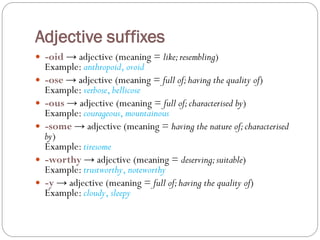
-oid → adjective (meaning = like; resembling) Example: anthropoid, ovoid 
-ose → adjective (meaning = full of; having the quality of) Example: verbose, bellicose 
-ous → adjective (meaning = full of; characterised by) Example: courageous, mountainous 
-some → adjective (meaning = having the nature of; characterised by) Example: tiresome 
-worthy → adjective (meaning = deserving; suitable) Example: trustworthy, noteworthy 
-y → adjective (meaning = full of; having the quality of) Example: cloudy, sleepy

Suffixes

  • 1.
    for 2nd BATstudents by Pepa Mut Suffixes
  • 2.
    Definition Suffix: agroup of letters that you add to the end of a word to make another word. In the word 'slowly', '-ly' is a suffix. /ˈsʌfɪks/
  • 3.
    Noun suffixes -eradded to a verb is used for the person who does an activity: writer, worker, singer,... (sometimes -or, as in actor, sailor, supervisor,...) -er/-or are also used for things which do a particular job: tin-opener, projector, ... -er and -ee can contrast with each other, meaning "person who does something" (-er) and "person who receives or experiences the action" (-ee): employer/employee, ... -(t)ion is used to make nouns from verbs: communication, pollution, admission, ...
  • 4.
    Noun suffixes -istis also used for people who play musical instruments: pianist, violinist -al is added to some verbs to make nouns: arrival, refusal, -ness is used to make abstract nouns from adjectives: happiness, goodness, weakness -ment is used to make abstract nouns from verbs: excitement, enjoyment -hood is used to make abstract nouns, especially family terms, from nouns: childhood, brotherhood -ship is used to make abstract nouns, especially status, from nouns: friendship, membership, partnership -(i)ty is used to make abstract nouns from adjectives: honesty, loyalty
  • 5.
    Adjective suffixes -able/ -ible → adjective (meaning = capable of) Example: portable, edible -acious / -icious → adjective (meaning = full of; characterised by) Example: audacious, avaricious -al → adjective (meaning = pertaining to; related to) Example: regional, musical -an / -ian → adjective (meaning = related to; characterised by; nationality) Example: republican, Iranian -ant / -ent → adjective (meaning = full of) Example: reluctant, fluent -ary → adjective (meaning = related to; concerned with) Example: budgetary, military
  • 6.
    Adjective suffixes -ed→ adjective (meaning = having; affected by; as past participle of verbs) Example: talented, excited -en → adjective (meaning = resembling; as past participle of verbs) Example: golden, mistaken -ern → adjective (meaning = related to; coming from; characterised by) Example: northern, eastern -escent → adjective (meaning = becoming) Example: pubescent, evanescent -ful → adjective (meaning = full of; having the quality of) Example: colourful, restful -ic / -ical → adjective (meaning = pertaining to; related to) Example: mythic, historical
  • 7.
    Adjective suffixes -ing→ adjective (meaning = having the quality of; as present participle of verbs) Example: interesting, moving -ish → adjective (meaning = like; having the quality of; nationality) Example: childish, Swedish -ive → adjective (meaning = concerned with; having the nature of) Example: attractive, quantitative -less → adjective (meaning = without; not having) Example: careless, endless -ly → adjective (meaning = having the quality of; recurring at intervals of) Example: brotherly, hourly
  • 8.
    Adjective suffixes -oid→ adjective (meaning = like; resembling) Example: anthropoid, ovoid -ose → adjective (meaning = full of; having the quality of) Example: verbose, bellicose -ous → adjective (meaning = full of; characterised by) Example: courageous, mountainous -some → adjective (meaning = having the nature of; characterised by) Example: tiresome -worthy → adjective (meaning = deserving; suitable) Example: trustworthy, noteworthy -y → adjective (meaning = full of; having the quality of) Example: cloudy, sleepy