Improving Your Spelling
The following rules can help you
eliminate spelling errors, so learn them.
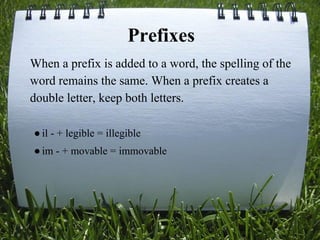
Prefixes
When a prefix is added to a word, the spelling of the
word remains the same. When a prefix creates a
double letter, keep both letters.
●il - + legible = illegible
●im - + movable = immovable
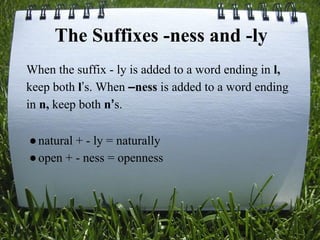
The Suffixes -ness and -ly
When the suffix - ly is added to a word ending in l,
keep both l’s. When –ness is added to a word ending
in n, keep both n’s.
●natural + - ly = naturally
●open + - ness = openness
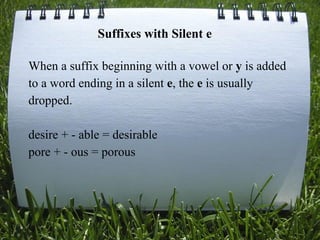
When a suffix beginning with a vowel or y is added
to a word ending in a silent e, the e is usually
dropped.
desire + - able = desirable
pore + - ous = porous
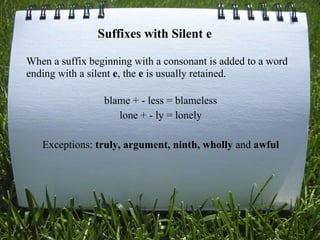
Suffixes with Silent e
When a suffix beginning with a consonant is added to a word
ending with a silent e, the e is usually retained.
blame + - less = blameless
lone + - ly = lonely
Exceptions: truly, argument, ninth, wholly and awful
Suffixes with Silent e
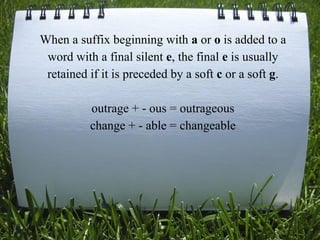
When a suffix beginning with a or o is added to a
word with a final silent e, the final e is usually
retained if it is preceded by a soft c or a soft g.
outrage + - ous = outrageous
change + - able = changeable
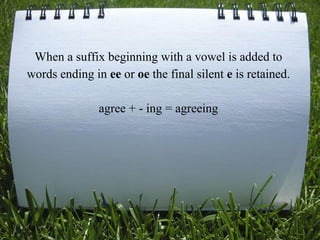
When a suffix beginning with a vowel is added to
words ending in ee or oe the final silent e is retained.
agree + - ing = agreeing
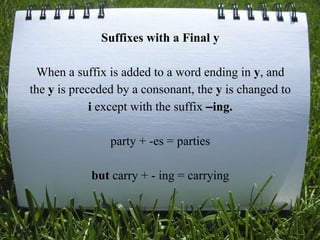
Suffixes with a Final y
When a suffix is added to a word ending in y, and
the y is preceded by a consonant, the y is changed to
i except with the suffix –ing.
party + -es = parties
but carry + - ing = carrying
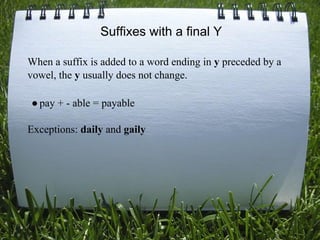
Suffixes with a final Y
When a suffix is added to a word ending in y preceded by a
vowel, the y usually does not change.
●pay + - able = payable
Exceptions: daily and gaily
Words Ending in a Consonant
In one-syllable words that end with a single consonant
preceded by a single vowel, double the final consonant before
adding a suffix beginning with a vowel.
●shun + - ed = shunned
Words Ending in a Consonant
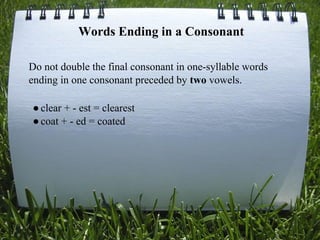
Do not double the final consonant in one-syllable words
ending in one consonant preceded by two vowels.
●clear + - est = clearest
●coat + - ed = coated
Words Ending in a Consonant
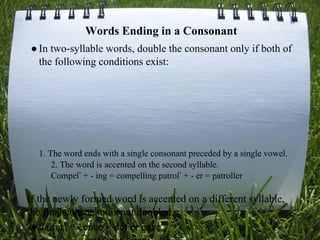
●In two-syllable words, double the consonant only if both of
the following conditions exist:
1. The word ends with a single consonant preceded by a single vowel.
2. The word is accented on the second syllable.
Compel’ + - ing = compelling patrol’ + - er = patroller
If the newly formed word is accented on a different syllable,
the final consonant is not doubled.
●de fer’ + - ence = def’er ence
Words with ie and ei
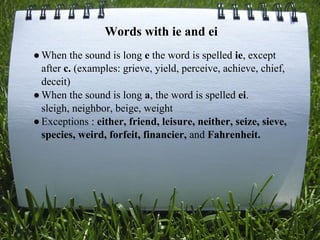
●When the sound is long e the word is spelled ie, except
after c. (examples: grieve, yield, perceive, achieve, chief,
deceit)
●When the sound is long a, the word is spelled ei.
sleigh, neighbor, beige, weight
●Exceptions : either, friend, leisure, neither, seize, sieve,
species, weird, forfeit, financier, and Fahrenheit.
Words with ie and ei
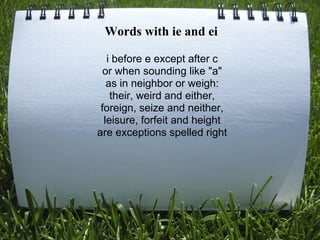
i before e except after c
or when sounding like "a"
as in neighbor or weigh:
their, weird and either,
foreign, seize and neither,
leisure, forfeit and height
are exceptions spelled right
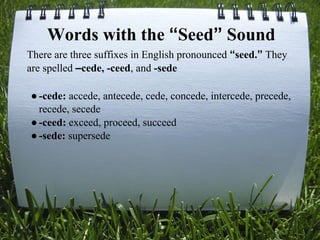
There are three suffixes in English pronounced “seed.” They
are spelled –cede, -ceed, and -sede
●-cede: accede, antecede, cede, concede, intercede, precede,
recede, secede
●-ceed: exceed, proceed, succeed
●-sede: supersede
Words with the “Seed” Sound

Improve your spelling

  • 1.
    Improving Your Spelling Thefollowing rules can help you eliminate spelling errors, so learn them.
  • 2.
    Prefixes When a prefixis added to a word, the spelling of the word remains the same. When a prefix creates a double letter, keep both letters. ●il - + legible = illegible ●im - + movable = immovable
  • 3.
    The Suffixes -nessand -ly When the suffix - ly is added to a word ending in l, keep both l’s. When –ness is added to a word ending in n, keep both n’s. ●natural + - ly = naturally ●open + - ness = openness
  • 4.
    When a suffixbeginning with a vowel or y is added to a word ending in a silent e, the e is usually dropped. desire + - able = desirable pore + - ous = porous Suffixes with Silent e
  • 5.
    When a suffixbeginning with a consonant is added to a word ending with a silent e, the e is usually retained. blame + - less = blameless lone + - ly = lonely Exceptions: truly, argument, ninth, wholly and awful Suffixes with Silent e
  • 6.
    When a suffixbeginning with a or o is added to a word with a final silent e, the final e is usually retained if it is preceded by a soft c or a soft g. outrage + - ous = outrageous change + - able = changeable
  • 7.
    When a suffixbeginning with a vowel is added to words ending in ee or oe the final silent e is retained. agree + - ing = agreeing
  • 8.
    Suffixes with aFinal y When a suffix is added to a word ending in y, and the y is preceded by a consonant, the y is changed to i except with the suffix –ing. party + -es = parties but carry + - ing = carrying
  • 9.
    Suffixes with afinal Y When a suffix is added to a word ending in y preceded by a vowel, the y usually does not change. ●pay + - able = payable Exceptions: daily and gaily
  • 10.
    Words Ending ina Consonant In one-syllable words that end with a single consonant preceded by a single vowel, double the final consonant before adding a suffix beginning with a vowel. ●shun + - ed = shunned
  • 11.
    Words Ending ina Consonant Do not double the final consonant in one-syllable words ending in one consonant preceded by two vowels. ●clear + - est = clearest ●coat + - ed = coated
  • 12.
    Words Ending ina Consonant ●In two-syllable words, double the consonant only if both of the following conditions exist: 1. The word ends with a single consonant preceded by a single vowel. 2. The word is accented on the second syllable. Compel’ + - ing = compelling patrol’ + - er = patroller If the newly formed word is accented on a different syllable, the final consonant is not doubled. ●de fer’ + - ence = def’er ence
  • 13.
    Words with ieand ei ●When the sound is long e the word is spelled ie, except after c. (examples: grieve, yield, perceive, achieve, chief, deceit) ●When the sound is long a, the word is spelled ei. sleigh, neighbor, beige, weight ●Exceptions : either, friend, leisure, neither, seize, sieve, species, weird, forfeit, financier, and Fahrenheit.
  • 14.
    Words with ieand ei i before e except after c or when sounding like "a" as in neighbor or weigh: their, weird and either, foreign, seize and neither, leisure, forfeit and height are exceptions spelled right
  • 15.
    There are threesuffixes in English pronounced “seed.” They are spelled –cede, -ceed, and -sede ●-cede: accede, antecede, cede, concede, intercede, precede, recede, secede ●-ceed: exceed, proceed, succeed ●-sede: supersede Words with the “Seed” Sound