
PREFIX SUFFIX
A prefix is a group of letters placed before the root of a
word. For example, the word “unhappy” consists of the
prefix “un-” [which means “not”] combined with the root (or
stem) word “happy”; the word “unhappy” means “not
happy.”
Prefix
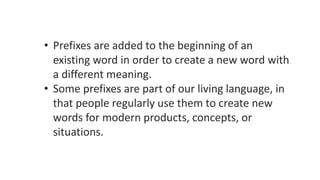
• Prefixes are added to the beginning of an
existing word in order to create a new word with
a different meaning.
• Some prefixes are part of our living language, in
that people regularly use them to create new
words for modern products, concepts, or
situations.
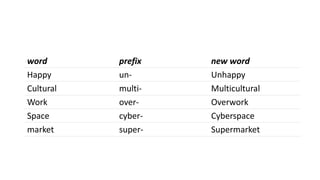
word prefix new word
Happy un- Unhappy
Cultural multi- Multicultural
Work over- Overwork
Space cyber- Cyberspace
market super- Supermarket
A suffix is a group of letters placed after the root of a
word. For example, the word flavorless consists of the
root word “flavor” combined with the suffix “-less”
[which means “without”]; the word “flavorless” means
“having no flavor.”
suffix
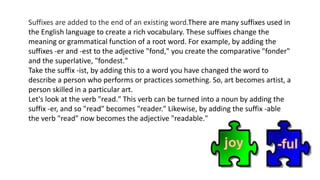
Suffixes are added to the end of an existing word.There are many suffixes used in
the English language to create a rich vocabulary. These suffixes change the
meaning or grammatical function of a root word. For example, by adding the
suffixes -er and -est to the adjective "fond," you create the comparative "fonder"
and the superlative, "fondest."
Take the suffix -ist, by adding this to a word you have changed the word to
describe a person who performs or practices something. So, art becomes artist, a
person skilled in a particular art.
Let's look at the verb "read." This verb can be turned into a noun by adding the
suffix -er, and so "read" becomes "reader." Likewise, by adding the suffix -able
the verb "read" now becomes the adjective "readable."
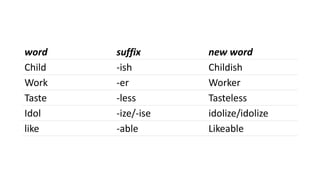
word suffix new word
Child -ish Childish
Work -er Worker
Taste -less Tasteless
Idol -ize/-ise idolize/idolize
like -able Likeable

Prefix suffix

  • 1.
  • 3.
    A prefix isa group of letters placed before the root of a word. For example, the word “unhappy” consists of the prefix “un-” [which means “not”] combined with the root (or stem) word “happy”; the word “unhappy” means “not happy.” Prefix
  • 4.
    • Prefixes areadded to the beginning of an existing word in order to create a new word with a different meaning. • Some prefixes are part of our living language, in that people regularly use them to create new words for modern products, concepts, or situations.
  • 5.
    word prefix newword Happy un- Unhappy Cultural multi- Multicultural Work over- Overwork Space cyber- Cyberspace market super- Supermarket
  • 6.
    A suffix isa group of letters placed after the root of a word. For example, the word flavorless consists of the root word “flavor” combined with the suffix “-less” [which means “without”]; the word “flavorless” means “having no flavor.” suffix
  • 7.
    Suffixes are addedto the end of an existing word.There are many suffixes used in the English language to create a rich vocabulary. These suffixes change the meaning or grammatical function of a root word. For example, by adding the suffixes -er and -est to the adjective "fond," you create the comparative "fonder" and the superlative, "fondest." Take the suffix -ist, by adding this to a word you have changed the word to describe a person who performs or practices something. So, art becomes artist, a person skilled in a particular art. Let's look at the verb "read." This verb can be turned into a noun by adding the suffix -er, and so "read" becomes "reader." Likewise, by adding the suffix -able the verb "read" now becomes the adjective "readable."
  • 8.
    word suffix newword Child -ish Childish Work -er Worker Taste -less Tasteless Idol -ize/-ise idolize/idolize like -able Likeable