ENGLISH GRAMMAR
EASYTO UNDERSTAND; EASY TO LEARN
By Gopal Krushna Panda
“Adjectives”
Class I to XII
Pronouns
What Are Pronouns?
• In linguistics and grammar, a pronoun (abbreviated PRO) is a
word that substitutes for a noun or noun phrase. It is a particular
case of a pro-form.. We often use them to avoid repeating the
nouns that they refer to.
• Pronouns have different forms for the different ways we use
them.
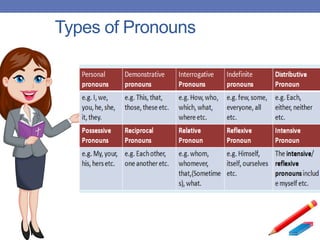
Types of Pronouns
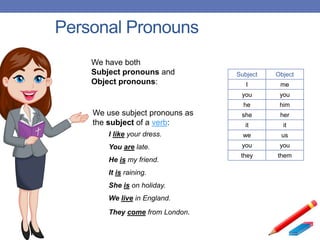
Personal Pronouns
Subject Object
I me
you you
he him
she her
it it
we us
you you
they them
We have both
Subject pronouns and
Object pronouns:
We use subject pronouns as
the subject of a verb:
I like your dress.
You are late.
He is my friend.
It is raining.
She is on holiday.
We live in England.
They come from London.
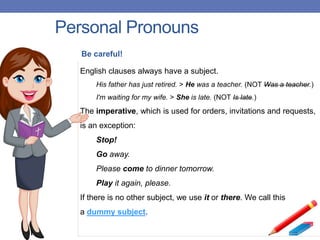
Personal Pronouns
Be careful!
English clauses always have a subject.
His father has just retired. > He was a teacher. (NOT Was a teacher.)
I'm waiting for my wife. > She is late. (NOT Is late.)
The imperative, which is used for orders, invitations and requests,
is an exception:
Stop!
Go away.
Please come to dinner tomorrow.
Play it again, please.
If there is no other subject, we use it or there. We call this
a dummy subject.
Personal Pronouns
We use object pronouns as the object of a verb:
Can you help me, please?
I can see you.
She doesn't like him.
I saw her in town today.
We saw them in town yesterday, but they didn't see us.
and after prepositions:
She is waiting for me.
I'll get it for you.
Give it to him.
Why are you looking at her?
Don't take it from us.
I'll speak to them.
Personal Pronouns
he, she and they
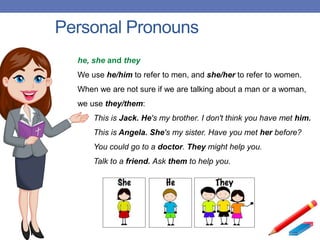
We use he/him to refer to men, and she/her to refer to women.
When we are not sure if we are talking about a man or a woman,
we use they/them:
This is Jack. He's my brother. I don't think you have met him.
This is Angela. She's my sister. Have you met her before?
You could go to a doctor. They might help you.
Talk to a friend. Ask them to help you.
Personal Pronouns
you and they
We use you to talk about people in general, including the speaker
and the hearer:
You can buy this book everywhere. = This book is on sale everywhere.
You can't park here. = Parking is not allowed here.
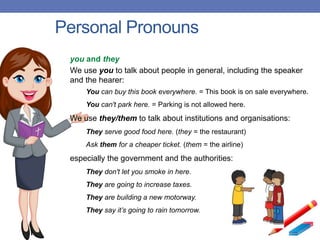
We use they/them to talk about institutions and organisations:
They serve good food here. (they = the restaurant)
Ask them for a cheaper ticket. (them = the airline)
especially the government and the authorities:
They don't let you smoke in here.
They are going to increase taxes.
They are building a new motorway.
They say it’s going to rain tomorrow.
Personal Pronouns
We use it to talk about ourselves:
on the telephone:
Hello. It's George.
when other people cannot see us:
It's me. It's Mary. (Mary is knocking on the door.)
We also use it to talk about other people:
when we point people out for the first time:
Look. It's Paul McCartney.
Who's that? I think it's John's brother.
when we cannot see someone and we ask them for their name:
Hello. Who is it? (someone answering the phone)
Who is it? (someone about to answer the door)
It
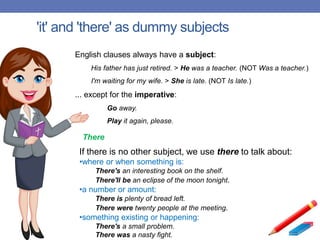
'it' and 'there' as dummy subjects
English clauses always have a subject:
His father has just retired. > He was a teacher. (NOT Was a teacher.)
I'm waiting for my wife. > She is late. (NOT Is late.)
... except for the imperative:
Go away.
Play it again, please.
If there is no other subject, we use there to talk about:
•where or when something is:
There's an interesting book on the shelf.
There'll be an eclipse of the moon tonight.
•a number or amount:
There is plenty of bread left.
There were twenty people at the meeting.
•something existing or happening:
There's a small problem.
There was a nasty fight.
There
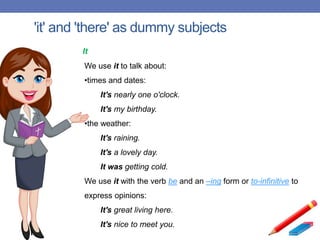
'it' and 'there' as dummy subjects
It
We use it to talk about:
•times and dates:
It's nearly one o'clock.
It's my birthday.
•the weather:
It's raining.
It's a lovely day.
It was getting cold.
We use it with the verb be and an –ing form or to-infinitive to
express opinions:
It's great living here.
It's nice to meet you.
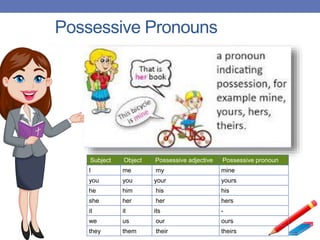
Possessive Pronouns
Subject Object Possessive adjective Possessive pronoun
I me my mine
you you your yours
he him his his
she her her hers
it it its -
we us our ours
they them their theirs
Possessive Pronouns
Be careful!
Possessive pronouns do not have an apostrophe:
Is that car yours/hers/ours/theirs?
(NOT Is that car your's/her's/our's/their's?)
We can use a possessive pronoun instead of a full noun phrase to
avoid repeating words:
Is that John's car?
No, it's mine. (NOT No, it's [my car].)
Whose coat is this?
Is it yours? (NOT Is it [your coat]?)
Her coat is grey.
Mine is brown. (NOT [My coat] is brown.)
We can use possessive pronouns and nouns after of. We
can say:
Susan is one of my friends. > Susan is a friend of mine.
(NOT Susan is a friend of me.)
I am one of Susan's friends. > I am a friend of Susan's.
(NOT I am a friend of Susan.)
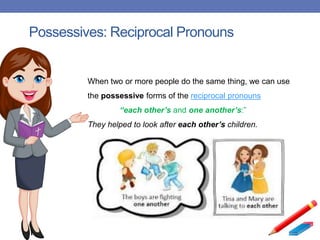
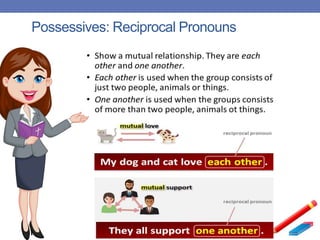
Possessives: Reciprocal Pronouns
When two or more people do the same thing, we can use
the possessive forms of the reciprocal pronouns
“each other’s and one another’s:”
They helped to look after each other’s children.
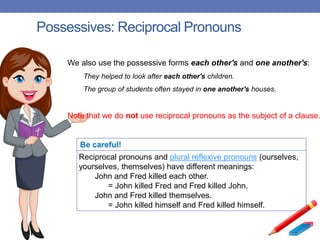
Possessives: Reciprocal Pronouns
We also use the possessive forms each other's and one another's:
They helped to look after each other's children.
The group of students often stayed in one another's houses.
Note that we do not use reciprocal pronouns as the subject of a clause.
Be careful!
Reciprocal pronouns and plural reflexive pronouns (ourselves,
yourselves, themselves) have different meanings:
John and Fred killed each other.
= John killed Fred and Fred killed John.
John and Fred killed themselves.
= John killed himself and Fred killed himself.
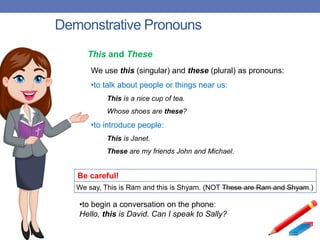
Demonstrative Pronouns
Be careful!
We say, This is Ram and this is Shyam. (NOT These are Ram and Shyam.)
We use this (singular) and these (plural) as pronouns:
•to talk about people or things near us:
This is a nice cup of tea.
Whose shoes are these?
•to introduce people:
This is Janet.
These are my friends John and Michael.
This and These
•to begin a conversation on the phone:
Hello, this is David. Can I speak to Sally?
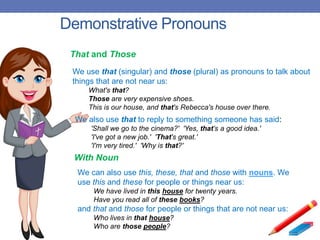
Demonstrative Pronouns
That and Those
We use that (singular) and those (plural) as pronouns to talk about
things that are not near us:
What's that?
Those are very expensive shoes.
This is our house, and that's Rebecca's house over there.
We also use that to reply to something someone has said:
'Shall we go to the cinema?' 'Yes, that’s a good idea.'
'I've got a new job.' 'That's great.'
'I'm very tired.' 'Why is that?'
We can also use this, these, that and those with nouns. We
use this and these for people or things near us:
We have lived in this house for twenty years.
Have you read all of these books?
and that and those for people or things that are not near us:
Who lives in that house?
Who are those people?
With Noun
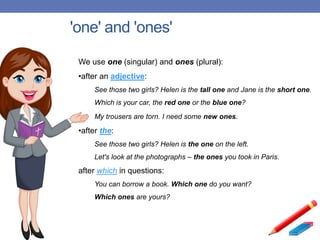
'one' and 'ones'
We use one (singular) and ones (plural):
•after an adjective:
See those two girls? Helen is the tall one and Jane is the short one.
Which is your car, the red one or the blue one?
My trousers are torn. I need some new ones.
•after the:
See those two girls? Helen is the one on the left.
Let's look at the photographs – the ones you took in Paris.
after which in questions:
You can borrow a book. Which one do you want?
Which ones are yours?
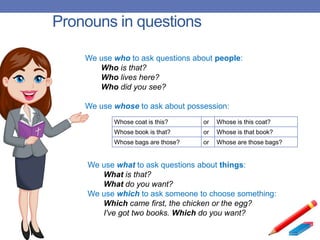
Pronouns in questions
We use who to ask questions about people:
Who is that?
Who lives here?
Who did you see?
We use whose to ask about possession:
Whose coat is this? or Whose is this coat?
Whose book is that? or Whose is that book?
Whose bags are those? or Whose are those bags?
We use what to ask questions about things:
What is that?
What do you want?
We use which to ask someone to choose something:
Which came first, the chicken or the egg?
I've got two books. Which do you want?
Pronouns in questions
We can also use what and which with nouns:
What subjects did you study at school?
What newspaper do you read?
Which newspaper do you read – The Times or The Hindu?
Which book do you want?
Which one is yours?
We often have a preposition at the end of a question:
Who does this book belong to?
What are you looking for?
Which university did you go to?
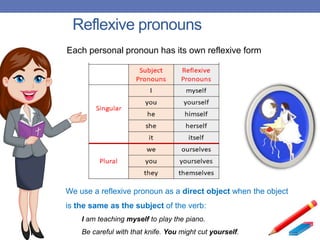
Reflexive pronouns
Each personal pronoun has its own reflexive form
We use a reflexive pronoun as a direct object when the object
is the same as the subject of the verb:
I am teaching myself to play the piano.
Be careful with that knife. You might cut yourself.
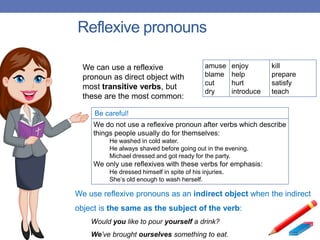
Reflexive pronouns
amuse
blame
cut
dry
enjoy
help
hurt
introduce
kill
prepare
satisfy
teach
We can use a reflexive
pronoun as direct object with
most transitive verbs, but
these are the most common:
Be careful!
We do not use a reflexive pronoun after verbs which describe
things people usually do for themselves:
He washed in cold water.
He always shaved before going out in the evening.
Michael dressed and got ready for the party.
We only use reflexives with these verbs for emphasis:
He dressed himself in spite of his injuries.
She’s old enough to wash herself.
We use reflexive pronouns as an indirect object when the indirect
object is the same as the subject of the verb:
Would you like to pour yourself a drink?
We’ve brought ourselves something to eat.
Reflexive pronouns
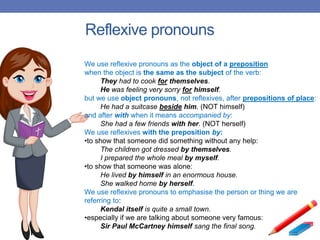
We use reflexive pronouns as the object of a preposition
when the object is the same as the subject of the verb:
They had to cook for themselves.
He was feeling very sorry for himself.
but we use object pronouns, not reflexives, after prepositions of place:
He had a suitcase beside him. (NOT himself)
and after with when it means accompanied by:
She had a few friends with her. (NOT herself)
We use reflexives with the preposition by:
•to show that someone did something without any help:
The children got dressed by themselves.
I prepared the whole meal by myself.
•to show that someone was alone:
He lived by himself in an enormous house.
She walked home by herself.
We use reflexive pronouns to emphasise the person or thing we are
referring to:
Kendal itself is quite a small town.
•especially if we are talking about someone very famous:
Sir Paul McCartney himself sang the final song.
Reflexive pronouns
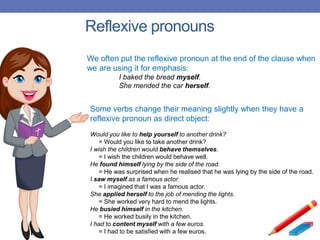
We often put the reflexive pronoun at the end of the clause when
we are using it for emphasis:
I baked the bread myself.
She mended the car herself.
Some verbs change their meaning slightly when they have a
reflexive pronoun as direct object:
Would you like to help yourself to another drink?
= Would you like to take another drink?
I wish the children would behave themselves.
= I wish the children would behave well.
He found himself lying by the side of the road.
= He was surprised when he realised that he was lying by the side of the road.
I saw myself as a famous actor.
= I imagined that I was a famous actor.
She applied herself to the job of mending the lights.
= She worked very hard to mend the lights.
He busied himself in the kitchen.
= He worked busily in the kitchen.
I had to content myself with a few euros.
= I had to be satisfied with a few euros.
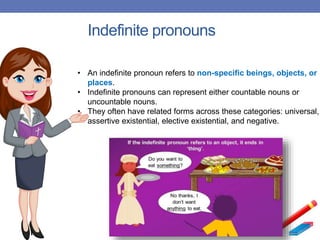
Indefinite pronouns
• An indefinite pronoun refers to non-specific beings, objects, or
places.
• Indefinite pronouns can represent either countable nouns or
uncountable nouns.
• They often have related forms across these categories: universal,
assertive existential, elective existential, and negative.
Indefinite pronouns
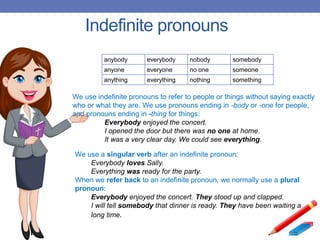
anybody everybody nobody somebody
anyone everyone no one someone
anything everything nothing something
We use indefinite pronouns to refer to people or things without saying exactly
who or what they are. We use pronouns ending in -body or -one for people,
and pronouns ending in -thing for things:
Everybody enjoyed the concert.
I opened the door but there was no one at home.
It was a very clear day. We could see everything.
We use a singular verb after an indefinite pronoun:
Everybody loves Sally.
Everything was ready for the party.
When we refer back to an indefinite pronoun, we normally use a plural
pronoun:
Everybody enjoyed the concert. They stood up and clapped.
I will tell somebody that dinner is ready. They have been waiting a
long time.
Indefinite pronouns
Be careful!
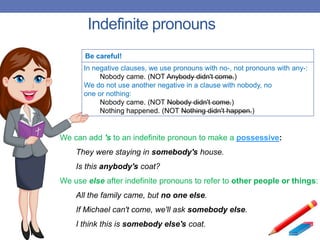
In negative clauses, we use pronouns with no-, not pronouns with any-:
Nobody came. (NOT Anybody didn't come.)
We do not use another negative in a clause with nobody, no
one or nothing:
Nobody came. (NOT Nobody didn't come.)
Nothing happened. (NOT Nothing didn't happen.)
We can add 's to an indefinite pronoun to make a possessive:
They were staying in somebody's house.
Is this anybody's coat?
We use else after indefinite pronouns to refer to other people or things:
All the family came, but no one else.
If Michael can't come, we'll ask somebody else.
I think this is somebody else's coat.
Relative pronouns and relative clauses
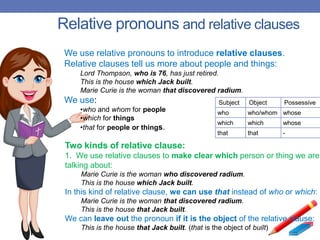
We use relative pronouns to introduce relative clauses.
Relative clauses tell us more about people and things:
Lord Thompson, who is 76, has just retired.
This is the house which Jack built.
Marie Curie is the woman that discovered radium.
We use:
•who and whom for people
•which for things
•that for people or things.
Subject Object Possessive
who who/whom whose
which which whose
that that -
Two kinds of relative clause:
1. We use relative clauses to make clear which person or thing we are
talking about:
Marie Curie is the woman who discovered radium.
This is the house which Jack built.
In this kind of relative clause, we can use that instead of who or which:
Marie Curie is the woman that discovered radium.
This is the house that Jack built.
We can leave out the pronoun if it is the object of the relative clause:
This is the house that Jack built. (that is the object of built)
Relative pronouns and relative clauses
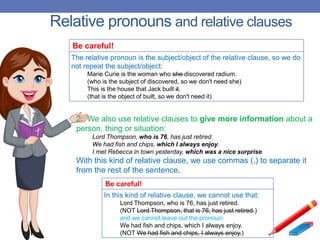
Be careful!
The relative pronoun is the subject/object of the relative clause, so we do
not repeat the subject/object:
Marie Curie is the woman who she discovered radium.
(who is the subject of discovered, so we don't need she)
This is the house that Jack built it.
(that is the object of built, so we don't need it)
2. We also use relative clauses to give more information about a
person, thing or situation:
Lord Thompson, who is 76, has just retired.
We had fish and chips, which I always enjoy.
I met Rebecca in town yesterday, which was a nice surprise.
With this kind of relative clause, we use commas (,) to separate it
from the rest of the sentence.
Be careful!
In this kind of relative clause, we cannot use that:
Lord Thompson, who is 76, has just retired.
(NOT Lord Thompson, that is 76, has just retired.)
and we cannot leave out the pronoun:
We had fish and chips, which I always enjoy.
(NOT We had fish and chips, I always enjoy.)
Relative pronouns and relative clauses
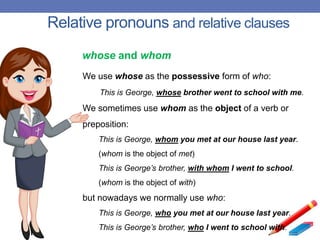
We use whose as the possessive form of who:
This is George, whose brother went to school with me.
We sometimes use whom as the object of a verb or
preposition:
This is George, whom you met at our house last year.
(whom is the object of met)
This is George’s brother, with whom I went to school.
(whom is the object of with)
but nowadays we normally use who:
This is George, who you met at our house last year.
This is George’s brother, who I went to school with.
whose and whom
Relative pronouns and relative clauses
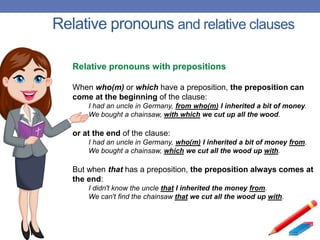
Relative pronouns with prepositions
When who(m) or which have a preposition, the preposition can
come at the beginning of the clause:
I had an uncle in Germany, from who(m) I inherited a bit of money.
We bought a chainsaw, with which we cut up all the wood.
or at the end of the clause:
I had an uncle in Germany, who(m) I inherited a bit of money from.
We bought a chainsaw, which we cut all the wood up with.
But when that has a preposition, the preposition always comes at
the end:
I didn't know the uncle that I inherited the money from.
We can't find the chainsaw that we cut all the wood up with.
Relative pronouns and relative clauses
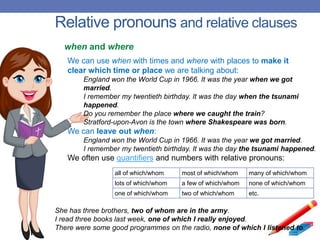
We can use when with times and where with places to make it
clear which time or place we are talking about:
England won the World Cup in 1966. It was the year when we got
married.
I remember my twentieth birthday. It was the day when the tsunami
happened.
Do you remember the place where we caught the train?
Stratford-upon-Avon is the town where Shakespeare was born.
We can leave out when:
England won the World Cup in 1966. It was the year we got married.
I remember my twentieth birthday. It was the day the tsunami happened.
We often use quantifiers and numbers with relative pronouns:
when and where
all of which/whom most of which/whom many of which/whom
lots of which/whom a few of which/whom none of which/whom
one of which/whom two of which/whom etc.
She has three brothers, two of whom are in the army.
I read three books last week, one of which I really enjoyed.
There were some good programmes on the radio, none of which I listened to.
COMING UP NEXT…
“Tag Question”
By Gopal Krushna Panda

Understanding pronouns

  • 1.
    ENGLISH GRAMMAR EASYTO UNDERSTAND;EASY TO LEARN By Gopal Krushna Panda “Adjectives” Class I to XII
  • 2.
    Pronouns What Are Pronouns? •In linguistics and grammar, a pronoun (abbreviated PRO) is a word that substitutes for a noun or noun phrase. It is a particular case of a pro-form.. We often use them to avoid repeating the nouns that they refer to. • Pronouns have different forms for the different ways we use them.
  • 3.
  • 4.
    Personal Pronouns Subject Object Ime you you he him she her it it we us you you they them We have both Subject pronouns and Object pronouns: We use subject pronouns as the subject of a verb: I like your dress. You are late. He is my friend. It is raining. She is on holiday. We live in England. They come from London.
  • 5.
    Personal Pronouns Be careful! Englishclauses always have a subject. His father has just retired. > He was a teacher. (NOT Was a teacher.) I'm waiting for my wife. > She is late. (NOT Is late.) The imperative, which is used for orders, invitations and requests, is an exception: Stop! Go away. Please come to dinner tomorrow. Play it again, please. If there is no other subject, we use it or there. We call this a dummy subject.
  • 6.
    Personal Pronouns We useobject pronouns as the object of a verb: Can you help me, please? I can see you. She doesn't like him. I saw her in town today. We saw them in town yesterday, but they didn't see us. and after prepositions: She is waiting for me. I'll get it for you. Give it to him. Why are you looking at her? Don't take it from us. I'll speak to them.
  • 7.
    Personal Pronouns he, sheand they We use he/him to refer to men, and she/her to refer to women. When we are not sure if we are talking about a man or a woman, we use they/them: This is Jack. He's my brother. I don't think you have met him. This is Angela. She's my sister. Have you met her before? You could go to a doctor. They might help you. Talk to a friend. Ask them to help you.
  • 8.
    Personal Pronouns you andthey We use you to talk about people in general, including the speaker and the hearer: You can buy this book everywhere. = This book is on sale everywhere. You can't park here. = Parking is not allowed here. We use they/them to talk about institutions and organisations: They serve good food here. (they = the restaurant) Ask them for a cheaper ticket. (them = the airline) especially the government and the authorities: They don't let you smoke in here. They are going to increase taxes. They are building a new motorway. They say it’s going to rain tomorrow.
  • 9.
    Personal Pronouns We useit to talk about ourselves: on the telephone: Hello. It's George. when other people cannot see us: It's me. It's Mary. (Mary is knocking on the door.) We also use it to talk about other people: when we point people out for the first time: Look. It's Paul McCartney. Who's that? I think it's John's brother. when we cannot see someone and we ask them for their name: Hello. Who is it? (someone answering the phone) Who is it? (someone about to answer the door) It
  • 10.
    'it' and 'there'as dummy subjects English clauses always have a subject: His father has just retired. > He was a teacher. (NOT Was a teacher.) I'm waiting for my wife. > She is late. (NOT Is late.) ... except for the imperative: Go away. Play it again, please. If there is no other subject, we use there to talk about: •where or when something is: There's an interesting book on the shelf. There'll be an eclipse of the moon tonight. •a number or amount: There is plenty of bread left. There were twenty people at the meeting. •something existing or happening: There's a small problem. There was a nasty fight. There
  • 11.
    'it' and 'there'as dummy subjects It We use it to talk about: •times and dates: It's nearly one o'clock. It's my birthday. •the weather: It's raining. It's a lovely day. It was getting cold. We use it with the verb be and an –ing form or to-infinitive to express opinions: It's great living here. It's nice to meet you.
  • 12.
    Possessive Pronouns Subject ObjectPossessive adjective Possessive pronoun I me my mine you you your yours he him his his she her her hers it it its - we us our ours they them their theirs
  • 13.
    Possessive Pronouns Be careful! Possessivepronouns do not have an apostrophe: Is that car yours/hers/ours/theirs? (NOT Is that car your's/her's/our's/their's?) We can use a possessive pronoun instead of a full noun phrase to avoid repeating words: Is that John's car? No, it's mine. (NOT No, it's [my car].) Whose coat is this? Is it yours? (NOT Is it [your coat]?) Her coat is grey. Mine is brown. (NOT [My coat] is brown.) We can use possessive pronouns and nouns after of. We can say: Susan is one of my friends. > Susan is a friend of mine. (NOT Susan is a friend of me.) I am one of Susan's friends. > I am a friend of Susan's. (NOT I am a friend of Susan.)
  • 14.
    Possessives: Reciprocal Pronouns Whentwo or more people do the same thing, we can use the possessive forms of the reciprocal pronouns “each other’s and one another’s:” They helped to look after each other’s children.
  • 15.
  • 16.
    Possessives: Reciprocal Pronouns Wealso use the possessive forms each other's and one another's: They helped to look after each other's children. The group of students often stayed in one another's houses. Note that we do not use reciprocal pronouns as the subject of a clause. Be careful! Reciprocal pronouns and plural reflexive pronouns (ourselves, yourselves, themselves) have different meanings: John and Fred killed each other. = John killed Fred and Fred killed John. John and Fred killed themselves. = John killed himself and Fred killed himself.
  • 17.
    Demonstrative Pronouns Be careful! Wesay, This is Ram and this is Shyam. (NOT These are Ram and Shyam.) We use this (singular) and these (plural) as pronouns: •to talk about people or things near us: This is a nice cup of tea. Whose shoes are these? •to introduce people: This is Janet. These are my friends John and Michael. This and These •to begin a conversation on the phone: Hello, this is David. Can I speak to Sally?
  • 18.
    Demonstrative Pronouns That andThose We use that (singular) and those (plural) as pronouns to talk about things that are not near us: What's that? Those are very expensive shoes. This is our house, and that's Rebecca's house over there. We also use that to reply to something someone has said: 'Shall we go to the cinema?' 'Yes, that’s a good idea.' 'I've got a new job.' 'That's great.' 'I'm very tired.' 'Why is that?' We can also use this, these, that and those with nouns. We use this and these for people or things near us: We have lived in this house for twenty years. Have you read all of these books? and that and those for people or things that are not near us: Who lives in that house? Who are those people? With Noun
  • 19.
    'one' and 'ones' Weuse one (singular) and ones (plural): •after an adjective: See those two girls? Helen is the tall one and Jane is the short one. Which is your car, the red one or the blue one? My trousers are torn. I need some new ones. •after the: See those two girls? Helen is the one on the left. Let's look at the photographs – the ones you took in Paris. after which in questions: You can borrow a book. Which one do you want? Which ones are yours?
  • 20.
    Pronouns in questions Weuse who to ask questions about people: Who is that? Who lives here? Who did you see? We use whose to ask about possession: Whose coat is this? or Whose is this coat? Whose book is that? or Whose is that book? Whose bags are those? or Whose are those bags? We use what to ask questions about things: What is that? What do you want? We use which to ask someone to choose something: Which came first, the chicken or the egg? I've got two books. Which do you want?
  • 21.
    Pronouns in questions Wecan also use what and which with nouns: What subjects did you study at school? What newspaper do you read? Which newspaper do you read – The Times or The Hindu? Which book do you want? Which one is yours? We often have a preposition at the end of a question: Who does this book belong to? What are you looking for? Which university did you go to?
  • 22.
    Reflexive pronouns Each personalpronoun has its own reflexive form We use a reflexive pronoun as a direct object when the object is the same as the subject of the verb: I am teaching myself to play the piano. Be careful with that knife. You might cut yourself.
  • 23.
    Reflexive pronouns amuse blame cut dry enjoy help hurt introduce kill prepare satisfy teach We canuse a reflexive pronoun as direct object with most transitive verbs, but these are the most common: Be careful! We do not use a reflexive pronoun after verbs which describe things people usually do for themselves: He washed in cold water. He always shaved before going out in the evening. Michael dressed and got ready for the party. We only use reflexives with these verbs for emphasis: He dressed himself in spite of his injuries. She’s old enough to wash herself. We use reflexive pronouns as an indirect object when the indirect object is the same as the subject of the verb: Would you like to pour yourself a drink? We’ve brought ourselves something to eat.
  • 24.
    Reflexive pronouns We usereflexive pronouns as the object of a preposition when the object is the same as the subject of the verb: They had to cook for themselves. He was feeling very sorry for himself. but we use object pronouns, not reflexives, after prepositions of place: He had a suitcase beside him. (NOT himself) and after with when it means accompanied by: She had a few friends with her. (NOT herself) We use reflexives with the preposition by: •to show that someone did something without any help: The children got dressed by themselves. I prepared the whole meal by myself. •to show that someone was alone: He lived by himself in an enormous house. She walked home by herself. We use reflexive pronouns to emphasise the person or thing we are referring to: Kendal itself is quite a small town. •especially if we are talking about someone very famous: Sir Paul McCartney himself sang the final song.
  • 25.
    Reflexive pronouns We oftenput the reflexive pronoun at the end of the clause when we are using it for emphasis: I baked the bread myself. She mended the car herself. Some verbs change their meaning slightly when they have a reflexive pronoun as direct object: Would you like to help yourself to another drink? = Would you like to take another drink? I wish the children would behave themselves. = I wish the children would behave well. He found himself lying by the side of the road. = He was surprised when he realised that he was lying by the side of the road. I saw myself as a famous actor. = I imagined that I was a famous actor. She applied herself to the job of mending the lights. = She worked very hard to mend the lights. He busied himself in the kitchen. = He worked busily in the kitchen. I had to content myself with a few euros. = I had to be satisfied with a few euros.
  • 26.
    Indefinite pronouns • Anindefinite pronoun refers to non-specific beings, objects, or places. • Indefinite pronouns can represent either countable nouns or uncountable nouns. • They often have related forms across these categories: universal, assertive existential, elective existential, and negative.
  • 27.
    Indefinite pronouns anybody everybodynobody somebody anyone everyone no one someone anything everything nothing something We use indefinite pronouns to refer to people or things without saying exactly who or what they are. We use pronouns ending in -body or -one for people, and pronouns ending in -thing for things: Everybody enjoyed the concert. I opened the door but there was no one at home. It was a very clear day. We could see everything. We use a singular verb after an indefinite pronoun: Everybody loves Sally. Everything was ready for the party. When we refer back to an indefinite pronoun, we normally use a plural pronoun: Everybody enjoyed the concert. They stood up and clapped. I will tell somebody that dinner is ready. They have been waiting a long time.
  • 28.
    Indefinite pronouns Be careful! Innegative clauses, we use pronouns with no-, not pronouns with any-: Nobody came. (NOT Anybody didn't come.) We do not use another negative in a clause with nobody, no one or nothing: Nobody came. (NOT Nobody didn't come.) Nothing happened. (NOT Nothing didn't happen.) We can add 's to an indefinite pronoun to make a possessive: They were staying in somebody's house. Is this anybody's coat? We use else after indefinite pronouns to refer to other people or things: All the family came, but no one else. If Michael can't come, we'll ask somebody else. I think this is somebody else's coat.
  • 29.
    Relative pronouns andrelative clauses We use relative pronouns to introduce relative clauses. Relative clauses tell us more about people and things: Lord Thompson, who is 76, has just retired. This is the house which Jack built. Marie Curie is the woman that discovered radium. We use: •who and whom for people •which for things •that for people or things. Subject Object Possessive who who/whom whose which which whose that that - Two kinds of relative clause: 1. We use relative clauses to make clear which person or thing we are talking about: Marie Curie is the woman who discovered radium. This is the house which Jack built. In this kind of relative clause, we can use that instead of who or which: Marie Curie is the woman that discovered radium. This is the house that Jack built. We can leave out the pronoun if it is the object of the relative clause: This is the house that Jack built. (that is the object of built)
  • 30.
    Relative pronouns andrelative clauses Be careful! The relative pronoun is the subject/object of the relative clause, so we do not repeat the subject/object: Marie Curie is the woman who she discovered radium. (who is the subject of discovered, so we don't need she) This is the house that Jack built it. (that is the object of built, so we don't need it) 2. We also use relative clauses to give more information about a person, thing or situation: Lord Thompson, who is 76, has just retired. We had fish and chips, which I always enjoy. I met Rebecca in town yesterday, which was a nice surprise. With this kind of relative clause, we use commas (,) to separate it from the rest of the sentence. Be careful! In this kind of relative clause, we cannot use that: Lord Thompson, who is 76, has just retired. (NOT Lord Thompson, that is 76, has just retired.) and we cannot leave out the pronoun: We had fish and chips, which I always enjoy. (NOT We had fish and chips, I always enjoy.)
  • 31.
    Relative pronouns andrelative clauses We use whose as the possessive form of who: This is George, whose brother went to school with me. We sometimes use whom as the object of a verb or preposition: This is George, whom you met at our house last year. (whom is the object of met) This is George’s brother, with whom I went to school. (whom is the object of with) but nowadays we normally use who: This is George, who you met at our house last year. This is George’s brother, who I went to school with. whose and whom
  • 32.
    Relative pronouns andrelative clauses Relative pronouns with prepositions When who(m) or which have a preposition, the preposition can come at the beginning of the clause: I had an uncle in Germany, from who(m) I inherited a bit of money. We bought a chainsaw, with which we cut up all the wood. or at the end of the clause: I had an uncle in Germany, who(m) I inherited a bit of money from. We bought a chainsaw, which we cut all the wood up with. But when that has a preposition, the preposition always comes at the end: I didn't know the uncle that I inherited the money from. We can't find the chainsaw that we cut all the wood up with.
  • 33.
    Relative pronouns andrelative clauses We can use when with times and where with places to make it clear which time or place we are talking about: England won the World Cup in 1966. It was the year when we got married. I remember my twentieth birthday. It was the day when the tsunami happened. Do you remember the place where we caught the train? Stratford-upon-Avon is the town where Shakespeare was born. We can leave out when: England won the World Cup in 1966. It was the year we got married. I remember my twentieth birthday. It was the day the tsunami happened. We often use quantifiers and numbers with relative pronouns: when and where all of which/whom most of which/whom many of which/whom lots of which/whom a few of which/whom none of which/whom one of which/whom two of which/whom etc. She has three brothers, two of whom are in the army. I read three books last week, one of which I really enjoyed. There were some good programmes on the radio, none of which I listened to.
  • 34.
    COMING UP NEXT… “TagQuestion” By Gopal Krushna Panda