Lesson 1
WORD
meaningful unit of language
sounds: a meaningful sound
or combination of sounds that
is a unit of language or its
representation in a text
-(Encarta Dictionaries & American Heritage Dictionary)
Base, original word
Can be added with either prefixes or suffixes
to create other words
Ex: benefit, benevolent
unbeneficial, benediction
ROOT WORD
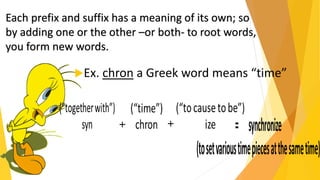
Each prefix and suffix has a meaning of its own; so
by adding one or the other –or both- to root words,
you form new words.
Ex. chron a Greek word means “time”
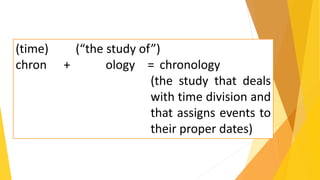
(time) (“the study of”)
chron + ology = chronology
(the study that deals
with time division and
that assigns events to
their proper dates)
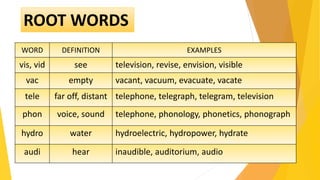
WORD DEFINITION EXAMPLES
vis, vid see television, revise, envision, visible
vac empty vacant, vacuum, evacuate, vacate
tele far off, distant telephone, telegraph, telegram, television
phon voice, sound telephone, phonology, phonetics, phonograph
hydro water hydroelectric, hydropower, hydrate
audi hear inaudible, auditorium, audio
ROOT WORDS
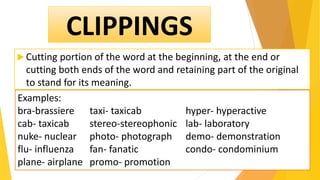
 Cutting portion of the word at the beginning, at the end or
cutting both ends of the word and retaining part of the original
to stand for its meaning.
CLIPPINGS
Examples:
bra-brassiere taxi- taxicab hyper- hyperactive
cab- taxicab stereo-stereophonic lab- laboratory
nuke- nuclear photo- photograph demo- demonstration
flu- influenza fan- fanatic condo- condominium
plane- airplane promo- promotion
Lets give a shot!
Write the clipped form of the following terms and use them in meaningful sentences.
1. psychology - ________________________________
Sentence___________________________________
2. microphone - ________________________________
Sentence___________________________________
3. professor - ________________________________
Sentence___________________________________
4. schedule - ________________________________
Sentence___________________________________
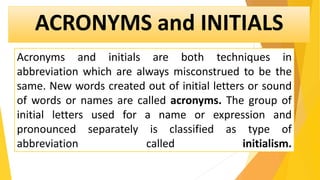
ACRONYMS and INITIALS
Acronyms and initials are both techniques in
abbreviation which are always misconstrued to be the
same. New words created out of initial letters or sound
of words or names are called acronyms. The group of
initial letters used for a name or expression and
pronounced separately is classified as type of
abbreviation called initialism.
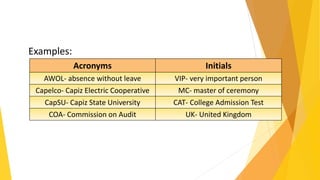
Examples:
Acronyms Initials
AWOL- absence without leave VIP- very important person
Capelco- Capiz Electric Cooperative MC- master of ceremony
CapSU- Capiz State University CAT- College Admission Test
COA- Commission on Audit UK- United Kingdom
Let’s give a shot!
Tell what the following acronyms and initials stand for. Then use the dictionary to
define them.
1. SOP stands for:_______________________________________
It means:________________
2. Laser stands for:_______________________________________
It means:________________
3. Scuba stands for:_______________________________________
It means:________________
4. ALS stands for:_______________________________________
It means:________________
5. DOLE stands for:_______________________________________
It means:________________
Blending
 Another word formation process where portions of two words
are combined or fused together, thus creating a new word.
Examples:
internet- inter and network heliport- helicopter and airport
cellphone- cellular and phone motel- motorist and hotel
emoticon- emotion and icon flare- flame and glare
Three ways of blending words:
 The beginning of the word is added to the end of the other word.
Example: brunch – breakfast and lunch
 Both the beginning of the words are added.
Example: cyborg – cybernetic and organism
 Combining two words entirely without clipping or adding its parts
to form new word.
Example: thumbprint– thumb and print
Let’s give it a shot!
Find out where the following words came and give their meaning.
1. pixel __________________ ____________________
_____________________________________________________
2. maxicare __________________ ____________________
_____________________________________________________
3. telecast __________________ ____________________
_____________________________________________________
Merge the following words and indicate what method is used in the combination. Write the letters only.
A. The beginning of the word is added to the end of the other word
B. Both the beginning of the words are added.
C. Two words are combined
Merged Word Method
1. camera and recorder ___________ ______
2. town and house ___________ ______
3. motor and cavalcade ___________ ______
4. Splash and surge ___________ ______
5. of the clock ___________ ______
Prefixes
A prefix is a group of letters that is added at
the beginning of a word (called a root) to
create a new word with a different meaning.
Ex.
reunion insignificant preliminary
incorporate unfriend television
A hyphen separates the word
when prefix is joined to a proper
noun or a number.
neo-Freudian
pre-1900s
The new word, if spelled
without a hyphen, could be
confused with another word.
re-creation [the creation of something for a second time]
recreation [an enjoyable activity]
re-sign [to sign again]
resign [to submit or relinquish]
The same vowel appears at the end
of the prefix and the beginning of
the root.
anti-intellectual
co-ownership
Suffixes
 A suffix is a group of letters added to the end of
a word (called a root) to create a new word with
a different meaning or, more often, to indicate a
change in the root word’s function.
 For example, adding the -ed suffix to the present
stem of a regular verb puts the verb in the past
tense.
talk + ed = talked
The addition of a suffix frequently
causes spelling errors because the
spelling of some roots must be
changed before a suffix can be
attached.
Eat
Eaten Eating
A group of letters added to the
end of the word to form a new
word, the meaning of which is
usually different from
the original word.
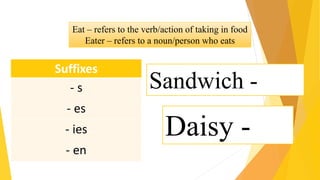
Eat – refers to the verb/action of taking in food
Eater – refers to a noun/person who eats
Sandwich -
Daisy -
1.A suffix is a letter or group of letters added to the end of a word to form a
new word, the meaning of which is usually different from that of the original
word.
2. Suffixes modify the root word to which they are added.
3. Suffixes are used to form plural of nouns.
Example: -s, -es, -ies and – er
4. Suffixes are used to change the tense of a verb.
Example: - s, -es, -d, ed, -t, - ing
5. Suffixes are used to form an adverb from adjectives.
Examples: - ly
6. The suffixes – er, -ful, and –less are some of the commonly used suffixes.
7. For root word ending in – e, only – r is added.
8. For root word ending in – y is dropped and replaced with – ier.
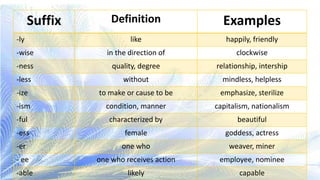
Suffix Definition Examples
-ly like happily, friendly
-wise in the direction of clockwise
-ness quality, degree relationship, intership
-less without mindless, helpless
-ize to make or cause to be emphasize, sterilize
-ism condition, manner capitalism, nationalism
-ful characterized by beautiful
-ess female goddess, actress
-er one who weaver, miner
- ee one who receives action employee, nominee
-able likely capable
General Rules that govern the most
common spelling changes required by
adding a suffix
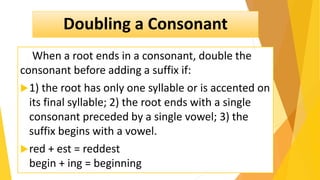
Doubling a Consonant
When a root ends in a consonant, double the
consonant before adding a suffix if:
1) the root has only one syllable or is accented on
its final syllable; 2) the root ends with a single
consonant preceded by a single vowel; 3) the
suffix begins with a vowel.
red + est = reddest
begin + ing = beginning
Do not double the consonant if the root ends in w, x, or y.
 tow + ed = towed
lax + est = laxest
play + er = player
The root ends with a single consonant preceded by two
vowels.
 bloat + ing = bloating
The root has two or more syllables and is not accented on the
final one.
 suffer + ed = suffered
Dropping a silent e
If a root ends in a silent e, delete the e
before adding a suffix if:
1) the e is preceded by a consonant; 2) the
suffix begins with a vowel.
merge + ing = merging
the e is preceded by an o.
hoe + ed = hoed
Retain the silent e if
1) the e is preceded by a consonant; 2) the suffix
begins with a consonant.
like + ness = likeness
1) the e is preceded by a soft c (pronounced like an
s) or a soft g (pronounced like a j); 2) the suffix
begins with an a, o, or u.
notice + able = noticeable
courage + ous = courageous
Changing a Final ie to a y
If a root ends in ie, change the ie to a y
before adding ing.
die + ing = dying
Changing a Final y to an i
If a root ends in a consonant followed by a y,
change the y to an i before adding a suffix unless
the suffix begins with an i.
busy + ness = business
But: carry + ing = carrying
If a vowel precedes the y, however, retain the y.
obey + ing = obeying
Adding a k after a Final c
If root ends with a hard c (pronounced like
a k), insert a k before adding a suffix that
begins with an i, an e, or a y.
panic + ed = panicked
No k is needed if:
the suffix begins with an a, an o, a u, or a
consonant.
frolic + some = frolicsome
the c at the end of the root becomes soft
(pronounced like an s) after the suffix is added.
critic + ism = criticism
Hyphens Before
Suffixes
When a suffix is added to a root, the
result is usually spelled as one word.
-twofold -handbook
The suffixes elect and odd are
exceptions. They should always be
connected to a root word with a hyphen.
-governor-elect -twenty-odd
If a root is a proper noun, a
hyphen should usually be
inserted before adding a suffix.
American-like
Miami-wide
Analyze the following words carefully and identify the
prefix, root word, suffix and its meaning and derivation.
word prefix root word suffix meaning derivation
irreplaceable
donated
adventurous
Intangible
impotency
numerology
unconditional
References
 Antonio, Maria Theresa M. et.al.,2012. Building Vocabulary and Grammar
Skills. Mutya Pub. House, Inc. 105 engineering Road, Araneta University
Village, Potrero, Malabon City. pp.4-21.
 (Encarta Dictionaries & American Heritage Dictionary)
 Microsoft ® Encarta ® 2009. © 1993-2008 Microsoft Corporation. All rights
reserved.
Reported by:
END.
Thank you!!!

Word formation

  • 1.
  • 2.
    WORD meaningful unit oflanguage sounds: a meaningful sound or combination of sounds that is a unit of language or its representation in a text -(Encarta Dictionaries & American Heritage Dictionary)
  • 3.
    Base, original word Canbe added with either prefixes or suffixes to create other words Ex: benefit, benevolent unbeneficial, benediction ROOT WORD
  • 4.
    Each prefix andsuffix has a meaning of its own; so by adding one or the other –or both- to root words, you form new words. Ex. chron a Greek word means “time”
  • 5.
    (time) (“the studyof”) chron + ology = chronology (the study that deals with time division and that assigns events to their proper dates)
  • 6.
    WORD DEFINITION EXAMPLES vis,vid see television, revise, envision, visible vac empty vacant, vacuum, evacuate, vacate tele far off, distant telephone, telegraph, telegram, television phon voice, sound telephone, phonology, phonetics, phonograph hydro water hydroelectric, hydropower, hydrate audi hear inaudible, auditorium, audio ROOT WORDS
  • 7.
     Cutting portionof the word at the beginning, at the end or cutting both ends of the word and retaining part of the original to stand for its meaning. CLIPPINGS Examples: bra-brassiere taxi- taxicab hyper- hyperactive cab- taxicab stereo-stereophonic lab- laboratory nuke- nuclear photo- photograph demo- demonstration flu- influenza fan- fanatic condo- condominium plane- airplane promo- promotion
  • 8.
    Lets give ashot! Write the clipped form of the following terms and use them in meaningful sentences. 1. psychology - ________________________________ Sentence___________________________________ 2. microphone - ________________________________ Sentence___________________________________ 3. professor - ________________________________ Sentence___________________________________ 4. schedule - ________________________________ Sentence___________________________________
  • 9.
    ACRONYMS and INITIALS Acronymsand initials are both techniques in abbreviation which are always misconstrued to be the same. New words created out of initial letters or sound of words or names are called acronyms. The group of initial letters used for a name or expression and pronounced separately is classified as type of abbreviation called initialism.
  • 10.
    Examples: Acronyms Initials AWOL- absencewithout leave VIP- very important person Capelco- Capiz Electric Cooperative MC- master of ceremony CapSU- Capiz State University CAT- College Admission Test COA- Commission on Audit UK- United Kingdom
  • 11.
    Let’s give ashot! Tell what the following acronyms and initials stand for. Then use the dictionary to define them. 1. SOP stands for:_______________________________________ It means:________________ 2. Laser stands for:_______________________________________ It means:________________ 3. Scuba stands for:_______________________________________ It means:________________ 4. ALS stands for:_______________________________________ It means:________________ 5. DOLE stands for:_______________________________________ It means:________________
  • 12.
    Blending  Another wordformation process where portions of two words are combined or fused together, thus creating a new word. Examples: internet- inter and network heliport- helicopter and airport cellphone- cellular and phone motel- motorist and hotel emoticon- emotion and icon flare- flame and glare
  • 13.
    Three ways ofblending words:  The beginning of the word is added to the end of the other word. Example: brunch – breakfast and lunch  Both the beginning of the words are added. Example: cyborg – cybernetic and organism  Combining two words entirely without clipping or adding its parts to form new word. Example: thumbprint– thumb and print
  • 14.
    Let’s give ita shot! Find out where the following words came and give their meaning. 1. pixel __________________ ____________________ _____________________________________________________ 2. maxicare __________________ ____________________ _____________________________________________________ 3. telecast __________________ ____________________ _____________________________________________________ Merge the following words and indicate what method is used in the combination. Write the letters only. A. The beginning of the word is added to the end of the other word B. Both the beginning of the words are added. C. Two words are combined Merged Word Method 1. camera and recorder ___________ ______ 2. town and house ___________ ______ 3. motor and cavalcade ___________ ______ 4. Splash and surge ___________ ______ 5. of the clock ___________ ______
  • 15.
    Prefixes A prefix isa group of letters that is added at the beginning of a word (called a root) to create a new word with a different meaning. Ex. reunion insignificant preliminary incorporate unfriend television
  • 16.
    A hyphen separatesthe word when prefix is joined to a proper noun or a number. neo-Freudian pre-1900s
  • 17.
    The new word,if spelled without a hyphen, could be confused with another word. re-creation [the creation of something for a second time] recreation [an enjoyable activity] re-sign [to sign again] resign [to submit or relinquish]
  • 18.
    The same vowelappears at the end of the prefix and the beginning of the root. anti-intellectual co-ownership
  • 19.
    Suffixes  A suffixis a group of letters added to the end of a word (called a root) to create a new word with a different meaning or, more often, to indicate a change in the root word’s function.  For example, adding the -ed suffix to the present stem of a regular verb puts the verb in the past tense. talk + ed = talked
  • 20.
    The addition ofa suffix frequently causes spelling errors because the spelling of some roots must be changed before a suffix can be attached.
  • 21.
  • 22.
    A group ofletters added to the end of the word to form a new word, the meaning of which is usually different from the original word.
  • 23.
    Eat – refersto the verb/action of taking in food Eater – refers to a noun/person who eats Sandwich - Daisy -
  • 25.
    1.A suffix isa letter or group of letters added to the end of a word to form a new word, the meaning of which is usually different from that of the original word. 2. Suffixes modify the root word to which they are added. 3. Suffixes are used to form plural of nouns. Example: -s, -es, -ies and – er 4. Suffixes are used to change the tense of a verb. Example: - s, -es, -d, ed, -t, - ing 5. Suffixes are used to form an adverb from adjectives. Examples: - ly 6. The suffixes – er, -ful, and –less are some of the commonly used suffixes. 7. For root word ending in – e, only – r is added. 8. For root word ending in – y is dropped and replaced with – ier.
  • 26.
    Suffix Definition Examples -lylike happily, friendly -wise in the direction of clockwise -ness quality, degree relationship, intership -less without mindless, helpless -ize to make or cause to be emphasize, sterilize -ism condition, manner capitalism, nationalism -ful characterized by beautiful -ess female goddess, actress -er one who weaver, miner - ee one who receives action employee, nominee -able likely capable
  • 27.
    General Rules thatgovern the most common spelling changes required by adding a suffix
  • 28.
    Doubling a Consonant Whena root ends in a consonant, double the consonant before adding a suffix if: 1) the root has only one syllable or is accented on its final syllable; 2) the root ends with a single consonant preceded by a single vowel; 3) the suffix begins with a vowel. red + est = reddest begin + ing = beginning
  • 29.
    Do not doublethe consonant if the root ends in w, x, or y.  tow + ed = towed lax + est = laxest play + er = player The root ends with a single consonant preceded by two vowels.  bloat + ing = bloating The root has two or more syllables and is not accented on the final one.  suffer + ed = suffered
  • 30.
    Dropping a silente If a root ends in a silent e, delete the e before adding a suffix if: 1) the e is preceded by a consonant; 2) the suffix begins with a vowel. merge + ing = merging the e is preceded by an o. hoe + ed = hoed
  • 31.
    Retain the silente if 1) the e is preceded by a consonant; 2) the suffix begins with a consonant. like + ness = likeness 1) the e is preceded by a soft c (pronounced like an s) or a soft g (pronounced like a j); 2) the suffix begins with an a, o, or u. notice + able = noticeable courage + ous = courageous
  • 32.
    Changing a Finalie to a y If a root ends in ie, change the ie to a y before adding ing. die + ing = dying
  • 33.
    Changing a Finaly to an i If a root ends in a consonant followed by a y, change the y to an i before adding a suffix unless the suffix begins with an i. busy + ness = business But: carry + ing = carrying If a vowel precedes the y, however, retain the y. obey + ing = obeying
  • 34.
    Adding a kafter a Final c If root ends with a hard c (pronounced like a k), insert a k before adding a suffix that begins with an i, an e, or a y. panic + ed = panicked
  • 35.
    No k isneeded if: the suffix begins with an a, an o, a u, or a consonant. frolic + some = frolicsome the c at the end of the root becomes soft (pronounced like an s) after the suffix is added. critic + ism = criticism
  • 36.
  • 37.
    When a suffixis added to a root, the result is usually spelled as one word. -twofold -handbook The suffixes elect and odd are exceptions. They should always be connected to a root word with a hyphen. -governor-elect -twenty-odd
  • 38.
    If a rootis a proper noun, a hyphen should usually be inserted before adding a suffix. American-like Miami-wide
  • 39.
    Analyze the followingwords carefully and identify the prefix, root word, suffix and its meaning and derivation. word prefix root word suffix meaning derivation irreplaceable donated adventurous Intangible impotency numerology unconditional
  • 40.
    References  Antonio, MariaTheresa M. et.al.,2012. Building Vocabulary and Grammar Skills. Mutya Pub. House, Inc. 105 engineering Road, Araneta University Village, Potrero, Malabon City. pp.4-21.  (Encarta Dictionaries & American Heritage Dictionary)  Microsoft ® Encarta ® 2009. © 1993-2008 Microsoft Corporation. All rights reserved.
  • 41.
  • 42.