PT 103 PHARMACEUTICAL INORGANIC
CHEMISTRY(THEORY)
KUNAL DATTA
UNIT III : Gastrointestinal Agents
Acidifiers
Acidifiers
• Acidifiers or Acidifying Reagents are the
drugs which are able to increase the acidity
temporarily in GIT.
• In another words Acidifiers are inorganic
chemicals that either produce or become
acid.
• These chemicals increase the level of gastric
acid in the stomach when ingested, thus
decreasing the stomach pH.
• Systemic acidifiers given via injection
reduces the alkali accumulation in the body
and useful in reducing metabolic alkalosis.
Types Of Acidifiers
Mainly there are three types of acidifiers:
1.Gastric Acidifiers
2.Urinary Acidifiers
3.Systemic Acidifiers
Gastric Acidifiers
• Used in controlling acidic pH in stomach.
Urinary Acidifiers
• Used in controlling acidic pH in urine.
Systemic Acidifiers
• Used in controlling acidic pH of all parts of the
body.
Dilute Hydrochloric acid
Preparation
• It is prepared by adding 274 g of concentrated HCl
slowly into 726 g of purified water.
• Pungent odour
• Colorless liquid
• Fuming
• It reacts with metals and release hydrogen gas.
Assay
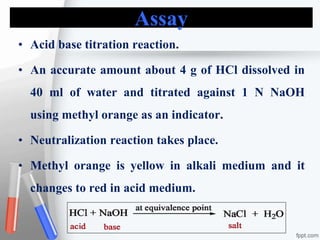
• Acid base titration reaction.
• An accurate amount about 4 g of HCl dissolved in
40 ml of water and titrated against 1 N NaOH
using methyl orange as an indicator.
• Neutralization reaction takes place.
• Methyl orange is yellow in alkali medium and it
changes to red in acid medium.
Uses
• It is used as an acidifier.
Storage
• It is stored in well closed containers.
Dose
• 0.6 to 8 ml
Ammonium Chloride
Preparation
• Ammonium chloride is prepared by commercial
method.
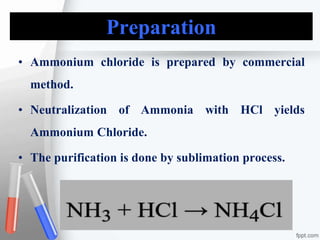
• Neutralization of Ammonia with HCl yields
Ammonium Chloride.
• The purification is done by sublimation process.
Properties
• Appearance :White solid, hygroscopic
• Odor: Odourless
• Taste: Cooling saline
• Density: 1.5274 g/cm3
• Melting point: 338 degree C (decomposes, sublimes)
• Solubility: free soluble in water and glycerol,
Sparingly soluble in alcohol.
Assay
• Acid base titration reaction.
• Dissolve 1.000 g of Ammonium chloride in 20 ml of
water and add a mixture of 5 ml of formaldehyde
solution, with few drops of phenolphthalein solution.
After 1 min to 2 min, titrate slowly with 1M sodium
hydroxide.
• Neutralization reaction takes place.
• End point is the appearance of pale permanent pink
color.
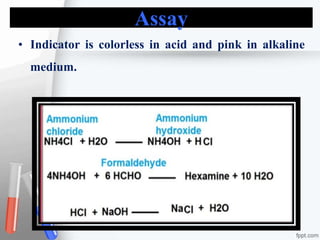
Assay
• Indicator is colorless in acid and pink in alkaline
medium.
Uses
 Ammonium chloride is used as an expectorant in cough
medicine.
 Ammonium salts are an irritant to the gastric mucosa and
may induce nausea and vomiting.
 Ammonium chloride is used as a systemic acidifying agent
in treatment of severe metabolic alkalosis.
 The main application of ammonium chloride is as a
nitrogen source in fertilizers.
 Ammonium chloride is used as a flux in preparing metals
to be tin coated, galvanized or soldered.
Storage
• It is stored in highly closed
containers.
Dose
1 to 2 gm (As systemic acidifier)
0.3 to 0.5 gm (Expectorant)
THANK YOU

Gastrointestinal agents _ Acidifiers.ppt

  • 1.
    PT 103 PHARMACEUTICALINORGANIC CHEMISTRY(THEORY) KUNAL DATTA UNIT III : Gastrointestinal Agents Acidifiers
  • 2.
  • 3.
    • Acidifiers orAcidifying Reagents are the drugs which are able to increase the acidity temporarily in GIT. • In another words Acidifiers are inorganic chemicals that either produce or become acid. • These chemicals increase the level of gastric acid in the stomach when ingested, thus decreasing the stomach pH. • Systemic acidifiers given via injection reduces the alkali accumulation in the body and useful in reducing metabolic alkalosis.
  • 4.
    Types Of Acidifiers Mainlythere are three types of acidifiers: 1.Gastric Acidifiers 2.Urinary Acidifiers 3.Systemic Acidifiers
  • 5.
    Gastric Acidifiers • Usedin controlling acidic pH in stomach.
  • 6.
    Urinary Acidifiers • Usedin controlling acidic pH in urine.
  • 7.
    Systemic Acidifiers • Usedin controlling acidic pH of all parts of the body.
  • 8.
  • 9.
    Preparation • It isprepared by adding 274 g of concentrated HCl slowly into 726 g of purified water. • Pungent odour • Colorless liquid • Fuming • It reacts with metals and release hydrogen gas.
  • 10.
    Assay • Acid basetitration reaction. • An accurate amount about 4 g of HCl dissolved in 40 ml of water and titrated against 1 N NaOH using methyl orange as an indicator. • Neutralization reaction takes place. • Methyl orange is yellow in alkali medium and it changes to red in acid medium.
  • 11.
    Uses • It isused as an acidifier.
  • 12.
    Storage • It isstored in well closed containers.
  • 13.
  • 14.
  • 15.
    Preparation • Ammonium chlorideis prepared by commercial method. • Neutralization of Ammonia with HCl yields Ammonium Chloride. • The purification is done by sublimation process.
  • 16.
    Properties • Appearance :Whitesolid, hygroscopic • Odor: Odourless • Taste: Cooling saline • Density: 1.5274 g/cm3 • Melting point: 338 degree C (decomposes, sublimes) • Solubility: free soluble in water and glycerol, Sparingly soluble in alcohol.
  • 17.
    Assay • Acid basetitration reaction. • Dissolve 1.000 g of Ammonium chloride in 20 ml of water and add a mixture of 5 ml of formaldehyde solution, with few drops of phenolphthalein solution. After 1 min to 2 min, titrate slowly with 1M sodium hydroxide. • Neutralization reaction takes place. • End point is the appearance of pale permanent pink color.
  • 18.
    Assay • Indicator iscolorless in acid and pink in alkaline medium.
  • 19.
    Uses  Ammonium chlorideis used as an expectorant in cough medicine.  Ammonium salts are an irritant to the gastric mucosa and may induce nausea and vomiting.  Ammonium chloride is used as a systemic acidifying agent in treatment of severe metabolic alkalosis.  The main application of ammonium chloride is as a nitrogen source in fertilizers.  Ammonium chloride is used as a flux in preparing metals to be tin coated, galvanized or soldered.
  • 20.
    Storage • It isstored in highly closed containers.
  • 21.
    Dose 1 to 2gm (As systemic acidifier) 0.3 to 0.5 gm (Expectorant)
  • 22.