JVP & PRECORDIAL IMPULSE
STUDENT- Dr VINAL J SHAH
CHAIRPERSON- Dr PRAVEEN KUSUBI
INTRODUCTION
JVP- reflects Right side of heart.
Right atrial pressure during systole.
Right ventricular filling pressure during
diastole.
• JUGULAR VENOUS PULSE:
• Defined as the oscillating top of vertical
column of blood in right IJV that reflects
pressure changes in right atrium in cardiac
cycle.
• JUGULAR VENOUS PRESSURE:
• Vertical height of oscillating column of
blood.
Why IJV over EJV?
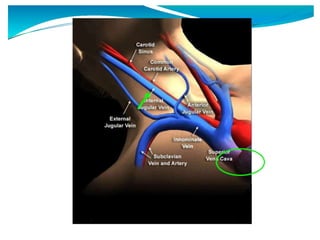
 IJV are close to RA, direct course from
innominate vein to SVC & RA.
 Valves at proximal part of EJV are more than IJV.
 EJV passes through more fascial plane,
hence, affected by extrinsic compression.
 EJV become small and pulsation barely visible
during venoconstriction due to increased
sympathetic activity.
Right IJV preferred than Left IJV?
• Right IJV – in straight line from SVC & RA
• Left IJV– not in straight line.
• Left IJV may get compressed by variety
of normal structures, dilated aorta or
aneurysm.
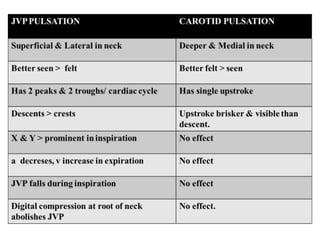
• JVP PULSATION
• CAROTID PULSATION
• Superficial & Lateral in neck
• Deeper & Medial in neck
• Better seen > felt
• Better felt > seen
• Has 2 peaks & 2 troughs/ cardiac cycle
• Has single upstroke
• Descents > crests
• Upstroke brisker & visible than descent.
• X & Y > prominent in inspiration
• No effect
• a decreses, v increase in expiration
• No effect
• JVP falls during inspiration
• No effect
• Digital compression at root of neck
• abolishes JVP
• No effect.
“JVP measurement”
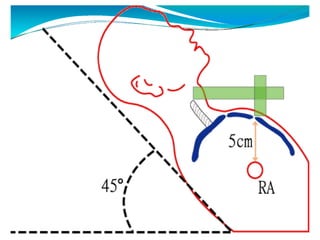
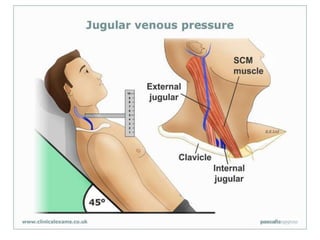
Sternal angle/ angle of Louis- approx 5 cm
from centre of RA, constant regardless of
position. Hence reference point.
 30-90 recline, relaxed neck muscles, beam of
light tangentially across skin over IJV exposes
top of oscillating venous column.
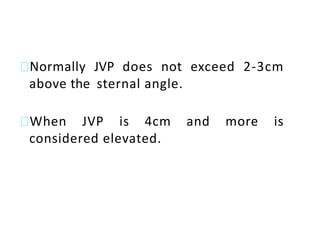
Normally JVP does not exceed 2-3cm
above the sternal angle.
When JVP is 4cm and more is
considered elevated.
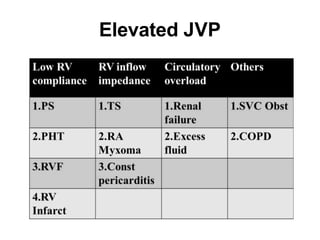
Elevated JVP
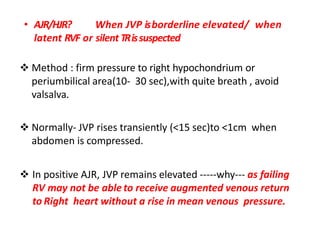
• AJR/HJR? When JVP isborderline elevated/ when
latent RVF or silent TRissuspected
 Method : firm pressure to right hypochondrium or
periumbilical area(10- 30 sec),with quite breath , avoid
valsalva.
 Normally- JVP rises transiently (<15 sec)to <1cm when
abdomen is compressed.
 In positive AJR, JVP remains elevated -----why--- as failing
RV may not be able to receive augmented venous return
to Right heart without a rise in mean venous pressure.
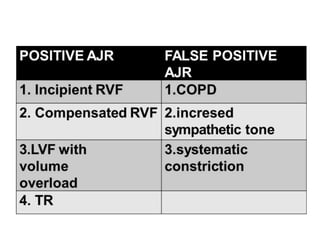
• POSITIVE AJR
• FALSE POSITIVE AJR
• 1. Incipient RVF
• 1.COPD
• 2. Compensated RVF
• 2.incresed sympathetic tone
• 3.LVF with volume overload
• 3.systematic constriction
• 4. TR
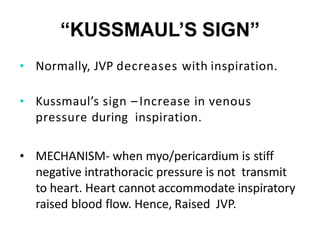
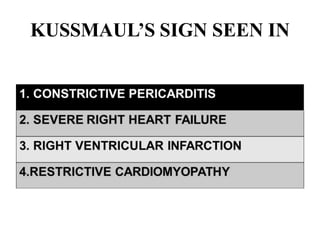
“KUSSMAUL’S SIGN”
• Normally, JVP decreases with inspiration.
• Kussmaul’s sign –Increase in venous
pressure during inspiration.
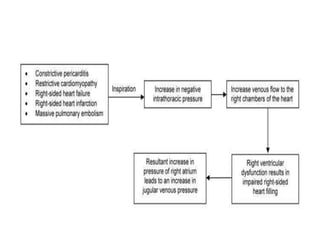
• MECHANISM- when myo/pericardium is stiff
negative intrathoracic pressure is not transmit
to heart. Heart cannot accommodate inspiratory
raised blood flow. Hence, Raised JVP.
KUSSMAUL’S SIGN SEEN IN
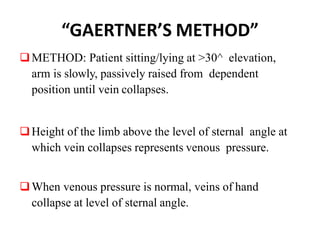
“GAERTNER’S METHOD”
METHOD: Patient sitting/lying at >30^ elevation,
arm is slowly, passively raised from dependent
position until vein collapses.
Height of the limb above the level of sternal angle at
which vein collapses represents venous pressure.
When venous pressure is normal, veins of hand
collapse at level of sternal angle.
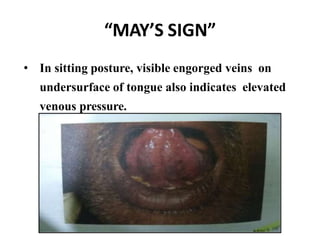
“MAY’S SIGN”
• In sitting posture, visible engorged veins on
undersurface of tongue also indicates elevated
venous pressure.
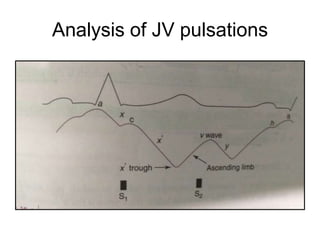
Analysis of JV pulsations
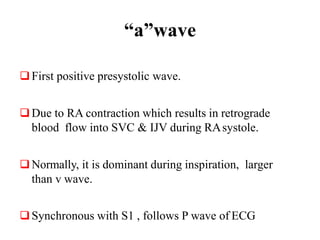
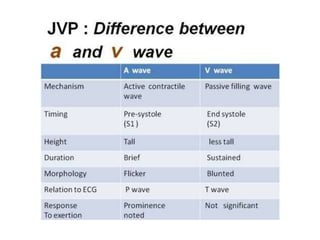
“a”wave
First positive presystolic wave.
Due to RA contraction which results in retrograde
blood flow into SVC & IJV during RAsystole.
Normally, it is dominant during inspiration, larger
than v wave.
Synchronous with S1 , follows P wave of ECG
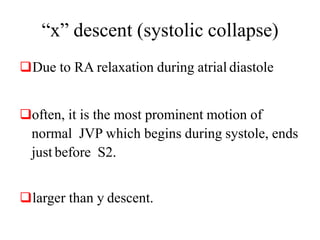
“x” descent (systolic collapse)
Due to RA relaxation during atrial diastole
often, it is the most prominent motion of
normal JVP which begins during systole, ends
just before S2.
larger than y descent.
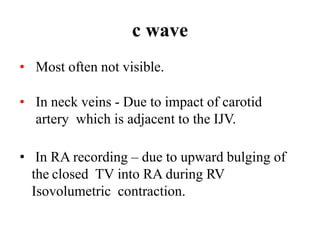
c wave
• Most often not visible.
• In neck veins - Due to impact of carotid
artery which is adjacent to the IJV.
• In RA recording – due to upward bulging of
the closed TV into RA during RV
Isovolumetric contraction.
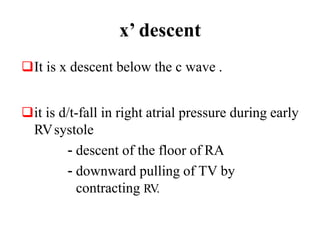
x’ descent
It is x descent below the c wave .
it is d/t-fall in right atrial pressure during early
RVsystole
- descent of the floor of RA
- downward pulling of TV by
contracting RV.
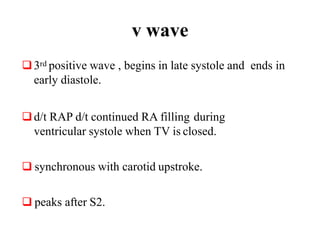
v wave
3rd positive wave , begins in late systole and ends in
early diastole.
d/t RAP d/t continued RA filling during
ventricular systole when TV is closed.
 synchronous with carotid upstroke.
 peaks after S2.
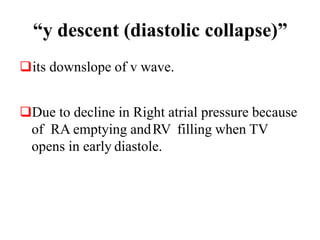
“y descent (diastolic collapse)”
its downslope of v wave.
Due to decline in Right atrial pressure because
of RA emptying andRV filling when TV
opens in early diastole.
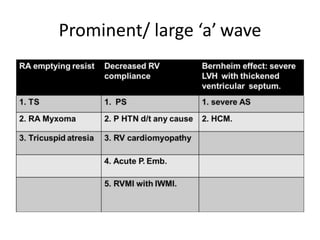
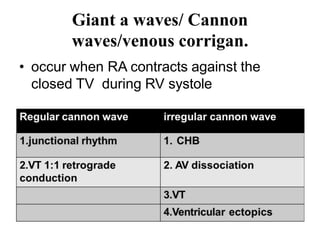
Prominent/ large ‘a’ wave
Giant a waves/ Cannon
waves/venous corrigan.
• occur when RA contracts against the
closed TV during RV systole
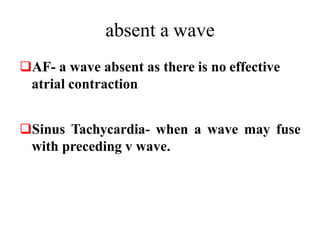
absent a wave
AF- a wave absent as there is no effective
atrial contraction
Sinus Tachycardia- when a wave may fuse
with preceding v wave.
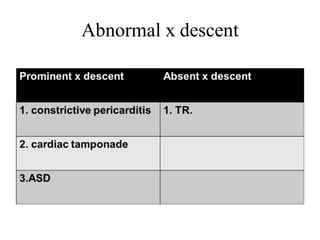
Abnormal x descent
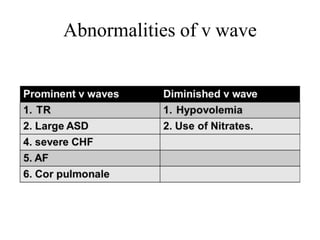
Abnormalities of v wave
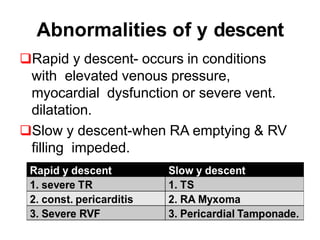
Abnormalities of y descent
Rapid y descent- occurs in conditions
with elevated venous pressure,
myocardial dysfunction or severe vent.
dilatation.
Slow y descent-when RA emptying & RV
filling impeded.
PRECORDIAL IMPULSE
DEFINITION
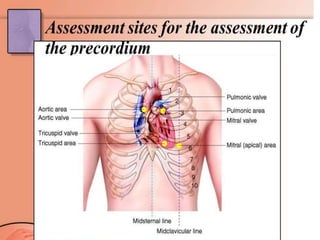
• Precordium is the anterior aspect of
chest overlying the heart.
INSPECTION
Position of patient:
• Supine position with thorax elevated to ≤30
degree
• Chest to be examined tangentially
a)Foot end of bed
b)Patients right side directing a beam of light
across precordium
SHAPE OF CHEST
• Muscular Thorax
• Broad Chest
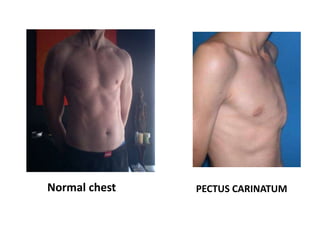
• Pectus Carinatum
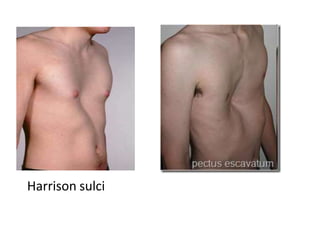
• Pectus Excavatum
• Harrison’s Sulci
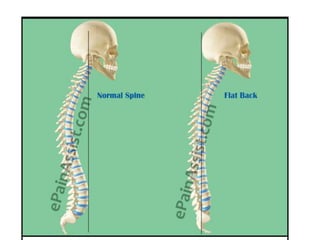
• Straight Back Syndrome
PECTUS CARINATUMNormal chest
Harrison sulci
BREAST ABNORMALITIES
• Male gynacomastia-Digitalis,Klienfelter
syndrome
• Female hypomastia-MVP
• Widely spaced nipples-Turners
Distended vessels:
• Veins
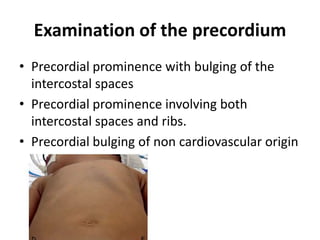
Examination of the precordium
• Precordial prominence with bulging of the
intercostal spaces
• Precordial prominence involving both
intercostal spaces and ribs.
• Precordial bulging of non cardiovascular origin
APICAL IMPULSE
• Location.
• Duration.
• Size.
• Force or amplitude.
• Contour.
Apical impulse(AI)
• Normal AI defined as lowermost,outermost
point of maximum impulse in early systole
which imparts a perpendicular gentle thurst to
palpating finger followed by medial retraction
in late systole
• 5th left ICS at medial to MCL and <10cm from
midsternal line
• 2-2.5cm in diameter,confined to one ICS
• Lasts for <50% of systole.
NORMAL APICAL IMPULSE
• Produced by LV during early systole
• When LVP rises,LV rotates in counterclockwise
direction on its long axis
• Cardiac apex lifts and makes contact with left
anterior chest wall
• Following aortic valve opening,LV chamber
moves away after first half of ejection.
• Thus recorded as early outward thurst
followed by retraction in last part of systole.
RV APICAL IMPULSE
• Palpable RV activity reflects level of pul. Artery
pressure,RV size and severity of the TR.
• When RV is large ,precordial activity may
produce a rocking or see-saw motion.
• Greatly enlarged RV may occupy the usual
apex area,literally pushing the LV
posterolaterally
• ABSENT APICAL IMPULSE:
CVS Causes
Non-CVS causes
• DOUBLE APICAL IMPULSE:
HOCM
LV ANEURYSM
• Lateral displacement-
Skeletal deformity
Intrathoracic patology
Eccentric LVH due to MR or AR
RVH
• DOWNWARD DISPLACEMENT:
Aortic aneursysm
Mediastinal new growth
• UPWARD DISPLACEMENT:
Normal Children
Pregnancy
Ascitis
Abdominal Tumour
• RIGHT SIDED APICAL IMPULSE:
Dextrocardia
Left massive pleural effusion or pneumothorax
and right sided collapse
Skeletal abnormality
Extent of apical impulse:
• Diffuse apical impulse >3cm in diameter or AI
present in more than one ICS due to
CVS:
Eccentric LVH as in AR.
LV aneurysm.
NON CVS:
Thin individuals
Hyperdynamic circulation
Retraction of lung due to fibrosis or collapse
Suprasternal pulsations:
Aneurysm of arch of aorta
Thyroidea ima artery
Sternoclavicular pulsations:
 Aortic dissection
 Aneurysm of aorta
 Aortic regurgitation
 Right aortic arch
Presence of right 2nd ICS pulsations:
• Aneurysm of ascending aorta or
• Chronic AR
Pulsations in left 2nd and 3rd ICS:
• Pulmonary Hypertension
• Increased pulmonary blood flow as in
PDA,ASD
• Idiopathic pulmonary artery dilatation
• Hyperdynamic circulation as in
fever,pregnancy
Left parasternal pulsations
• Children and thin adults
• RVH with Pressure overload-
PH,PPH,PS,Pulmonary embolism,cor
pulmonale
• Volume overload-TR,ASD,VSD
Left parasternal pulsations
In Moderate To Severe MR due to apparent
anterior systolic movements of normal RV
a)Jet or Squid effect
b)Subsequent systolic expansion of enlarged LA
RWMA
EPIGASTRIC PULSATIONS
• Cardiac
• Aortic
• Hepatic
ECTOPIC PULSATIONS
• Ectopic LV impulse
• Ectopic LA impulse
• RA impulse
• Ectopic impulse beneath left clavicle-PDA
PALPATION
• Examination of the chest for shape and
distended vessels.
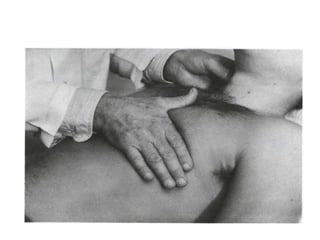
• Palpation of precordium for tenderness.
• Palpation of the cardiovascular pulsations
,palpaple sounds,thrills and rubs.
TENDERNESS
• Tietze syndrome
• Acute pericarditis
• Acute myocarditis
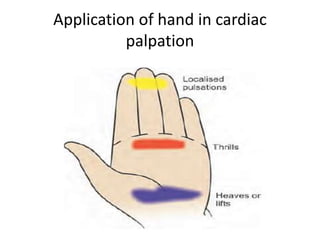
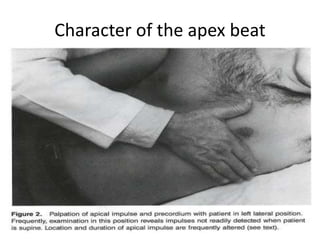
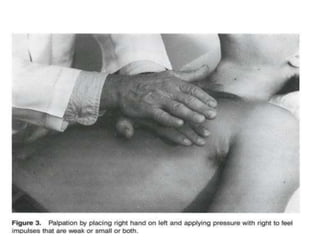
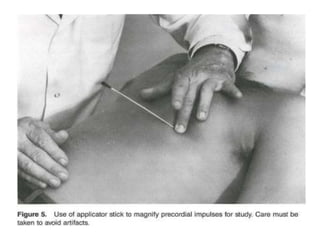
Application of hand in cardiac
palpation
Palpation of cardiac apex
Size and extent of the cardiac apex
Normal cardiac apex
Displaced cardiac apex
Double or triple cardiac apex
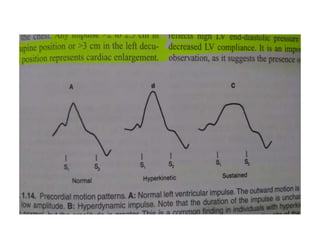
Character of the apex beat
Types:
Absent or feeble
Tapping
Hyperdynamic
Heaving
Tapping apex beat
• Characteristic of MS
• Palpable equivalent of S1
• Short,sharp and tapping nature
Hyperdynamic,hyperkinetic
• Increase in amplitute and duration of
excursion of the apical impulse
• Ill sustained i.e <50%of systole with partial
lifting of examining fingers.
• CVS Causes
• Non CVS Causes
Heaving
• Sustained Increase In duration and amplitude
of excursion of apical impulse
• Duration of excursion is >50% of systole with
sustained lift of the examining fingers
• Causes
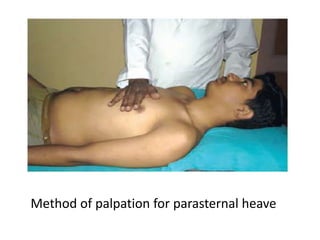
Method of palpation for parasternal heave
Palpable low frequency sounds at
apex
• Palpable S3
• Palpable S4
• Palpable pericardial knock
Palpable high frequency sounds at
apex
• Palpable loud S1
• Palpable opening snap
• Palpable ejection sounds-Ejection sound of
congenital AS
Palpable murmurs-thrills
• Diastolic thrill-MS
• Systolic thrill-severe MR,AS,VSD
• Palpable pericardial rub-Acute pericarditis
PALPATION OF LEFT PARASTERNAL
AREA
• Left parasternal lift
• Methods of left parasternal lift:
Heel of the hand
Tips of three fingers(index,middle,ring)
ulnar border of the hand
With simultaneous palpation of apex.
Grade 1-3.
Palpation of tricuspid area:
• Palpable low frequency sounds-RV S3,RV S4
• Palpable high frequency sounds-OS of
Tricuspid Stenosis
Palpation of Aortic and pulmonary areas:
• Palpable high frequency sounds-Sys.
HTN,Moderate AS,Dilated aortic
root,PS,Pulmonary HTN
• Palpable murmurs-THRILLS
• Palpation of epigastrium
• Palpation of ectopic areas
REFERENCES
• Evaluation of patient with heart disease,Carlos
and Jonathan Abrams
• Clinical examination in
cardiology,Vijayaraghava rao
• Manual of practical medicine, R.Alagappan
Jugular venous pulse and Precordial impulses

Jugular venous pulse and Precordial impulses

  • 1.
    JVP & PRECORDIALIMPULSE STUDENT- Dr VINAL J SHAH CHAIRPERSON- Dr PRAVEEN KUSUBI
  • 2.
    INTRODUCTION JVP- reflects Rightside of heart. Right atrial pressure during systole. Right ventricular filling pressure during diastole.
  • 3.
    • JUGULAR VENOUSPULSE: • Defined as the oscillating top of vertical column of blood in right IJV that reflects pressure changes in right atrium in cardiac cycle. • JUGULAR VENOUS PRESSURE: • Vertical height of oscillating column of blood.
  • 4.
    Why IJV overEJV?  IJV are close to RA, direct course from innominate vein to SVC & RA.  Valves at proximal part of EJV are more than IJV.  EJV passes through more fascial plane, hence, affected by extrinsic compression.  EJV become small and pulsation barely visible during venoconstriction due to increased sympathetic activity.
  • 6.
    Right IJV preferredthan Left IJV? • Right IJV – in straight line from SVC & RA • Left IJV– not in straight line. • Left IJV may get compressed by variety of normal structures, dilated aorta or aneurysm.
  • 7.
    • JVP PULSATION •CAROTID PULSATION • Superficial & Lateral in neck • Deeper & Medial in neck • Better seen > felt • Better felt > seen • Has 2 peaks & 2 troughs/ cardiac cycle • Has single upstroke • Descents > crests • Upstroke brisker & visible than descent. • X & Y > prominent in inspiration • No effect • a decreses, v increase in expiration • No effect • JVP falls during inspiration • No effect • Digital compression at root of neck • abolishes JVP • No effect.
  • 8.
    “JVP measurement” Sternal angle/angle of Louis- approx 5 cm from centre of RA, constant regardless of position. Hence reference point.  30-90 recline, relaxed neck muscles, beam of light tangentially across skin over IJV exposes top of oscillating venous column.
  • 11.
    Normally JVP doesnot exceed 2-3cm above the sternal angle. When JVP is 4cm and more is considered elevated.
  • 12.
  • 13.
    • AJR/HJR? WhenJVP isborderline elevated/ when latent RVF or silent TRissuspected  Method : firm pressure to right hypochondrium or periumbilical area(10- 30 sec),with quite breath , avoid valsalva.  Normally- JVP rises transiently (<15 sec)to <1cm when abdomen is compressed.  In positive AJR, JVP remains elevated -----why--- as failing RV may not be able to receive augmented venous return to Right heart without a rise in mean venous pressure.
  • 14.
    • POSITIVE AJR •FALSE POSITIVE AJR • 1. Incipient RVF • 1.COPD • 2. Compensated RVF • 2.incresed sympathetic tone • 3.LVF with volume overload • 3.systematic constriction • 4. TR
  • 15.
    “KUSSMAUL’S SIGN” • Normally,JVP decreases with inspiration. • Kussmaul’s sign –Increase in venous pressure during inspiration. • MECHANISM- when myo/pericardium is stiff negative intrathoracic pressure is not transmit to heart. Heart cannot accommodate inspiratory raised blood flow. Hence, Raised JVP.
  • 17.
  • 18.
    “GAERTNER’S METHOD” METHOD: Patientsitting/lying at >30^ elevation, arm is slowly, passively raised from dependent position until vein collapses. Height of the limb above the level of sternal angle at which vein collapses represents venous pressure. When venous pressure is normal, veins of hand collapse at level of sternal angle.
  • 19.
    “MAY’S SIGN” • Insitting posture, visible engorged veins on undersurface of tongue also indicates elevated venous pressure.
  • 20.
    Analysis of JVpulsations
  • 21.
    “a”wave First positive presystolicwave. Due to RA contraction which results in retrograde blood flow into SVC & IJV during RAsystole. Normally, it is dominant during inspiration, larger than v wave. Synchronous with S1 , follows P wave of ECG
  • 22.
    “x” descent (systoliccollapse) Due to RA relaxation during atrial diastole often, it is the most prominent motion of normal JVP which begins during systole, ends just before S2. larger than y descent.
  • 23.
    c wave • Mostoften not visible. • In neck veins - Due to impact of carotid artery which is adjacent to the IJV. • In RA recording – due to upward bulging of the closed TV into RA during RV Isovolumetric contraction.
  • 24.
    x’ descent It isx descent below the c wave . it is d/t-fall in right atrial pressure during early RVsystole - descent of the floor of RA - downward pulling of TV by contracting RV.
  • 25.
    v wave 3rd positivewave , begins in late systole and ends in early diastole. d/t RAP d/t continued RA filling during ventricular systole when TV is closed.  synchronous with carotid upstroke.  peaks after S2.
  • 26.
    “y descent (diastoliccollapse)” its downslope of v wave. Due to decline in Right atrial pressure because of RA emptying andRV filling when TV opens in early diastole.
  • 28.
  • 29.
    Giant a waves/Cannon waves/venous corrigan. • occur when RA contracts against the closed TV during RV systole
  • 30.
    absent a wave AF-a wave absent as there is no effective atrial contraction Sinus Tachycardia- when a wave may fuse with preceding v wave.
  • 31.
  • 32.
  • 33.
    Abnormalities of ydescent Rapid y descent- occurs in conditions with elevated venous pressure, myocardial dysfunction or severe vent. dilatation. Slow y descent-when RA emptying & RV filling impeded.
  • 34.
  • 35.
    DEFINITION • Precordium isthe anterior aspect of chest overlying the heart.
  • 36.
    INSPECTION Position of patient: •Supine position with thorax elevated to ≤30 degree • Chest to be examined tangentially a)Foot end of bed b)Patients right side directing a beam of light across precordium
  • 38.
    SHAPE OF CHEST •Muscular Thorax • Broad Chest • Pectus Carinatum • Pectus Excavatum • Harrison’s Sulci • Straight Back Syndrome
  • 39.
  • 40.
  • 42.
    BREAST ABNORMALITIES • Malegynacomastia-Digitalis,Klienfelter syndrome • Female hypomastia-MVP • Widely spaced nipples-Turners Distended vessels: • Veins
  • 43.
    Examination of theprecordium • Precordial prominence with bulging of the intercostal spaces • Precordial prominence involving both intercostal spaces and ribs. • Precordial bulging of non cardiovascular origin
  • 44.
    APICAL IMPULSE • Location. •Duration. • Size. • Force or amplitude. • Contour.
  • 45.
    Apical impulse(AI) • NormalAI defined as lowermost,outermost point of maximum impulse in early systole which imparts a perpendicular gentle thurst to palpating finger followed by medial retraction in late systole • 5th left ICS at medial to MCL and <10cm from midsternal line • 2-2.5cm in diameter,confined to one ICS • Lasts for <50% of systole.
  • 46.
    NORMAL APICAL IMPULSE •Produced by LV during early systole • When LVP rises,LV rotates in counterclockwise direction on its long axis • Cardiac apex lifts and makes contact with left anterior chest wall • Following aortic valve opening,LV chamber moves away after first half of ejection. • Thus recorded as early outward thurst followed by retraction in last part of systole.
  • 47.
    RV APICAL IMPULSE •Palpable RV activity reflects level of pul. Artery pressure,RV size and severity of the TR. • When RV is large ,precordial activity may produce a rocking or see-saw motion. • Greatly enlarged RV may occupy the usual apex area,literally pushing the LV posterolaterally
  • 48.
    • ABSENT APICALIMPULSE: CVS Causes Non-CVS causes • DOUBLE APICAL IMPULSE: HOCM LV ANEURYSM
  • 49.
    • Lateral displacement- Skeletaldeformity Intrathoracic patology Eccentric LVH due to MR or AR RVH
  • 50.
    • DOWNWARD DISPLACEMENT: Aorticaneursysm Mediastinal new growth • UPWARD DISPLACEMENT: Normal Children Pregnancy Ascitis Abdominal Tumour
  • 51.
    • RIGHT SIDEDAPICAL IMPULSE: Dextrocardia Left massive pleural effusion or pneumothorax and right sided collapse Skeletal abnormality
  • 52.
    Extent of apicalimpulse: • Diffuse apical impulse >3cm in diameter or AI present in more than one ICS due to CVS: Eccentric LVH as in AR. LV aneurysm. NON CVS: Thin individuals Hyperdynamic circulation Retraction of lung due to fibrosis or collapse
  • 53.
    Suprasternal pulsations: Aneurysm ofarch of aorta Thyroidea ima artery Sternoclavicular pulsations:  Aortic dissection  Aneurysm of aorta  Aortic regurgitation  Right aortic arch
  • 54.
    Presence of right2nd ICS pulsations: • Aneurysm of ascending aorta or • Chronic AR
  • 55.
    Pulsations in left2nd and 3rd ICS: • Pulmonary Hypertension • Increased pulmonary blood flow as in PDA,ASD • Idiopathic pulmonary artery dilatation • Hyperdynamic circulation as in fever,pregnancy
  • 56.
    Left parasternal pulsations •Children and thin adults • RVH with Pressure overload- PH,PPH,PS,Pulmonary embolism,cor pulmonale • Volume overload-TR,ASD,VSD
  • 57.
    Left parasternal pulsations InModerate To Severe MR due to apparent anterior systolic movements of normal RV a)Jet or Squid effect b)Subsequent systolic expansion of enlarged LA RWMA
  • 58.
  • 59.
    ECTOPIC PULSATIONS • EctopicLV impulse • Ectopic LA impulse • RA impulse • Ectopic impulse beneath left clavicle-PDA
  • 60.
    PALPATION • Examination ofthe chest for shape and distended vessels. • Palpation of precordium for tenderness. • Palpation of the cardiovascular pulsations ,palpaple sounds,thrills and rubs.
  • 61.
    TENDERNESS • Tietze syndrome •Acute pericarditis • Acute myocarditis
  • 63.
    Application of handin cardiac palpation
  • 64.
    Palpation of cardiacapex Size and extent of the cardiac apex Normal cardiac apex Displaced cardiac apex Double or triple cardiac apex
  • 65.
  • 67.
  • 69.
    Tapping apex beat •Characteristic of MS • Palpable equivalent of S1 • Short,sharp and tapping nature
  • 70.
    Hyperdynamic,hyperkinetic • Increase inamplitute and duration of excursion of the apical impulse • Ill sustained i.e <50%of systole with partial lifting of examining fingers. • CVS Causes • Non CVS Causes
  • 71.
    Heaving • Sustained IncreaseIn duration and amplitude of excursion of apical impulse • Duration of excursion is >50% of systole with sustained lift of the examining fingers • Causes
  • 72.
    Method of palpationfor parasternal heave
  • 74.
    Palpable low frequencysounds at apex • Palpable S3 • Palpable S4 • Palpable pericardial knock
  • 75.
    Palpable high frequencysounds at apex • Palpable loud S1 • Palpable opening snap • Palpable ejection sounds-Ejection sound of congenital AS
  • 76.
    Palpable murmurs-thrills • Diastolicthrill-MS • Systolic thrill-severe MR,AS,VSD • Palpable pericardial rub-Acute pericarditis
  • 77.
    PALPATION OF LEFTPARASTERNAL AREA • Left parasternal lift • Methods of left parasternal lift: Heel of the hand Tips of three fingers(index,middle,ring) ulnar border of the hand With simultaneous palpation of apex. Grade 1-3.
  • 78.
    Palpation of tricuspidarea: • Palpable low frequency sounds-RV S3,RV S4 • Palpable high frequency sounds-OS of Tricuspid Stenosis Palpation of Aortic and pulmonary areas: • Palpable high frequency sounds-Sys. HTN,Moderate AS,Dilated aortic root,PS,Pulmonary HTN • Palpable murmurs-THRILLS
  • 79.
    • Palpation ofepigastrium • Palpation of ectopic areas
  • 80.
    REFERENCES • Evaluation ofpatient with heart disease,Carlos and Jonathan Abrams • Clinical examination in cardiology,Vijayaraghava rao • Manual of practical medicine, R.Alagappan

Editor's Notes

  • #39 Broad chest-prominent angle between manubrium and strnum and widely spaced nipple- turnur and noonan Carinatum-marfans and noonan,chronic nasopharyngeal obstruction,rickets. harrison-extend transversly as grooves from the sides if xiphisternum on either side,giving thorax a transverse consrtiction appearance Excavatum-marfans and homocystinuria,ehler donlos,cobblers,secondary in rickets SBS-loss of normal thoracic kyphosis-parasternal systolic impulse,mid systolic murmur
  • #42 Sbs-los of thoracic kyphosis,,, parasternal systolic impulse,midsystolic murmur,,expiratory splitting of s2
  • #43 Klienfelter syndrome- MVP SEENI 55% OF PATIENTS,VARICOSE VEINS AND PUL EMBOLISM ALSO FOUND Turners-MC IS bicuspid aortic valve and CoA
  • #44 Long standing duration of cardiac enlargement usaly before puberty. NON CVS Causes-skeletal deformities such as scoliosis,kyphoscoliosis or rickety deformity,,,,disease of lungs such as bronchogenic ca,,,mediastinal new growth
  • #45 Force-whether it unimpressive impulse or whether it lifts examining fingers,,,it is highly subjectve Normal contour-brief,non sustained,anterior motion in early systole
  • #47 Lvp-left ventricular pressure Ventricle continues to decrease in size until systole is completed
  • #48 Page no 134…Left anterior chest and LV apex retract as the medial RV area adjacent to left lower sternal border,move anteriorly and then retract during mid to late systole
  • #49 Cvs-CAD with dec apical motion and reduced EF,,,DilATED cardiomyopathy,,,Pericardial effusion Non cvs-when behind rib,,muscular chest wall,,,obesity,,copd emphysema,left pleral effusion
  • #50 Skeletal deformity-Scoliosis,SBS,pectus excavatum Intrathoracic patology-right sided pleural effusion,right pneumothorax,left lung collapse
  • #51 Upward displacement-pericardial effusion
  • #52 Skeletal abnormalities such as scoliosis.
  • #53 Hyperdynamic-fever,threotoxicosis
  • #54 Thyrodia ima artery- inconsistent artery from brachiocephalic trunk supplying the inferior throid
  • #55 Cong,rheumatic,endocarditis
  • #57 Children-small antero- posterior diameter In normal adults RV moves away from chest wall during the systole.HENCE ITS ACTIVITY IS NEITHER SEEN OR PALPATED
  • #58 LA lies behind RV.Causes anterior dispalcement of RV RWMA IN dyskinetic motion ventricular septal displaces RV forwrd.seen in angina pectoris.transient and relieves after relief of angina
  • #60 Ectopic lv impulse- above or medial to normally expected cardiac impulse.dyskinesia after mi,venticular aneurysm due to mi or trauma Ectopic la impulse-seen in severe mr with gaint left atrium,pulsation seen in right anterior or lateral chest or in axilla(american heart association) RA impulse-seen in enlarged RA in TR,Late systolic movement of entire right lower chest,right 4th ICS
  • #62 Veins-mondor disease
  • #63 Pericarditis-infections,post mi,uremia,neoplasia,chylopericardium,trauma,aortic dissection,irradiation,sarcoidosis Drug induced-procainamide,hydralazine,isoniazid,phenytion
  • #66 Hocm-late systolic secondary bulge –double,,,if s4 palpable the triple apex
  • #67 1st seen in the supine position nd then in the left latersl positoin. Outward movement of the apical impuse is normlly felt during the 1st third of the systole,but systolic inward movement is only seen as retractin
  • #71 Shortened outward movt of the apex during early systole due to reduced venricular filling during diastole
  • #72 CVS-vsd,AAR,MR,PDA,systemic AV fistulaum Non cvs-hyperkinetic circulatory ststes-pregnancy,anemia,thyrotoxicosis,anemia,beri beri,thin chest wall,pectus excavatum
  • #73 Pressure overlod-AS,HOCM,HTN CAD-LV aneusrysm,severe LV dysfunction Volume overload-sometimes severe AR or MR
  • #75 KINETIC APEX CARDIOGRAM
  • #76 Lv s3-lvf,chronic MR LV S4-AS,HOCM,Acute MR,ACUTE AR,Coronary artery disease Palpable pericardial knock-due to sudden cessation of ventricular filling, constrictive pericarditis,with systolic retraction in 10th and 11th ICS IN POSTERIOR axillary line/scapular line(broadbents sign)
  • #77 Palapable S1-In MS which imparts tapping type of apical impulse Opening snap-early diastole with pliable mitral valve
  • #78 Diastolic thrill-highly localised to apex,indicates mobile and non calcified mitral valve. Severe MR –due to chordal rupture at apex,less common AS-in 2nd ICS VSD-3RD TO 4TH ICS At left sternal edge Pericardial knock-sitting and leaning forward,2ND AND 3RD ICS,KNEE CHEST POSITION
  • #79 Gr 1-mild lift,penil or scale kept along parasternal area to make it clear,disappears on application of mild counter pressur,illsustained and <one third of systole,children,pectus excavatum Gr2-obvious lift easily made out,>50% of systole,illsustained,RV VOLUME overload-TR,ASD,VSD,MOD MS GR 3-PROMINAENT PARASTERNAL LIFT,present throughout systole and beyond S2,pressure overload conditions-PS,severe pul.HTN
  • #80 RV s3-RV dysfunction,severe TR RV S4-DCEREASED COMPLIANC OF RV-PS,PUL HTN
  • #81 Ectopic areas- Ectopic LV IMPULSE-above and medial to expected apex beat-dyskinesia in CAD,ventricular aneursym ECTOPIC LA-ENLARGED LA IN MR-right anterior,lateral chest or in axilla. Ectopic RA-right 4TH ICS,SEEN IN TR