

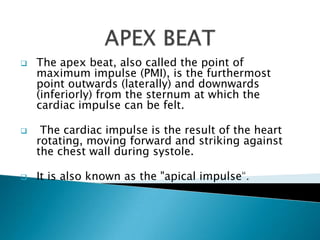
   The apex beat, also called the point of
    maximum impulse (PMI), is the furthermost
    point outwards (laterally) and downwards
    (inferiorly) from the sternum at which the
    cardiac impulse can be felt.

    The cardiac impulse is the result of the heart
    rotating, moving forward and striking against
    the chest wall during systole.

   It is also known as the "apical impulse“.
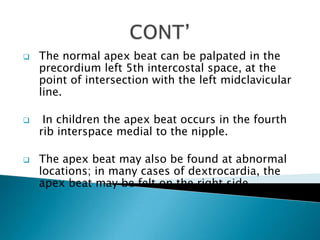
   The normal apex beat can be palpated in the
    precordium left 5th intercostal space, at the
    point of intersection with the left midclavicular
    line.

    In children the apex beat occurs in the fourth
    rib interspace medial to the nipple.

   The apex beat may also be found at abnormal
    locations; in many cases of dextrocardia, the
    apex beat may be felt on the right side.
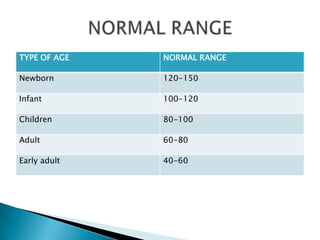
TYPE OF AGE   NORMAL RANGE

Newborn       120-150

Infant        100-120

Children      80-100

Adult         60-80

Early adult   40-60

Apex beat

  • 2.
    The apex beat, also called the point of maximum impulse (PMI), is the furthermost point outwards (laterally) and downwards (inferiorly) from the sternum at which the cardiac impulse can be felt.  The cardiac impulse is the result of the heart rotating, moving forward and striking against the chest wall during systole.  It is also known as the "apical impulse“.
  • 3.
    The normal apex beat can be palpated in the precordium left 5th intercostal space, at the point of intersection with the left midclavicular line.  In children the apex beat occurs in the fourth rib interspace medial to the nipple.  The apex beat may also be found at abnormal locations; in many cases of dextrocardia, the apex beat may be felt on the right side.
  • 4.
    TYPE OF AGE NORMAL RANGE Newborn 120-150 Infant 100-120 Children 80-100 Adult 60-80 Early adult 40-60