CARDIOVASCULAR
ASSESSMENT
BY
ASER Mohamed kamal
LECTURE OBJECTIVES
1. Review anatomy & physiology of the
cardiovascular system.
2. Describe physical assessment of
cardiovascular status.
3. Review diagnostic procedures
Anatomy & Physiology
Functions of the heart & CV system
• Pumps blood to tissues to supply O2 &
nutrients
• Remove CO2 & metabolic wastes
Heart Tissue
1. Pericardium :fibrous protective sac enclosing
heart .
2. Epicardium :inner layer of pericardium.
3. Myocardium : heart muscle ,major portion of the
heart .
4. Endocardium: smooth linning of the inner surface
and cavities of the heart .
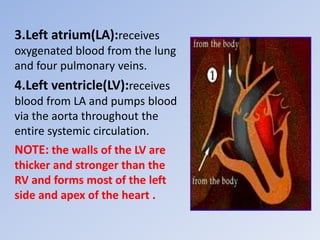
Circulation in the Heart
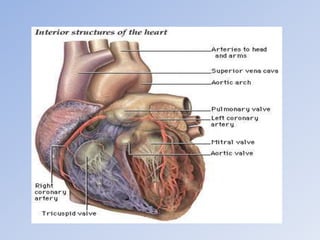
1.Right atrium(RA):
receives blood from
systimic circulation, from
the sup&inf vena cava .
2.Right ventricle(RV):
receives blood from RA
and pumps blood via
pulmonary artery to the
lungs for oxygenation .
3.Left atrium(LA):receives
oxygenated blood from the lung
and four pulmonary veins.
4.Left ventricle(LV):receives
blood from LA and pumps blood
via the aorta throughout the
entire systemic circulation.
NOTE: the walls of the LV are
thicker and stronger than the
RV and forms most of the left
side and apex of the heart .
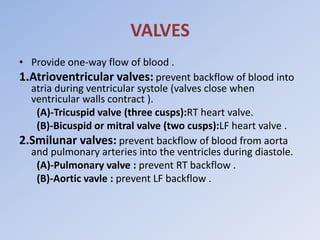
VALVES
• Provide one-way flow of blood .
1.Atrioventricular valves: prevent backflow of blood into
atria during ventricular systole (valves close when
ventricular walls contract ).
(A)-Tricuspid valve (three cusps):RT heart valve.
(B)-Bicuspid or mitral valve (two cusps):LF heart valve .
2.Smilunar valves: prevent backflow of blood from aorta
and pulmonary arteries into the ventricles during diastole.
(A)-Pulmonary valve : prevent RT backflow .
(B)-Aortic vavle : prevent LF backflow .
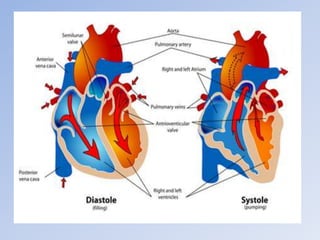
Cardiac cycle
• The rhythmic pumping action of the heart .
1.Systole : the period of ventricular contraction .
(End-systolic volume is the amount of blood in the
ventricles after systole, about 50 ml )
2.Diastole : the period of ventricular relaxation and
filling of blood .
(End-diastolic volume is the amount of blood in the
ventricles after diastole,about 120 ml )
3.Atrial contraction occurs during the last third
of diastole and completes ventricular filling .
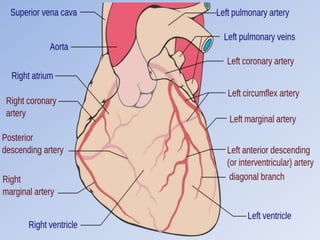
Coronary circulation
1. Arteries: arise directly from aorta near aortic valve.
(A).Right coronary artery (RCA):supplies RT atrium ,most of
RT ventricle, and in most individuals the INF wall of LF
ventricle, atrioventricular(AV)node and 60%of
sinoatrial(SA)node .
(B).Left coronary artery (LCA):supplies most of LF ventricle ;
has two main divisions :
I-left anterior descending (LAD):supplies LF ventricle
,interventricular septum and inferior areas of apex .
II-circumflex (Circ):supplies blood to LAT and inferior,
walls of the LF ventricle, portions of LF atrium and 40% of SA
node .
2. Veins: parallel to arterial system .
CARDIOVASCULAR EXAMINATION
Part I: Assessment of cardiovascular function:
A. Patient interview
1. Health history
2. Past history :other diagnosis, surgeries, medications.
3. social history :current living situation and lifestyle.
4. Risk factor : positive and negative risk factors.
B. Physical assessment
1. Inspection
2. Palpation
3. Percussion
4. Auscultation
C. Laboratory test
1. Cardiac enzyme = enzymes are released when cells are damaged (MI).
Enzymes are found in many tissues/muscles, and some are specific to cardiac
tissue.
2. Lipid profile
3. Coagulation studies
Part II: Assessment of cardiovascular structure
• Diagnostic studies
• ECG
• X- ray
• fluoroscopy
• The exercise stress
• Cardiac catheterization
A.Patient interview
1.Health history :
a- Socio - cultural history: - Name ,Age, sex,
occupation, educational level, marital status.
b- Presenting symptoms.
c-Family History
d- Psychosocial Profile
Presenting symptoms
Note onset, progression, and nature of symptoms .
1.Chest pain and shortness of breath.
2.Fatigue:generalized feeling of tiredness.
3.Palpitation:awareness by patient of heart rhythm abnormalities e.g
pounding fluttering.
4.Dizziness, syncope(transient loss of consciousness)due to
inadequate cerebral blood flow.
5.Edema:retention of fluid in the tissues especially in dependent body
partsL.L with sudden weight gain.
6.Extremity Changes :Changes in the extremities may provide clues
about underlying cardiovascular disease. Symptoms such as
Paresthesia (numbness, tingling), coolness, and intermittent
claudication (pain in calves during ambulation) may be associated
with vascular disease, coronary heart disease, or cerebral vascular
disease.
7- Dyspnea and Cough: Dyspnea may also occur with cardiac disease
such as left-sided CHF
Pitting edema
• is a depression in the skin from pressure.
• To demonstrate the presence of pitting edema, the examiner
presses firmly with his or her thumb over a bony surface
• The severity of edema is described on a five-point scale, from none
(0) to very marked (4).
1+ Mild pitting, slight indentation, no perceptible swelling of the leg
2+ Moderate pitting, indentation subsides rapidly
3+ Deep pitting, indentation remains for a short time, leg looks
swollen
4+ Very deep pitting, indentation lasts a long time, leg is very
swollen
Risk factor
a. Positive risk factor :
1.hypercholestesterolemia.
2.hypertension
3.cigarette smoking
4. Alcohol
5.sedantary lifestyle.
6.obesity:body mass index (BMI) >30KG or waist girth >100cm.
7.imparied fasting glucose: fasting blood glucose >110mgdL
B. Negative risk factor :
as high serum HDL cholesterol>60mgdL
B- Physical assessment
ASSESSMENT ARTICLES:
• A Double-Headed, Double-Lumen
Stethoscope
• A Blood Pressure Cuff
• A Moveable Light Source or Pen Light
• Sphygmomanometer
• Measure tap
• Wrist watch and pen
INSPECTION:
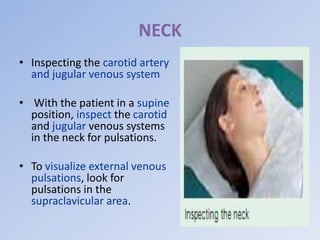
NECK
• Inspecting the carotid artery
and jugular venous system
• With the patient in a supine
position, inspect the carotid
and jugular venous systems
in the neck for pulsations.
• To visualize external venous
pulsations, look for
pulsations in the
supraclavicular area.
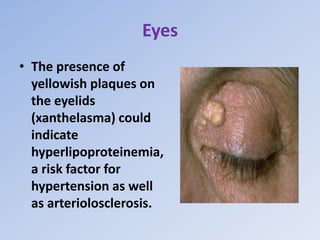
Eyes
• The presence of
yellowish plaques on
the eyelids
(xanthelasma) could
indicate
hyperlipoproteinemia,
a risk factor for
hypertension as well
as arteriolosclerosis.
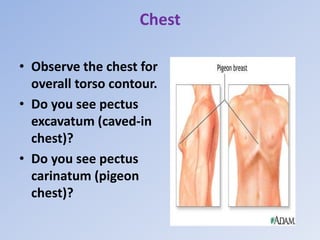
Chest
• Observe the chest for
overall torso contour.
• Do you see pectus
excavatum (caved-in
chest)?
• Do you see pectus
carinatum (pigeon
chest)?
Skin
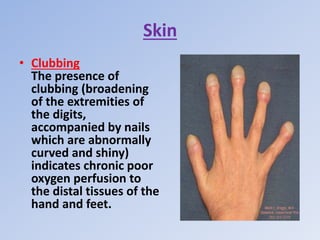
• Clubbing
The presence of
clubbing (broadening
of the extremities of
the digits,
accompanied by nails
which are abnormally
curved and shiny)
indicates chronic poor
oxygen perfusion to
the distal tissues of the
hand and feet.
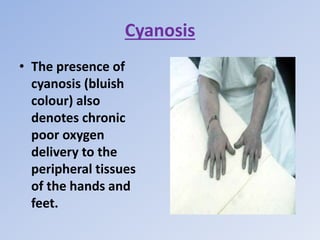
Cyanosis
• The presence of
cyanosis (bluish
colour) also
denotes chronic
poor oxygen
delivery to the
peripheral tissues
of the hands and
feet.
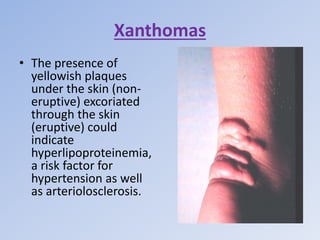
Xanthomas
• The presence of
yellowish plaques
under the skin (non-
eruptive) excoriated
through the skin
(eruptive) could
indicate
hyperlipoproteinemia,
a risk factor for
hypertension as well
as arteriolosclerosis.
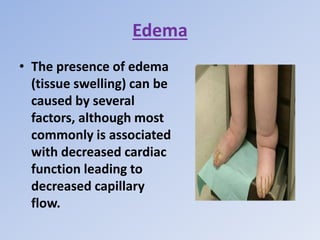
Edema
• The presence of edema
(tissue swelling) can be
caused by several
factors, although most
commonly is associated
with decreased cardiac
function leading to
decreased capillary
flow.
Palpation
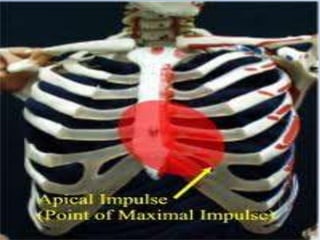
• Use the palm of your hand to feel the chest
wall for the "Point of Maximal Impulse"
(PMI), which is usually found at the apex of
the heart. This apical pulse is generally
located in the 5th intercostal space, about 7-9
cm (the width of your palm) to the left of the
midline.
PALPATE THE PERIPHERAL ARTERIES. THESE
INCLUDE THE APICAL ,RADIAL , CAROTID,
BRACHIAL, FEMORAL, POPLITEAL, AND
PEDAL. NOTE THE CONTOUR AND
AMPLITUDE OF EACH PULSATION. THESE
SHOULD FEEL SIMILAR BILATERALLY.
*NOTE: PALATE FOR 30 SECONDS WITH
REGULAR RHYTHM AND 1-2 MIN WITH
IRREGULAR RHYTHM.
1.APICAL PULSE
• Or point of maximal impulse (PMI):
• Patient is supine, palpate at 5th interspace,
midcalvicular vertical line(apex of the heart
maybe displaced upward by pregnancy or high
diaphragm and maybe displaced laterally in
congestive heart failure, cardiomyopathy
ischemic heart diseases.
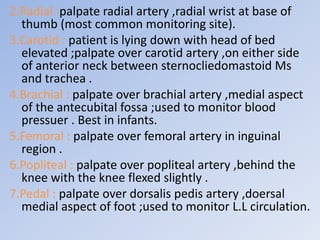
2.Radial :palpate radial artery ,radial wrist at base of
thumb (most common monitoring site).
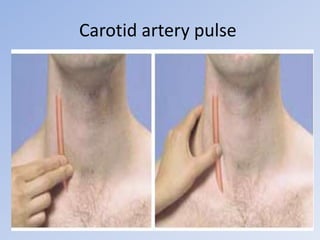
3.Carotid : patient is lying down with head of bed
elevated ;palpate over carotid artery ,on either side
of anterior neck between sternocliedomastoid Ms
and trachea .
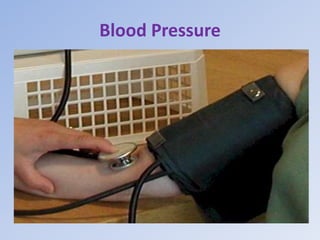
4.Brachial : palpate over brachial artery ,medial aspect
of the antecubital fossa ;used to monitor blood
pressuer . Best in infants.
5.Femoral : palpate over femoral artery in inguinal
region .
6.Popliteal : palpate over popliteal artery ,behind the
knee with the knee flexed slightly .
7.Pedal : palpate over dorsalis pedis artery ,doersal
medial aspect of foot ;used to monitor L.L circulation.
Carotid artery pulse
Blood Pressure
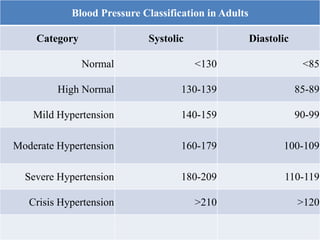
Blood Pressure Classification in Adults
Category Systolic Diastolic
Normal <130 <85
High Normal 130-139 85-89
Mild Hypertension 140-159 90-99
Moderate Hypertension 160-179 100-109
Severe Hypertension 180-209 110-119
Crisis Hypertension >210 >120
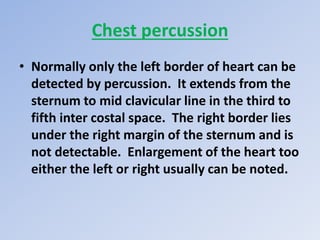
Chest percussion
• Normally only the left border of heart can be
detected by percussion. It extends from the
sternum to mid clavicular line in the third to
fifth inter costal space. The right border lies
under the right margin of the sternum and is
not detectable. Enlargement of the heart too
either the left or right usually can be noted.
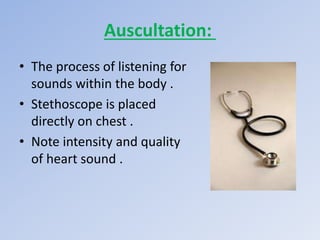
Auscultation:
• The process of listening for
sounds within the body .
• Stethoscope is placed
directly on chest .
• Note intensity and quality
of heart sound .
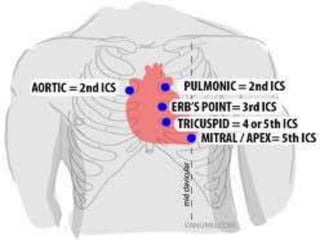
Ausucultation Land marks
1. Aortic valve: locate the 2nd right intercostal
space at the sternal border.
2. Pulmonic valve: located the 2nd left
intercostal space at sternal border.
3. Tricuspid valve : locate the 4th left intercostal
space at the sternal border.
4. Mitral valve: locate the 5th left intercostal at
the midclavical area.
S1
• S1, the “lub” of the “lub-dub,” is produced
by the closure of tricuspid and mitral
valves.
• S1 is accentuated in exercise, anemia,
hyperthyroidism, and mitral stenosis.
• S1 is diminished in first degree heart
block.
• S1 split is most audible in tricuspid area
(T-lub-dub).
S2
• Normal closure of of aortic and pulmonary
valves.
• S2, the “dub” of the “lub-dub,” is produced by
the closure of aortic & pulmonic valves.
• Normal physiological splitting of S2 is best heard
at pulmonic area. It occurs on inspiration(“lub-T-
dub, lub-dub”).
• Splitting of S2 can indicate pulmonic stenosis,
atrial septal defect, right ventricular failure,
• and left bundle branch block .
S3
• S3 is also known as a ventricular filling
(“lub-DUB-ta”). S3 is heard in early diastole.
It is normal in pregnancy, children, adults
less than thirty years old, during exercise,
anxiety, or anemia.
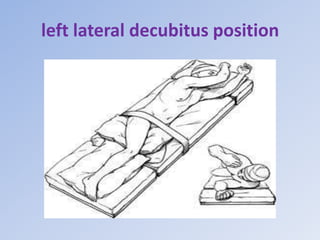
• It is heard best at the apex in the left lateral
decubitus position, using the bell.
• Pathologic S3 occurs in people over the age
of 40, usually due to myocardial failure.
left lateral decubitus position
S4
• S4 is also known as an atrial gallop (“ta-
lub-DUB”). It is typically heard in late
diastole before S1.
• It associated with ventricular filling and
atrial contraction .
• It is indicative of pathology e.g aortic
stenosis, or chronic hypertension.
Murmurs
• A murmur is an abnormal heart sound caused by turbulent blood
flow. The sound may indicate that blood is flowing through a
damaged or overworked heart valve, that there may be a hole in
one of the heart's walls, or that there is a narrowing in one of the
heart's vessels.
1. In systolic: falls between S1 and S2.may indicate valvular disease
(mitral valve prolapse)or maybe normal .
2. In diastolic: falls between S2 and S1.usually indicates valvular
disease .
3. Grades of heart murmurs : from grade 1 (softest audible
murmur) to grade 6 (audible with stethoscope of the chest ).
4. Thrill : an abnormal tremor accompanying a vascular or cardiac
murmur,felt on palpation.
• Bruit: an adventious sound or murmur
(blowing sound) of arterial or venous origin
;common in carotid or femoral arteries;
indicative of atherosclerosis.
• Gallop rhythm : an abnormal heart rhythm
with three sounds in each cycle ; resembles
the gallop of a horse.
Laboratory tests
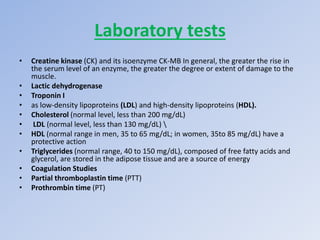
• Creatine kinase (CK) and its isoenzyme CK-MB In general, the greater the rise in
the serum level of an enzyme, the greater the degree or extent of damage to the
muscle.
• Lactic dehydrogenase
• Troponin I
• as low-density lipoproteins (LDL) and high-density lipoproteins (HDL).
• Cholesterol (normal level, less than 200 mg/dL)
• LDL (normal level, less than 130 mg/dL) 
• HDL (normal range in men, 35 to 65 mg/dL; in women, 35to 85 mg/dL) have a
protective action
• Triglycerides (normal range, 40 to 150 mg/dL), composed of free fatty acids and
glycerol, are stored in the adipose tissue and are a source of energy
• Coagulation Studies
• Partial thromboplastin time (PTT)
• Prothrombin time (PT)
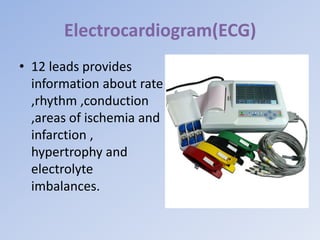
Electrocardiogram(ECG)
• 12 leads provides
information about rate
,rhythm ,conduction
,areas of ischemia and
infarction ,
hypertrophy and
electrolyte
imbalances.
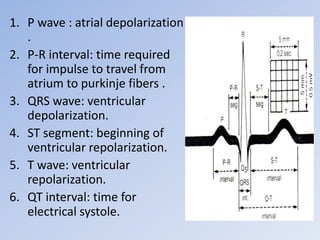
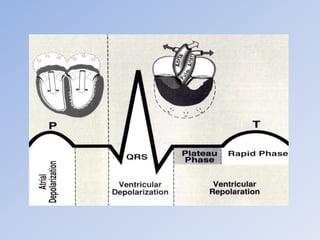
1. P wave : atrial depolarization
.
2. P-R interval: time required
for impulse to travel from
atrium to purkinje fibers .
3. QRS wave: ventricular
depolarization.
4. ST segment: beginning of
ventricular repolarization.
5. T wave: ventricular
repolarization.
6. QT interval: time for
electrical systole.
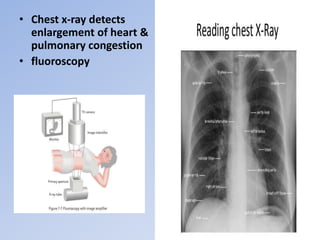
• Chest x-ray detects
enlargement of heart &
pulmonary congestion
• fluoroscopy
Cardiovascular assessment aser

Cardiovascular assessment aser

  • 1.
  • 2.
    LECTURE OBJECTIVES 1. Reviewanatomy & physiology of the cardiovascular system. 2. Describe physical assessment of cardiovascular status. 3. Review diagnostic procedures
  • 3.
    Anatomy & Physiology Functionsof the heart & CV system • Pumps blood to tissues to supply O2 & nutrients • Remove CO2 & metabolic wastes
  • 4.
    Heart Tissue 1. Pericardium:fibrous protective sac enclosing heart . 2. Epicardium :inner layer of pericardium. 3. Myocardium : heart muscle ,major portion of the heart . 4. Endocardium: smooth linning of the inner surface and cavities of the heart .
  • 5.
    Circulation in theHeart 1.Right atrium(RA): receives blood from systimic circulation, from the sup&inf vena cava . 2.Right ventricle(RV): receives blood from RA and pumps blood via pulmonary artery to the lungs for oxygenation .
  • 6.
    3.Left atrium(LA):receives oxygenated bloodfrom the lung and four pulmonary veins. 4.Left ventricle(LV):receives blood from LA and pumps blood via the aorta throughout the entire systemic circulation. NOTE: the walls of the LV are thicker and stronger than the RV and forms most of the left side and apex of the heart .
  • 7.
    VALVES • Provide one-wayflow of blood . 1.Atrioventricular valves: prevent backflow of blood into atria during ventricular systole (valves close when ventricular walls contract ). (A)-Tricuspid valve (three cusps):RT heart valve. (B)-Bicuspid or mitral valve (two cusps):LF heart valve . 2.Smilunar valves: prevent backflow of blood from aorta and pulmonary arteries into the ventricles during diastole. (A)-Pulmonary valve : prevent RT backflow . (B)-Aortic vavle : prevent LF backflow .
  • 9.
    Cardiac cycle • Therhythmic pumping action of the heart . 1.Systole : the period of ventricular contraction . (End-systolic volume is the amount of blood in the ventricles after systole, about 50 ml ) 2.Diastole : the period of ventricular relaxation and filling of blood . (End-diastolic volume is the amount of blood in the ventricles after diastole,about 120 ml ) 3.Atrial contraction occurs during the last third of diastole and completes ventricular filling .
  • 11.
    Coronary circulation 1. Arteries:arise directly from aorta near aortic valve. (A).Right coronary artery (RCA):supplies RT atrium ,most of RT ventricle, and in most individuals the INF wall of LF ventricle, atrioventricular(AV)node and 60%of sinoatrial(SA)node . (B).Left coronary artery (LCA):supplies most of LF ventricle ; has two main divisions : I-left anterior descending (LAD):supplies LF ventricle ,interventricular septum and inferior areas of apex . II-circumflex (Circ):supplies blood to LAT and inferior, walls of the LF ventricle, portions of LF atrium and 40% of SA node . 2. Veins: parallel to arterial system .
  • 13.
    CARDIOVASCULAR EXAMINATION Part I:Assessment of cardiovascular function: A. Patient interview 1. Health history 2. Past history :other diagnosis, surgeries, medications. 3. social history :current living situation and lifestyle. 4. Risk factor : positive and negative risk factors. B. Physical assessment 1. Inspection 2. Palpation 3. Percussion 4. Auscultation C. Laboratory test 1. Cardiac enzyme = enzymes are released when cells are damaged (MI). Enzymes are found in many tissues/muscles, and some are specific to cardiac tissue. 2. Lipid profile 3. Coagulation studies
  • 14.
    Part II: Assessmentof cardiovascular structure • Diagnostic studies • ECG • X- ray • fluoroscopy • The exercise stress • Cardiac catheterization
  • 15.
    A.Patient interview 1.Health history: a- Socio - cultural history: - Name ,Age, sex, occupation, educational level, marital status. b- Presenting symptoms. c-Family History d- Psychosocial Profile
  • 16.
    Presenting symptoms Note onset,progression, and nature of symptoms . 1.Chest pain and shortness of breath. 2.Fatigue:generalized feeling of tiredness. 3.Palpitation:awareness by patient of heart rhythm abnormalities e.g pounding fluttering. 4.Dizziness, syncope(transient loss of consciousness)due to inadequate cerebral blood flow. 5.Edema:retention of fluid in the tissues especially in dependent body partsL.L with sudden weight gain. 6.Extremity Changes :Changes in the extremities may provide clues about underlying cardiovascular disease. Symptoms such as Paresthesia (numbness, tingling), coolness, and intermittent claudication (pain in calves during ambulation) may be associated with vascular disease, coronary heart disease, or cerebral vascular disease. 7- Dyspnea and Cough: Dyspnea may also occur with cardiac disease such as left-sided CHF
  • 17.
    Pitting edema • isa depression in the skin from pressure. • To demonstrate the presence of pitting edema, the examiner presses firmly with his or her thumb over a bony surface • The severity of edema is described on a five-point scale, from none (0) to very marked (4). 1+ Mild pitting, slight indentation, no perceptible swelling of the leg 2+ Moderate pitting, indentation subsides rapidly 3+ Deep pitting, indentation remains for a short time, leg looks swollen 4+ Very deep pitting, indentation lasts a long time, leg is very swollen
  • 18.
    Risk factor a. Positiverisk factor : 1.hypercholestesterolemia. 2.hypertension 3.cigarette smoking 4. Alcohol 5.sedantary lifestyle. 6.obesity:body mass index (BMI) >30KG or waist girth >100cm. 7.imparied fasting glucose: fasting blood glucose >110mgdL B. Negative risk factor : as high serum HDL cholesterol>60mgdL
  • 19.
    B- Physical assessment ASSESSMENTARTICLES: • A Double-Headed, Double-Lumen Stethoscope • A Blood Pressure Cuff • A Moveable Light Source or Pen Light • Sphygmomanometer • Measure tap • Wrist watch and pen
  • 20.
  • 21.
    NECK • Inspecting thecarotid artery and jugular venous system • With the patient in a supine position, inspect the carotid and jugular venous systems in the neck for pulsations. • To visualize external venous pulsations, look for pulsations in the supraclavicular area.
  • 22.
    Eyes • The presenceof yellowish plaques on the eyelids (xanthelasma) could indicate hyperlipoproteinemia, a risk factor for hypertension as well as arteriolosclerosis.
  • 23.
    Chest • Observe thechest for overall torso contour. • Do you see pectus excavatum (caved-in chest)? • Do you see pectus carinatum (pigeon chest)?
  • 24.
    Skin • Clubbing The presenceof clubbing (broadening of the extremities of the digits, accompanied by nails which are abnormally curved and shiny) indicates chronic poor oxygen perfusion to the distal tissues of the hand and feet.
  • 25.
    Cyanosis • The presenceof cyanosis (bluish colour) also denotes chronic poor oxygen delivery to the peripheral tissues of the hands and feet.
  • 26.
    Xanthomas • The presenceof yellowish plaques under the skin (non- eruptive) excoriated through the skin (eruptive) could indicate hyperlipoproteinemia, a risk factor for hypertension as well as arteriolosclerosis.
  • 27.
    Edema • The presenceof edema (tissue swelling) can be caused by several factors, although most commonly is associated with decreased cardiac function leading to decreased capillary flow.
  • 28.
    Palpation • Use thepalm of your hand to feel the chest wall for the "Point of Maximal Impulse" (PMI), which is usually found at the apex of the heart. This apical pulse is generally located in the 5th intercostal space, about 7-9 cm (the width of your palm) to the left of the midline.
  • 30.
    PALPATE THE PERIPHERALARTERIES. THESE INCLUDE THE APICAL ,RADIAL , CAROTID, BRACHIAL, FEMORAL, POPLITEAL, AND PEDAL. NOTE THE CONTOUR AND AMPLITUDE OF EACH PULSATION. THESE SHOULD FEEL SIMILAR BILATERALLY. *NOTE: PALATE FOR 30 SECONDS WITH REGULAR RHYTHM AND 1-2 MIN WITH IRREGULAR RHYTHM.
  • 31.
    1.APICAL PULSE • Orpoint of maximal impulse (PMI): • Patient is supine, palpate at 5th interspace, midcalvicular vertical line(apex of the heart maybe displaced upward by pregnancy or high diaphragm and maybe displaced laterally in congestive heart failure, cardiomyopathy ischemic heart diseases.
  • 32.
    2.Radial :palpate radialartery ,radial wrist at base of thumb (most common monitoring site). 3.Carotid : patient is lying down with head of bed elevated ;palpate over carotid artery ,on either side of anterior neck between sternocliedomastoid Ms and trachea . 4.Brachial : palpate over brachial artery ,medial aspect of the antecubital fossa ;used to monitor blood pressuer . Best in infants. 5.Femoral : palpate over femoral artery in inguinal region . 6.Popliteal : palpate over popliteal artery ,behind the knee with the knee flexed slightly . 7.Pedal : palpate over dorsalis pedis artery ,doersal medial aspect of foot ;used to monitor L.L circulation.
  • 33.
  • 34.
  • 35.
    Blood Pressure Classificationin Adults Category Systolic Diastolic Normal <130 <85 High Normal 130-139 85-89 Mild Hypertension 140-159 90-99 Moderate Hypertension 160-179 100-109 Severe Hypertension 180-209 110-119 Crisis Hypertension >210 >120
  • 36.
    Chest percussion • Normallyonly the left border of heart can be detected by percussion. It extends from the sternum to mid clavicular line in the third to fifth inter costal space. The right border lies under the right margin of the sternum and is not detectable. Enlargement of the heart too either the left or right usually can be noted.
  • 37.
    Auscultation: • The processof listening for sounds within the body . • Stethoscope is placed directly on chest . • Note intensity and quality of heart sound .
  • 38.
    Ausucultation Land marks 1.Aortic valve: locate the 2nd right intercostal space at the sternal border. 2. Pulmonic valve: located the 2nd left intercostal space at sternal border. 3. Tricuspid valve : locate the 4th left intercostal space at the sternal border. 4. Mitral valve: locate the 5th left intercostal at the midclavical area.
  • 40.
    S1 • S1, the“lub” of the “lub-dub,” is produced by the closure of tricuspid and mitral valves. • S1 is accentuated in exercise, anemia, hyperthyroidism, and mitral stenosis. • S1 is diminished in first degree heart block. • S1 split is most audible in tricuspid area (T-lub-dub).
  • 41.
    S2 • Normal closureof of aortic and pulmonary valves. • S2, the “dub” of the “lub-dub,” is produced by the closure of aortic & pulmonic valves. • Normal physiological splitting of S2 is best heard at pulmonic area. It occurs on inspiration(“lub-T- dub, lub-dub”). • Splitting of S2 can indicate pulmonic stenosis, atrial septal defect, right ventricular failure, • and left bundle branch block .
  • 42.
    S3 • S3 isalso known as a ventricular filling (“lub-DUB-ta”). S3 is heard in early diastole. It is normal in pregnancy, children, adults less than thirty years old, during exercise, anxiety, or anemia. • It is heard best at the apex in the left lateral decubitus position, using the bell. • Pathologic S3 occurs in people over the age of 40, usually due to myocardial failure.
  • 43.
  • 44.
    S4 • S4 isalso known as an atrial gallop (“ta- lub-DUB”). It is typically heard in late diastole before S1. • It associated with ventricular filling and atrial contraction . • It is indicative of pathology e.g aortic stenosis, or chronic hypertension.
  • 45.
    Murmurs • A murmuris an abnormal heart sound caused by turbulent blood flow. The sound may indicate that blood is flowing through a damaged or overworked heart valve, that there may be a hole in one of the heart's walls, or that there is a narrowing in one of the heart's vessels. 1. In systolic: falls between S1 and S2.may indicate valvular disease (mitral valve prolapse)or maybe normal . 2. In diastolic: falls between S2 and S1.usually indicates valvular disease . 3. Grades of heart murmurs : from grade 1 (softest audible murmur) to grade 6 (audible with stethoscope of the chest ). 4. Thrill : an abnormal tremor accompanying a vascular or cardiac murmur,felt on palpation.
  • 46.
    • Bruit: anadventious sound or murmur (blowing sound) of arterial or venous origin ;common in carotid or femoral arteries; indicative of atherosclerosis. • Gallop rhythm : an abnormal heart rhythm with three sounds in each cycle ; resembles the gallop of a horse.
  • 47.
    Laboratory tests • Creatinekinase (CK) and its isoenzyme CK-MB In general, the greater the rise in the serum level of an enzyme, the greater the degree or extent of damage to the muscle. • Lactic dehydrogenase • Troponin I • as low-density lipoproteins (LDL) and high-density lipoproteins (HDL). • Cholesterol (normal level, less than 200 mg/dL) • LDL (normal level, less than 130 mg/dL) • HDL (normal range in men, 35 to 65 mg/dL; in women, 35to 85 mg/dL) have a protective action • Triglycerides (normal range, 40 to 150 mg/dL), composed of free fatty acids and glycerol, are stored in the adipose tissue and are a source of energy • Coagulation Studies • Partial thromboplastin time (PTT) • Prothrombin time (PT)
  • 48.
    Electrocardiogram(ECG) • 12 leadsprovides information about rate ,rhythm ,conduction ,areas of ischemia and infarction , hypertrophy and electrolyte imbalances.
  • 49.
    1. P wave: atrial depolarization . 2. P-R interval: time required for impulse to travel from atrium to purkinje fibers . 3. QRS wave: ventricular depolarization. 4. ST segment: beginning of ventricular repolarization. 5. T wave: ventricular repolarization. 6. QT interval: time for electrical systole.
  • 51.
    • Chest x-raydetects enlargement of heart & pulmonary congestion • fluoroscopy