







Detection and Classification
of Disturbances in a Hybrid
Distributed System Using
Wavelet Transform and ANN
GUIDE : Prof. P. R. Subadhra
By,
Sleeba Paul Puthenpurakel
Introduction
Rapid Increment in Energy Demand
India : By 2030, Demand = 6 x Current Demand
Feasibility of Renewable Energy Sources
Minimizes the environmental pollution
Advancement in Power Electronics, Internet of Things and Automation
Distributed Generation
Power Generation is no more oligopolistic
Advanced Reliability of Power
Types
Stand Alone
Grid Connected
DG Penetration Increment
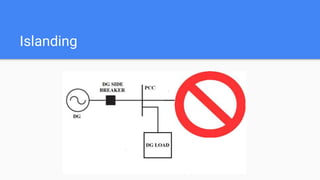
Islanding
Intentional Islanding
Informed at Grid and DG side
Reduce congestion in network
Improves voltage profile
Separate the faulty part from network
Unintentional Islanding
Safety
Change in Impedance level
Protection Scheme
Ferroresonance
Over Loading of DG
Islanding Detection Methods
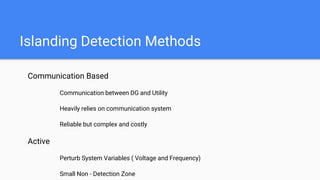
Communication Based
Communication between DG and Utility
Heavily relies on communication system
Reliable but complex and costly
Active
Perturb System Variables ( Voltage and Frequency)
Small Non - Detection Zone
Islanding Detection Methods
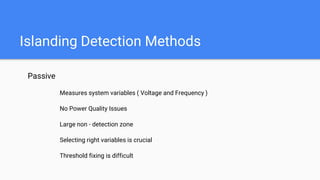
Passive
Measures system variables ( Voltage and Frequency )
No Power Quality Issues
Large non - detection zone
Selecting right variables is crucial
Threshold fixing is difficult
Computational Intelligence based methods
Mimics human intelligence
Solves non - linear multi objective problems
High speed and accuracy
Learn from examples
Training of algorithm is a one time process
Can detect and classify disturbances
Motivation of Thesis
Importance of Distributed Generation
Unintentional Islanding hazards
Inabilities of conventional methods
Power Quality issues
High Non – Detection zone
Cost of implementation
Popularity and Robustness of Computational Intelligence and Machine
learning
Objectives
Disturbance Detection using a conventional method in Hybrid System
Disturbance Detection using Wavelet Transform in Hybrid System
Disturbance Classification using Computational Intelligence Method
Comparative study
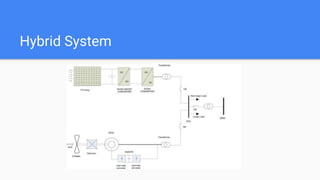
Hybrid System
Hybrid System Specifications
PV System
Rated Power - 250 kW
Irradiance - 1000 W/m2
Wind Power Plant
Rated Power - 1.5 MW
Wind Speed - 12 m/s
Grid
Conventional Islanding Detection Method
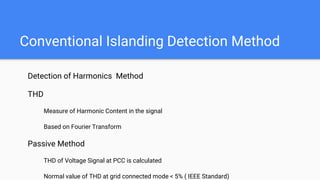
Detection of Harmonics Method
THD
Measure of Harmonic Content in the signal
Based on Fourier Transform
Passive Method
THD of Voltage Signal at PCC is calculated
Normal value of THD at grid connected mode < 5% ( IEEE Standard)
Transform of a Signal
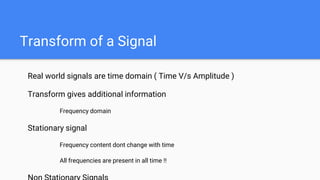
Real world signals are time domain ( Time V/s Amplitude )
Transform gives additional information
Frequency domain
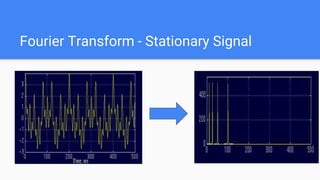
Stationary signal
Frequency content dont change with time
All frequencies are present in all time !!
Fourier Transform - Stationary Signal
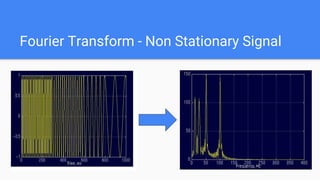
Fourier Transform - Non Stationary Signal
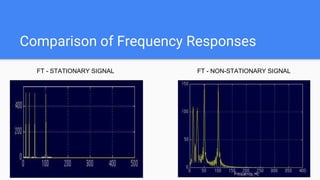
Comparison of Frequency Responses
FT - STATIONARY SIGNAL FT - NON-STATIONARY SIGNAL
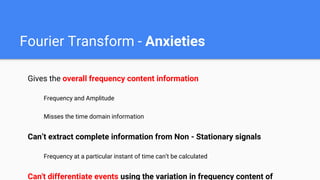
Fourier Transform - Anxieties
Gives the overall frequency content information
Frequency and Amplitude
Misses the time domain information
Can’t extract complete information from Non - Stationary signals
Frequency at a particular instant of time can’t be calculated
Can't differentiate events using the variation in frequency content of
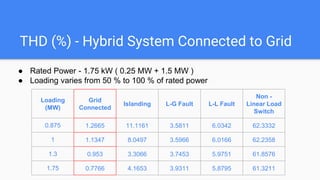
THD (%) - Hybrid System Connected to Grid
Loading
(MW)
Grid
Connected
Islanding L-G Fault L-L Fault
Non -
Linear Load
Switch
0.875 1.2665 11.1161 3.5811 6.0342 62.3332
1 1.1347 8.0497 3.5966 6.0166 62.2358
1.3 0.953 3.3066 3.7453 5.9751 61.8576
1.75 0.7766 4.1653 3.9311 5.8795 61.3211
â—Ź Rated Power - 1.75 kW ( 0.25 MW + 1.5 MW )
â—Ź Loading varies from 50 % to 100 % of rated power
Inferences
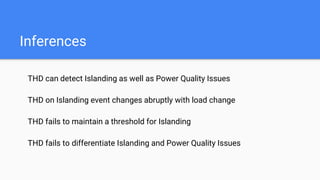
THD can detect Islanding as well as Power Quality Issues
THD on Islanding event changes abruptly with load change
THD fails to maintain a threshold for Islanding
THD fails to differentiate Islanding and Power Quality Issues
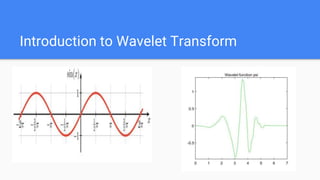
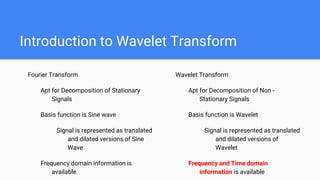
Introduction to Wavelet Transform
Fourier Transform
Apt for Decomposition of Stationary
Signals
Basis function is Sine wave
Signal is represented as translated
and dilated versions of Sine
Wave
Frequency domain information is
available
Wavelet Transform
Apt for Decomposition of Non -
Stationary Signals
Basis function is Wavelet
Signal is represented as translated
and dilated versions of
Wavelet
Frequency and Time domain
information is available
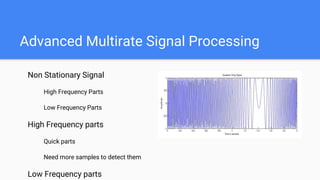
Advanced Multirate Signal Processing
Non Stationary Signal
High Frequency Parts
Low Frequency Parts
High Frequency parts
Quick parts
Need more samples to detect them
Low Frequency parts
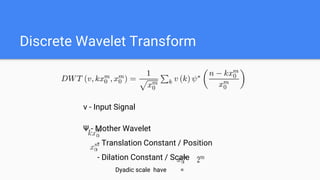
Discrete Wavelet Transform
v - Input Signal
Ψ - Mother Wavelet
- Translation Constant / Position
- Dilation Constant / Scale
Dyadic scale have =
Discrete Wavelet Transform - Working
● x[n] → Signal
● h[n] → HPF
● g[n] → LPF
Coefficients
Filters
Down - Sampling
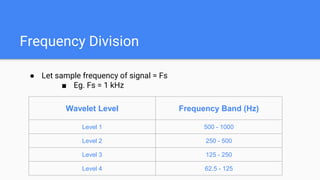
Frequency Division
â—Ź Let sample frequency of signal = Fs
â–  Eg. Fs = 1 kHz
Wavelet Level Frequency Band (Hz)
Level 1 500 - 1000
Level 2 250 - 500
Level 3 125 - 250
Level 4 62.5 - 125
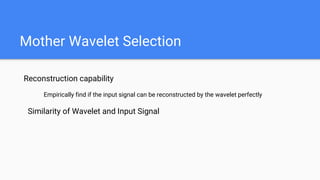
Mother Wavelet Selection
Reconstruction capability
Empirically find if the input signal can be reconstructed by the wavelet perfectly
Similarity of Wavelet and Input Signal
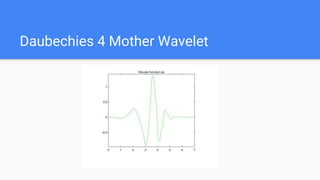
Daubechies 4 Mother Wavelet
â—Ź Disturbance in power system features exhibit sharp changes
â—Ź Daubechies mother wavelet with low order
â—‹ Which have an angular shape
â—‹ Ideal to analyse sharp changes
â–  For smooth features , a higher order is preferred.
Daubechies 4 Mother Wavelet
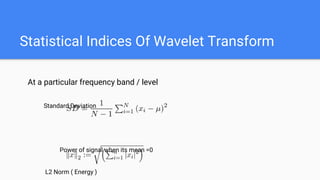
Statistical Indices Of Wavelet Transform
At a particular frequency band / level
Standard Deviation
Power of signal when its mean =0
L2 Norm ( Energy )
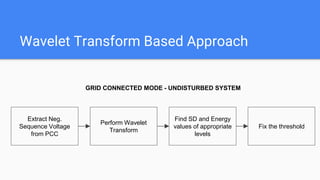
Wavelet Transform Based Approach
Extract Neg.
Sequence Voltage
from PCC
Perform Wavelet
Transform
Find SD and Energy
values of appropriate
levels
Fix the threshold
GRID CONNECTED MODE - UNDISTURBED SYSTEM
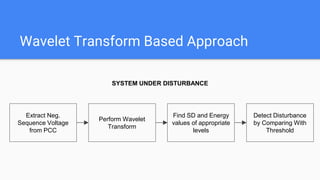
Wavelet Transform Based Approach
Extract Neg.
Sequence Voltage
from PCC
Perform Wavelet
Transform
Find SD and Energy
values of appropriate
levels
Detect Disturbance
by Comparing With
Threshold
SYSTEM UNDER DISTURBANCE
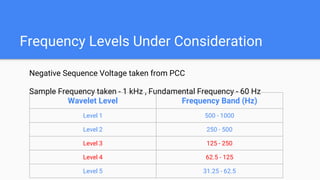
Frequency Levels Under Consideration
Negative Sequence Voltage taken from PCC
Sample Frequency taken - 1 kHz , Fundamental Frequency - 60 Hz
Wavelet Level Frequency Band (Hz)
Level 1 500 - 1000
Level 2 250 - 500
Level 3 125 - 250
Level 4 62.5 - 125
Level 5 31.25 - 62.5
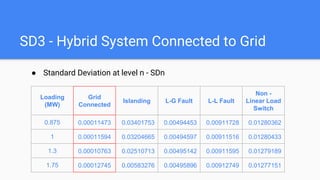
SD3 - Hybrid System Connected to Grid
â—Ź Standard Deviation at level n - SDn
Loading
(MW)
Grid
Connected
Islanding L-G Fault L-L Fault
Non -
Linear Load
Switch
0.875 0.00011473 0.03401753 0.00494453 0.00911728 0.01280362
1 0.00011594 0.03204665 0.00494597 0.00911516 0.01280433
1.3 0.00010763 0.02510713 0.00495142 0.00911595 0.01279189
1.75 0.00012745 0.00583276 0.00495896 0.00912749 0.01277151
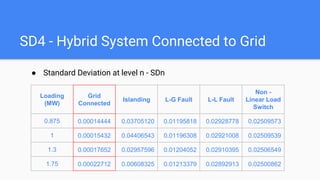
SD4 - Hybrid System Connected to Grid
â—Ź Standard Deviation at level n - SDn
Loading
(MW)
Grid
Connected
Islanding L-G Fault L-L Fault
Non -
Linear Load
Switch
0.875 0.00014444 0.03705120 0.01195818 0.02928778 0.02509573
1 0.00015432 0.04406543 0.01196308 0.02921008 0.02509539
1.3 0.00017652 0.02957596 0.01204052 0.02910395 0.02506549
1.75 0.00022712 0.00608325 0.01213379 0.02892913 0.02500862
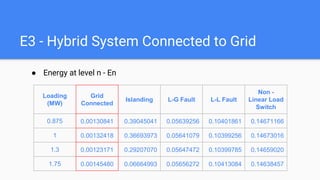
E3 - Hybrid System Connected to Grid
â—Ź Energy at level n - En
Loading
(MW)
Grid
Connected
Islanding L-G Fault L-L Fault
Non -
Linear Load
Switch
0.875 0.00130841 0.39045041 0.05639256 0.10401861 0.14671166
1 0.00132418 0.36693973 0.05641079 0.10399256 0.14673016
1.3 0.00123171 0.29207070 0.05647472 0.10399785 0.14659020
1.75 0.00145480 0.06664993 0.05656272 0.10413084 0.14638457
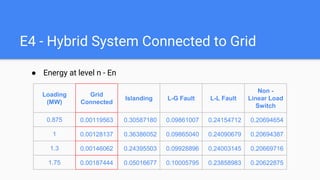
E4 - Hybrid System Connected to Grid
â—Ź Energy at level n - En
Loading
(MW)
Grid
Connected
Islanding L-G Fault L-L Fault
Non -
Linear Load
Switch
0.875 0.00119563 0.30587180 0.09861007 0.24154712 0.20694654
1 0.00128137 0.36386052 0.09865040 0.24090679 0.20694387
1.3 0.00146062 0.24395503 0.09928896 0.24003145 0.20669716
1.75 0.00187444 0.05016677 0.10005795 0.23858983 0.20622875
Inferences
Change in SD and Energy are not abrupt, unlike THD
Thus it's easy to fix a threshold with SD and Energy
SD and Energy can classify the events
Between Islanding and Power Quality Issues
Machine Learning
Subfield of Computer Science
Study of pattern recognition
Learns from examples
Training → Learning → Prediction
Category
Applications
Voice assistants like Google Voice Search , Cortana and Siri
Product Recommendations on E- Commerce sites
Spam mail classifier
According to Gartner’s Hype Cycle 2015
Most promising technology of future
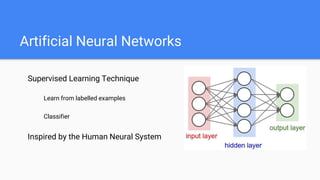
Artificial Neural Networks
Supervised Learning Technique
Learn from labelled examples
Classifier
Inspired by the Human Neural System
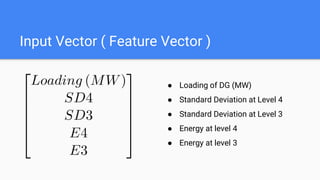
Input Vector ( Feature Vector )
â—Ź Loading of DG (MW)
â—Ź Standard Deviation at Level 4
â—Ź Standard Deviation at Level 3
â—Ź Energy at level 4
â—Ź Energy at level 3
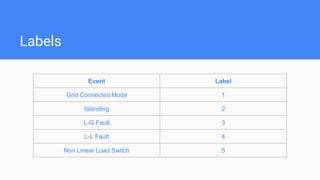
Labels
Event Label
Grid Connected Mode 1
Islanding 2
L-G Fault 3
L-L Fault 4
Non Linear Load Switch 5
ANN - Specifications
No. of layers - 3
Input layer size - 5
No. of features taken
Hidden layer size - 40
Optimized by trial and error method
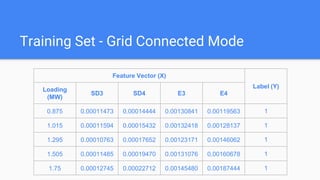
Training Set - Grid Connected Mode
Feature Vector (X)
Label (Y)
Loading
(MW)
SD3 SD4 E3 E4
0.875 0.00011473 0.00014444 0.00130841 0.00119563 1
1.015 0.00011594 0.00015432 0.00132418 0.00128137 1
1.295 0.00010763 0.00017652 0.00123171 0.00146062 1
1.505 0.00011485 0.00019470 0.00131076 0.00160678 1
1.75 0.00012745 0.00022712 0.00145480 0.00187444 1
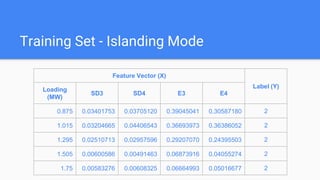
Training Set - Islanding Mode
Feature Vector (X)
Label (Y)
Loading
(MW)
SD3 SD4 E3 E4
0.875 0.03401753 0.03705120 0.39045041 0.30587180 2
1.015 0.03204665 0.04406543 0.36693973 0.36386052 2
1.295 0.02510713 0.02957596 0.29207070 0.24395503 2
1.505 0.00600586 0.00491463 0.06873916 0.04055274 2
1.75 0.00583276 0.00608325 0.06664993 0.05016677 2
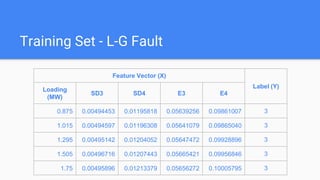
Training Set - L-G Fault
Feature Vector (X)
Label (Y)
Loading
(MW)
SD3 SD4 E3 E4
0.875 0.00494453 0.01195818 0.05639256 0.09861007 3
1.015 0.00494597 0.01196308 0.05641079 0.09865040 3
1.295 0.00495142 0.01204052 0.05647472 0.09928896 3
1.505 0.00496716 0.01207443 0.05665421 0.09956846 3
1.75 0.00495896 0.01213379 0.05656272 0.10005795 3
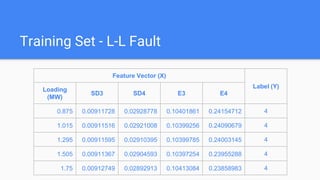
Training Set - L-L Fault
Feature Vector (X)
Label (Y)
Loading
(MW)
SD3 SD4 E3 E4
0.875 0.00911728 0.02928778 0.10401861 0.24154712 4
1.015 0.00911516 0.02921008 0.10399256 0.24090679 4
1.295 0.00911595 0.02910395 0.10399785 0.24003145 4
1.505 0.00911367 0.02904593 0.10397254 0.23955288 4
1.75 0.00912749 0.02892913 0.10413084 0.23858983 4
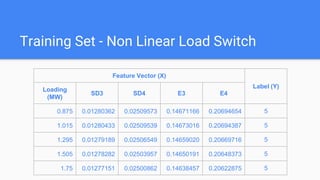
Training Set - Non Linear Load Switch
Feature Vector (X)
Label (Y)
Loading
(MW)
SD3 SD4 E3 E4
0.875 0.01280362 0.02509573 0.14671166 0.20694654 5
1.015 0.01280433 0.02509539 0.14673016 0.20694387 5
1.295 0.01279189 0.02506549 0.14659020 0.20669716 5
1.505 0.01278282 0.02503957 0.14650191 0.20648373 5
1.75 0.01277151 0.02500862 0.14638457 0.20622875 5
Data Set
No. of examples for each event - 26
No. of events = 5
Total Examples = 26 x 5 = 130
Splitting percentage of data - 70 %
Training Set - 91
Inferences
Verified using 3-fold cross validation
ANN can classify and identify the events with excellent accuracy
Prediction accuracy is > 95 %
Final Conclusions
WT Indices provide a better prospect on detecting and classifying Islanding
and PQ disturbances in a Hybrid DG System
THD fails to perform accurate classification
Implementation using Machine Learning Classifier
High prediction accuracy
Future Scope
Detection of Voltage Swell events are not well performed by WT
Load Switching
Capacitor Bank switching
Performance of WT at noisy environments
Feature Vector Selection
Implementation
Implementation as a Web Service
Using Microsoft Azure Machine Learning Suite
API Key -
zogVJpUKUmTEEh3auMuVYZ1q1tBKBWA+tHeZWIyzuG2sYUfxHKJ7F4IpXhGALe5IiVpunz
MHjDF8i0gTImfqfA==
URL -
https://ussouthcentral.services.azureml.net/workspaces/8e3a01b9b5a94cd8be8f69c85b
fd1215/services/923ca965d52a46788d91c32cd9cdc9fd/execute?api-
version=2.0&details=true
Web Service- Microsoft Azure ML Suite
GUI Using Python
GUI Using Python
Reference
[1] El-Saadany, E. F., H. H. Zeineldin, and A. H. Al-Badi. "Distributed generation: benefits and challenges." International Conference on Communication, Computer & Power. Vol.
115119. 2007.
[2] Algarni, Ayed. "Operational and planning aspects of distribution systems in deregulated electricity markets." (2009).
[3] Zeineldin, H. H., and M. M. A. Salama. "Islanding detection of inverter-based distributed generation." IEE Proceedings-Generation, Transmission and Distribution 153.6
(2006): 644-652..
[4] Eltawil, Mohamed A., and Zhengming Zhao. "Grid-connected photovoltaic power systems: Technical and potential problems—A review." Renewable and Sustainable Energy
Reviews 14.1 (2010): 112-129.
[5] United States of America. Congress of the U.S., Congressional Budget Office. Prospects for distributed electricity generation. September, 2003.
[6] Tailor, J. K., and A. H. Osman. "Restoration of fuse-recloser coordination in distribution system with high DG penetration." Power and Energy Society General Meeting-
Conversion and Delivery of Electrical Energy in the 21st Century, 2008 IEEE. IEEE, 2008.
[7] Xu, Wilsun, Konrad Mauch, and Sylvain Martel. "An assessment of distributed generation islanding detection methods and issues for Canada."CANMET Energy Technology
Centre-Varennes, Natural Resources Canada, QC-Canada, Tech. Rep. CETC-Varennes 74 (2004).
[8] Menon, Vivek, and M. Hashem Nehrir. "A hybrid islanding detection technique using voltage unbalance and frequency set point." IEEE Transactions on Power Systems 22.1
(2007): 442-448.
[9] PVPS, IEA. "Evaluation of islanding detection methods for photovoltaic utility-interactive power systems." Report IEA PVPS T5-09 (2002).
[10] Ropp, M. E., et al. "Using power line carrier communications to prevent islanding [of PV power systems]." Photovoltaic Specialists Conference, 2000. Conference Record of the Twenty-Eighth
IEEE. IEEE, 2000.
Reference
[11] Xu, Wilsun, et al. "A power line signaling based technique for anti-islanding protection of distributed generators—part i: scheme and analysis." IEEE Transactions on Power
Delivery 22.3 (2007): 1758-1766.
[12 Xu, Wilsun, et al. "A power line signaling based technique for anti-islanding protection of distributed generators—part i: scheme and analysis." IEEE Transactions on Power
Delivery 22.3 (2007): 1758-1766.
[13] Redfern, M. A., O. Usta, and G. Fielding. "Protection against loss of utility grid supply for a dispersed storage and generation unit." IEEE Transactions on Power Delivery 8.3
(1993): 948-954.
[15] Wrinch, Michael C. Negative sequence impedance measurement for distributed generator islanding detection. Diss. University of British Columbia, 2008.
[16] Yin, Jun, Liuchen Chang, and Chris Diduch. "Recent developments in islanding detection for distributed power generation." Power Engineering, 2004. LESCOPE-04. 2004
Large Engineering systems Conference on. IEEE, 2004.
[17] Smith, G. A., P. A. Onions, and D. G. Infield. "Predicting islanding operation of grid connected PV inverters." IEE Proceedings-Electric Power Applications 147.1 (2000): 1-6.
[18] Ropp, M. E., Miroslav Begovic, and A. Rohatgi. "Analysis and performance assessment of the active frequency drift method of islanding prevention."IEEE Transactions on
Energy Conversion 14.3 (1999): 810-816.
[19] Hung, Guo-Kiang, Chih-Chang Chang, and Chern-Lin Chen. "Automatic phase-shift method for islanding detection of grid-connected photovoltaic inverters." IEEE
Transactions on energy conversion 18.1 (2003): 169-173.
[20] Hernandez-Gonzalez, Guillermo, and Reza Iravani. "Current injection for active islanding detection of electronically-interfaced distributed resources."IEEE Transactions on
power delivery 21.3 (2006): 1698-1705.
Publications [1] Sleeba Paul Puthenpurakel, Subadhra P.R.,
“Islanding Detection in Grid-Connected 100 KW
Photovoltaic System Using Wavelet Transform”,
International Conference on Emerging Trends in
Smart Grid Technology - INCETS'16, IJIRSET Volume
5, Special Issue 5, April 2016
[2] Sleeba Paul Puthenpurakel, Subadhra P.R.,
“Identification and Classification of Microgrid
Disturbances in a Hybrid Distributed Generation
System Using Wavelet Transform”, International
Conference on Next Generation Intelligent Systems”
Thank you all very much !

PPT_Final_Presentation

  • 1.
    Detection and Classification ofDisturbances in a Hybrid Distributed System Using Wavelet Transform and ANN GUIDE : Prof. P. R. Subadhra By, Sleeba Paul Puthenpurakel
  • 2.
    Introduction Rapid Increment inEnergy Demand India : By 2030, Demand = 6 x Current Demand Feasibility of Renewable Energy Sources Minimizes the environmental pollution Advancement in Power Electronics, Internet of Things and Automation
  • 3.
    Distributed Generation Power Generationis no more oligopolistic Advanced Reliability of Power Types Stand Alone Grid Connected DG Penetration Increment
  • 4.
  • 5.
    Intentional Islanding Informed atGrid and DG side Reduce congestion in network Improves voltage profile Separate the faulty part from network
  • 6.
    Unintentional Islanding Safety Change inImpedance level Protection Scheme Ferroresonance Over Loading of DG
  • 7.
    Islanding Detection Methods CommunicationBased Communication between DG and Utility Heavily relies on communication system Reliable but complex and costly Active Perturb System Variables ( Voltage and Frequency) Small Non - Detection Zone
  • 8.
    Islanding Detection Methods Passive Measuressystem variables ( Voltage and Frequency ) No Power Quality Issues Large non - detection zone Selecting right variables is crucial Threshold fixing is difficult
  • 9.
    Computational Intelligence basedmethods Mimics human intelligence Solves non - linear multi objective problems High speed and accuracy Learn from examples Training of algorithm is a one time process Can detect and classify disturbances
  • 10.
    Motivation of Thesis Importanceof Distributed Generation Unintentional Islanding hazards Inabilities of conventional methods Power Quality issues High Non – Detection zone Cost of implementation Popularity and Robustness of Computational Intelligence and Machine learning
  • 11.
    Objectives Disturbance Detection usinga conventional method in Hybrid System Disturbance Detection using Wavelet Transform in Hybrid System Disturbance Classification using Computational Intelligence Method Comparative study
  • 12.
  • 13.
    Hybrid System Specifications PVSystem Rated Power - 250 kW Irradiance - 1000 W/m2 Wind Power Plant Rated Power - 1.5 MW Wind Speed - 12 m/s Grid
  • 14.
    Conventional Islanding DetectionMethod Detection of Harmonics Method THD Measure of Harmonic Content in the signal Based on Fourier Transform Passive Method THD of Voltage Signal at PCC is calculated Normal value of THD at grid connected mode < 5% ( IEEE Standard)
  • 15.
    Transform of aSignal Real world signals are time domain ( Time V/s Amplitude ) Transform gives additional information Frequency domain Stationary signal Frequency content dont change with time All frequencies are present in all time !!
  • 16.
    Fourier Transform -Stationary Signal
  • 17.
    Fourier Transform -Non Stationary Signal
  • 18.
    Comparison of FrequencyResponses FT - STATIONARY SIGNAL FT - NON-STATIONARY SIGNAL
  • 19.
    Fourier Transform -Anxieties Gives the overall frequency content information Frequency and Amplitude Misses the time domain information Can’t extract complete information from Non - Stationary signals Frequency at a particular instant of time can’t be calculated Can't differentiate events using the variation in frequency content of
  • 20.
    THD (%) -Hybrid System Connected to Grid Loading (MW) Grid Connected Islanding L-G Fault L-L Fault Non - Linear Load Switch 0.875 1.2665 11.1161 3.5811 6.0342 62.3332 1 1.1347 8.0497 3.5966 6.0166 62.2358 1.3 0.953 3.3066 3.7453 5.9751 61.8576 1.75 0.7766 4.1653 3.9311 5.8795 61.3211 â—Ź Rated Power - 1.75 kW ( 0.25 MW + 1.5 MW ) â—Ź Loading varies from 50 % to 100 % of rated power
  • 21.
    Inferences THD can detectIslanding as well as Power Quality Issues THD on Islanding event changes abruptly with load change THD fails to maintain a threshold for Islanding THD fails to differentiate Islanding and Power Quality Issues
  • 22.
  • 23.
    Introduction to WaveletTransform Fourier Transform Apt for Decomposition of Stationary Signals Basis function is Sine wave Signal is represented as translated and dilated versions of Sine Wave Frequency domain information is available Wavelet Transform Apt for Decomposition of Non - Stationary Signals Basis function is Wavelet Signal is represented as translated and dilated versions of Wavelet Frequency and Time domain information is available
  • 24.
    Advanced Multirate SignalProcessing Non Stationary Signal High Frequency Parts Low Frequency Parts High Frequency parts Quick parts Need more samples to detect them Low Frequency parts
  • 25.
    Discrete Wavelet Transform v- Input Signal Ψ - Mother Wavelet - Translation Constant / Position - Dilation Constant / Scale Dyadic scale have =
  • 26.
    Discrete Wavelet Transform- Working ● x[n] → Signal ● h[n] → HPF ● g[n] → LPF Coefficients Filters Down - Sampling
  • 27.
    Frequency Division â—Ź Letsample frequency of signal = Fs â–  Eg. Fs = 1 kHz Wavelet Level Frequency Band (Hz) Level 1 500 - 1000 Level 2 250 - 500 Level 3 125 - 250 Level 4 62.5 - 125
  • 28.
    Mother Wavelet Selection Reconstructioncapability Empirically find if the input signal can be reconstructed by the wavelet perfectly Similarity of Wavelet and Input Signal
  • 29.
    Daubechies 4 MotherWavelet â—Ź Disturbance in power system features exhibit sharp changes â—Ź Daubechies mother wavelet with low order â—‹ Which have an angular shape â—‹ Ideal to analyse sharp changes â–  For smooth features , a higher order is preferred.
  • 30.
  • 31.
    Statistical Indices OfWavelet Transform At a particular frequency band / level Standard Deviation Power of signal when its mean =0 L2 Norm ( Energy )
  • 32.
    Wavelet Transform BasedApproach Extract Neg. Sequence Voltage from PCC Perform Wavelet Transform Find SD and Energy values of appropriate levels Fix the threshold GRID CONNECTED MODE - UNDISTURBED SYSTEM
  • 33.
    Wavelet Transform BasedApproach Extract Neg. Sequence Voltage from PCC Perform Wavelet Transform Find SD and Energy values of appropriate levels Detect Disturbance by Comparing With Threshold SYSTEM UNDER DISTURBANCE
  • 34.
    Frequency Levels UnderConsideration Negative Sequence Voltage taken from PCC Sample Frequency taken - 1 kHz , Fundamental Frequency - 60 Hz Wavelet Level Frequency Band (Hz) Level 1 500 - 1000 Level 2 250 - 500 Level 3 125 - 250 Level 4 62.5 - 125 Level 5 31.25 - 62.5
  • 35.
    SD3 - HybridSystem Connected to Grid â—Ź Standard Deviation at level n - SDn Loading (MW) Grid Connected Islanding L-G Fault L-L Fault Non - Linear Load Switch 0.875 0.00011473 0.03401753 0.00494453 0.00911728 0.01280362 1 0.00011594 0.03204665 0.00494597 0.00911516 0.01280433 1.3 0.00010763 0.02510713 0.00495142 0.00911595 0.01279189 1.75 0.00012745 0.00583276 0.00495896 0.00912749 0.01277151
  • 36.
    SD4 - HybridSystem Connected to Grid â—Ź Standard Deviation at level n - SDn Loading (MW) Grid Connected Islanding L-G Fault L-L Fault Non - Linear Load Switch 0.875 0.00014444 0.03705120 0.01195818 0.02928778 0.02509573 1 0.00015432 0.04406543 0.01196308 0.02921008 0.02509539 1.3 0.00017652 0.02957596 0.01204052 0.02910395 0.02506549 1.75 0.00022712 0.00608325 0.01213379 0.02892913 0.02500862
  • 37.
    E3 - HybridSystem Connected to Grid â—Ź Energy at level n - En Loading (MW) Grid Connected Islanding L-G Fault L-L Fault Non - Linear Load Switch 0.875 0.00130841 0.39045041 0.05639256 0.10401861 0.14671166 1 0.00132418 0.36693973 0.05641079 0.10399256 0.14673016 1.3 0.00123171 0.29207070 0.05647472 0.10399785 0.14659020 1.75 0.00145480 0.06664993 0.05656272 0.10413084 0.14638457
  • 38.
    E4 - HybridSystem Connected to Grid â—Ź Energy at level n - En Loading (MW) Grid Connected Islanding L-G Fault L-L Fault Non - Linear Load Switch 0.875 0.00119563 0.30587180 0.09861007 0.24154712 0.20694654 1 0.00128137 0.36386052 0.09865040 0.24090679 0.20694387 1.3 0.00146062 0.24395503 0.09928896 0.24003145 0.20669716 1.75 0.00187444 0.05016677 0.10005795 0.23858983 0.20622875
  • 39.
    Inferences Change in SDand Energy are not abrupt, unlike THD Thus it's easy to fix a threshold with SD and Energy SD and Energy can classify the events Between Islanding and Power Quality Issues
  • 40.
    Machine Learning Subfield ofComputer Science Study of pattern recognition Learns from examples Training → Learning → Prediction Category
  • 41.
    Applications Voice assistants likeGoogle Voice Search , Cortana and Siri Product Recommendations on E- Commerce sites Spam mail classifier According to Gartner’s Hype Cycle 2015 Most promising technology of future
  • 42.
    Artificial Neural Networks SupervisedLearning Technique Learn from labelled examples Classifier Inspired by the Human Neural System
  • 43.
    Input Vector (Feature Vector ) â—Ź Loading of DG (MW) â—Ź Standard Deviation at Level 4 â—Ź Standard Deviation at Level 3 â—Ź Energy at level 4 â—Ź Energy at level 3
  • 44.
    Labels Event Label Grid ConnectedMode 1 Islanding 2 L-G Fault 3 L-L Fault 4 Non Linear Load Switch 5
  • 45.
    ANN - Specifications No.of layers - 3 Input layer size - 5 No. of features taken Hidden layer size - 40 Optimized by trial and error method
  • 46.
    Training Set -Grid Connected Mode Feature Vector (X) Label (Y) Loading (MW) SD3 SD4 E3 E4 0.875 0.00011473 0.00014444 0.00130841 0.00119563 1 1.015 0.00011594 0.00015432 0.00132418 0.00128137 1 1.295 0.00010763 0.00017652 0.00123171 0.00146062 1 1.505 0.00011485 0.00019470 0.00131076 0.00160678 1 1.75 0.00012745 0.00022712 0.00145480 0.00187444 1
  • 47.
    Training Set -Islanding Mode Feature Vector (X) Label (Y) Loading (MW) SD3 SD4 E3 E4 0.875 0.03401753 0.03705120 0.39045041 0.30587180 2 1.015 0.03204665 0.04406543 0.36693973 0.36386052 2 1.295 0.02510713 0.02957596 0.29207070 0.24395503 2 1.505 0.00600586 0.00491463 0.06873916 0.04055274 2 1.75 0.00583276 0.00608325 0.06664993 0.05016677 2
  • 48.
    Training Set -L-G Fault Feature Vector (X) Label (Y) Loading (MW) SD3 SD4 E3 E4 0.875 0.00494453 0.01195818 0.05639256 0.09861007 3 1.015 0.00494597 0.01196308 0.05641079 0.09865040 3 1.295 0.00495142 0.01204052 0.05647472 0.09928896 3 1.505 0.00496716 0.01207443 0.05665421 0.09956846 3 1.75 0.00495896 0.01213379 0.05656272 0.10005795 3
  • 49.
    Training Set -L-L Fault Feature Vector (X) Label (Y) Loading (MW) SD3 SD4 E3 E4 0.875 0.00911728 0.02928778 0.10401861 0.24154712 4 1.015 0.00911516 0.02921008 0.10399256 0.24090679 4 1.295 0.00911595 0.02910395 0.10399785 0.24003145 4 1.505 0.00911367 0.02904593 0.10397254 0.23955288 4 1.75 0.00912749 0.02892913 0.10413084 0.23858983 4
  • 50.
    Training Set -Non Linear Load Switch Feature Vector (X) Label (Y) Loading (MW) SD3 SD4 E3 E4 0.875 0.01280362 0.02509573 0.14671166 0.20694654 5 1.015 0.01280433 0.02509539 0.14673016 0.20694387 5 1.295 0.01279189 0.02506549 0.14659020 0.20669716 5 1.505 0.01278282 0.02503957 0.14650191 0.20648373 5 1.75 0.01277151 0.02500862 0.14638457 0.20622875 5
  • 51.
    Data Set No. ofexamples for each event - 26 No. of events = 5 Total Examples = 26 x 5 = 130 Splitting percentage of data - 70 % Training Set - 91
  • 52.
    Inferences Verified using 3-foldcross validation ANN can classify and identify the events with excellent accuracy Prediction accuracy is > 95 %
  • 53.
    Final Conclusions WT Indicesprovide a better prospect on detecting and classifying Islanding and PQ disturbances in a Hybrid DG System THD fails to perform accurate classification Implementation using Machine Learning Classifier High prediction accuracy
  • 54.
    Future Scope Detection ofVoltage Swell events are not well performed by WT Load Switching Capacitor Bank switching Performance of WT at noisy environments Feature Vector Selection
  • 55.
    Implementation Implementation as aWeb Service Using Microsoft Azure Machine Learning Suite API Key - zogVJpUKUmTEEh3auMuVYZ1q1tBKBWA+tHeZWIyzuG2sYUfxHKJ7F4IpXhGALe5IiVpunz MHjDF8i0gTImfqfA== URL - https://ussouthcentral.services.azureml.net/workspaces/8e3a01b9b5a94cd8be8f69c85b fd1215/services/923ca965d52a46788d91c32cd9cdc9fd/execute?api- version=2.0&details=true
  • 56.
    Web Service- MicrosoftAzure ML Suite
  • 57.
  • 58.
  • 59.
    Reference [1] El-Saadany, E.F., H. H. Zeineldin, and A. H. Al-Badi. "Distributed generation: benefits and challenges." International Conference on Communication, Computer & Power. Vol. 115119. 2007. [2] Algarni, Ayed. "Operational and planning aspects of distribution systems in deregulated electricity markets." (2009). [3] Zeineldin, H. H., and M. M. A. Salama. "Islanding detection of inverter-based distributed generation." IEE Proceedings-Generation, Transmission and Distribution 153.6 (2006): 644-652.. [4] Eltawil, Mohamed A., and Zhengming Zhao. "Grid-connected photovoltaic power systems: Technical and potential problems—A review." Renewable and Sustainable Energy Reviews 14.1 (2010): 112-129. [5] United States of America. Congress of the U.S., Congressional Budget Office. Prospects for distributed electricity generation. September, 2003. [6] Tailor, J. K., and A. H. Osman. "Restoration of fuse-recloser coordination in distribution system with high DG penetration." Power and Energy Society General Meeting- Conversion and Delivery of Electrical Energy in the 21st Century, 2008 IEEE. IEEE, 2008. [7] Xu, Wilsun, Konrad Mauch, and Sylvain Martel. "An assessment of distributed generation islanding detection methods and issues for Canada."CANMET Energy Technology Centre-Varennes, Natural Resources Canada, QC-Canada, Tech. Rep. CETC-Varennes 74 (2004). [8] Menon, Vivek, and M. Hashem Nehrir. "A hybrid islanding detection technique using voltage unbalance and frequency set point." IEEE Transactions on Power Systems 22.1 (2007): 442-448. [9] PVPS, IEA. "Evaluation of islanding detection methods for photovoltaic utility-interactive power systems." Report IEA PVPS T5-09 (2002). [10] Ropp, M. E., et al. "Using power line carrier communications to prevent islanding [of PV power systems]." Photovoltaic Specialists Conference, 2000. Conference Record of the Twenty-Eighth IEEE. IEEE, 2000.
  • 60.
    Reference [11] Xu, Wilsun,et al. "A power line signaling based technique for anti-islanding protection of distributed generators—part i: scheme and analysis." IEEE Transactions on Power Delivery 22.3 (2007): 1758-1766. [12 Xu, Wilsun, et al. "A power line signaling based technique for anti-islanding protection of distributed generators—part i: scheme and analysis." IEEE Transactions on Power Delivery 22.3 (2007): 1758-1766. [13] Redfern, M. A., O. Usta, and G. Fielding. "Protection against loss of utility grid supply for a dispersed storage and generation unit." IEEE Transactions on Power Delivery 8.3 (1993): 948-954. [15] Wrinch, Michael C. Negative sequence impedance measurement for distributed generator islanding detection. Diss. University of British Columbia, 2008. [16] Yin, Jun, Liuchen Chang, and Chris Diduch. "Recent developments in islanding detection for distributed power generation." Power Engineering, 2004. LESCOPE-04. 2004 Large Engineering systems Conference on. IEEE, 2004. [17] Smith, G. A., P. A. Onions, and D. G. Infield. "Predicting islanding operation of grid connected PV inverters." IEE Proceedings-Electric Power Applications 147.1 (2000): 1-6. [18] Ropp, M. E., Miroslav Begovic, and A. Rohatgi. "Analysis and performance assessment of the active frequency drift method of islanding prevention."IEEE Transactions on Energy Conversion 14.3 (1999): 810-816. [19] Hung, Guo-Kiang, Chih-Chang Chang, and Chern-Lin Chen. "Automatic phase-shift method for islanding detection of grid-connected photovoltaic inverters." IEEE Transactions on energy conversion 18.1 (2003): 169-173. [20] Hernandez-Gonzalez, Guillermo, and Reza Iravani. "Current injection for active islanding detection of electronically-interfaced distributed resources."IEEE Transactions on power delivery 21.3 (2006): 1698-1705.
  • 61.
    Publications [1] SleebaPaul Puthenpurakel, Subadhra P.R., “Islanding Detection in Grid-Connected 100 KW Photovoltaic System Using Wavelet Transform”, International Conference on Emerging Trends in Smart Grid Technology - INCETS'16, IJIRSET Volume 5, Special Issue 5, April 2016 [2] Sleeba Paul Puthenpurakel, Subadhra P.R., “Identification and Classification of Microgrid Disturbances in a Hybrid Distributed Generation System Using Wavelet Transform”, International Conference on Next Generation Intelligent Systems”
  • 62.
    Thank you allvery much !