Wavelength converters
 A wavelength converter is a device that convert data from one
incoming wavelength to another wavelength.
Wavelength converters
• Enable optical channels to be relocated.
• Achieved in optical domain by employing nonlinear phenomena.
Wavelength converters are useful components in WDM networks for
three major reasons.
1) Data may enter the network at a wavelength that is not
suitable for use within the network.
2) Wavelength converters may be needed within the network to
improve the utilization of the available wavelength on the
network link.
3) Wavelength converters may be needed at boundaries between
different networks if the different networks are managed by
different entities and these entities do not coordinate the
allocation of wavelength in their networks.
Types of wavelength converters
a) Optoelectronic approach.
a) Optical gating - cross-gain modulation.
a) Four-wave mixing.
Optoelectronic approach.
This is perhaps the simplest, most obvious,
and most practical method today to realize
wavelength conversion.
The input signal is first converted to electronic
form, regenerated, and then retransmitted
using a laser at a different wavelength.
(a) 1R (regeneration without reshaping or retiming.
(b) 2R (regeneration with reshaping).
(c) 3R (regeneration with reshaping and retiming).
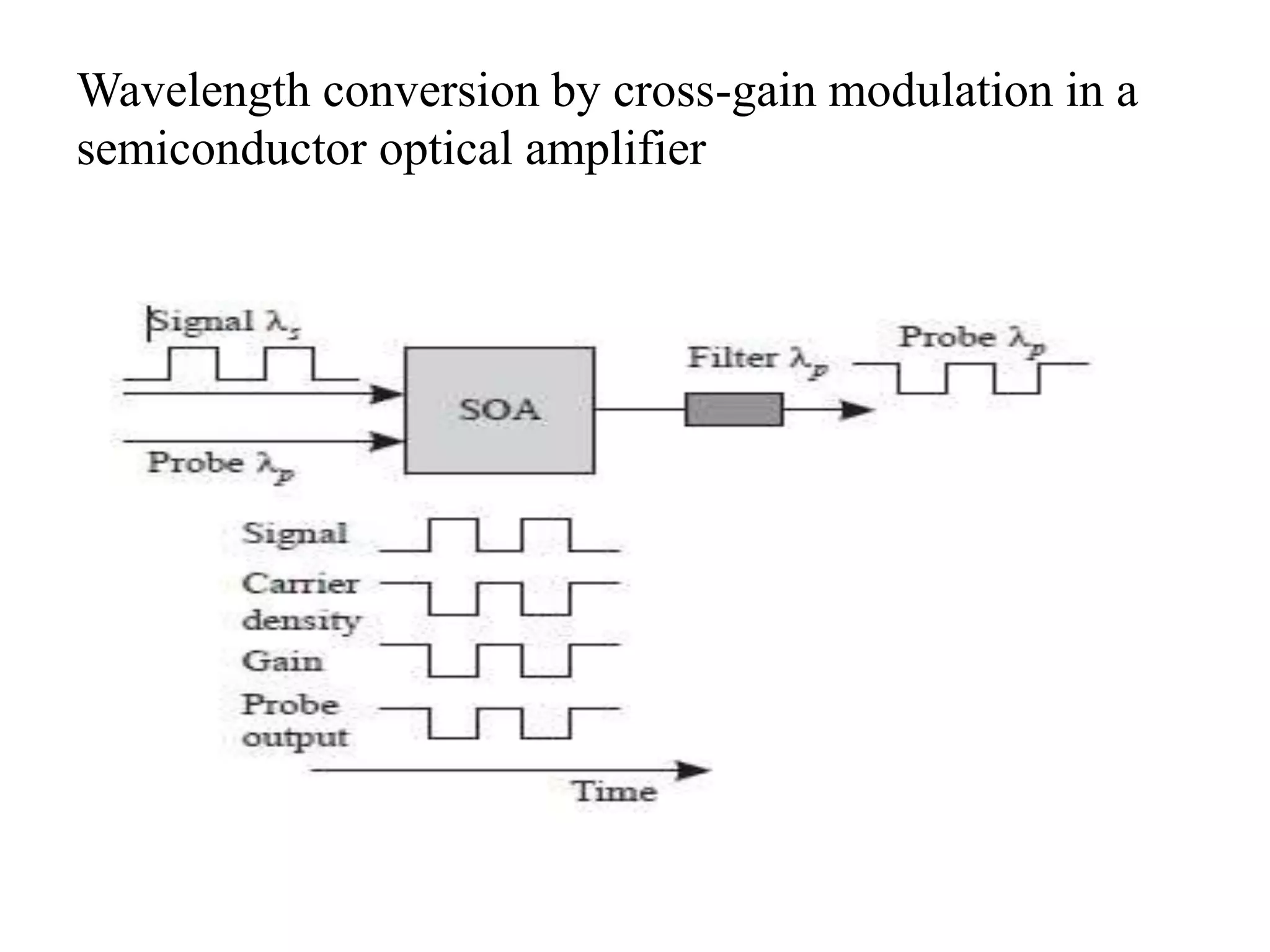
Optical gating - cross-gain modulation
Optical gating makes use of an optical device
whose characteristics change with the intensity
of an input signal. This change can be
transferred to another un-modulated probe
signal at a different wavelength going through
the device.
Wavelength conversion by cross-gain modulation in a
semiconductor optical amplifier
Four-wave mixing.
 The four-wave mixing phenomenon that occurs because of nonlinearities
in the transmission medium can also be utilized to realize wavelength
conversion.
 Four-wave mixing is usually an undesirable phenomenon in fibers.
• Can be exploited to achieve wavelength conversion.
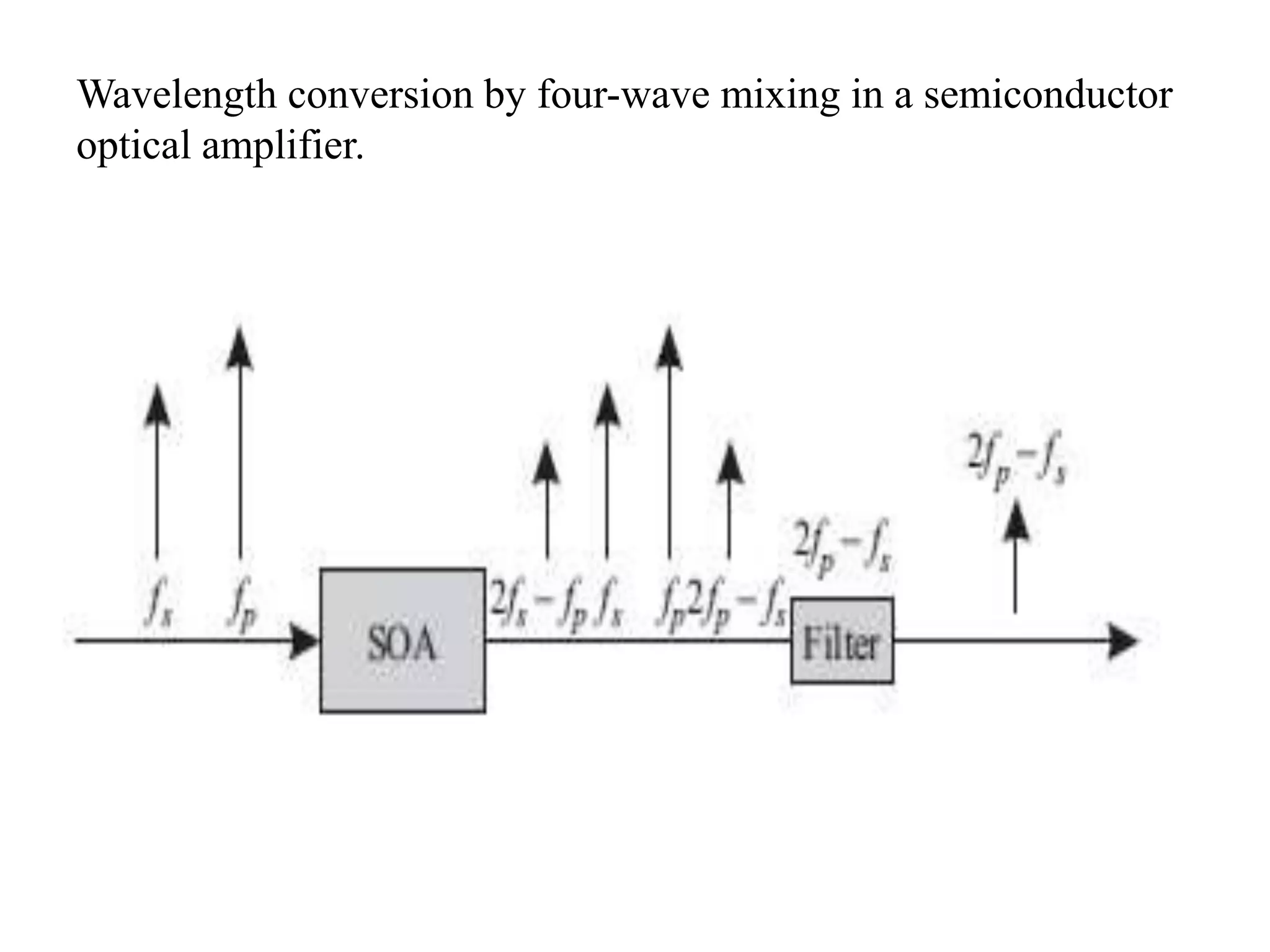
• In four-wave mixing, three waves at frequencies f1, f2 and f3 produce
• a wave at the frequency f1 + f2 - f3 When
• f1 = fs (signal)
• f2 = f3 = fp (pump) => a new wave is produces at 2fp – fs
 Four-wave mixing can be enhanced by using SOA to increase the power
levels.
 Other wavelengths are filtered out.
Wavelength conversion by four-wave mixing in a semiconductor
optical amplifier.

Optical Wavelength converters

  • 1.
    Wavelength converters  Awavelength converter is a device that convert data from one incoming wavelength to another wavelength. Wavelength converters • Enable optical channels to be relocated. • Achieved in optical domain by employing nonlinear phenomena. Wavelength converters are useful components in WDM networks for three major reasons.
  • 2.
    1) Data mayenter the network at a wavelength that is not suitable for use within the network. 2) Wavelength converters may be needed within the network to improve the utilization of the available wavelength on the network link. 3) Wavelength converters may be needed at boundaries between different networks if the different networks are managed by different entities and these entities do not coordinate the allocation of wavelength in their networks.
  • 3.
    Types of wavelengthconverters a) Optoelectronic approach. a) Optical gating - cross-gain modulation. a) Four-wave mixing.
  • 4.
    Optoelectronic approach. This isperhaps the simplest, most obvious, and most practical method today to realize wavelength conversion. The input signal is first converted to electronic form, regenerated, and then retransmitted using a laser at a different wavelength.
  • 5.
    (a) 1R (regenerationwithout reshaping or retiming. (b) 2R (regeneration with reshaping). (c) 3R (regeneration with reshaping and retiming).
  • 6.
    Optical gating -cross-gain modulation Optical gating makes use of an optical device whose characteristics change with the intensity of an input signal. This change can be transferred to another un-modulated probe signal at a different wavelength going through the device.
  • 7.
    Wavelength conversion bycross-gain modulation in a semiconductor optical amplifier
  • 8.
    Four-wave mixing.  Thefour-wave mixing phenomenon that occurs because of nonlinearities in the transmission medium can also be utilized to realize wavelength conversion.  Four-wave mixing is usually an undesirable phenomenon in fibers. • Can be exploited to achieve wavelength conversion. • In four-wave mixing, three waves at frequencies f1, f2 and f3 produce • a wave at the frequency f1 + f2 - f3 When • f1 = fs (signal) • f2 = f3 = fp (pump) => a new wave is produces at 2fp – fs  Four-wave mixing can be enhanced by using SOA to increase the power levels.  Other wavelengths are filtered out.
  • 9.
    Wavelength conversion byfour-wave mixing in a semiconductor optical amplifier.