Virtual Machine Systems CS-502 Operating Systems Slides excerpted from Silbershatz, Ch. 2
Question Can a “small” operating system simulate the hardware of some machine so that Another operating system can run in that simulated hardware? More than one instance of that operating system run on the same hardware at the same time? More than one  different  operating system can share the same hardware at the same time? Answer:  Yes
Solution –  Virtual Machine A virtual machine provides interface  identical  to underlying bare hardware I.e., all devices, interrupts, memory, page tables, etc. Virtual Machine Operating System creates illusion of multiple processors Each capable of executing independently No sharing, except via network protocols
History – CP67 / CMS IBM Cambridge Scientific Center Ran on IBM 360/67  Alternative to TSS/360, which never sold very well Replicated hardware in each “process” Virtual 360/67 processor Virtual disk(s), virtual console, printer, card reader, etc. CMS:  C ambridge  M onitor  S ystem A single user, interactive operating system Commercialized as VM370 in mid-1970s
History  (continued) Various other attempts with other machines VMware Workstation Servers (for IT centers)
Virtual Machines (continued) The resources of the physical computer are shared to create the virtual machines CPU scheduling can create the appearance that each user has own processor Spooling and a file system provide  virtual card readers, virtual line printers Disk partitioned to provide virtual disks A normal user time-sharing terminal serves as the virtual machine operator’s console
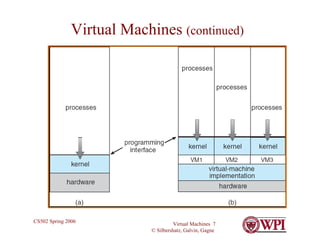
Virtual Machines  (continued) (a) Nonvirtual machine (b) virtual machine Non-virtual Machine Virtual Machine
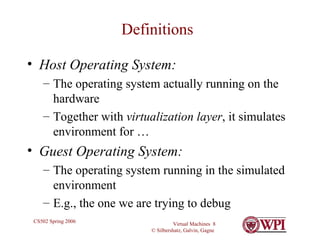
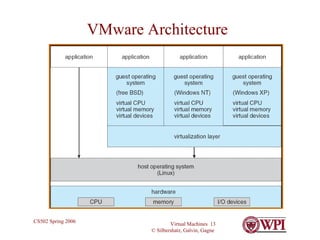
Definitions Host Operating System: The operating system actually running on the hardware Together with  virtualization layer , it simulates environment for … Guest Operating System: The operating system running in the simulated environment E.g., the one we are trying to debug
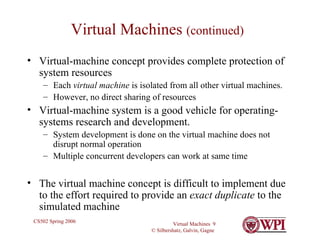
Virtual Machines  (continued) Virtual-machine concept provides complete protection of system resources  Each  virtual machine  is isolated from all other virtual machines. However, no direct sharing of resources Virtual-machine system is a good vehicle for operating-systems research and development.  System development is done on the virtual machine does not disrupt normal operation Multiple concurrent developers can work at same time The virtual machine concept is difficult to implement due to the effort required to provide an  exact duplicate  to the simulated machine
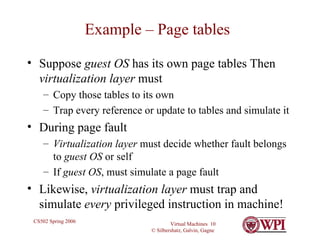
Example – Page tables Suppose  guest OS  has its own page tables Then  virtualization layer  must Copy those tables to its own Trap every reference or update to tables and simulate it During page fault Virtualization layer  must decide whether fault belongs to  guest OS  or self If  guest OS , must simulate a page fault Likewise,  virtualization layer  must trap and simulate  every  privileged instruction in machine!
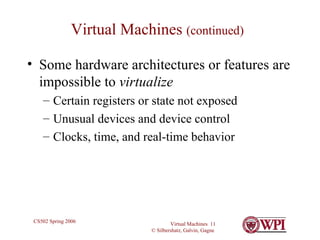
Virtual Machines  (continued) Some hardware architectures or features are impossible to  virtualize Certain registers or state not exposed Unusual devices and device control Clocks, time, and real-time behavior
VMware – Modern Virtual Machine System Founded 1998, Mendel Rosenblum  et al. Research at Stanford University VMware Workstation Separates  Host OS  from  virtualization layer Host OS may be Windows, Linux, etc. Wide variety of Guest operating systems < $200
VMware Architecture
VMware Server Free version released in 2006 http:// www.vmware.com /products/server/ Runs on any x86 server hardware and OS Windows Server and Linux Host OS’s Partition a physical server into multiple virtual server machines Target market – IT centers providing multiple services Allows separate virtual servers to be separately configured for separate IT applications Provisioning Portability, replication, etc.
VMware Server ESX  Total decoupling between hardware and applications High-end, high-performance IT applications Oracle, SQL Server, Microsoft Exchange server, SAP, Siebel, Lotus Notes, BEA WebLogic, Apache  Dynamically move  running  application to different hardware Maintenance, hardware replacement Provisioning new versions, etc.
Must virtual machine be replica of host machine? No,  virtualization layer  can simulate  any  architecture Typically used for debugging specialized systems Real-time systems, niche products, etc. Guest architecture does not even have to be real hardware!
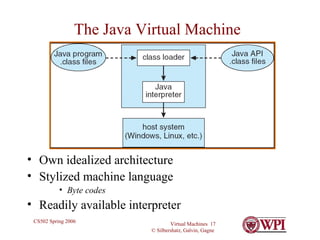
The Java Virtual Machine Own idealized architecture Stylized machine language Byte codes Readily available interpreter
Break
PPT
PPT
PPT
PPT
PPT
PPT
PPT
PPT
PPT
PPT
PPT

PPT

  • 1.
    Virtual Machine SystemsCS-502 Operating Systems Slides excerpted from Silbershatz, Ch. 2
  • 2.
    Question Can a“small” operating system simulate the hardware of some machine so that Another operating system can run in that simulated hardware? More than one instance of that operating system run on the same hardware at the same time? More than one different operating system can share the same hardware at the same time? Answer: Yes
  • 3.
    Solution – Virtual Machine A virtual machine provides interface identical to underlying bare hardware I.e., all devices, interrupts, memory, page tables, etc. Virtual Machine Operating System creates illusion of multiple processors Each capable of executing independently No sharing, except via network protocols
  • 4.
    History – CP67/ CMS IBM Cambridge Scientific Center Ran on IBM 360/67 Alternative to TSS/360, which never sold very well Replicated hardware in each “process” Virtual 360/67 processor Virtual disk(s), virtual console, printer, card reader, etc. CMS: C ambridge M onitor S ystem A single user, interactive operating system Commercialized as VM370 in mid-1970s
  • 5.
    History (continued)Various other attempts with other machines VMware Workstation Servers (for IT centers)
  • 6.
    Virtual Machines (continued)The resources of the physical computer are shared to create the virtual machines CPU scheduling can create the appearance that each user has own processor Spooling and a file system provide virtual card readers, virtual line printers Disk partitioned to provide virtual disks A normal user time-sharing terminal serves as the virtual machine operator’s console
  • 7.
    Virtual Machines (continued) (a) Nonvirtual machine (b) virtual machine Non-virtual Machine Virtual Machine
  • 8.
    Definitions Host OperatingSystem: The operating system actually running on the hardware Together with virtualization layer , it simulates environment for … Guest Operating System: The operating system running in the simulated environment E.g., the one we are trying to debug
  • 9.
    Virtual Machines (continued) Virtual-machine concept provides complete protection of system resources Each virtual machine is isolated from all other virtual machines. However, no direct sharing of resources Virtual-machine system is a good vehicle for operating-systems research and development. System development is done on the virtual machine does not disrupt normal operation Multiple concurrent developers can work at same time The virtual machine concept is difficult to implement due to the effort required to provide an exact duplicate to the simulated machine
  • 10.
    Example – Pagetables Suppose guest OS has its own page tables Then virtualization layer must Copy those tables to its own Trap every reference or update to tables and simulate it During page fault Virtualization layer must decide whether fault belongs to guest OS or self If guest OS , must simulate a page fault Likewise, virtualization layer must trap and simulate every privileged instruction in machine!
  • 11.
    Virtual Machines (continued) Some hardware architectures or features are impossible to virtualize Certain registers or state not exposed Unusual devices and device control Clocks, time, and real-time behavior
  • 12.
    VMware – ModernVirtual Machine System Founded 1998, Mendel Rosenblum et al. Research at Stanford University VMware Workstation Separates Host OS from virtualization layer Host OS may be Windows, Linux, etc. Wide variety of Guest operating systems < $200
  • 13.
  • 14.
    VMware Server Freeversion released in 2006 http:// www.vmware.com /products/server/ Runs on any x86 server hardware and OS Windows Server and Linux Host OS’s Partition a physical server into multiple virtual server machines Target market – IT centers providing multiple services Allows separate virtual servers to be separately configured for separate IT applications Provisioning Portability, replication, etc.
  • 15.
    VMware Server ESX Total decoupling between hardware and applications High-end, high-performance IT applications Oracle, SQL Server, Microsoft Exchange server, SAP, Siebel, Lotus Notes, BEA WebLogic, Apache Dynamically move running application to different hardware Maintenance, hardware replacement Provisioning new versions, etc.
  • 16.
    Must virtual machinebe replica of host machine? No, virtualization layer can simulate any architecture Typically used for debugging specialized systems Real-time systems, niche products, etc. Guest architecture does not even have to be real hardware!
  • 17.
    The Java VirtualMachine Own idealized architecture Stylized machine language Byte codes Readily available interpreter
  • 18.