DETERGENCY
Created by:
MANAS MANDAL RUPOM
Registration No: J201713017
Session: 2016-17
Department: Wet Process Engineering
Sheikh Kamal Textile Engineering College,
Jhenaidah.
Detergency is a process to remove oil or
dirt from fabric surface using surface
active agents(surfactants/ detergent).
In other word detergency is the ability
of a detergent to detach(remove) soil
(dirt and grease) from a surface by
displacing it with chemicals(called
surfactants) which adhere more readily
to the surface being cleaned than to the
soil.
 CLEANING PROCESS:
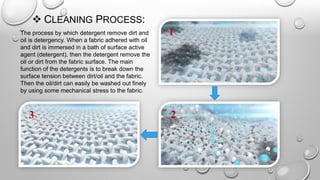
The process by which detergent remove dirt and
oil is detergency. When a fabric adhered with oil
and dirt is immersed in a bath of surface active
agent (detergent), then the detergent remove the
oil or dirt from the fabric surface. The main
function of the detergents is to break down the
surface tension between dirt/oil and the fabric.
Then the oil/dirt can easily be washed out finely
by using some mechanical stress to the fabric.
1
23
Mechanism
 MECHANISM:
Fabric
Oil
ɵ
Stage: 1
Stage: 2
Stage: 3
For each type of fabric and dirt there is a certain
angel between fabric and oil or dirt which
depends on the surface tension between them.
But detergent or surfactant can reduce the surface
tension. And by reducing the surface tension, the
dirt or oil is being converted from horizontal
shape to spherical shape. Then the contact angel
between fabric and dirt or oil increased and the
area of contact reduce the most.
So, then the oil or dirt can easily be removed
from fabric surface by some physical stress.
ɵ
ɵ
 MECHANISM:
ɵ
Ts TLS
TL
At the adhering situation of dirt, its actual shape will
be detached by the interaction of the following
forces:
i. TL = Surface tension between oil and surrounding.
ii. TS = Surface tension between fibre and water.
iii. TLS = Surface tension between fibre and oil.
iv. ɵ = Contact angel.
From Young’s equation we get,
TS = TLS + TL cosƟ
cosƟ =
TS−TLS
TL
TL = TS - TLS [When Ɵ=0, cosƟ= 1]
TS = TLS + TL
TLS = TS – TL
ɵ
Ts TLS
TL MECHANISM:
Any increase in TLS + TL in relation to
TS will decrease the area of contact
between the oil and fibre. Then oil
drop will more spherical and easy to
detach.
If Ɵ = 0°, then TL = TS - TLS
If Ɵ < 90°, Attaching face.
If Ɵ > 90°, Detaching face. ɵ
Attaching Phase
Detaching Phase
MICELLE FORMATION:
Fig: 02 Fig: 03Fig: 01
 When detergent molecules are added to
pure water, firstly few molecules aligned
to the air/ water surface.
 Hydrophilic heads are on to touch of
water and hydrophobic tail oriented
towards air.
 When additional molecules are added,
surface are pecked fully then molecules
are forced into bulk.
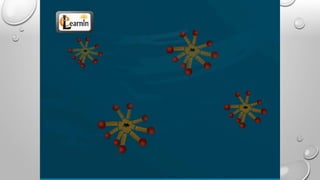
 Then detergent molecules form a spherical
shape named ‘MICELLE’.
Hydrophilic head
Hydrophobic tail
Fig: Detergent Molecule
 In micelle, hydrophobic tail of molecules are situated inner side of the spherical shape which are
insoluble in water. And hydrophilic heads surrounded outside.
MICELLE FORMATION:
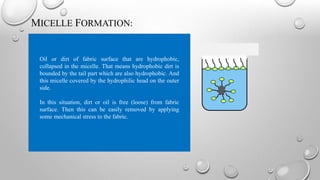
Oil or dirt of fabric surface that are hydrophobic,
collapsed in the micelle. That means hydrophobic dirt is
bounded by the tail part which are also hydrophobic. And
this micelle covered by the hydrophilic head on the outer
side.
In this situation, dirt or oil is free (loose) from fabric
surface. Then this can be easily removed by applying
some mechanical stress to the fabric.
CLASSIFICATION:
1. Ionic detergency:
a) Anionic
b) Cationic
c) Amphoteric
2. Non ionic detergency
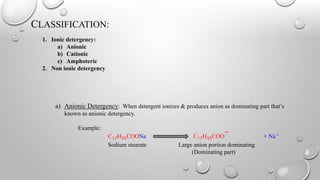
a) Anionic Detergency: When detergent ionizes & produces anion as dominating part that’s
known as anionic detergency.
Example:
C17H35COONa C17H35COO
- + Na+
Sodium stearate Large anion portion dominating
(Dominating part)
CLASSIFICATION:
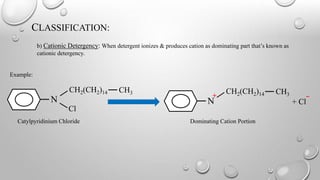
b) Cationic Detergency: When detergent ionizes & produces cation as dominating part that’s known as
cationic detergency.
N
CH2(CH2)14 CH3
Cl
Catylpyridinium Chloride
N
CH2(CH2)14 CH3+
+ Cl
-
Dominating Cation Portion
Example:
CLASSIFICATION:
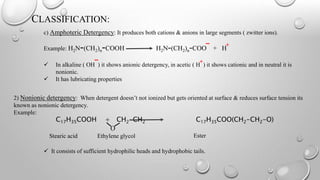
c) Amphoteric Detergency: It produces both cations & anions in large segments ( zwitter ions).
Example: H2N-(CH2)n-COOH H2N-(CH2)n-COO + H
 In alkaline ( OH ) it shows anionic detergency, in acetic ( H ) it shows cationic and in neutral it is
nonionic.
 It has lubricating properties
- +
- +
2) Nonionic detergency: When detergent doesn’t not ionized but gets oriented at surface & reduces surface tension its
known as nonionic detergency.
Example:
C17H35COOH + CH2-CH2 C17H35COO(CH2-CH2-O)
O
Stearic acid Ethylene glycol Ester
 It consists of sufficient hydrophilic heads and hydrophobic tails.
Thanks to all.

Detergency

  • 2.
    DETERGENCY Created by: MANAS MANDALRUPOM Registration No: J201713017 Session: 2016-17 Department: Wet Process Engineering Sheikh Kamal Textile Engineering College, Jhenaidah.
  • 3.
    Detergency is aprocess to remove oil or dirt from fabric surface using surface active agents(surfactants/ detergent). In other word detergency is the ability of a detergent to detach(remove) soil (dirt and grease) from a surface by displacing it with chemicals(called surfactants) which adhere more readily to the surface being cleaned than to the soil.
  • 4.
     CLEANING PROCESS: Theprocess by which detergent remove dirt and oil is detergency. When a fabric adhered with oil and dirt is immersed in a bath of surface active agent (detergent), then the detergent remove the oil or dirt from the fabric surface. The main function of the detergents is to break down the surface tension between dirt/oil and the fabric. Then the oil/dirt can easily be washed out finely by using some mechanical stress to the fabric. 1 23
  • 5.
  • 6.
     MECHANISM: Fabric Oil ɵ Stage: 1 Stage:2 Stage: 3 For each type of fabric and dirt there is a certain angel between fabric and oil or dirt which depends on the surface tension between them. But detergent or surfactant can reduce the surface tension. And by reducing the surface tension, the dirt or oil is being converted from horizontal shape to spherical shape. Then the contact angel between fabric and dirt or oil increased and the area of contact reduce the most. So, then the oil or dirt can easily be removed from fabric surface by some physical stress. ɵ ɵ
  • 7.
     MECHANISM: ɵ Ts TLS TL Atthe adhering situation of dirt, its actual shape will be detached by the interaction of the following forces: i. TL = Surface tension between oil and surrounding. ii. TS = Surface tension between fibre and water. iii. TLS = Surface tension between fibre and oil. iv. ɵ = Contact angel. From Young’s equation we get, TS = TLS + TL cosƟ cosƟ = TS−TLS TL TL = TS - TLS [When Ɵ=0, cosƟ= 1] TS = TLS + TL TLS = TS – TL
  • 8.
    ɵ Ts TLS TL MECHANISM: Anyincrease in TLS + TL in relation to TS will decrease the area of contact between the oil and fibre. Then oil drop will more spherical and easy to detach. If Ɵ = 0°, then TL = TS - TLS If Ɵ < 90°, Attaching face. If Ɵ > 90°, Detaching face. ɵ Attaching Phase Detaching Phase
  • 9.
    MICELLE FORMATION: Fig: 02Fig: 03Fig: 01  When detergent molecules are added to pure water, firstly few molecules aligned to the air/ water surface.  Hydrophilic heads are on to touch of water and hydrophobic tail oriented towards air.  When additional molecules are added, surface are pecked fully then molecules are forced into bulk.  Then detergent molecules form a spherical shape named ‘MICELLE’. Hydrophilic head Hydrophobic tail Fig: Detergent Molecule  In micelle, hydrophobic tail of molecules are situated inner side of the spherical shape which are insoluble in water. And hydrophilic heads surrounded outside.
  • 10.
    MICELLE FORMATION: Oil ordirt of fabric surface that are hydrophobic, collapsed in the micelle. That means hydrophobic dirt is bounded by the tail part which are also hydrophobic. And this micelle covered by the hydrophilic head on the outer side. In this situation, dirt or oil is free (loose) from fabric surface. Then this can be easily removed by applying some mechanical stress to the fabric.
  • 12.
    CLASSIFICATION: 1. Ionic detergency: a)Anionic b) Cationic c) Amphoteric 2. Non ionic detergency a) Anionic Detergency: When detergent ionizes & produces anion as dominating part that’s known as anionic detergency. Example: C17H35COONa C17H35COO - + Na+ Sodium stearate Large anion portion dominating (Dominating part)
  • 13.
    CLASSIFICATION: b) Cationic Detergency:When detergent ionizes & produces cation as dominating part that’s known as cationic detergency. N CH2(CH2)14 CH3 Cl Catylpyridinium Chloride N CH2(CH2)14 CH3+ + Cl - Dominating Cation Portion Example:
  • 14.
    CLASSIFICATION: c) Amphoteric Detergency:It produces both cations & anions in large segments ( zwitter ions). Example: H2N-(CH2)n-COOH H2N-(CH2)n-COO + H  In alkaline ( OH ) it shows anionic detergency, in acetic ( H ) it shows cationic and in neutral it is nonionic.  It has lubricating properties - + - + 2) Nonionic detergency: When detergent doesn’t not ionized but gets oriented at surface & reduces surface tension its known as nonionic detergency. Example: C17H35COOH + CH2-CH2 C17H35COO(CH2-CH2-O) O Stearic acid Ethylene glycol Ester  It consists of sufficient hydrophilic heads and hydrophobic tails.
  • 15.