Khalifa M.Asif Yunus
M.Pharm (Pharmaceutics)
J I I U ’ S
Ali-Allana College of Pharmacy Akkalkuwa
NBAAccredited
Asst. Prof.
Pharmaceutics Department
Ali-Allana college of pharmacy Akkalkuwa
E-mail: khalifa4517@gmail.com Mob. No. +91 9925064346
Watch this video for better understanding
https://www.youtube.com/watch?v=XvxZ4XLDkR8&t=162s
Introduction of Surface tension
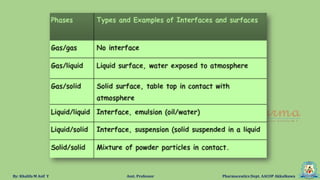
 The boundary between two phases is generally described as an
interface
 When one of the phase is a gas or a vapor, the term surface is
frequently used.
 These terms surface and interface can be used interchangeably
in some cases.
By: Khalifa M Asif Y Asst. Professor Pharmaceutics Dept. AACOP Akkalkuwa
Solid Phase
Gas Phase (air)
Solid Surface
By: Khalifa M Asif Y Asst. Professor Pharmaceutics Dept. AACOP Akkalkuwa
Liquid Surface
Liquid Phase
Gas Phase
By: Khalifa M Asif Y Asst. Professor Pharmaceutics Dept. AACOP Akkalkuwa
Liquid Phase
Solid Phase
Solid-Liquid
interface
By: Khalifa M Asif Y Asst. Professor Pharmaceutics Dept. AACOP Akkalkuwa
Liquid-Liquid
interface
Liquid Phase
Liquid Phase
By: Khalifa M Asif Y Asst. Professor Pharmaceutics Dept. AACOP Akkalkuwa
Surface Tension
The surface tension (γ) is defined as : The force in dynes acting along
the surface of a liquid at right angle to any line 1 cm in length.
Units of Surface Tension
 In CGS system is dynes per centimeter (dyne cm–1).
 In SI system, the unit is Newton per meter (Nm–1).
By: Khalifa M Asif Y Asst. Professor Pharmaceutics Dept. AACOP Akkalkuwa
Surface molecules pulled
inward
Interior molecules pulled
equally in all direction
By: Khalifa M Asif Y Asst. Professor Pharmaceutics Dept. AACOP Akkalkuwa
Surface tension is caused by the net inward pull on the surface
molecules.
At the bulk of the liquid;
 Molecules in the interior experience an attractive force from
neighboring molecules which surround on all sides
At the liquid surface:
 Molecules on the surface have neighboring molecules only
on one side and thus experience an attractive force which
tends to pull them into the interior
By: Khalifa M Asif Y Asst. Professor Pharmaceutics Dept. AACOP Akkalkuwa
 The net effect is that the molecules at the surface of the liquid
experience an inward force toward the bulk of the liquid.
 Such force results in what is called Surface Tension.
 Due to this unbalanced forces, the surface of the liquid
behaves like a stretched elastic membrane containing the
molecules of the liquid inside.
By: Khalifa M Asif Y Asst. Professor Pharmaceutics Dept. AACOP Akkalkuwa
 since the liquid tends to contract to a minimum area, the surface
of the liquid appears to be in a state of tension, so in order to
increase the area of the surface it is necessary to do work to bring
the molecules from the bulk of the liquid to the surface against
the inward attractive force.
By: Khalifa M Asif Y Asst. Professor Pharmaceutics Dept. AACOP Akkalkuwa
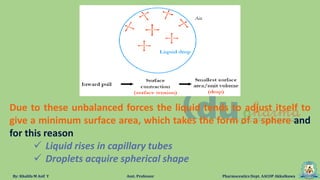
Due to these unbalanced forces the liquid tends to adjust itself to
give a minimum surface area, which takes the form of a sphere and
for this reason
 Liquid rises in capillary tubes
 Droplets acquire spherical shape
By: Khalifa M Asif Y Asst. Professor Pharmaceutics Dept. AACOP Akkalkuwa
1.Formation of spherical globules in emulsions.
The phenomenon of surface tension is responsible for following
processes. (Significance)
By: Khalifa M Asif Y Asst. Professor Pharmaceutics Dept. AACOP Akkalkuwa
2. Formation of nearly spherical shape of falling water droplets.
By: Khalifa M Asif Y Asst. Professor Pharmaceutics Dept. AACOP Akkalkuwa
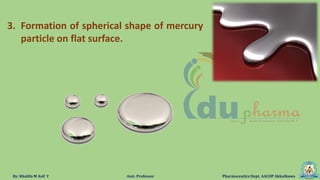
3. Formation of spherical shape of mercury
particle on flat surface.
By: Khalifa M Asif Y Asst. Professor Pharmaceutics Dept. AACOP Akkalkuwa
4. Rise of liquid in capillary tube.
By: Khalifa M Asif Y Asst. Professor Pharmaceutics Dept. AACOP Akkalkuwa
5. Formation of hemispherical surface i.e.
lower meniscus.
By: Khalifa M Asif Y Asst. Professor Pharmaceutics Dept. AACOP Akkalkuwa
Adhesional and Cohesional forces
Adhesional forces : Are forces which act between molecules of
different phases.
Cohesional forces : Are forces which act between molecules of the
same phase.
 Cohesional force tend to keep the phases separate while
adhesional forces tend to increase the affinity of two phases
 If adhesive force > cohesive force results;
• Wetting • Spreading • Rising in the tube
By: Khalifa M Asif Y Asst. Professor Pharmaceutics Dept. AACOP Akkalkuwa
Interfacial Tension
“The tension existing at the interface between two immiscible
liquids. “
“The force per unit length existing at the interface between two
immiscible liquid.”
 When two liquid are completely miscible, the interface can not
be observed and hence, do not possess interfacial tension. E.g.
water & alcohol.
By: Khalifa M Asif Y Asst. Professor Pharmaceutics Dept. AACOP Akkalkuwa
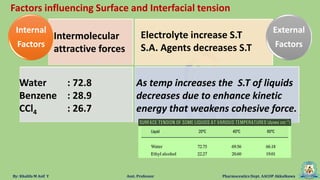
Factors influencing Surface and Interfacial tension
Internal
Factors
External
Factors
As temp increases the S.T of liquids
decreases due to enhance kinetic
energy that weakens cohesive force.
Water : 72.8
Benzene : 28.9
CCl4 : 26.7
Electrolyte increase S.T
S.A. Agents decreases S.T
Intermolecular
attractive forces

surface tension part 1

  • 1.
    Khalifa M.Asif Yunus M.Pharm(Pharmaceutics) J I I U ’ S Ali-Allana College of Pharmacy Akkalkuwa NBAAccredited Asst. Prof. Pharmaceutics Department Ali-Allana college of pharmacy Akkalkuwa E-mail: khalifa4517@gmail.com Mob. No. +91 9925064346
  • 2.
    Watch this videofor better understanding https://www.youtube.com/watch?v=XvxZ4XLDkR8&t=162s Introduction of Surface tension
  • 3.
     The boundarybetween two phases is generally described as an interface  When one of the phase is a gas or a vapor, the term surface is frequently used.  These terms surface and interface can be used interchangeably in some cases.
  • 4.
    By: Khalifa MAsif Y Asst. Professor Pharmaceutics Dept. AACOP Akkalkuwa Solid Phase Gas Phase (air) Solid Surface
  • 5.
    By: Khalifa MAsif Y Asst. Professor Pharmaceutics Dept. AACOP Akkalkuwa Liquid Surface Liquid Phase Gas Phase
  • 6.
    By: Khalifa MAsif Y Asst. Professor Pharmaceutics Dept. AACOP Akkalkuwa Liquid Phase Solid Phase Solid-Liquid interface
  • 7.
    By: Khalifa MAsif Y Asst. Professor Pharmaceutics Dept. AACOP Akkalkuwa Liquid-Liquid interface Liquid Phase Liquid Phase
  • 8.
    By: Khalifa MAsif Y Asst. Professor Pharmaceutics Dept. AACOP Akkalkuwa
  • 9.
    By: Khalifa MAsif Y Asst. Professor Pharmaceutics Dept. AACOP Akkalkuwa Surface Tension The surface tension (γ) is defined as : The force in dynes acting along the surface of a liquid at right angle to any line 1 cm in length. Units of Surface Tension  In CGS system is dynes per centimeter (dyne cm–1).  In SI system, the unit is Newton per meter (Nm–1).
  • 10.
    By: Khalifa MAsif Y Asst. Professor Pharmaceutics Dept. AACOP Akkalkuwa Surface molecules pulled inward Interior molecules pulled equally in all direction
  • 11.
    By: Khalifa MAsif Y Asst. Professor Pharmaceutics Dept. AACOP Akkalkuwa Surface tension is caused by the net inward pull on the surface molecules. At the bulk of the liquid;  Molecules in the interior experience an attractive force from neighboring molecules which surround on all sides At the liquid surface:  Molecules on the surface have neighboring molecules only on one side and thus experience an attractive force which tends to pull them into the interior
  • 12.
    By: Khalifa MAsif Y Asst. Professor Pharmaceutics Dept. AACOP Akkalkuwa  The net effect is that the molecules at the surface of the liquid experience an inward force toward the bulk of the liquid.  Such force results in what is called Surface Tension.  Due to this unbalanced forces, the surface of the liquid behaves like a stretched elastic membrane containing the molecules of the liquid inside.
  • 13.
    By: Khalifa MAsif Y Asst. Professor Pharmaceutics Dept. AACOP Akkalkuwa  since the liquid tends to contract to a minimum area, the surface of the liquid appears to be in a state of tension, so in order to increase the area of the surface it is necessary to do work to bring the molecules from the bulk of the liquid to the surface against the inward attractive force.
  • 14.
    By: Khalifa MAsif Y Asst. Professor Pharmaceutics Dept. AACOP Akkalkuwa Due to these unbalanced forces the liquid tends to adjust itself to give a minimum surface area, which takes the form of a sphere and for this reason  Liquid rises in capillary tubes  Droplets acquire spherical shape
  • 15.
    By: Khalifa MAsif Y Asst. Professor Pharmaceutics Dept. AACOP Akkalkuwa 1.Formation of spherical globules in emulsions. The phenomenon of surface tension is responsible for following processes. (Significance)
  • 16.
    By: Khalifa MAsif Y Asst. Professor Pharmaceutics Dept. AACOP Akkalkuwa 2. Formation of nearly spherical shape of falling water droplets.
  • 17.
    By: Khalifa MAsif Y Asst. Professor Pharmaceutics Dept. AACOP Akkalkuwa 3. Formation of spherical shape of mercury particle on flat surface.
  • 18.
    By: Khalifa MAsif Y Asst. Professor Pharmaceutics Dept. AACOP Akkalkuwa 4. Rise of liquid in capillary tube.
  • 19.
    By: Khalifa MAsif Y Asst. Professor Pharmaceutics Dept. AACOP Akkalkuwa 5. Formation of hemispherical surface i.e. lower meniscus.
  • 20.
    By: Khalifa MAsif Y Asst. Professor Pharmaceutics Dept. AACOP Akkalkuwa Adhesional and Cohesional forces Adhesional forces : Are forces which act between molecules of different phases. Cohesional forces : Are forces which act between molecules of the same phase.  Cohesional force tend to keep the phases separate while adhesional forces tend to increase the affinity of two phases  If adhesive force > cohesive force results; • Wetting • Spreading • Rising in the tube
  • 21.
    By: Khalifa MAsif Y Asst. Professor Pharmaceutics Dept. AACOP Akkalkuwa Interfacial Tension “The tension existing at the interface between two immiscible liquids. “ “The force per unit length existing at the interface between two immiscible liquid.”  When two liquid are completely miscible, the interface can not be observed and hence, do not possess interfacial tension. E.g. water & alcohol.
  • 22.
    By: Khalifa MAsif Y Asst. Professor Pharmaceutics Dept. AACOP Akkalkuwa Factors influencing Surface and Interfacial tension Internal Factors External Factors As temp increases the S.T of liquids decreases due to enhance kinetic energy that weakens cohesive force. Water : 72.8 Benzene : 28.9 CCl4 : 26.7 Electrolyte increase S.T S.A. Agents decreases S.T Intermolecular attractive forces